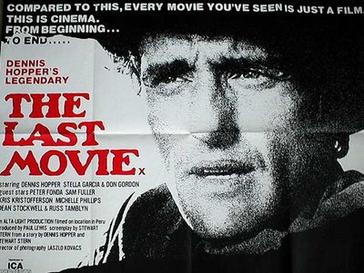
Icarus File No 9: The Last Movie (dir by Dennis Hopper)


The story behind the making of 1971’s The Last Movie is legendary.  It’s also a bit of a cautionary tale.

In 1969, Hollywood was stunned by the box office success of an independent, low-budget counter-culture film called Easy Rider.  Easy Rider not only made a star out of Jack Nicholson but it was also the film that finally convinced the studios that the way to be relevant was not to continue to crank out big budget musical extravaganzas like Doctor Doolittle and Hello, Dolly!  Instead, it was decided that the smart thing to do would be to hire young (or, at the very least, youngish) directors and basically just let them shoot whatever they wanted.  The resulting films might not make much sense to the executives but, presumably, the kids would dig them and as long as the kids were paying money to see them, everyone would continue to get rich.   Because Dennis Hopper had directed Easy Rider, he suddenly found himself very much in demand as a director.

Of course, almost everyone in Hollywood knew Dennis Hopper.  Long before he became an icon of the counter-culture, Dennis Hopper had been a part of the studio system.  John Wayne even referred to Hopper as being his “favorite communist.”  Everyone knew that Dennis could be a bit arrogant.  Everyone knew that Dennis was very much into drugs and that, as a result, he had a reputation for being a bit unstable.  Everyone knew that Dennis Hopper deliberately cultivated an image of being a bit of a wild man and a revolutionary artist.  But Dennis Hopper had just directed Easy Rider and Universal was willing to give Hopper some money to go down to Peru and direct his follow-up.
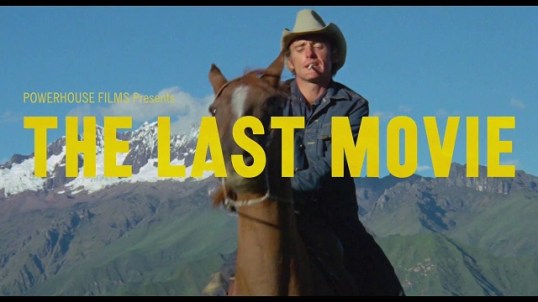
The Last Movie was a film that Hopper had been planning on making for a while.  The film’s original script told the story of an aging and broken-down stuntman named Kansas who retires to Mexico and searches for a gold mine with a friend of his.  Hopper first tried to get the film going in 1965, with Montgomery Clift in the lead role.  After Clift died, Hopper tried to interest John Wayne in the starring role but, though Wayne enjoyed having Hopper in his films so that he could threaten to shoot him whenever Abbie Hoffman said something shocking, he had no interest in being directed by him.   When Universal finally agreed to put up the money for the film, Hopper offered the lead role to Jack Nicholson.  Nicholson turned it down and told Hopper that it was obvious that Dennis wanted to play the role himself.  Dennis decided that he agreed with Nicholson and he cast himself as Kansas.  Dennis also made the fateful decision to not only change the story’s setting to Peru but to also film on location.

Dennis and a group of friends flew down to Peru, which, at that time, was the cocaine capitol of the world.  Drug use was rampant on the set, with Dennis reportedly being one of the main offenders.  The cast and crew filmed during the day and partied at night and no one was particularly sure what the film was supposed to be about.  Amazingly, Hopper finished filming on schedule and within budget but, much as he did with Easy Rider, he also overfilmed and ended up with 40 hours of footage.  Not wanting to be bothered by the studios, Hopper edited the footage in his compound in Taos, New Mexico.  Working slowly and continuing to consume a large amount of drugs and alcohol, Hopper still managed to put together a film that had a straightforward storyline.  When Hopper showed his initial cut to filmmaker Alejandro Jodorowsky, the director of El Topo accused Hopper of being too conventional in his approach, which led to Hopper chopping up the film and reassembling it.  Finally, after spending over a year working with the footage, Hopper turned in his final edit.

Universal had no idea what to make of the film that Hopper delivered to them.  Still, they released it with the hope that the same crowd that loved Easy Rider would embrace The Last Movie.  While the film did win an award at the Venice Film Festival, critics hated it and, even worse, audiences stayed away.  The film’s reception was so overwhelmingly negative that Hopper found himself largely exiled from Hollywood, with only a few directors (like Francis Ford Coppola) willing to take the chance of working with him.  It wasn’t until the 80s, when he finally got clean and sober, that Dennis Hopper was able to reestablish himself as a character actor and, ultimately, a beloved cultural institution.

But what about The Last Movie?  Was is it really as bad as the critics claimed?  Or was it, as some more recent reviewers have suggested, an unacknowledged masterpiece that was ahead of its time?  I recently watched The Last Movie to find out for myself.

Despite its reputation, The Last Movie gets off to a pretty strong start.  Samuel Fuller (playing himself) is directing a hilariously over-the-top and violent western in the mountains of Peru.  Kansas (Dennis Hopper) is working as a stuntman.  He’s fallen in love with a local sex worker named Maria (Stella Garcia).  Kansas is meant to be an aging Hollywood veteran, someone who has broken a lot of bones and who carries a lot of aches as a result of his line of work.  (One can see why Hopper initially imagined an actor like John Wayne in the role.)  He knows that this is going to be his last job and, as we see over the first 25 minutes of the film, he feels alienated from the rest of the cast and crew.  Admittedly, Hopper does appear to be a bit too young for the role.  The ideal Kansas would have been someone like Ben Johnson, L.Q. Jones, or perhaps Warren Oates.  But, still, Hopper does a good job of capturing Kansas’s mixed feelings about the western that’s being filmed around him.

A lot of familiar faces pop up in the film’s fictional western.  Dean Stockwell plays an outlaw.  Jim Mitchum, Russ Tamblyn and Kris Kristofferson plays his associates.  Peter Fonda is the youthful sheriff.  Michelle Phillips is the daughter of the town’s banker and apparently, she’s also the girlfriend of one of the outlaws.  We watch as the actors pretend to shoot guns and kill each other while the cameras are rolling, just to get up off the ground once “Cut” is yelled.  When a local Indian who has been cast as an extra grows upset at the violence, an assistant director explains to him that no one really dies while the cameras are rolling.  When shooting wraps, the film company goes home but Kansas stays behind with Maria.  One day, the local priest (Tomas Milian) warns Kansas that the local indigenous people have moved into the abandoned film set and are trying to shoot their own movie.  Kansas discovers that they have built wooden cameras and wooden boom mics and that their chief is giving orders in the style of Sam Fuller.  They’re also firing the guns that the Americans left behind.

The first part of the film works quite well.  Hopper’s camera captures the beautiful and isolated Peruvian landscape.  The violent western is a pitch perfect and affectionate parody of a generic studio film. Though Hopper is a bit too young for the role, he still does a good job of capturing Kansas’s alienation from his fellow Americans.  Even more importantly, the first part of the film seems to have an identifiable theme.  The American film crew invaded an isolated part of Peru and changed the culture of the natives without even realizing it.  Now, they’ve left but the natives are still dealing with the after effects of the American “invasion.”  It’s easy to see, within that part of the story, a critique of both American culture and American foreign policy.
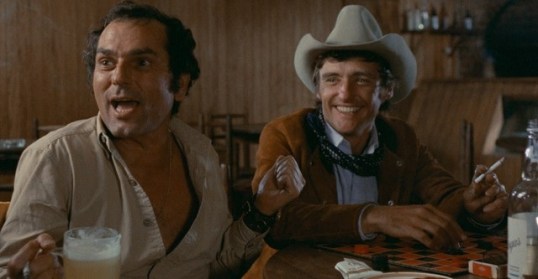
The second part of the film is where things start to fall apart.  Kansas meets an old friend named Neville (Don Gordon).  Neville has discovered a gold mine in the Peruvian mountains.  With Kansas as his partner, he tries to get a businessman named Harry Anderson (Roy Engel) to invest in it.  Kansas and Neville try to impress Harry and his wife (Julie Adams, best-known for being stalked by The Creature From The Black Lagoon).  Kansas and Neville take the Andersons to a brothel and, in the process, Kansas offends Maria.  Kansas then paws Mrs. Anderson’s fur coat and mentions that human beings are covered in hair.  For all of their efforts, Harry will not invest, no matter how desperately Neville begs him to reconsider.

The second part of the film drags, with many of the scenes being obviously improvised between Hopper, Gordon, Garcia, Engel, and Adams.  Unfortunately, the improved conversations aren’t particularly interesting and they tend to go on forever.  Usually a reliable character actor, Don Gordon ferociously chews the scenery as Neville and it doesn’t take long before one grows tired of listening to him yell.  (Gordon was far more impressive in Hopper’s Out of the Blue.)  With the use of improvisation and overlapping dialogue, the second half of the film tries to feel naturalistic but instead, it’s a migraine-inducing method exercise gone wrong.  It’s also during the second part of the film that a “scene missing” title card flashes on the screen, an indication that the discipline that Hopper showed as a director during the beginning of the film is about to be abandoned.

Finally, the third part of the film — well, who knows?  The final 25 minutes of the film is collection of random scenes, some of which may be connected and some of which may not.  The natives have decided that the only way to properly end their “film” is to kill Kansas.  Kansas is shot several times and rides away on his horse.  Suddenly, Kansas is back at his home and Maria is taunting him for getting shot.  Then, Kansas is riding his horse again.  Then suddenly, Dennis Hopper and Tomas Milian are laughing at the camera.  A script supervisor tries to get Dennis to look at the shooting schedule while Dennis drinks.  This happens:
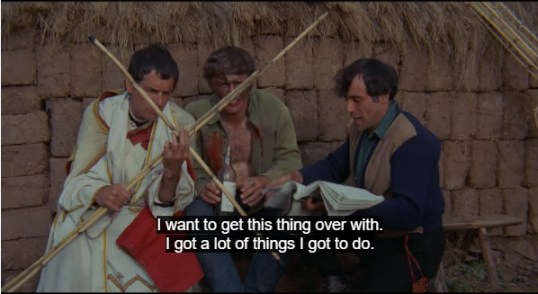
Milian points out that the blood on Hopper’s shirt is dry.  Hopper looks at his shoulder, where Kansas was previously shot, and says that someone needs to add his scar before he can shoot the scene.  Ah!  So, now we’re acknowledging that it’s all just a movie.  Thanks, Dennis!  Suddenly, Dennis is Kansas again and he’s collapsing over and over again in the dust.  He appears to be dead but no, now he’s Dennis again and he’s standing up and smiling at the camera.  And now, he’s singing Hooray for Hollywood.  And now, suddenly, Kansas and Neville are talking about The Treasure of the Sierra Madre and then….

Well, let’s just say that it goes on and on before finally ending with a scrawled title card.

It’s a disjointed mess and it’s all the more frustrating because the first 30 minutes of the film is actually pretty good.  But then, Dennis apparently remembered that he was supposed to be the voice of the counter-culture and he gave into his most pretentious impulses.  Of course, just because a film is a mess, that doesn’t mean that it can’t be entertaining.  And again, the first part of the film is entertaining and third part of the film is weird enough that it’ll hold most people’s attention for at least a few minutes.  But the middle section of the film is so slow and pointless that it pretty much brings down the entire film.

In the end, what is The Last Movie about?  In The American Dreamer (a documentary that was filmed while Hopper was editing The Last Movie in New Mexico), Hopper spends a lot of time talking about revolution and taking over Hollywood but The Last Movie is hardly a revolutionary film.  The film is at its most alive when it is focused on the shooting of its fictional western.  For all the satirical pokes that The Last Movie takes at the studio system, it’s obvious that Hopper had a lot of affection for Old Hollywood and for directors like Sam Fuller.  Kansas may say “Far out,” but he’s hardly a hippie.  Even the film’s jumbled finale seems to be saying, “It’s all Hollywood magic!”  In the end, the film’s call for a new style of cinema is defeated by its love for the old style of cinema.

Instead, I think The Last Movie works best when viewed as a portrait of paranoia.  Hopper himself admitted that he was naturally paranoid and the heavy amount of drugs that he was doing in the 70s didn’t help.  One reason why Hopper filmed in Peru and edited in New Mexico was so the studios couldn’t keep track of him and, while directing, he worried about being arrested by the Peruvian secret police.  As an actor, Hopper plays Kansas as being someone who views the world with caution and untrusting eyes.  He doesn’t trust the other members of the film crew.  He loves Maria but he’s still convinced that she’s going to betray him.  Even the natives ultimately try to destroy him and the script supervisor tries to get him to stick to the shooting schedule.  The film works best as a disjoined portrait of one man’s paranoid and fatalistic world view.

The Last Movie pretty much ended the studio’s attempts to harness the counter-culture by giving money to self-described revolutionaries.  The new wave of directors — like Spielberg and Lucas — may have shared Hopper’s then-politics but they weren’t looking to burn down the system.  (Hopper himself later became a Republican.)  The Last Movie may not have been the literal last movie but it was, for a while at least, the last of its kind.
Previous Icarus Files:

  1. Cloud Atlas
  2. Maximum Overdrive
  3. Glass
  4. Captive State
  5. Mother!
  6. The Man Who Killed Don Quixote
  7. Last Days
  8. Plan 9 From Outer Space

Film Review: Drive, He Said (dir by Jack Nicholson)


First released in 1971, Drive, He Said tells the story of two college roommates.

Hector (William Tepper) is a star basketball player who everyone expects to turn pro.  His intense coach (Bruce Dern) is always yelling at him to stop fooling around on the court but Hector is more interested in fooling around elsewhere as he’s having an affair with Olive (Karen Black), the wife of a self-styled “hip” philosophy professor named Richard (Robert Towne).

Gabriel (Michael Margotta) is Hector’s best friend.  They live together, even though Hector’s coach thinks that Gabriel is a bad influence.  Gabriel is a self-styled campus radical.  He has a devoted group of followers who will do just about anything that he tells them to do.  Gabriel is big into guerilla theater and symbolic protests.  Nothing he does seems to add up too much but, unlike Hector, he’s good at giving speeches.

Together, they worry about the draft!

Of course, they’re both worrying about two different types of drafts.  Hector is worried about the NBA draft and whether he should enter it.  He’s been playing basketball for as long as he can remember.  The only thing that he’s really good at is playing basketball.  And yet, Hector isn’t sure if he wants to spend the rest of his life taking orders from his coaches and devoting every minute to playing the game.  However, Hector’s worked himself into a corner.  When one NBA official asks him what he’s going to do if he’s not drafted, Hector admits that he doesn’t know.  When asked what his major is, Hector replies, “Greek.”

Gabriel, on the other hand, is worried about being drafted into the military and being sent to Vietnam.  Gabriel considers himself to be a revolutionary but it soon becomes clear that he really doesn’t have much of a plan for how to start his revolution.  Indeed, the film suggests that his activism is more about his own insecurity over his own sexuality than anything else.  Gabriel particularly seems to be obsessed with Hector’s affair with Olive.  While Hector reaches new highs on the court, Gabriel comes closer and closer to having a psychotic break.

Director Jack Nicholson found a way to work in shout out to his friend, Harry Dean Stanton

Drive, He Said was one of the many “campus rebellion” films that were released in the early 70s and, much like Getting Straight, it’s definitely a product of its time.  Today, it it’s known for anything, it’s for being the directorial debut of actor Jack Nicholson.  (Nicholson has said that, before he was cast in Easy Rider, he was actually planning on abandoning acting and pursuing a career as a director.)  The film features many of the flaws the are typically present in directorial debuts.  The pacing is terrible, with some scenes ending too quickly while others seem to go on forever.  At times, the film feels a bit overstylized as Nicholson mixes jump cuts, odd camera angles, and slow motion to little effect. It’s very much a film about men, so much so that the film’s ultra-masculinity almost verges on self-parody.

And yet, there are moments of isolated brilliance to be found in Drive, He Said.  Some of the shots are genuinely impressive and the army induction scene shows that Nicholson could direct comedy, even if he does let the scene drag on for a bit too long.  Though Nicholson doesn’t appear in the film, his approach to the story features his trademark cynicism and sense of fatalism.  Though he was often associated with the counterculture, Nicholson was more a member of the Beat generation than of the hippies.  As such, Drive, He Said has more in common with Jack Kerouac than Abbie Hoffman.  Drive, He Said is definitely an anti-establishment film but, at the same time, it doesn’t make the mistake of glorifying Gabriel or his followers.  Gabriel, with his constant demand that everyone join him in his ill-defined revolution, is almost as overbearing as basketball coach and, towards the end of the film, he commits an act of violence that leaves no doubt that his “revolution” is all about his own self-gratification.  The film is less a polemic and more a portrait of people trying to find their identity during a time of political and cultural upheaval.

The film’s biggest flaw is that neither William Tepper or Michael Margotta really have the charisma necessary to carry a movie, especially one in which even the main characters often do unlikable things.  Tepper is dull while Margotta overacts and, at times, comes across as if he’s trying too hard to imitate his director.  It falls to the film’s supporting cast to provide the energy that Tepper and Margotta lack.  Fortunately, Bruce Dern and Karen Black are both perfectly cast.  Bruce Dern seems to be having a blast as the fanatical basketball coach while Karen Black brings a fierce intelligence to the role of Oliva, an intelligence that one gets the feeling wasn’t really in the original script.  Considering how misogynistic every other character in the film is, it’s impossible not to cheer when Olive announces, “I’m not going with anybody, anywhere.”

(For whatever reason, there was a definite strain of misogyny that seemed to run through the majority of the late 60s and early 70s counterculture films.  Just consider the amount of time Getting Straight devoted to Elliott Gould shouting at Candice Bergen.)

Drive, He Said is flawed but interesting.  As a director, Nicholson understood how to frame a shot but he wasn’t quite sure how to tell a cohesive story.  That said, the film itself is a definite time capsule of a very specific cultural moment.

Film Review: Psych-Out (dir by Richard Rush)


There’s a scene in the 1968 film, Psych-Out, in which a group of hippies are talking to be a liberal-minded minister, asking him if a mysterious figure known as “The Seeker” has even come by his church.  The minister tells them that he has not seen the Seeker, though he has heard of him.  As the hippies politely leave the church, one of them accidentally brushes past a middle-aged woman.  Though the hippie politely apologizes, the woman is still obviously disgusted by his presence in the church.  She asks her companion how the minister can possibly allow people who “dress like that” into the church.

As the woman complains, the camera focuses in on the stained glass window directly over her shadow.  There’s Jesus and the disciples.  They’ve all got beards.  They all have long hair.  They’re all wearing simple clothing …. oh my God, they’re hippies!

That’s actually one of the more subtle moments to be found in Psych-Out, an entertainingly heavy-handed film about hippies and wanderers in California.  Psych-Out was made at the height of the counter culture.  It was filmed on location in the San Francisco neighborhood of Haight-Ashbury, where both the love and the clothes are free and no one is about judging anyone else’s thing.  Into this neighborhood comes Jenny Davis (Susan Strasberg), who has run away from home and who is looking for her brother, Steve (Bruce Dern).  Jenny may have been raised in a conservative household but she’s eager to embrace the counter-culture.  Jenny is also deaf but she can read lips.  She also has the police looking for her but fear not!  The residents of Haight-Ashbury look after one another!  They have to, considering that there are still cops and even a few rednecks hanging out around the neighborhood.

No sooner has Jenny arrived in San Francisco than she falls in with a 30-something hippie named Stoney (Jack Nicholson, with a pony tail).  Stoney is a member of a band, along with Elwood (Max Julien) and Ben (Adam Roarke).  Even though Stoney says that he doesn’t care about material goods, he’s still eager to become a rock star.  Stoney also says that he doesn’t want to get tied down by any commitments.  He wants to do his own thing.  He may sleep with Jenny but that doesn’t mean that either one belongs to the other.  Stoney may say that but he certainly gets jealous when he sees Jenny talking to the local guru, Dave (Dean Stockwell).  Dave calls Stoney for being a phony.  “You may be righteous but you’re not hip,” Dave tells him.   Can Stoney become both righteous and hip before the film ends?  Can Jenny find her brother?  Will the band get signed to a recording contract and will the menacing junkyard rednecks ever see the errors of their fascist ways?

Today, of course, Jack Nicholson is probably the main reason why most people would want to see Psych-Out.  Ironically, for a figure who is so identified with the counter-culture, Jack Nicholson did not make for a very convincing hippie.  A lot of that is because Nicholson’s trademark sarcasm (which is on full display in Psych-Out, as this is a far more typical Nicholson performance than the one that would make him a star a year later in Easy Rider) owed more to the beats than to the hippies.  Nicolson’s persona always had more in common with Jack Kerouac than Abbie Hoffman.  In Psych-Out, he comes across as being too much of a natural skeptic to fit in with the free-spirited hippies all around him.  Nicholson is fun to watch because he’s Jack Nicholson but you never buy him as someone who would really want to live in a commune where no one has any possessions and money is frowned upon.

Dean Stockwell, on the other hand, is a totally believable hippie guru though, to his credit, his still brings some welcome wit to his role.  The script may call for him to recite some fairly shallow platitudes but he does so with just enough of a smile to let use know that not even Dave takes himself that seriously.  As for the rest of the cast, Bruce Dern gets to do his spaced-out routine and Henry Jaglom, who would later become an insufferably self-important director, plays an artist with huge sideburns who tries to chop off his hand while having a bad trip.  Jenny is horrified but everyone tells her not to judge.  Susan Strasberg is sympathetic as Jenny and is convincing as a deaf character.  Unfortunately, the film doesn’t give her much to do other than walk around San Francisco with a dazed expression on her face and stare lovingly up at Jack Nicholson.

Psych-Out‘s greatest value is probably as a time capsule.  It was filmed on location and it features actual hippies.  Watching it is like getting a chance to step into a time machine and go back to San Francisco in 1968.  Of course, judging from this film, San Francisco in 1968 wasn’t that appealing of a place but still, Psych-Out remains an entertainingly silly historical document.  Just a year after the release of Psych-Out, Charles Manson and his followers would come out of the canyons and the Altamont Free Concert would end in murder and the 60s would come to an abrupt end.  Watching Psych-Out, it’s hard to believe all of that was right around the corner.

Film Review: Tracks (1977, dir by Henry Jaglom)


The 1977 film, Tracks, opens somewhere in America.

Jack Falen (Dennis Hopper) sits on a bench, waiting for a train.  He’s wearing a military uniform.  He claims that he’s a 1st sergeant.  He claims that he’s just returned from Vietnam.  He’s traveling with a flag-draped coffin.  He says that the coffin contains the remains of his best friend from Nam.  Jack is accompanying the coffin back to his friend’s hometown.  Jack says that he’s going to make sure that his friend gets a proper burial.

From the minute we meet Jack, we get the feeling that there’s something off about him.  He’s a little bit too quick to smile and, when he laughs, it’s the guttural sound of someone who has learned how to show joy by watching other people but who has perhaps never felt it himself.  Sometimes, he’s quiet.  Sometimes, he is loquacious and verbose.  When he does speak, he rarely looks anyone in the eyes.  Jack is jumpy, as if he’s constantly afraid that he’s about to be exposed as a liar.

Soon, Jack is riding a train across the country.  While the rest of the passengers look out the windows and takes in the American landscape, Jack nervously wanders around the train.  He gets involved in a regular chess game.  He befriends a mysterious man named Mark (Dean Stockwell).  He starts a tentative relationship with a student named Stephanie (Taryn Power).  He tells anyone who will listen that he’s traveling with the body of his best friend.  When a black Korean war vet complains that Jack is acting like he’s the only person who lost a friend in a war, an offended Jack replies that his friend was black.

Jack sees things.  When he sees that the other passengers are assaulting Stepanie, he pulls out a small gun and aims it at the back of the train, just to suddenly realize that Stephanie is sitting unbothered at the back of the train.  While we know that Jack was hallucinating the attack on Stephanie, we still wonder if he really pulled out that gun.  If he did, no one else seems to have noticed.

Sometimes, the passengers say things to Jack that don’t seem to make any sense, leaving Jack staring at them in confusion.  Other times, Jack sees dark figures walking through the train.  At night, he wanders around naked.  Jack spends the trip watching the other passengers with a slightly dazed look on his face.  He plays chess with a man who later insists that he’s never played chess with Jack.  Sometimes, he thinks that he and Stephanie are outside of the train.  When Mark approaches Jack and asks for help, Jack explains that he can’t help anyone.  While a soundtrack of old World War II propaganda songs thunders in the background, Jack struggles to keep track of what’s real and what isn’t.

And so does the audience.  As we watch, it occurs to us that Jack’s stories about Vietnam don’t really seem to add up.  Add to that, we never actually saw Jack board the train.  Instead, we saw him sitting on a bench and waiting for the train.  We’re left to wonder if the train’s real or if the whole movie is just a figment of Jack’s damaged imagination.  And what about the coffin?  Tracks is full of unanswered questions but, in the film’s incendiary final moments, we do learn the truth about that coffin … maybe.

Henry Jaglom has been making independent films for several decades now.  Tracks is one of his better films, if just because Jaglom’s loose, seemingly improvised style actually works well at communicating Jack’s own struggle to keep up with what’s really happening and what he’s imagining.  As deceptively random as the film’s collections of scenes may appear, it’s all anchored by Dennis Hopper’s wonderfully unhinged performance.  Hopper brings a method actor’s intensity to Jack’s struggle to not only keep straight what’s real and what isn’t but also to keep his fellow passengers from understanding that he’s deeply unbalanced.  This film was made during Hopper’s drug-fueled lost years and he plays Jack like a man who is desperately trying to keep the world from seeing that he’s in the throes of withdrawal.  Unlike Hopper, Jack’s addiction isn’t to drugs.  Instead, Jack’s addicted to war, or at the very least his obsession with war.  (By the end of the movie, you have your doubts about whether Jack’s ever been to Vietnam or not.)  The use of World War II propaganda songs on the soundtrack may occasionally get annoying but they actually play up the contrast between our often simplistic view of war and the far more complex reality.

If nothing else, I would recommend Tracks for Hopper’s performance.  As well, since he co-stars with Dean Stockwell, it’s easy to imagine Tracks as being a bit of a prequel to Blue Velvet.  Who’s to say that Jack Falen didn’t change his name to Frank Booth?

10 Films I Must See Before I Die


I love movies.  I love watching movies, reading about movies, and talking about movies.  Perhaps most of all, I love the hunt.  I love discovering movies or finding movies that had previously, for me, only existed in reviews or as a collection of screen captures.  To me, there is no greater experience the watching a movie for the first time.  (Even if, as often happens, that first time turns out to be the only time.)  Listed below are ten movies that I have yet to see but desperately hope to at some point in my life. 

1)  Giallo a Venzia (1979) — This is supposedly one of the most graphically depraved Italian horror films ever made.  If that’s not a recommendation, I don’t know what is.  Actually, I haven’t heard a single good thing about this movie but it has still become something of a Holy Grail in my quest to see as much Italian horror as possible.  This is largely because the movie is nearly impossible to find.  When it was first released, it was banned in the UK as part of the so-called “video nasties” scare.  (Trust the English to not only ban a movie but to come up with an annoying name for doing so in the process.)   This led to it never really getting much of a release in the English-speaking world and, now years later, it’s only available on bootleg DVDs.  As such, I imagine that if I ever do see it, it’ll be because I made a deal in a back alley with some bald guy who speaks with a Russian accent.  Much as with drug prohibition, the fact that its “forbidden” has made this movie rather attractive.

The few people who have seen this always mention that towards the end of the movie, Mariangela Giordano’s legs are graphically sawed off.  This makes sense as Giordano was always meeting grotesque ends in Italian horror movies.  In Patrick Lives Again, she is impaled (through her vagina no less) by a fireplace poker while in Burial Ground, she makes the mistake of breast feeding her zombie son.  In many ways, Giordano was like a female Giovanni Lombardo Radice.  However, its odd to consider that while the sight of Giordano’s legs getting sawed off was enough to get the film banned, the sight of poker being graphically driven into her crotch was apparently totally acceptable.  Censorship is a strange thing, no?

One last reason I want to see this movie — its filmed in Venice.  When I was in Italy, I fell in love with Venice.  (I also fell in love with a tour guide named Luigi but that’s another story.)

2) An uncut version of Nightmares in a Damaged Brain (1981) — This is another banned Italian movie.  When Nightmares was originally released, Tom Savini was credited as being behind the special effects.  Savini, however, has long claimed to have had little to nothing to do with the movie.  As Savini, to his credit, has never been embarrassed to claim ownership for his effects (regardless of the movie they appear in), I’m inclined to believe him.

In many ways, Nightmares reminds me of a film that Savini actually did work on, Maniac.  Not so much as far as the plot is concerned but just in the same bleak worldview and almost palpable sleaze that seems to ooze from every scene.  The version that is most widely available on DVD (and the one that I own) appears to be the cut version that was eventually okayed for release in the UK and even cut, this is a film that remains oddly compelling in just how much its willing to immerse itself in sleaze.  The uncut version remains elusive but someday, I will find it.

3) The Day The Clown Cried (1972) — You knew this one was coming, didn’t you?  I think everyone wants to see Jerry Lewis’s never released Holocaust comedy.  Supposedly, Lewis keeps the movie in a locked vault which I just find to be oddly hilarious.  My hope is that, if nothing else, some enterprising filmmaker will make a movie about a crack team of thieves who break into Jerry Lewis’s estate just to steal the only copy of The Day The Clown Cried and sell it to the people at Anchor Bay.  Jerry could play himself.  I also think this film will see the light of day sooner or later.  At some point, either Jerry Lewis or his estate is going to need the money.

4) The Other Side of the Wind — Orson Welles apparently spent the last few decades of his life making this movie.  At the time of his death, the movie was reportedly 95% film but only 40% edited.  Apparently, because of a whole lot of complicated legal things, the movie has spent the last 30 years under lock and key in Iran.  Even if somebody could rescue it, the remaining footage still needs a strong hand to put it together.  While I’m sure that many directors would be happy to volunteer to provide that hand, the two names most frequently mentioned — Peter Bogdonavich and Henry Jaglom — do not fill me with confidence.  I’d rather see the final film put together by Jess Franco, who was assistant director on Chimes at Midnight.

5) The Fantastic Four (1994) — This is not the dull movie that came out in 2005.  This apparently an even duller version of the same film that was made 11 years earlier for legal reasons.  Apparently, Roger Corman would have lost the movie rights to the comic book if he didn’t start production on a film by a certain date.  So, this film was made on the cheap and then promptly shelved.  My main desire to see it comes from the same morbid desire that makes me look at crime scene photos.  How bad can it be?

6) Le Cinque Giornate (1973) — This Italian film is apparently many things.  It’s a comedy.  It’s a historical epic.  It’s a satire of then contemporary Italian politics.  And most of all, it’s also apparently the only non-horror film directed by Dario Argento.  This was Argento’s fourth  film, coming after his celebrated animal trilogy and it was apparently an attempt, on Argento’s part, to break away from the giallo genre that he has since come to symbolize.  Though the film apparently did well enough in Italy, it failed to establish Argento as a director of comedy and that’s probably for the best as Argento’s fifth film would be the classic Deep Red.  Still, it’s hard not to play the “What If?” game, especially when it involves an iconic a figure as Dario Argento.  It’s also interesting to compare Argento’s attempts to go from horror to comedy with the career of Lucio Fulci, who went from comedy to horror.

7) Cocksucker Blues (1972) — Robert Frank’s documentary of the Rolling Stone touring America was officially unreleased because of its title.  While that title certainly played a role, it also appears that the film was unreleased because of just how much hedonism Frank managed to capture backstage.  The Stones apparently went to the court to block the film’s release.  Somehow, this resulted in a ruling that the movie can only be shown if Robert Frank is physically present.  Mr. Frank, if you’re alive and reading this, you have an open invitation to come down to Texas and stay with me anytime you want.  Seriously.

8 ) The Profit (2001) — The Profit is a satiric film about a cult.  The film’s cult is known as The Church of Scientific Spiritualism and is led by a recluse named L. Conrad Powers.  Sound familiar?  The film’s release was (and continues to be) prevented by a lawsuit brought by the Church of Scientology.  Say what you will about the Vatican, at least you can attack them in a movie without having to worry about getting sued or blown up.

9) Superstar: The Karen Carpenter Story (1987) — Probably one of the most famous film that most of us will never see, Superstar tells the story of Karen Carpenter through the use of Barbie dolls.  Director Todd Haynes supposedly failed to get the rights to the music he used in the film and, obviously enough, nobody in the Carpenter camp was all the eager to give him permission. 

9) Can Hieronymous Merkin Ever Forget Mercy Humppe And Find True Happiness (1969) — God, don’t you hate that title?  And, honestly, are you surprised that a film with that title is apparently history’s 1st X-rated musical?  Anyway, this is a movie I’ve come across in various film reference books where it’s either described as a masterpiece or (more often) one of the worst movies ever made.  Myself, I love musicals and if the musical numbers are mixed in with explicit sex — well, why not?  But that title — that title just gives me a bad feeling.  Another thing that gives me a bad feeling is that the movie was apparently the brainchild of Anthony Newley.  I don’t know much about Mr. Newley but what I do know seems to indicate that he personified everything that most people hate about musicals.  The film is apparently autobiographical and its about a really talented composer who treats the women in his life terribly but has a lot of reasons (or excuses) that we learn about in elaborate flashbacks and — wait, I’ve seen this movie.  Oh wait, that was Nine.  Anyway, Merkin was a huge flop and it has never been released on any type of video format.  Yet, it has not been forgotten which can only mean that it must have really traumatized the critics who saw it.  In other words, this is another one of my “how-bad-can-it-be” crime scene movies.

10) The uncut, original, 9-hour version of Erich Von Stroheim’s Greed (1924) — A girl can dream, can’t she?