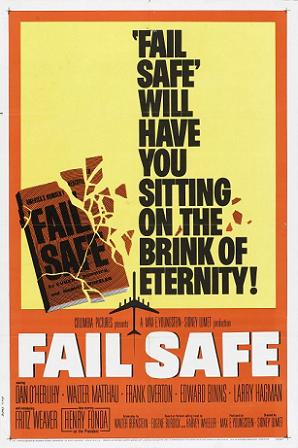
After watching Dr. Strangelove, you may find yourself asking what that film would have been like if it had treated its doomsday scenario seriously. Well, you can find out by watching yet another film from 1964, Sidney Lumet’s Fail-Safe.
What’s Fail-Safe about? Well, basically, it tells the exact same story as Dr. Strangelove, except without the humor. Once again, an American bomber is accidentally ordered to launch a nuclear attack against Russia. Again, the President (played, somewhat inevitably, by Henry Fonda) has to have an awkward conversation with the leader of Russia. Again, a sinister defense advisor (this time played by Walter Matthau) argues that the world can survive a nuclear war.
Admittedly, there is no equivalent to George C. Scott’s Buck Turgidson in Fail-Safe. However, there is a General Black (Dan O’Herilihy) who has a recurring nightmare about watching a bullfight while the sky around him glows with radiation.
Fail-Safe has the same plot as Dr. Strangelove but none of the humor. In fact, Fail-Safe has absolutely no humor at all. It’s one of the most somber films that I’ve ever seen. It has a good opening with General Black’s nightmare and an effective ending that makes excellent use of freeze frames but the middle of the film is basically just a collection of endless debates.
And I’m sure that approach made sense at the time because, after all, Fail-Safe was dealing with a serious theme, it was directed by a serious filmmaker, and it featured a bunch of serious actors. And maybe if I had never seen Dr. Strangelove, Fail-Safe would not seem like such a slow and boring movie. But I have seen Dr. Strangelove and, as a result, it’s impossible to watch Fail-Safe without wanting to hear Henry Fonda say, “You can’t fight here! This is the war room!”
“Does The Best Man Always Get To The White House?” asks the poster for the 1964 film, The Best Man.
Of course, nowadays, that question seems incredibly naive. Of course the best man doesn’t always get to the White House! Some of my friends are Republicans and some of my friends are Democrats and a lot of my friends are Libertarians but they all have one thing in common: the belief that at least half of the past 4 elections were won by the wrong man.
But, as anyone who has done their research can tell you, 1964 was a far different time from 2015. In general, people had greater faith in both government and their elected leaders. Ineffective leaders and corrupt authority figures were viewed as being the exception as opposed to the rule. We’re a lot more cynical now and, when we see political movies from the early 60s, all of that optimism and idealism often make them feel very dated.
Another big difference between the middle of the 20th Century and today is that, when it came to presidential nominating conventions, there was actually the potential for some suspense regarding who would win the nomination. Occasionally, it took more than one ballot for a candidate to be nominated. Last minute deals often had to be made and convention delegates were actually selecting an ideology along with a candidate. Political conventions were contests and not coronations.
Again, it’s obvious that times have changed and, as a result, a film like The Best Man, which may have seemed very provocative and shocking in 1964, feels a bit like an antique today. That doesn’t mean that it’s a bad film. In fact, The Best Man is an interesting time capsule of the way things used to be.
The Best Man takes place at a presidential nominating convention. The party is not specified but it feels like a Democratic convention. There are several candidates competing for the nomination but the two front-runners are former Secretary of State William Russell (Henry Fonda) and Senator Joe Cantwell (Cliff Robertson).
Much like the character that Fonda played in Advise & Consent, Russell is an intellectual, a calm and rational liberal. Much like Spencer Tracy in State of the Union, Russell is separated from his wife (Margaret Leighton) but the two of them are pretending to be a happy couple for the sake of the campaign.
Meanwhile, Joe Cantwell is a paranoid and ruthless opportunist, a former war hero who will do anything to win. The only person more ruthless than Joe Cantwell is his brother and campaign manager, Don (Gene Raymond).
(For those who enjoy history, it’s interesting to note that John F. Kennedy was a war hero-turned-senator who had a ruthless brother who doubled as his campaign manager.)
Both Cantwell and Russell come to the convention hoping to get the endorsement of former President Art Hockstader (Lee Tracy). While the pragmatic Hockstader cannot stand Cantwell personally, he also views Russell as being weak and indecisive.
However, both Russell and Cantwell have secrets of their own. When Cantwell discovers Russell’s secret and threatens to leak it, Russell has to decide whether or not to reveal Cantwell’s secret.
The Best Man was based on a stage play by Gore Vidal and the actual film never quite escapes its theatrical origins. And, in many ways, it feels undeniably dated. But it’s still a well-acted film, one that will probably be best enjoyed by political junkies and students of history. Before watching the movie, be sure to read up on the 1960 presidential election and then see if you can guess who everyone is supposed to be.
In case you hadn’t heard, U.S. Sen. Barbara Boxer has recently announced that she’s retiring in 2016. For the first time in decades, there’s going to be an open senate seat in California. There’s been a lot of speculation about who might run for the seat and, for the most part, it’s all been the usual political suspects. The state’s attorney general is running. A few congresspeople might run. Token billionaire Tom Steyer is thinking of getting into the race.
What disappoints me is that, as of right now, it doesn’t look like any celebrities are planning on running. You know what would have made the Golden Globes perfect? If George Clooney had announced his candidacy while accepting his Cecil B. DeMille award. (At the very least, it might have given Amal something to smile about, as opposed to just sitting there with a condescending smirk on her face. Seriously, what’s up with that?) But even beyond George Clooney, there’s all sorts of celebrities who could run. Charlie Sheen lives in California, after all. Jeff Bridges might not be able to run in Montana but what about California?
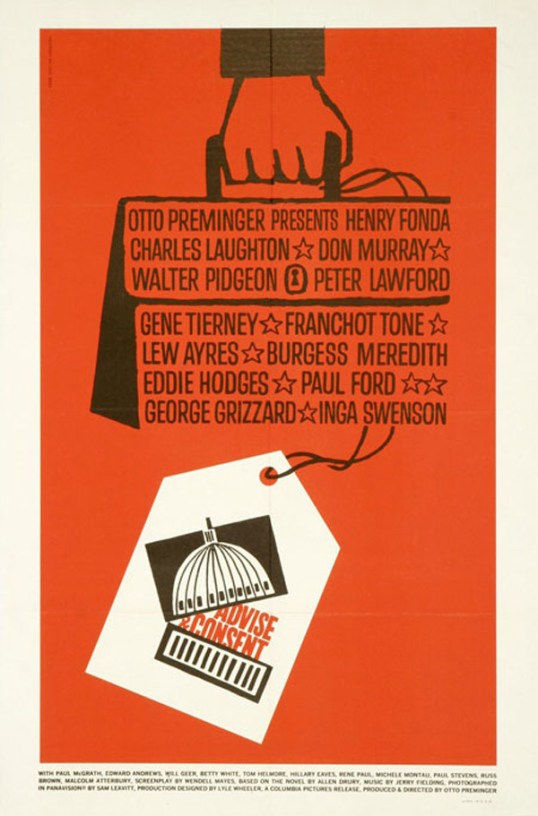
I was discussing this with a friend of mine who suggested that Betty White should run because who could vote against Betty White? Speaking for myself, I could easily vote against Betty White but I do think there would be something appropriate about Betty White serving in the U.S. Senate. After all, in 1962, she played a senator in Otto Preminger’s political epic, Advice & Consent.
White played Sen. Bessie Adams of Kansas and was only given a few minutes of screen time. She’s one of many performers to show up in Advise & Consent‘s version of the U.S. Senate.
For instance, Walter Pidgeon plays Sen. Bob Munson, who is the Senate majority leader and, as a result, the closest thing that this sprawling film has to a central character. His job is to make sure the President’s agenda is pushed through Congress.
And then there’s Peter Lawford, as Sen. Lafe Smith, who always has a different girl leaving his hotel room. When Advise & Consent was made, Lawford was President Kennedy’s brother-in-law. Interestingly enough, one of Kennedy’s former girlfriends — actress Gene Tierney — shows up in the film as well, playing Bob Munson’s lover.
George Grizzard plays Sen. Fred Van Ackerman, who is about as evil as you would expect someone named Fred Van Ackerman to be. Grizzard gives one of the better performances in the film, which just goes to prove that it’s more fun to play an evil character than a good one.
Don Murray is Sen. Brigham Anderson, a senator who is being blackmailed by Van Ackerman’s lackeys. Despite being happily married to Mabel (Inga Swenson), Anderson is leading a secret life as a gay man. The scene where Anderson steps into a gay bar may seem incredibly tame today but it was reportedly very controversial back in 1962.
And finally, there’s Sen. Seabright Cooley. You may be able to guess, just from his overly prosaic name, that Cooley is meant to be a southerner. That, of course, means that he wears a white suit, is constantly fanning himself, and speaks in lengthy metaphors. Sen. Cooley is played by Charles Laughton, who overacts to such a degree that I’m surprised that there was any oxygen left over for anyone else.
All of these senators have been tasked with deciding whether or not Robert Leffingwell (Henry Fonda) will be the next secretary of state. Fonda, not surprisingly, is the epitome of urbane liberalness in the role of Leffingwell. However, Leffingwell has a secret. Back in the 1930s, Leffingwell was a communist. When Sen. Cooley introduces a witness (Burgess Meredith) who can confirm this fact, Leffingwell offers to withdraw as the nominee. However, the President (Franchot Tone) refuses to allow Leffingwell to do so. Instead, with the help of Van Ackerman, he tries to pressure Anderson into supporting Leffingwell’s nomination.
This, of course, leads to melodrama and tragedy.
As far as literary adaptations directed by Otto Preminger are concerned, Advise & Consent is better than Hurry Sundown while being nowhere to close to being as good as Anatomy of a Murder. It’s a film that is occasionally entertaining, often draggy, and, if just because of all the different acting styles to be found in the cast, always interesting to watch.
And, for what it’s worth, Betty White makes for a convincing senator. So, perhaps the people of California should watch Advise & Consent before voting for Tom Steyer…
Way back in 1939, at the same time that Jimmy Stewart was conquering Washington in Frank Capra’s Mr. Smith Goes To Washington, the great director John Ford was making a film about another man who would eventually go to Washington.
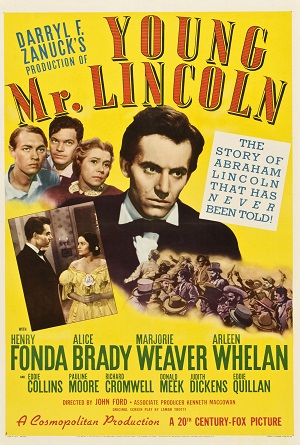
In Young Mr. Lincoln, Henry Fonda plays the future 16th President. Even though Fonda was probably far better looking than Abraham Lincoln ever was, he’s ideally cast in the role. Along with being a very natural actor, Fonda personified a certain middle-of-the-country, stoic decency. He played characters who were smart but never elitist and who were guided mostly by common decency. In short, his screen persona was everything that people tend to think about when considering Abraham Lincoln.
As for the film itself, it begins with Lincoln as a simple storekeeper who accepts, as payment for groceries, a barrel of old books. After reading the books and having a conversation with his doomed first love, Anne Rutledge (Pauline Moore), Lincoln decides to learn the law.
Years later, now a poor-but-honest lawyer, Abraham Lincoln arrives at Springfield, Illinois, sitting a top mule because he can’t afford a horse. Lincoln opens a law office, awkwardly courts the rich and spoiled Mary Todd (Marjorie Weaver), and eventually defends two brothers who have been accused of murder. While the case’s prosecutor (played by Donald Meek) may have a better education, he can’t compete with Lincoln’s common sense and ability to relate to the common people.
Obviously, the whole point behind Young Mr. Lincoln is that it’s about the early life of an American hero. You watch the entire film with the knowledge that Lincoln is going to be the man who eventually leads the U.S. during the Civil War and who frees the slaves. The viewer knows that Lincoln is going to be a great man, even if nobody else does and a good deal of the film’s effectiveness come from the moments when Fonda will strike an iconic pose or will casually deploy a familiar phase and you’re reminded of just who exactly it is he’s playing.
But, and this is why Young Mr. Lincoln remains a great film, the important thing is that the film is just effective when viewed as being a portrait of a dedicated lawyer trying to prove the innocence of his clients. Fonda is compelling as both a future President and as an honest man trying to do the right thing. Ultimately, the film would be just as compelling even if it was called Young Mr. Jones and didn’t open with soaring, patriotic music and end with a shot of the Lincoln Memorial.
It’s interesting to compare Young Mr. Lincoln to some of the other films made about Abraham Lincoln. It’s a far more assured film than D.W. Griffith’s Abraham Lincoln and, needless to say, Henry Fonda makes for a better Lincoln than Walter Huston did. At the same time, it’s far more naturalistic and less overly manipulative film than Steven Spielberg’s Lincoln.In the end, it’s a good film and a great tribute to our 16th President.
Everyone already knows that the 1957 Best Picture nominee 12 Angry Men is a classic. We all know the film’s story — a teenage boy is on trial for murdering his family. 11 jurors want to convict. 1 juror doesn’t. Over the next few hours, that one juror tries to change 11 minds. Some of the jurors are prejudiced, some of them are bored, and some of them just want to go home. And, as the film reminds us, all 12 of them have a huge responsibility. You don’t need me to tell you that this is a great movie. Therefore, consider this to be less of a review and more of an appreciation of one of the best movies ever made.
1) The film is the feature debut of director Sidney Lumet. As any student of American film can tell you, Sidney Lumet was one of the most important directors in the history of cinema. After beginning his career in television, Lumet made his film directing debut with 12 Angry Men and he was rewarded with a much deserved Oscar nomination for best director.
2) The film’s story is actually a lot more complex than you might think. 12 Angry Men is such an influential film and its story has been imitated so many times that it’s easy to forget that the film’s plot is a lot more nuanced than you might think. Despite what many people seem to think, Juror Number 8 never argues that the defendant is innocent. Instead, he argues that the state has not proven its case beyond a reasonable doubt and, as a result, the defendant cannot be convicted. That’s an important lesson that is too often forgotten.
3) The movie celebrates the power of one person determined to do the right thing. Again, that’s a lesson that remains very relevant today.
4) As Juror Number Eight, Henry Fonda makes human decency believable.
5) As the angry and bullying Juror Number Three, Lee J. Cobb is the perfect antagonist.
6) As Juror Number Ten, Ed Begley makes Cobb seem almost reasonable. To be honest, the scene where Begley’s racist ranting causes all of the other jurors to stand up and turn their back on him feels a bit too theatrical. But it’s still undeniably effective. Alone among the jurors, Juror Number Ten is the only one without any hope of redemption. It’s a bit of a thankless role but Begley does what he has to do to make the character believable.
7) E.G. Marshall makes the wealthy Juror Number Four into a worthy opponent of Fonda without crossing the line into prejudice like Cobb and Begley. In many ways, Marshall’s role is almost as important as Fonda’s because Marshall’s performance reminds us that not all disagreements are the product of ignorance or anger.
8) As the Jury Foreman, Martin Balsam is the epitome of every ineffectual authority figure.
9) As Juror Number Seven, Jack Warden is hilariously sleazy.
10) As Juror Number Nine, Joseph Sweeney grows on you. The first time I saw the film I thought that Sweeney went a bit overboard but, on more recent viewings, I’ve come to appreciate Sweeney’s performance.
11) As Juror Number Twelve, Robert Webber is hilariously shallow. Juror Number Twelve is in advertising and Webber seems like he was right at home on Mad Men.
12) Though they don’t get as much of a chance to make an impression, John Fiedler, Jack Klugman, Edward Binns, and George Voskovec all do good work as the other jurors. If there’s ever been a film that proves the value of a great ensemble, it’s 12 Angry Men.
Recently, despite my longstanding fear of heights and my refusal to ever ride one in real life, I watched a film called Rollercoaster. First released in 1977, Rollercoaster recently made its debut on TCM. I was hesitant about watching it but then Robert Osborne assured me that it was an entertaining film and, seriously, who can say no to Robert Osborne?
An unnamed bomber (Timothy Bottoms) is going from amusement park to amusement park and blowing up roller coasters. He wants money and, even more importantly, he wants the money to be delivered to him by safety inspector Harry Caulder (George Segal). Will the FBI back off long enough for Harry to deal with the bomber? Will the bomber ever smile? Finally, will Harry be able to save the day while, at the same time, trying to quit smoking and bond with his daughter?
Roller Coaster is about 30 minutes too long and it’s never quite as exciting as it should be. My mind kept wandering during the climax, which is not a good thing when the film is supposed to be a race against time. However, at the same time, when taken on its own dated terms, Roller Coaster is a lot of fun. Even if director James Goldstone (who also directed the far more surreal Brother John) struggles a bit with keeping the action moving at a steady pace, he still directs with a good eye for detail and gets good performances out of the majority of the film’s cast.
Since I best know George Segal for playing cantankerous father figures on about a thousand different sitcoms, it took me a few minutes to get used to the idea that he was the main character here. While Segal does have several funny lines in Rollercoaster, he is also totally convincing and likable as the film’s hero. Timothy Bottoms is equally convincing as the unnamed bomber. The fact that we learn little about the bomber’s motivations or background just serve to make Bottoms’s cold performance all the more chilling.
As for the supporting cast, Henry Fonda is the biggest distraction, snarling his way through his role as Segal’s jerk of a boss. Oddly enough, Fonda showed up in a lot of disaster films in the 70s, usually playing authority figures and usually only appearing in two or three scenes. Whenever Henry Fonda shows up in a film like this, overacting and looking somewhat humiliated, it’s best just to close your eyes and think of 12 Angry Men and then realize that even great actors sometimes just needed a paycheck. Richard Widmark is far more convincing, playing the stuffy FBI agent who doesn’t have much use for George Segal. Finally, for those of you who enjoy spotting future Oscar nominees in unlikely roles, 13 year-old Helen Hunt makes her film debut here as Segal’s daughter, who just wants to ride the rollercoaster one time.
Ultimately, the best recommendation that I can give to Rollercoaster is to say that it’s a quintessentially 70s films and hence, it’s a piece of history. Not only is the film full of 70s fashion, 70s hair, and 70s stereotypes (just check out the long-haired teenagers joking about getting high while unknowingly sitting on top of a bomb) but the film also features a performance from a band called Sparks that is so 70s that the cast of Dazed and Confused might as well have been watching them in the audience and going, “Alright, alright, alright…”
(I have to admit that I had never heard of Sparks before I saw this film. I looked them up on Wikipedia and I discovered that not only is the band still performing but that the lead singer claims that appearing in Rollercoaster was the band’s biggest regret. Personally, I think he’s being too hard on both the band and the film. Sure, they seem painfully out-of-place but I dare anyone to get the borderline annoying sound of “Big Boy” out of their head.)
For those of us who were born a few decades too late to experience it firsthand, Rollercoaster is our chance to spend two hours living in the 70s.
As part of my continuing mission of see every single movie ever nominated for best picture, I’ve been watching a lot of TCM this month. Last week, I caught the 1943 best picture nominee, The Ox-Bow Incident.
Taking place in Nevada in the 1880s, The Ox-Bow Incident is a western that examines both the mob mentality and takes on the issue of lynching. (It should be remembered that when the Ox-Bow Incident was first released, lynchings were still a regular occurrence.) Henry Fonda and Henry Morgan play two prospectors who ride into town one day and discover that everyone is on edge because there are apparently cattle rustlers about. When it’s reported that a rancher has been murdered, the townspeople form a posse and go searching for the rustlers. Realizing that until the real rustlers are caught they’ll be considered prime suspects, Fonda and Morgan join the posse. Led by Major Tetley (Frank Conroy), who falsely claims to be a Confederate veteran, the posse comes across a camp with three men. Though it quickly becomes obvious that the three men are probably innocent, the posse immediately makes plans to lynch the men. Fonda and Morgan find themselves forced to either side with the bloodthirsty posse or to stand up to the mob.
To be honest, I’ve never been a big fan of Westerns. On a personal note, Some of that is because whenever anyone from up north finds out that I’m from Texas, they always ask me if I’ve ever ridden a horse. (For the record, I do not own a horse, I do not ride horses, and I’m pretty sure I’m allergic to them.) On another note, Westerns often strike me as being predictable. All of the dark strangers and the old maid school teachers and the tight-lipped gunslingers spitting tobacco all over the place — it all just makes me want to go, “Bleh!”
However, I was surprised to discover that I really enjoyed The Ox-Bow Incident. While the film’s well-intentioned message was a bit heavy-handed, director William Wellman emphasizes the psychological aspects of the story and the movie itself was well-acted by a large cast who brought a surprising amount of depth to characters who, in lesser hands, could have easily just been stereotypes. Henry Fonda and Henry Morgan were both excellent and sympathetic leads while Jane Darwell dominated the film as one of the more bloodthirsty members of the lynching party. A very young and very suave Anthony Quinn also shows up as one of the accused men. Five decades before either Quentin Tarantino or the Coen Brothers, Wellman and his cast use the standard tropes of the western genre to comment on some very real issues and the end result is a fast-paced film that succeeds in making a moral debate just as exciting as any gunfight or stampede.
Released in 1943, The Ox-Bow Incident was nominated for best picture but, ultimately, it lost to Casablanca. It’s hard to complain about any film losing to Casablanca but taken on its own terms, the Ox-Bow Incident remains an entertaining and intelligent film and one that I’m thankful that TCM gave me a chance to discover.
With the recent passing of filmmaker Sidney Lumet I’ve gone through some of the films of his I’ve come to see as favorites of mine. One film which always came to the forefront whenever I spoke about Lumet as a filmmaker is his directorial film debut in 1957 with his adaptation of 12 Angry Men. Of all his films this is the one which I always go back to time and time again. Part of me is somewhat biased in regards to this film since I was part of a class reading of the original teleplay and played the role of Juror #3.
The scene in the film which I love the most has to be when Juror #8 (played with calm assurance by Henry Fonda) and Juror #3 (played with seething rage by Lee J. Cobb) finally get into it after a very long deliberation in trying to find a consensus on the guilt or innocence of the defendant in their case. I love how in this scene everything that’s right about the American jury system was being upheld by Juror #8. How the guilt or innocence of the defendant should come down to just the facts of the case and combing through all the testimony. How emotions and personal feelings and bias should never enter the equation. It is a person’s life in their hands and it is a responsibility too great to leave it to emotions to find the verdict.
This scene also shows the darker side of the American jury system in that there will be, at times, people chosen to preside as a juror in a case will come in with emotional baggage and a hidden agenda which clouds their decision making. They don’t look at the facts and testimony at hand but at what they believe to be true no matter what the facts may say otherwise. this is how the jury system becomes twisted and becomes part and parcel to the notion that justice is never truly blind but always colored by human frailties and prejudices.
Even 54 years since the films first premiered it still holds a powerful effect on me and those who sees it for the first time. It helps that you have a master filmmaker in Sidney Lumet guiding an exceptional cast of actors. One could come to the conclusion that the audience has the angel on one shoulder with Juror #8 and the devil on the other with Juror #3. All in all, a great scene that always stays with me long after the film has ended.
Earlier today, when I was talking about which trailers I was thinking of including in this edition, Jeff asked me if I had included any Sonny Chiba trailers. The way he asked the question seemed to indicate that it was the most important thing he had ever asked so, understandably, I was a little nervous when I answered, “N-no, I don’t think so.”
Well, apparently, that wasn’t the right answer because Jeff’s eyes just about popped out of his head and he’s lucky that he’s s0 cute because I might otherwise have taken his reaction personally. Instead of taking offense, I’m going to start this edition off with Sonny Chiba in The Streetfighter.
This one is from one of the great, unacknowledged directors of British cinema, Peter Walker. I think it’s always strange for Americans to hear grindhouse dialogue being delivered in an English accent.
This is a trailer for an Italian film that is also known as “House 4,” “Witchcraft,” “Ghost House,” and “Demons 5.” In Italy, it was promoted as a sequel to Sam Raimi’s Evil Dead 2. For all I know, they may have tried to sell this as an installment in the Zombi series as well. I saw this film a few years ago when I was first starting to explore the world of Italian horror and oh my God, it gave me nightmares. Seriously, don’t let the presence of David Hasselhoff fool you. This is a disturbing movie that was produced (and some day actually directed) by the infamous Joe D’Amato.
Apparently, the trailer is disturbing as well as I tried to show it to my sister Erin earlier and she asked me stop it around the time the gentleman with the weird mouth showed up.
“Even a peaceful man…can get fighting mad!” Peter Fonda looked good playing archer. This is an early film from Jonathan Demme who directed one of my favorite films ever, Rachel Getting Married.
I’m scared to death of rollercoasters so I probably won’t be seeing this film anytime soon. Still this film has a surprisingly good cast — George Segal, Richard Widmark, Henry Fonda — for a movie about a rollercoaster.
Not to be confused with Crazy Mama or Bloody Mama, Big Bad Mama features Angie Dickinson, Tom Skerritt, William Shatner, and a lot of tommy guns. It’s not a great film but it is a lot more fun than Public Enemies.

 Through the Shattered Lens