Film Review: Underground (dir by Vincent Sherman)


1941’s Underground tells the story of two brothers on opposite sides in Nazi Germany.

Kurt Franken (Jeffrey Lynn) is a patriotic German who believes that the country got a raw deal at the end of World War I and who is a strong supporter of the Nazis.  He served in the army, fighting on the front.  When he returns home to Berlin, he’s missing an arm.  Whenever his friends and his family say that they’re sorry that he lost his arm, he replies that he was happy to make the sacrifice for his country.  When someone starts to mourn for his son who was killed in the fighting, Kurt accuses the man of being a traitor for doubting the wisdom of the government.  Kurt is a true believer, just the type to be recruited by the SS and tasked with helping to investigate who is behind a series of anti-Nazi radio broadcasts.  Kurt believes that, if the government says it, it must be right.  Laws must be obeyed and orders followed without question.  Kurt, in other words, is a very familiar type.

What Kurt doesn’t realize is that the man behind the broadcasts is his own brother, Eric (Phillip Dorn).  As Kurt investigates, he falls in love with Sylvia (Kaaren Verne) without realizing that she is also a part of the resistance.  While Kurt tries to discover who is behind the underground radio station, Eric and his fellow resistance members attempt to stay one step ahead of the Gestapo.

For a film made in 1941, the film’s doesn’t flinch from showing the brutality of the Gestapo.  Like all authoritarian dictatorships, The Third Reich is determined to quash any and all signs of dissent and they investigate the underground radio station with a ruthlessness that even takes Kurt by surprise.  Witnessing first hand the brutality and sadism of the government for which he gave his arm, Kurt starts to doubt his previous beliefs.  But will Kurt’s doubts come in time to save the lives of Eric and his fellow resistance members?

Made at a time when the United States was still officially neutral in the violent conflict that was sweeping the rest of the world and released just a few months before the U.S. officially declared war on the Axis Powers, Underground is a powerful look at life under a dictatorship.  Shot in a noir style, the film’s black-and-white imagery perfectly captures the harshness of life in Germany while the shadows in the background perfectly capture the paranoia of knowing that saying the wrong word could lead to arrest, torture, and death.  The film’s final minutes involve a guillotine sitting ominously in the background, a reminder that Nazi Germany was not the first authoritarian regime and that it would not be the last.

The film is well-acted, with Jeffrey Lynn epitomizing the otherwise intelligent people who allow themselves to get caught up in the madness of the majority.  His discovery of the truth about Germany was obviously meant to mirror the awakening of the Americans who previously supported a policy of neutrality.  By the end of the film, both Karl Franken and the audience understand that the time for neutrality has passed.

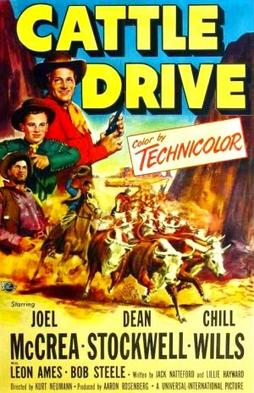
Cattle Drive (1951, directed by Kurt Neumann)


In this coming-of-age Western, Dean Stockwell plays Chester Graham, Jr., the spoiled and unruly son of a railroad owner (Leon Ames).  While riding on his father’s train and making trouble for the conductor, Chester overhears his father talking about sending him to a military school.  When the train makes as top, Chester impulsively runs away.  The train leaves without him and Chester finds himself stranded in the middle of the wilderness.  That’s when he sees cowboy Dan Matthews (Joel McCrea) trying to catch a wild stallion.

Dan is a part of a cattle drive.  Knowing that he can’t leave Chester to die in the wilderness, Dan brings him back to his camp.  The other members of the company aren’t too keen on having to look after a spoiled brat along with the cattle and Chester isn’t too happy to hear that he’ll be expected to work if he expects to get fed.  But with no choice but to work together, Chester, Dan, and the rest of the company make the journey to Santa Fe.  Chester finally drops his attitude enough to work with the company’s cook (Chill Wills) while Dan deals with a rival cowboy named Currie (Henry Brandon). Chester learns about responsibility and Dan finally finds the courage to consider settling down.

Of the many westerns that Joel McCrea made over the course of his career, he considered Cattle Drive to be his favorite and it’s easy to see why.  Cattle Drive features McCrea doing what he did best, playing a tough but good-hearted and down-to-earth cowboy who looked after an outsider.  If you were ever lost in the old west, Joel McCrea is precisely the type of cowboy that you would hope would come to your rescue.  The plot features almost every single cattle drive cliché that you could imagine but McCrea plays his role with a winning combination of grit and compassion and he and Dean Stockwell, who is also very good, make a good team.  Shot in Death Valley and Utah, Cattle Drive feels and look authentic and should be enjoyed by anyone looking for good, heartfelt western.

Horror On TV: Kolchak The Night Stalker 1.14 “The Trevi Collection” (dir by Don Weis)


Tonight on Kolchak….

After witnessing the murder of an informant, Kolchak finds himself being targeted by the mob!

Of course, after some of what Kolchak has been through, a simple Earth-bound threat like the Mafia would be a nice change of pace.  However, Kolchak soon discovers that he’s also got a witch after him!  With the help of a model (Lara Parker), Kolchak sets out uncover the witch at the heat of Chicago’s fashion industry!

This episode originally aired on January 24th, 1975.

Enjoy!

http://www.youtube.com/watch?v=1DM01oObdUg

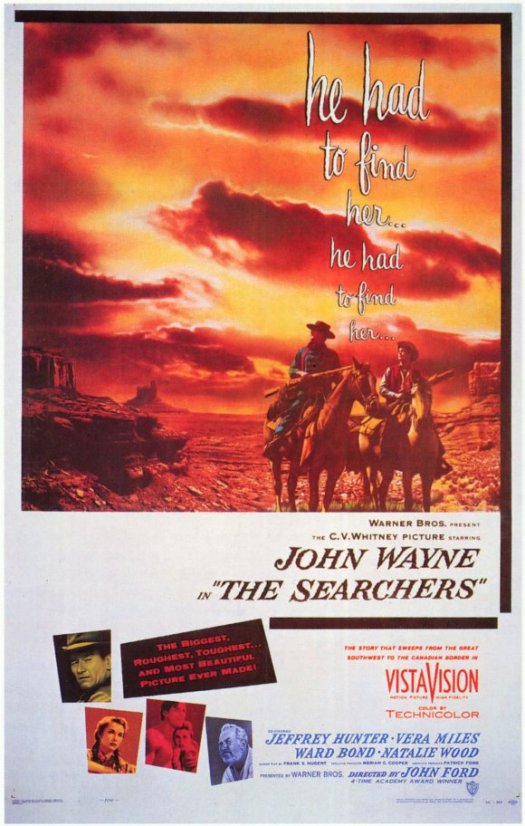
Ride Away: John Wayne in John Ford’s THE SEARCHERS (Warner Brothers 1956)


gary loggins's avatarcracked rear viewer

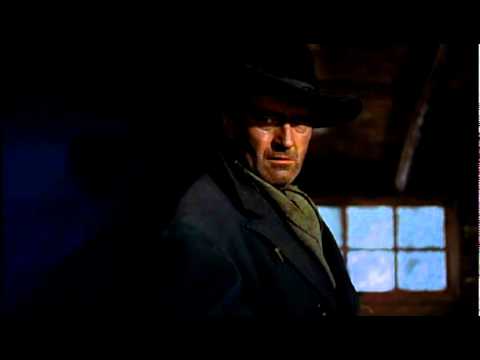
John Ford’s  THE SEARCHERS is without question an American Film Classic. I’d even go as far as saying it’s my second all-time favorite film, directly behind CASABLANCA. Every shot is a Remington Old West masterpiece, every actor perfect in their role, large or small, and not a minute of footage is wasted. The film has also stirred up quite a bit of controversy over time for John Wayne’s portrayal of the main character Ethan Edwards.

The plot is structured like Joseph Campbell’s “Hero’s Journey”, but let’s get it out of the way right now: Ethan Edwards is no hero. He’s a mean, bitter, unreconstructed Confederate who’s been on the shady side of the law since war’s end. When he returns to his brother Aaron’s homestead, he makes no bones about his distaste for “half-breed” Martin Pawley (really an eighth Cherokee). His hatred of Native Americans even extends to their dead, as…

View original post 1,096 more words

Lisa Watches An Oscar Nominee: Auntie Mame (dir by Morton DaCosta)


Oh Lord, Auntie Mame.

There were two reasons why I watched the 1958 film Auntie Mame.

First off, as I’ve mentioned before, TCM has been doing their 31 Days of Oscar this month.  They’ve been showing a lot of films — both good and bad — that were nominated for best picture.  Since it’s long been my goal to see and review every single film that has ever nominated for best picture, I have made it a point to DVR and watch every best picture nominee that has shown up on TCM this month.  Auntie Mame was nominated for best picture of 1958 and was broadcast on TCM this month so I really had no choice but to watch it.

My other reason for wanting to see Auntie Mame was because, when I was 19, I was cast in a community theater production of Mame.  (Mame, of course, is the musical version of Auntie Mame.)  Though everyone who saw the auditions agreed that I should have played the role of Gloria Upson, I was cast in the ensemble.  (Gloria was played by the daughter of a friend of the director.  Typical community theater politics.)  As a member of the ensemble, I didn’t get any lines but I still had fun.  In the opening party scene, I dressed up like a flapper and I got to show off my legs.  And then in another scene, I was an artist’s model and I got show off my cleavage.  (If you don’t use being in the ensemble as an excuse to show off what you’ve got, you’re doing community theater wrong.)  Towards the end of the play, I appeared as one of Gloria’s friends and whenever she delivered her lines, I would make sure to have the most over-the-top reactions possible.  She may have stolen the part but I stole the scene.  It was a lot of fun.

But, even while I was having fun, I have to admit that I didn’t care much for Mame.  It was an extremely long and kind of annoying show and there’s only so many times you can listen to someone sing We Need A Little Christmas before you’re tempted to rip out the hair of the actress who stole the role of Gloria Upson from you.

So, when I recently sat down and watched Auntie Mame, I was genuinely curious to see if the story itself worked better without everyone breaking out into song.  After all, Auntie Mame was the number one box office hit of 1958, it was nominated for best picture, and it was apparently so beloved that it inspired a musical!  There had to be something good about it, right!?

Right.

Auntie Mame tells the story of Mame Dennis (Rosalind Russell, attempting to be manic and just coming across as hyper) who is rich and quirky and irrepressibly irresponsible.  When her brother dies, Mame suddenly finds herself entrusted with raising his son, Patrick (played, as a child, by the charmless Jan Hadzlik and, as an adult, by the stiff Roger Smith).  Mame is a wild nonconformist (which I suppose is easy to be when you’ve got as much money as she does) and she tries to teach Patrick to always think for himself.  However, once Patrick grows up and decides that he wants to marry snobby Gloria Upson, Mame decides maybe Patrick shouldn’t think for himself and goes out of her way to prevent the wedding.

Auntie Mame is an episodic film that follows Mame as she goes through a series of oppressively zany adventures.  When the Great Depression hits, she’s forced to work as an actress, a saleswoman, and a telephone operator and she’s not very good at any of them.  She does eventually meet and marry the wealthy Beauregard Jackson Pickett Burnside (Forrest Tucker).  As you can probably guess from the man’s name, he’s supposed to be from the south.  (And yet Tucker plays the role with a western accent…)  He loves Mame but then he ends up falling off a mountain.  So much for Beau.

(In the production of Mame that I appeared in, Beau was played by this 50 year-old guy who simply would not stop hitting on me and every other girl in the cast and who was always “accidentally” entering the dressing room while we were all changing.  Whenever Mame mentioned Beau’s death, all of us ensemble girls would cheer backstage.)

Anyway, as a film, Auntie Mame doesn’t hold up extremely well.  I can understand, to an extent, why it was so popular when it was first released.  It was an elaborate adaptation of a Broadway play and, in 1958, I’m sure that its theme of nonconformity probably seemed somewhat daring.  When you watch it today, though, the whole film seems almost oppressively heavy-handed and simplistic.  It’s easy to embrace Mame’s philosophy when everyone else in the film is essentially a sitcom creation.

As I mentioned previously, Auntie Mame was nominated for best picture.  However, it lost to the musical Gigi.