4 Shots From 4 Films is just what it says it is, 4 shots from 4 of our favorite films. As opposed to the reviews and recaps that we usually post, 4 Shots From 4 Films lets the visuals do the talking.
Admittedly, it is not Bill Murray’s birthday today but it’s not really anyone else’s birthday either (and don’t you dare say Paul Mescal because you need to be around for a long while to get one of these appreciation posts). Today is Groundhog Day and, even though the production of the movie of the same name was not exactly harmonious by most accounts, it is one of the movies that has come to define everything that people love about Bill Murray.
So today, it just seem appropriate to share….
4 Shots From 4 Bill Murray Films
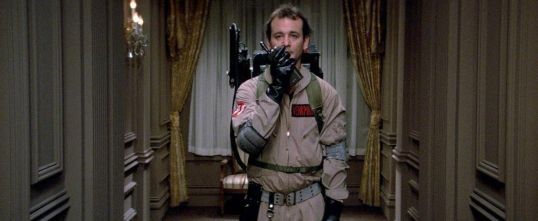
Ghostbusters (1984, dir by Ivan Reitman, DP: Laszlo Kovacs)
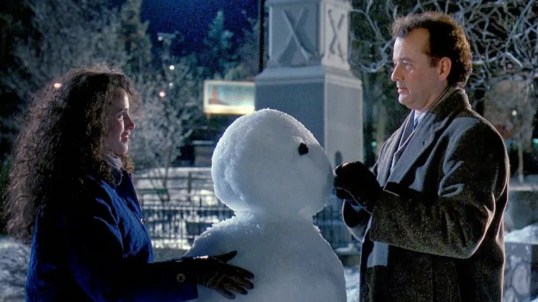
Groundhog Day (1993, Dir. by Harold Ramis, DP: John Bailey)
Rushmore (1998, dir by Wes Anderson, DP: Robert Yeoman)
Lost In Translation (2003, dir by Sofia Coppola, DP: Lance Acord)
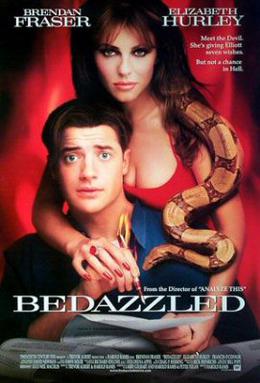
Elliot (Brendan Fraser) has a go-nowhere job at a computer company and an unrequited crush on Alison (Frances O’Connor), a co-worker who doesn’t even know who he is. One night, at a bar afterwork, he’s approached by the Devil (Elizabeth Hurley), who offers Elliot seven wishes in return for his soul. Elliot agrees but then he discovers that the Devil is tricky and his wishes always have an complication. Elliot wants to be powerful so the Devil turns him into a Columbian drug lord. Elliot wants to be sensitive and the Devil turns him into a whiny crybaby. Elliot wants to be president and suddenly, he’s Abraham Lincoln being told to get ready for the theater. Whenever things start to get too dangerous, the Devil brings Elliot back to reality so that she can continue to taunt him.
An Americanized remake of a British comedy that starred Dudley Moore and Peter Cook, Bedazzled was unfairly savaged by the critics when it was first released. While it can’t match the wit and heart of the original and not all of the wishes are equally effective, the remake has its charms. When Bedazzled first came out, most people talked about Elizabeth Hurley’s sexy performance of the Devil. When she appears as a school teacher, it’s not a surprise that every student brings her an apple at the start of the day. Hurley is so sexy that it’s easy to miss that she’s also giving a really good performance. Hurley’s Devil is a prankster. She likes to steal souls but mostly, she’s just having fun ruining all of Fraser’s wishes. Brendan Fraser is likable as Elliot and the way he responds to each wish gives him a chance to show off his comedic skills. Finally, the movie has a good ending, with Elliot growing up and realizing the truth about his crush on Alison.
Bedazzled may not be up to the level of some of director Harold Ramis’s otherfilms but it’s still better than its reputation.
Happy Groundhog Day! For the record, Punxsutawney Phil saw his shadow today so get ready for six more weeks of winter!
Oh, how I love Groundhog Day. I really do. It’s perhaps the silliest holiday that we have in America and I absolutely adore the whole thing. I love the fact that people get dressed up for it. I love that there are people who plan their entire weekend around seeing what the groundhog predicts. I love that we all know there’s no way a groundhog can reasonably predict the weather but, for one day, we pretend like it can. And while Groundhog Day itself had its beginning in Germany, the holiday really has become pure Americana. It’s such an innocent holiday, or at least it is now that Bill de Blasio is no longer in a position to kill the magic groundhog.
(Boo de Blasio! Boo!)
Of course, no Groundhog Day is complete without watching the 1993 comedy of the same name. The film has become such a major part of American culture that even people who haven’t watched it know what it’s about. (It’s a bit like It’s A Wonderful Life in that way.) Bill Murray plays Phil Connors, a cynical weatherman who is sent to cover Groundhog Day in Punxsutawney and finds himself reliving the same day over and over again. Every morning, it’s once again February 2nd. Sonny and Cher’s I Got You Babe plays on the radio. Phil is approached by Ned Ryerson (Stephen Tobolowsky), an annoying former classmate turned insurance salesman. Phil steps in the same puddle. He finds himself covering the same story and, again and again, he’s stranded by the same blizzard. At first, Phil is angry. Even multiple suicides can’t stop the cycle. Kidnapping the groundhog can’t stop the cycle. Then, he decides to take advantage of living the same day over and over again. He gets to know the people in the town and realizes that they’re not so bad. He saves the mayor (Brian Doyle-Murray) from choking at dinner but, in the film’s most poignant moment, realizes that an old homeless man is going to die regardless of how many times he tries to save him. Phil learns how to learn the piano. He learns how to speak French. And, most importantly, he falls in love with Rita (Andie MacDowell). Of course, when he tells Rita this, she assumes he’s just trying to take advantage of her. Rita says that they barely know each other but what she doesn’t realize is that Phil has been spending day-after-day with her.
As you might have guessed I relate to Rita. She loves the silliness of the holiday and so do I. I also relate to Nancy Taylor (Marita Geraghty), just because of her determination to enjoy the day no matter what. That said, this is totally Bill Murray’s film and this is one of his best performances, one in which he expertly mixes his trademark comedy with some very poignant drama. One thing I like about this film is that Phil becomes a better man as a result of living the same day over and over again but it doesn’t totally change his personality. At the end, he’s still the same sarcastic smartass that he was at the start of the film but he’s no longer a cynic. He’s learned how to appreciate other people. He’s fallen in love. Much like George Bailey, he’s become the richest man in town. This is a rare film where the main character is as interesting after he’s reformed as before.
It always breaks my heart a little to read that Bill Murray and director Harold Ramis had a difficult time working together while making this film. It’s truly a perfect film and that’s due to both Murray’s performance and Ramis’s heartfelt direction. I’m also glad that Ramis and Murray made up before Ramis passed away. Life’s too short and sadly, unlike in the movies, we don’t always get a chance to go back and correct the past.
Groundhog Day is a holiday classic and may it continue to be watched for decades to come.
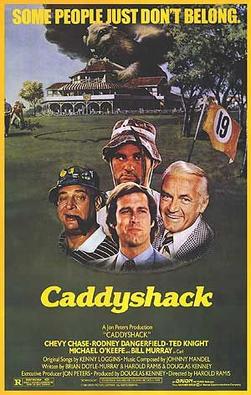
Whenever I think about Caddyshack, which is one of the funniest moves ever made, I think first of the Gopher, burrowing across the course and dancing to the music.
I then think about Bill Murray, playing the demented groundskeeper and growing his own special grass that you can both play golf on and smoke afterwards.
I remember Rodney Dangerfield dancing on the green while Ted Knight throws a fit. This was the first film that I ever saw Rodney Dangerfield in. “It looks good on you, though,” was one of those simple lines that Rodney could turn into a classic.
I remember Ted Knight, appearing in one of his few film roles, and saying, “Well, we’re waiting!” and drawing out every single word.
I remember the scene in the pool. You know which one I’m talking about.
I remember Chevy Chase, back when he was still funny.
Then I remember how Rodney Dangerfield’s classic last line, “We’re all going to get laid,” was changed to “We’re all going to take a shower!” for television. Why the censors thought that sounded less dirty than the original, I’ll never know.
I remember the Bishop getting struck by lightning while playing the best game of his life.
And, of course, I remember Cindy Morgan as Lacy Underall.
I remember so many classic moments and funny lines that I’m always surprised when I rewatch the movie and discover that it’s not really about the Gopher, Bill Murray, Rodney Dangerfield, Chevy Chase, or even Lacy Underall. Instead, the main character in the movie is Danny Noonan (Michael O’Keefe), a teenage caddy at Bushwood Country Club who wants to win a scholarship so he can go to college and avoid having to work in the lumber yard with his father (Albert Salmi). Danny has a friendly rivalry with caddy Tony D’Annuzio (Scott Colomby) and is dating Maggie (Sarah Holcomb). Danny has to decide whether to ally himself with the snobs (led by Ted Knight) or the slobs (led by Rodney Dangerfield).
Caddyshack was originally envisioned as being Danny’s story but, once filming started, Harold Ramis (making his directorial debut) realized that the comedic characters were actually more interesting. The movie went from being a straight-forward coming-of-age story to an almost plotless collection of gags and jokes, with both Bill Murray and Rodney Dangerfield improvising the majority of their dialogue and the Gopher emerging as the film’s true star. That was bad news for the younger actors playing the caddies, who all found their roles greatly reduced in the film’s final cut but that was good news for audiences. Caddyshack may not have much of a narrative structure but it does have some of the funniest people who ever lived at the peak of their powers.
Despite a legendarily troubled production, Caddyshack was a huge success with audiences and eventually, the critics came around as well. Harold Ramis always said that he had a hard time watching it because all he could see were the mistakes that he made. All audiences could see, though, was a hilariously funny movie that continues to bring people joy to this day.
Wait, that can’t be right, can it? Bill Murray and Harold Ramis were cinematic anarchists. Early in his career, Bill Murray was the ultimate smart aleck slacker who did not have any respect for authority. Harold Ramis was hardly a slacker but he came across as someone more likely to be marching on the Pentagon than guarding it. Stripes is one of the ultimate examples of a comedy where the laughs come from things that don’t seem to go together suddenly going together.
John Winger (Murray) at least has a reason to join the army. He has a dead end job. He has just broken up with his girlfriend. The country appears to be at peace so why not spend four years in the Army? It’s harder to understand why John’s friend, Russell (Ramis), also decides to enlist, other than to hang out with John. Along with Ox (John Candy), Cruiser (John Diehl), Psycho (Conrad Dunn), and Elm0 (Judge Reinhold), they enlist and go through basic training under the watchful eye of Sgt. Hulka (Warren Oates). John and Russell go from treating everything like a joke to invading East Germany in a tank that’s disguised as an RV. They also meet the two sexiest and friendliest MPs in the service, Stella (P.J. Soles) and Louise (Sean Young). Russell goes from being an proto-hippie who teaches ESL to asking John if he thinks he would make a good officer. John goes from not taking anything seriously to picking up a machine gun and rescuing his fellow soldiers.
It’s a comedy that shouldn’t work but it does. It’s actually one of my favorite comedies, full of memorable lines (“Lighten up, Frances.”), and stupidly funny situations. The cast is full of future comedy legends and P.J. Soles shows that she deserved to be a bigger star. This was early in Bill Murray’s film career and he was still largely getting by on his SNL persona but, in his confrontations with Hulka, Murray got a chance to show that he could handle drama. With all the comedic talent in the film, it’s Warren Oates who gets the biggest laughs because he largely plays his role straight. Sgt. Hulka is a drill sergeant who cares about his men and who knows how to inspire and teach but that doesn’t mean he’s happy about having to deal with a collection of misfits. (Watch his face when Cruiser says he enlisted so he wouldn’t get drafted.)
The movie does get strange when the action goes from the U.S. to Germany. What starts out as Animal-House-In-The-Army instead becomes an almost straight action movie and the movie itself sometimes feels like a recruiting video. Join the Army and maybe you’ll get to steal an RV with PJ Soles. That would have been enough to get me to enlist back in the day. But the combination of Murray, Ramis, and Oates makes Stripes a comedy that can be watched over and over again.
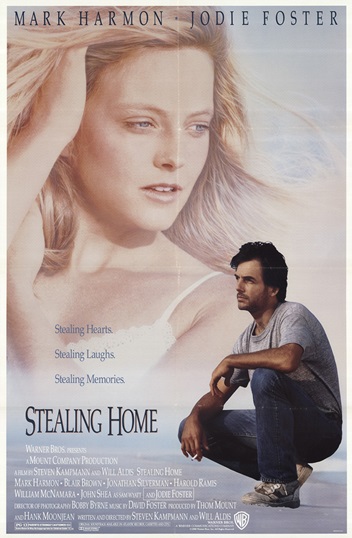
Back in December, Lisa agreed to watch a baseball movie with me to make up for making me watch The Catcherin 2023. The one we picked was Stealing Home, because it starred Mark Harmon and Jodie Foster and it looked like it would be a sweet movie.
Stealing Home opens with Billy Wyatt (Mark Harmon), a minor league baseball player who is getting ready to take the field and who is standing for the National Anthem. I immediately liked Billy because he was standing for the Anthem and not taking a knee. I also like aging minor leaguers because they’re still playing the game even though they know they’ve probably missed their window to move up to the majors. Billy Wyatt loves both the game and his country.
As Billy waits to play ball, he thinks about another type of love, the love that he had for Katie Chandler (Jodie Foster). Katie was six years older than him and encouraged him to always pursue his dreams, whether it was in baseball or love. The movie flashes back to Billy living in a motel with a cocktail waitress and getting a phone call from his mother who tells him that Katie has committed suicide and she wants Billy to spread her ashes at a special place. Billy then flashes back to his childhood and his teen years, in which he’s played by William McNamara who does not look like he could ever grow up to be Mark Harmon. Billy’s best friend is Alan Appleby, who is played as a teenager by Jonathan Silverman and as an adult by Harold Ramis. Jonathan Silverman growing up to be Harold Ramis seems even more unlikely than William McNamara becoming Mark Harmon. Billy remembers losing his virginity to Appleby’s prom date, losing his dad to a car wreck, and a Fourth of July weekend that he spent on the beach with Katie and his mom (Blair Brown).
Only Jodie Foster plays Katie Chandler and we only see Katie thorough Billy’s eyes. Jodie Foster gives a lively performance as Katie but she always more of a plot device than a fully rounded character. We never find out why Katie killed herself. Her father says that Katie was unhappy during her adult life but why? Even after Billy gets her ashes and tries to figure out where she wanted him to spread them, he never thinks about why she killed herself. In fact, he hadn’t even talked to her for years. That really bothered me.
The movie ends with Billy stealing home during a game and proving that he’s still got it as far as baseball goes. I love baseball but I still felt like Katie’s untold story was probably more interesting than Billy’s. I liked Mark Harmon’s performance and I really wanted to like Stealing Home more than I did. I wish the movie had been more about who Katie was instead of being about who Billy thought Katie was.
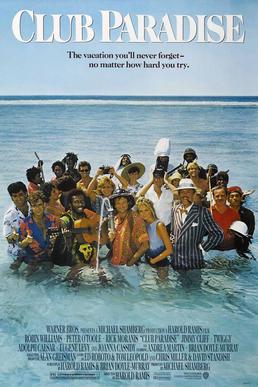
I think I was nine or ten years old when I first saw Club Paradise on HBO. I remember thinking it was pretty funny.
I recently rewatched Club Paradise and I discovered that ten year old me had terrible taste in movies.
Robin Williams plays Jack Moniker, a Chicago fireman who gets blown out of a building while rescuing a dog. Living off of his disability payments, he retires to the island of St. Nicholas, which is basically Jamaica but with less weed. Jack and reggae musician Ernest Reed (Jimmy Cliff) open up their own Club Med-style resort, Club Paradise. Jack doesn’t know much about the resort business but he does know how to put together a good brochure. Almost the entire cast of SCTV shows up at Club Paradise, looking for a tropical vacation. Things quickly go wrong because Jack doesn’t know how to run a resort and there’s also an evil developer (played by Brian Doyle-Murray) who wants Club Paradise to fail so that he can get the land.
Club Paradise has got a huge and impressive cast, the majority of whom probably signed on because they were looking forward to a paid Caribbean vacation. Peter O’Toole plays the British-appointed governor of St. Nicholas. Twiggy plays Jack’s girlfriend. Joanna Cassidy plays a reporter and Adolph Caesar is cast in the role of St. Nicolas’s corrupt prime minister. Because the film was directed by Harold Ramis, it is full of Ramis’s co-stars from SCTV. Andrea Martin tries to get her husband to enjoy the islands as much as she’s enjoying them. Joe Flaherty is the crazed pilot who flies people to the resort. Rick Moranis and Eugene Levy play two nerdy friends who are both named Barry and who are only interested in scoring weed, getting laid, and working on their tan. Rick Moranis and Eugene Levy playing nerds? It’s a shock, I know.
There’s enough funny people in Club Paradise to ensure that there are a few isolated laughs. Not surprisingly, the movie comes to life whenever Moranis and Levy are onscreen. (If I had to guess, I imagine they were the reason why ten year-old me liked this movie so much.) Needless to say, Jimmy Cliff also provides a killer soundtrack. But Club Paradise ultimately doesn’t work because the script is too disjointed and it feels more like an uneven collection of skits than an actual film. It’s impossible to tell whether we’re supposed to think of Club Paradise as being the worst resort ever or if we’re supposed to be worried that the bad guys will shut it down. For a movie like this, you need a strong central presence to hold things together. Unfortunately, Robin Williams’s style of comedy is too aggressive for the role of Jack. The role was originally written for Bill Murray and it shows. Most of Jack’s lines sound like things you would expect Bill Murray to say in his trademark laid back fashion and it is easy to imagine Murray redeeming some of Club Paradise‘s weaker scenes simply by attitude alone. Instead, Robin Williams is so frantic that you never buy he could be happy living a laid back life on a Caribbean island. As played by Williams, Jack often comes across as being unreasonably angry at everyone staying at Club Paradise and it’s hard to care whether or not he manages to save his resort or not.
Club Paradise was a bomb at the box office. Harry Shearer, who was originally credited with working on the screenplay, hated the movie so much that he requested his name be removed from the credits. (Instead, credit is given to Edward Roboto.) As a result of the film’s failure, it would be 7 years before Harold Ramis would get to direct another movie. Fortunately, that movie was Groundhog Day and this time, Ramis was able to get Bill Murray.
I wish the literal video for this was still up. Oh, well.
All these years later, I still don’t have any idea why she goes into that house. I guess we are supposed to believe she lives there with these two kids that miss their cue?
These other kids nail it.
Despite finding lists of all the celebrities in this video, I have no idea who this guy is that Ray Parker Jr. becomes for this bit.
I also wonder why she didn’t see him while turning away from the moving table to go to the window.
In the window is footage of the movie that has aged horribly. Parker Jr. is blue screened in there for this famous shot.
He ain’t afraid of no ghost. A lawsuit on the other the hand, that’s a different matter. I hope this music video doesn’t remind me of a Huey Lewis & The News video as well.
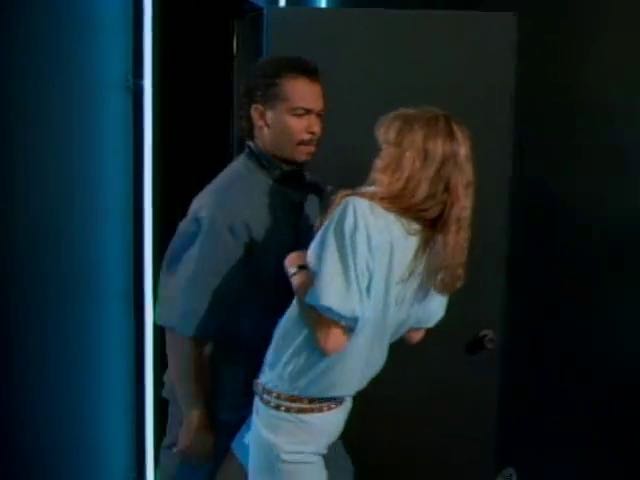
Now Ray Parker Jr. stands creepily outside of her window.
This is looking familiar.
Chevy Chase can call Ghostbusters if he has a ghost problem…
but what about if he gets stuck in Benji again?
Who can he call then?
I knew this looked familiar.
Do You Believe In Love by Huey Lewis & The News (1982)
Do You Believe In Love by Huey Lewis & The News (1982)
I’m sure it’s a coincidence. I just find it humorous to see that considering the lawsuit saying that this song ripped off, to one extent or another, the Huey Lewis & The News song I Want A New Drug. The scene above is from the video that helped kick off their career on MTV and set the tone for their future videos since it was such a success despite being ridiculous. Is the riff in You Crack Me Up…
sound like the same riff from Johnny And Mary by Robert Palmer?
Or is it just me?
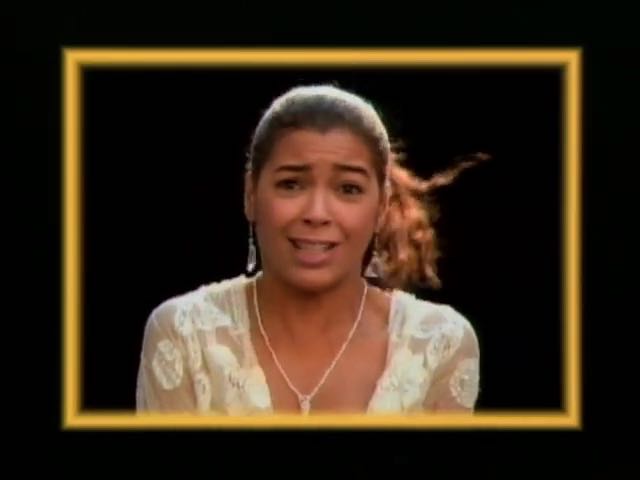
What a feeling. Thanks for making that one easy, Irene Cara.
Something tells me that Cindy Harrell was hired by someone who saw the movie Model Behavior (1982), which she was in.
Model Behavior (1982, dir. Bud Gardner)
Model Behavior (1982, dir. Bud Gardner)
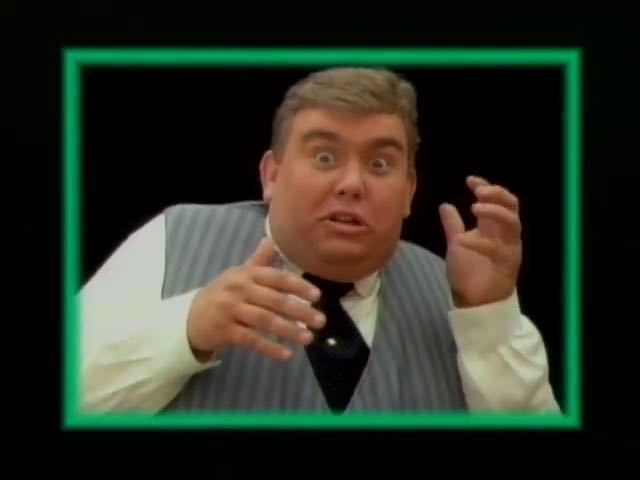
From what I’ve read, they just showed up on the set of a movie Candy was shooting to try and get him to make this cameo appearance.
Ray Parker Jr. rising from the top of the stairs like he’s Michael Myers come to kill her. Why?
Or at least scare her. It’s probably a reference to Gozer.
Melissa Gilbert. I have no idea what she’s doing here. I’ve only seen an episode or two of Little House On The Prairie, so I guess there could have been some episodes with ghosts. Some of these cameos feel like they happened because the celebrities were involved with NBC.
Speaking of cameos I can’t explain, it’s former baseball player Ollie Brown.
Boundaries!
I do like that for the majority of the shot it looks like she should be falling over but isn’t.
More people that Parker can summon for some reason.
Don’t worry about them.
Pose for the featured image of this post.
Thank you.
Jeffrey Tambor.
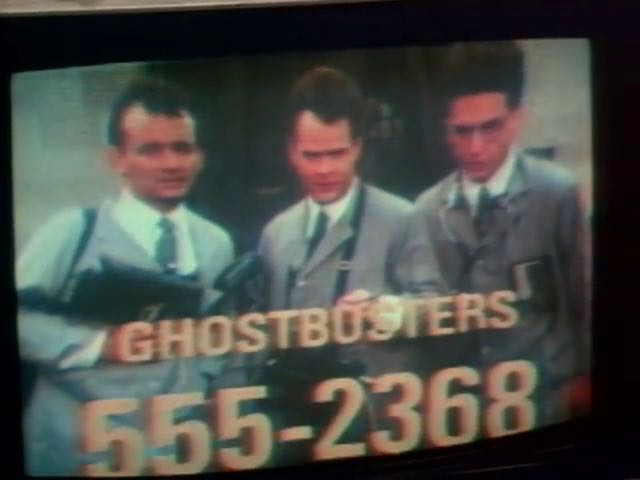
Is it 555-5555…
or 555-2368 as you showed earlier?
George Wendt apparently got in trouble with the Screen Actors Guild for his appearance in this video. I’ll link to the article with that information at the end.
Senator Al Franken.
Now we get a series of confusing cameos.
Danny DeVito. I think this is only the second music video he has ever been in. The other one was for the song Billy Ocean did for The Jewel Of The Nile (1985).
Carly Simon for some reason. She would go on to do the theme song to Working Girl (1988) with Sigourney Weaver. Maybe they were friends. I don’t know.
Umm…one more thing. Have you tried calling the Ghostbusters? No clue as to why Peter Falk is here.
The breakdancing was improvised. So was Parker Jr. pushing Bill Murray around.
I think Teri Garr has one of the best cameos.
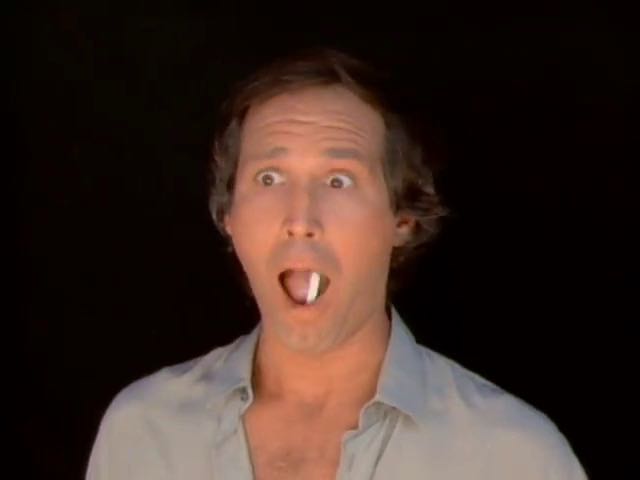
Don’t swallow that cigarette, Chevy.
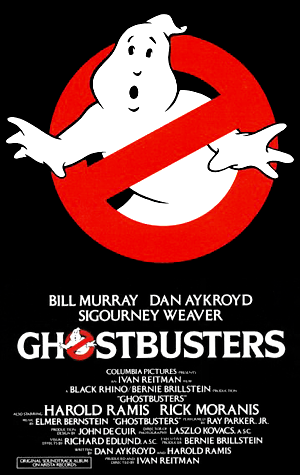
Fun fact: In European and other non-US markets, the “no” sign was flipped.
If you want to read some more information about the video, then follow this link over to ScreenCrush where they have a write-up on the video with information from people who worked on the video.
According to mvdbase, Ivan Reitman directed, Keith Williams wrote the script, Jeff Abelson produced it, Daniel Pearl shot it, and Peter Lippman was the production manager.
If you ever get a chance to watch the literal music video for this, then do so. I doubt it will surface again though seeing as this music video almost didn’t get an official release because of the issues surrounding all the cameos.
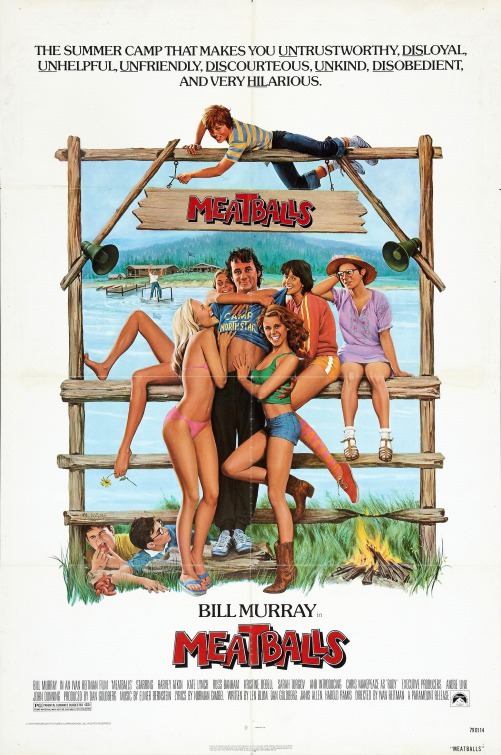
Summer is finally here, so what better way to celebrate than with a summer movie starring Bill Murray! Bill had joined the cast of SATURDAY NIGHT LIVE in 1979 (back when it was actually funny) and quickly became a fan favorite with his smarmy, snarky persona and silly characterizations. After the film success of John Belushi, it was only natural for Hollywood to come calling, right? Wrong, bucko… it was Canada that lured Bill for his first starring vehicle, the oh-so-70’s teen comedy MEATBALLS! Yeah, you heard right, ’twas the Great White North that plucked Bill away from being “Live from New York” to a location shoot at good ol’ Camp White Pines in the wilds of Ontario.
Bill’s fellow ‘Second City’ alumnus Harold Ramis (or as he was called in SCTV’s credits, ‘Ha-Harold Ramis’!) was a cowriter of the screenplay, beginning a long string of movie collaborations between the two (STRIPES, CADDYSHACK, GHOSTBUSTERS I…
I can not remember how old I was when I first saw the original Ghostbusters but I know I was young enough that “Gatekeeper” and “Keymaster” went over my head. But I do remember that Ghostbusters was one of my favorite movies from the first time I saw it and that Egon Spengler (played by the much missed Harold Ramis) was always my favorite character.
I know that, for most people, Peter Venkmen (Bill Murray) is their favorite. It is true that Peter got the best lines and Sigourney Weaver. But I always wanted to be Egon. Egon was the one who knew everything. He knew how to track down and capture ghosts. He knew that the only way to defeat Gozer was to cross streams. No matter what happened, Egon was never surprised or scared. Egon always knew what to do. Egon did not get Sigourney Weaver but he did get Annie Potts.
Dan Aykroyd’s Ray Stantz never gets as much attention as either Peter or Egon, even though, without Aykroyd, there never would have been a Ghostbusters. Aykroyd originally envisioned Ghostbusters as being a sci-fi epic that would be a vehicle for him and John Belushi. After Belushi died, Aykroyd and Harold Ramis rewrote the script and scaled back the story. Bill Murray took the role that would have been played by Belushi and the famous ghost, Slimer, was created as a tribute to their fallen friend.
As for Ernie Hudson’s Winston Zeddemore, his role was much larger in the original script. But with each rewrite, Winston’s role got smaller and Peter’s role got larger. Winston’s role is still important because he is the ghostbuster who stands in for the audience. He is not a skeptic like Peter but he’s not a true believer like Ray and Egon. Winston just wants a steady paycheck.
I remember loving the original Ghostbusters when I was a kid but a new Ghostbusters is being released today and I have read that some people think that it is going to destroy my childhood. Since the lovely Lisa Marie Bowman and I are planning on seeing the new Ghostbusters tonight, we rewatched the original on Wednesday. In case my childhood was on the verge of being destroyed, I needed to enjoy it one final time.
32 years after it was first released, the original Ghostbusters holds up well. With the exception of Slimer and the Stay Puft Marshmallow Man, the special effects are no longer special but the script is still full of laugh out loud moments, from the opening with Bill Murray testing students for ESP to Rick Moranis asking random New Yorkers if they were the Gatekeeper to “It’s true … this man has no dick” to “when someone ask you if you are a god, you say yes!” Even the song is still catchy.
As I watched the original Ghostbusters, I realized that my childhood was not in danger of being destroyed. I hope the remake is good but even if it is terrible, the original Ghostbusters will always be there and it will always be too good to be forgotten. The original Ghostbusters was both smart and funny enough to survive a bad sequel, which Lisa and I made the mistake of watching after we finished the original and about which we swore to never speak again. Ghostbusters will survive a remake. If the remake is bad, it can be placed in storage with Ghostbusters 2, The Phantom Menace, X-Men: Apocalypse, Gus Van Sant’s Psycho, Batman and Robin, and every other ill-conceived remake, reboot, and sequel of the past 50 years. If the remake is good, it will be continuing a fine legacy of comedy. If a new audience enjoys the remake as much as we enjoyed the original, who are any of us to begrudge them that pleasure?
Whether the remake is good or bad, I’m not worried.
My childhood is going to be fine and so is everyone else’s.
Or, at least, it will be until dogs and cats start to live together…















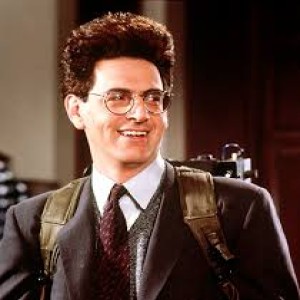 I always wanted to be Egon Spengler.
 Through the Shattered Lens