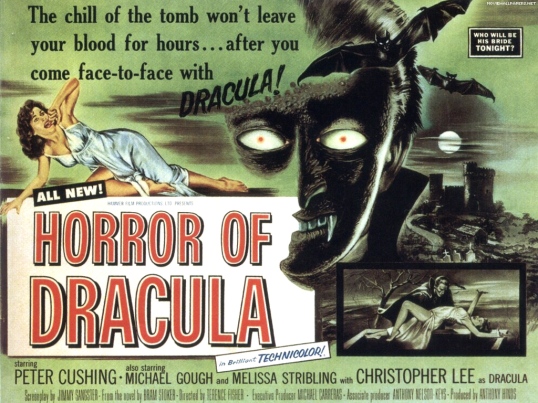
Horror Film Review: Horror of Dracula (dir by Terrence Fisher)


horrorofdracula
Of all the monsters who have appeared in horror cinema, Count Dracula is perhaps the most iconic.  Reportedly, Dracula first appeared on film in 1920, in a silent Russian film that is now considered to be lost.  In 1921, he would appear in a Hungarian film called Dracula’s Death and in 1922, he would be renamed Count Orlok for the German masterpiece Nosferatu.  Indeed, by the time Bela Lugosi gave his famous performance in Tod Browning’s Dracula, the count had been appearing in films for at least 11 years.  In nearly 100 years of filmmaking, a countless number of actors have brought Dracula to life.

We could spend hours debating who was the best Dracula and certainly, there are some worthy contenders.  Bela Lugosi brought a continental sophistication to the role, while John Carradine was properly intimidating and theatrical.  Udo Kier, Gary Oldman, Thomas Kretschmann, Leslie Neilsen, Zandor Vorkov, and Frank Langella have all played the prince of darkness, to varying degrees of success.

Yet for me, as worthy as any of those actors may be, there is only one true Dracula and he was played by Christopher Lee.

Lee famously played Dracula in seven movies for Hammer Films and, though he has often complained about the quality of these films (especially the later ones, which tended to mix Dracula with hippies), they were largely responsible for making Christopher Lee into the iconic figure that he remains today.  It’s also largely due to Lee’s performance that horror fans like me continue to discover and appreciate the films of Hammer today.

As played by Christopher Lee, Dracula was pure evil.  Lee’s Dracula had no use for self-pity and one can only imagine what his reaction would have been if he had ever run into the self-torturing vampires of Twilight.  Lee’s Dracula had no use for doubt or regret.  Instead, he was a determined animal who was driven by a singular lust for blood.

And yet, at the same time, Lee brought an intelligence to the role that was often lacking in previous performances.  Lee’s Dracula may have been an animal but he was a cunning animal.  Whereas it’s easy for me to imagine escaping from the clutches of Bela Lugosi, I know that if Lee’s Dracula wanted me then he would have me.  There’s no escape from Lee’s Dracula.  He’s too quick, determined, and intelligent.
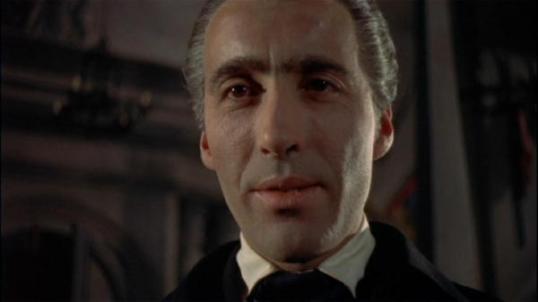
Christopher Lee Is Dracula

His animal nature made Lee’s Dracula frightening but it was his cunning and determination that made him dangerous and, ultimately, even sexy.  (While I’ve read that audiences in 1931 swooned over Bela Lugosi, whatever sex  appeal he may have had is lost on modern viewers like me.)  It has often been argued that Bram Stoker meant for Dracula to be a symbol of all the desires that were repressed by Victorian society.   That’s certainly true when it comes to Christopher Lee’s carnal and viscous portrayal of the character.

Of the seven Dracula films that Christopher Lee made for Hammer Films, the first remains the best.  Released in 1958 and known as Dracula in the UK and the Horror of Dracula in the US,  it revitalized the horror genre and helped to make stars of both Christopher Lee and Peter Cushing.  Especially when compared to some of the sequels that Hammer subsequently produced, it remains one of the best Dracula films ever made.

Horror of Dracula

The film is a very loose adaptation of Stoker’s original novel.  Jonathan Harker comes to Dracula’s castle in Romania.  Though posing as a librarian, Harker has actually come to the castle to drive a stake through the heart of both Dracula and his vampire bride.  However, no sooner has Harker staked the bride than he’s overpowered and bitten by Dracula.  Significantly, all of this occurs within the first 10 minutes of the film.  As opposed to certain other Dracula films, Horror of Dracula gets straight to the point.  And why shouldn’t it?  After all, anyone watching the film already knows that Dracula’s a vampire so why waste time trying to convince us otherwise?  We don’t watch Dracula for the familiar story as much as we watch to discover how different filmmakers will choose to tell that story.

When Harker’s colleague, Prof. Van Helsing (played with the perfect amount of intensity by Peter Cushing) shows up at the castle, he discovers that Harker is now a vampire and that Dracula is nowhere to be found.

Dracula, needless to say, is out for revenge.  He stalks Harker’s fiancee Lucy, as well as Lucy’s brother Arthur Holmwood (Michael Gough) and his wife Mina (Melissa Stribling).  Much as in Stoker’s original novel, Lucy is eventually turned into a vampire and it’s up to Van Helsing and Arthur to stop both her and her new master.

(Of course, in Stoker’s original novel, Harker is not turned into a vampire and instead marries Mina while the aristocratic Arthur is one of Lucy’s three suitors.  However, I have to say that I always thought the literary Harker was a bit on the dull side and that Arthur was always my favorite character so I’m happy that he gets to be the hero here.)

If I had to pick one film to epitomize everything that I love about the Hammer brand of horror, it would be Horror of Dracula.  As directed by Terrence Fisher, the film moves at an exciting, non-stop pace while the traditionally lush cinematography is almost bombastically colorful.  Cushing and Lee, who were the best of friends off screen, make for formidable opponents, with Cushing embodying good just as effective as Lee embodied evil.  Though it’s been over 50 years since Horror of Dracula was originally released, the film remains effective and, not coincidentally, a lot of fun.
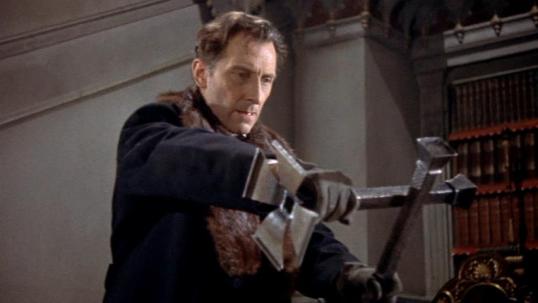
Peter Cushing as Dr. Van Helsing

Quite simply put, this is a film that, for so many reasons, remains a true pleasure to watch.

One final note — I often find myself lamenting that I was born several decades too late and I realize just how true that is whenever I watch a film like Horror of Dracula.  Seriously, I would have loved to have been a Hammer girl, showing off my cleavage and getting hypnotized by Christopher Lee.

Seriously, what more could you want?

6 Trailers From The Girl Who Has Returned Home


Now that I’m back home from my vacation, it’s time for me to post yet another installment in my raison d’être, Lisa Marie’s Favorite Grindhouse and Exploitation Film Trailers!  In keeping with this month’s theme, all of today’s trailers are horror-related.

Enjoy!

1) Virus (1980)

Let’s start things out with the end of the world.  From 1980, it’s the story of what happens when the world gets hit by the “Italian flu.”

2) The Evil of Frankenstein (1964)

It’s just not October without some Hammer horror.

3) Horror of Dracula (1958)

And wherever you have Frankenstein, you have to have Dracula…

4) The Mummy’s Shroud (1967)

As long as we’re taking a look at Hammer horror icons, let’s not forget the Mummy.

5) Baron Blood (1972)

This film is from the great Italian filmmaker, Mario Bava.

6) Invasion of the Blood Farmers (1972)

“They plant the dead and harvest the living!”

A Quickie With Lisa Marie: One Million Years B.C. (directed by Don Chaffey)


So, last night, I was talking Oscar fashion over on twitter and, at one point, I somehow ended up promising that if I was ever nominated for an Oscar, I would wear an outfit based the fur bikini that Raquel Welch wore in the 1966 film One Million Years B.C.  Well, everyone seemed to think that this was a pretty good idea on my part but it made me realize that I’ve never actually seen this movie.  As I was already planning on going to Fry’s to buy the Criterion edition of Fish Tank, I decided to buy One Million Years B.C. as well.  When I returned home, I kinda watched it.

I say “kinda” because One Million Years B.C. is probably one of the most draggy movies ever made and my mind wandered considerably whenever there wasn’t a dinosaur on-screen.  The movie opens with a really pompous sounding narrator who explains 1) that One Million Years B.C. was a long time ago and 2) not much else.  I mean, honestly, Mr. Narrator, I could have figured out we were dealing with prehistory just from the fact that there’s a bunch of dinosaurs wandering around.  Anyway, the movie itself is about a caveman (played by a nicely rugged actor named John Richardson) who is exiled from his own savage tribe but who eventually ends up with Raquel Welch’s tribe.  But then his new tribe gets sick of him and decides to exile him as well.  This time, Welch goes off with him and they eventually join Richardson’s old tribe which then goes to war with Welch’s old tribe and then finally, a volcano explodes.  Oh, and there’s a lot of dinosaurs wandering around as well.  On rare occasions, they attack the cave people but, for the most part, they just put out the same aloof vibe as my cat does right after he eats.

Most of the film’s dinosaurs were created through stop motion animation and they’re fun to watch.  However, for me, what truly made the film was a giant turtle that pops up about 30 minutes in.  It’s trying to make its way back to the ocean and, for its trouble, a bunch of little cave people insist on throwing spears at it.  But the turtle just kinda looks back at them and shrugs.  What a cool turtle!

There’s a certain type of viewer — and we all know the type — who will complain that One Million Years B.C. commits the sin of 1) having dinosaurs existing at the same time of cavemen and 2) having all the different dinosaurs living together at the exact same time.  And to those people, I think it’s high time that everyone just finally says, “Shut the fuck up.”  I mean, seriously, instead of nitpicking every little cinematic detail, why don’t you concentrate on losing some weight before you drop dead of a heart attack? 

Just a suggestion.

Oddly enough, this film has a weird connection to the James Bond film series in that, on the basis of their work here, both John Richardson (who also starred in Mario Bava’s classic Black Sunday) and Raquel Welch came close to being cast in On Her Majesty’s Secret Service.  However, the roles ended up going to George Lazenby and Diana Rigg instead.  (Welch was also nearly cast as a Bond girl in Diamonds are Forever.)   Though neither Welch nor Richardson ever became a part of the 007 franchise, Robert Brown (who plays Richardson’s father here) later played the role of M in a handful of Bond films.

6 More Trailers Exploit The 70s


Now that Thanksgiving has come and gone, it’s time for another installment of Lisa Marie’s Favorite Exploitation and Grindhouse Trailers.  Today, all 6 of our trailers come from the 70s.  That’s actually kind of a coincidence but it’s as close to a theme as I could find so let’s go with it.

1) Superchick

Let’s start things off on a positive, empowering note with the trailer for Superchick.  This appears to be an only-in-the-70s type film.  For one thing, the narrator says “stewardess” instead of “flight attendant.”  What a pig.  (Just kidding…I think stewardess has kind of a nice retro sound to it, to be honest…)

2) Satan’s Cheerleaders

“Are you kidding?  I’m no maiden.  I’ve been a cheerleader for three years…”  Would I find this trailer as amusing if my older sister hadn’t been a cheerleader at the same time that I was going through my whole goth ballerina phase?  Probably.  I haven’t seen the actual film but, for whatever reason, I suspect it doesn’t quite live up to the trailer.

3) Countess Dracula

Ingrid Pitt, who died on the 23rd on the month, helped to bring Hammer films fully into the 20th Century with this film and the Vampire Lovers.  Here she plays the infamous Elisabeth Bathory.

4) Don’t Answer The Phone

This is not a trailer to watch if you’re in a paranoid state-of-mind.  This is a pretty bad movie but it does feature one of the best “psycho” performances of all time from the late character actor, Nicholas Worth. 

5) The House That Vanished

I have mixed feelings about including this one because it’s a TV spot as opposed to an actual theatrical trailer.  But I’m including it anyway because it is the epitome of everything I love about 70s exploitation.  The film is actually an English film that was entitled Scream and Die! which, in all honesty, sounds like a pretty good title to me.   However, by the time it was released in the States, Wes Craven’s Last House On The Left was making a lot of money and every horror film was retitled with a House-themed title.  Also, the “it’s only a movie…” chant is lifted directly from the advertising campaign for Last House On The Left.

6) Ruby

Finally, let’s end with Ruby.  This is yet another one where I haven’t seen the actual movie but from the trailer, it appears to be a proud part of the grindhouse tradition in that it not only rips off Carrie but The Exorcist as well.

BONUS TRAILER:

Yes, I’m including a bonus trailer!  Why?  Because I love you, that’s why.

This is for Michael Almereyda’s haunting and odd vampire film, NadjaNadja was released in 1994 but it features Peter Fonda so it might as well be from the 70s.

And, since I have to end everything on an even number (it’s a long story), here’s another bonus trailer just so we end up with 8 trailers instead of 7.  This is another unconventional, New York vampire tale — Vampire’s Kiss.  This is also known as the movie where Nicolas Cage actually ate a live cockroach while being filmed.  (Personally, I think of it as being the precursor to Mary Harron’s American Psycho.)

Review: Let Me In (dir. by Matt Reeves)


In 2008 a little film from Sweden swept through the film festivals and earned a rightful and well-deserved place in many film critics and film circles “best of 2008” and “top ten” lists. This was Swedish filmmaker’s film adaptation of the John Ajvide Lindqvist vampire novel, Let The Right One In. It was a vampire film that appealed not just to horror genre fans hungry for a vampire film that was the polar opposite of the current “Twilight” vampire craze. Horror fans wanted something that wasn’t watered down and emasculated to better appeal to the tween girl set. So, Alfredson’s vampire film was embraced by these horror fans and when news came that the rights to the novel was licensed by British-studio Hammer Film and an American-remake was set for production the reaction was decisively negative.

Fans of the original Swedish film were quite protective of the film and saw any plans to remake it for the North American audience as a cynical cash-grab. Their argument was that the original film was such a great one that there should be no need to remake it. Why fix something that wasn’t broken was another point made. It didn’t help the side of those supporting the remake that Matt Reeves was chosen to direct the remake. Reeves was better known as J. J. Abrams friend (some would say Reeves owes his success to Abrams and that he was coattailing the successful producer-director) and the director of the POV monster film, Cloverfield.

As strident fans of the original continued to vent and complain about the remake already failing (despite not an inch of film being shot) the producers were gradually filling the roles in the remake with some very interesting names. Fresh off her break-out performance in Kick-Ass was Chloe Grace Moretz taking on the role of Abby (the vampire child in the original was named Eli) with Kodi-Smit McPhee (The Road) taking on the role of the young boy Owen who befriends her. One name after the other filled out the cast with some very good veteran actors from Elias Koteas to Richard Jenkins (taking on the role of Abby’s Renfield).

Matt Reeeves’ version of Lindqvist novel from Alfredson comes from using the novel itself as the base for the screenplay Reeves himself wrote for the remake. While Let Me In shares many similarities in characters and situations from the original Swedish film, Reeves film does use more of the themes and details from the novel than Alfredson did for his adaptation. Let Me In definitely has enough about it which will distinguish itself from its Swedish counterpart and stand on its own.

The film switches locales from a suburb of in Sweden to a snowy Los Alamos, New Mexico (yes, it does snow in New Mexico). We learn quickly that Owen has become quite the loner due to the constant bullying by classmates. He spends time alone in the plaza area of the apartment complex he lives in with his mother (played by Carla Buono who we never fully see). He fantasizes of getting back at those who have and still bullying him even to the point that he buys a small pocketknife and practices his retribution on one of the trees in the plaza. It’s during one of his nighttime practices with the pocketknife that he first encounters Abby. There’s a certain wariness during their encounter with Abby proclaiming that Owen will not become a friend. But in time the two do become friends with Abby becoming quite protective of Owen once learning about the bullying he has to endure on a daily basis.

The change in Abby’s relationship with Owen doesn’t sit well with Abby’s Renfield. He asks Abby never to see Owen again as he goes out to procure Abby more fresh blood (a previous attempt goes awry forcing Abby to go out into the night to hunt). It’s in the scenes between Abby and Jenkins character that we see more of the duo’s relationship mirroring the novel’s. The novel explores the theme of pedophilia and while Reeves adaptation wasn’t quite obvious about it there are clues and small character interactions which hint at this pedophilic relationship which the Swedish original never really touched upon.

It’s in these small character interactions that Reeves’ film begins to differentiate itself from Alfredson’s version. The narrative between the two films still remain the same, but Reeves’ version explores the darker themes in the novel source while Alfredson concentrates more on the growing relationship between the two primary characters. These differences could be seen in how Reeves films Abby’s attacks while hunting her prey to be more animalistic (though at times the CGI seems too apparent when Abby attacks) and Abby’s subtle manipulation of Owen. I say manipulation because Abby seems very intent on trying to befriend and put Owen at ease despite the earlier comment that they will never be friends. Not to mention her Renfield admitting to Abby that he has gotten tired of what he has done to keep Abby safe and that maybe he wants to get caught to just end it all.

The film moves along quite leisurely but with a sense of growing dread not just between Owen and his bullies, but between Abby, her Renfield and those suspecting the duo. Owen gets caught in the lives of these two newcomers and soon gets confronted by Abby’s true nature and his own reaction to this. It’s a reaction that at first shows Owen fearing Abby and wanting to escape the growing bond between the two of them, but seeing how Abby’s been nothing but helpful to Owen he chooses to remain at her side. Abby rewards Owen’s protective nature by saving Owen from a near-deadly encounter with the school bullies at the school swimming pool.

This is the one sequence in Reeves’ film which many fans scrutinized to no end. The original film shot the scene with an almost arthouse eye despite the obvious violence involved. It was a scene where Alfredson filmed it as “less is more” and let the audience’s imagination run wild. Reeves’ does the same but adds his own stylistic touches to the sequence. not too much to make it so different from Alfredson’s version, but enough that it’s not a shot-for-shot copy. Again Reeves’ chose to show Abby’s violent predator aspect in this scene, but still keeps the focus of the scene on Owen as he struggles underwater. It’s only once he is out that we see — just as he does — the aftermath of Abby’s promise to protect Owen.

The question remains whether this American-remake stands up to the original. In terms of storytelling it more than holds it own from the original film and at times actually surpasses Alfredson’s version. This Reeves version journeys through the darkside more than the original film. It definitely strips away much of the arthouse sensibilities of Alfredson’s film which made it such a beauty to watch even if at times the narrative became more than too slow to keep one’s attention. Reeves’ adaptation doesn’t ramp up the pacing of the film, but keeps it moving forward even if at a gradual pace. When violence does occur in the remake it happens quickly and with a sense of brutality that the original film fails to deliver. The remake doesn’t linger on the gore and violence, but does show enough of it to remind everyone in the audience that this is a horror film first and foremost.

If there was one quibble to be made about this remake its that Reeves relies too much on CGI to show Abby at her most dangerous. Each attack made by Abby was shot at a wide-angle and we see every move but with each move done using CGI which gives it too much of an artificial look to it. It’s a testament to Moretz’ performance as she switches from a friendly Abby when interacting with Owen during their time together at night to one of a predator older than anyone in the film doing what was necessary to attain the blood needed to survive. Reeves could definitely have used less CGI and went for a more natural approach using sudden edits to show the ferocious nature of Abby’s attacks.

The film’s cast does a great job with the roles given to them. While it was Moretz’s and McPhee’s performances as Abby and Owen that keeps the audience’s attention and keeps it from wavering it’s the supporting cast around them which provides the glue. Koteas as the detective who begins to suspect Abby as having to do more with the attacks than previously mentioned was very good, but in the end it was Richard Jenkins in the Renfield role who would steal every scene he’s in. His character’s fatalistic acceptance of his role when it came to Abby was palpable. We watch him do horrible things to people and to himself, but we also get a sense that he couldn’t stop on his own if he wanted to. He has been doing the role of blood procurer for Abby for so long that he doesn’t know what else to do. I will say that Jenkin’s with the garbage bag mask when out hunting for victims will be the images that will stick to people’s minds long after they’ve left the theater. Some will even unconsciously check the back seat of their cars at night before getting in.

In the end, this remake of Let The Right One In doesn’t feel, look and sound like the cash-grab that cynical fans of the original have proclaimed it to be. Matt Reeves does a great job in adapting more of the novel in his version and using some of the darker themes in that source to allow his film to stand on its own when compared next to Alfredson’s version. The performances by everyone involved was wonderful and keeps the story’s slow pacing from losing the audience. While this remake doesn’t have the arthouse quality of the original film it does have a certain grittiness to its look which lends quite well in pointing out how brutal the narrative really was not just in physical violence but in how one of the two leads manipulates the situation to benefit it’s survival even if there was some genuine affection between Abby and Owen. In the end, Abby gets everything and continues to exist for another boy’s lifetime.

Fans so vocal of their negative attitudes towards this film will not have their minds changed, but those keeping an open-mind will be rewarded with one of the better horror films of the year. If the original Swedish adaptation never existed I’m quite sure that all the accolades heaped on Tomas Alfredson’s film would be given to Matt Reeves instead. A remake should never be discounted because its one of an original that’s already lauded for its quality. There’s been bad remakes but thankfully Let Me In is not one of them.

Review: Masters of Horror – Haeckel’s Tale (dir. by John McNaughton)


Masters of Horror has been good but very uneven in its execution during it’s two season run on Showtime. Haeckel’s Tale is the last episode for Season One (Takashi Miike’s episode never got an official airing) and it sure ends the season on a disturbingly kinky compilation of twisted grotesqueries. The story is from a Clive Barker short story that’s been adapted by Mick Garris (fellow Masters of Horror director and also its brainchild) and produced by George A. Romero to be directed by John McNaughton.

One wonders why Romero would be producing instead of directing the piece. Scheduling conflicts prohibited Romero from taking the director’s chair and he instead recommended John McNaughton (his one film which earned him Master of Horror status is one of the best horror films of the last quarter century: Henry – Portrait of a Serial Killer). The fact that Romero was originally chosen to direct Barker’s Garris adapted short story means there’s got to be zombies or some form of undead within. I, for one, was glad that Romero decided that he wouldn’t be able to direct and chose another in his stead. Barker’s short story does indeed include zombies but it also has a heavy sense of the old classic technicolor Hammer Films vibe to it. Haeckel’s Tale under the capable hands of McNaughton takes those Hammer Films conventions and ramps it up into overdrive.

Even though John McNaughton really has only one true horror film under his belt (he also directed a little-known cult scifi-horror called The Borrowers which had fledgling effects shop KNB EFX still doing things guerilla-style), but his work in Henry: Portrait of a Serial Killer more than earned him his horror creds. In Haeckel’s Tale, John McNaughton clearly has a bit of fun making the only true period piece in the whole Masters of Horror series. McNaughton goes for the classic Hammer Films look for this episode and it shows in the gothic, fog-shrouded atmosphere in the outdoor scenes. The look of the costumes and even the dialogue harkens back to those Christopher Lee and Peter Cushing Hammer Films.

The story is a mixture of the Frankenstein tale with a some Cemetary Man (aka Dellamorte Dellamore) mixed in. Haeckel’s Tale begins somewhere around the 1800’s and I’m assuming close to the end of it from the costume worn by Steve Bacic who played Mr. Ralston who arrives to seek the help of Miz Carnation who is purported to be a necromancer who can grant him his wish to have his dead wife brought back to life for him. Miz Carnation rebuffs Ralston, but after some begging she makes a deal with him to hear Haeckel’s Tale. If he still wants his wife brought back to life after hearing it then she would do so.

Ernst Haeckel (played by Derek Cecil)is a young medical professor whose obsession to conquer death mirrors that of a certain eccentric European scientist he so admires. Unlike his idol, Haeckel’s attempt to use electricity to put the spark of life back into a corpse fails dramatically. He’s soon investigating the rumor of a certain traveling necromancer who goes by the name of Montesquino (played by Joe Polito) who he thinks to be a fraud, but he soon finds out that Montesquino is all he says he is when Haeckel stumbles upon Wolfram (played by Stargate SG-1‘s own Maybourne, Tom McBeath) and his stunning young wife Elise (the drop-dead gorgeous Leela Savasta).

Haeckel quickly lusts after the young Elise, but as Wolfram will later tell him as the story nears it’s climax (in more ways than one), Elise cannot be satisfied by him or Haeckel. Her obsession with a dead husband she loves and cannot let go brings Haeckel to a scene that he cannot comprehend nor accept as something she truly wants. I must say that Leela Savasta’s performance as the dead-obsessed Elise is only surpassed by Anna Falchi’s own work as “She” in Dellamorte Dellamore. Leela’s pretty much spending most of her screentime fully naked and writhing around in an orgy not typical of most horror movies. It’s also in this orgy scene where we get the biggest Clive Barker feel to the story. Anyone how has read Barker earlier work knows the man can mix horror and sex like no other.

The ending of the episode brings to it a slight twist with Miz Carnation being more than she says she is. This Masters of Horror episode is not the best of the lot, but it is one of the better looking ones in terms of cinematography and it’s leads. It also doesn’t have much in terms of genuine scares. The story gradually builds up the dreads and disturbing images but never anything that will put a genuine heart-stopping scare on the viewer. Like McNaughton’s own foray into horror with Henry, Haeckel’s Tale lets the story’s own disturbing themes on obsession and the darker side of love put the horror in the story. It does have a nice gore-laden sequence courtesy of Howard Berger and Greg Nicotero and their KNB FX team.

In the end, Haeckel’s Tale is a very good episode which has its flaws like the rest of the Masters of Horror episodes. What sets it apart from the rest of the series entries is its unique Hammer Films look and the return of McNaughton back in the director’s chair as a horror filmmaker. It’s no Henry: Portrait of a Serial Killer, but Haeckel’s Tale will have enough disturbing images to burn itself to its audiences’ minds.