Doctor Who — The War Games (1969, directed by David Maloney)


The War Games is an episode of firsts and lasts.

It featured the last regular appearance by Patrick Troughton as the Second Doctor.  (Troughton would return for three guest appearances.)  Having played the role for three years, Troughton feared getting typecast and felt it was time to leave.  It was also the last episode to feature Frazer Hines (as Jamie) and Wendy Padbury (as Zoe) as companions.  (Hines holds the record for appearing in the most episodes as a companion.)  Finally, this episode was the last to be broadcast in black-and-white.

The War Games also featured a very important first.  This episode featured the first appearance of the Time Lords and the first trip to their home planet.  This was the first episode that showed the society that the Doctor fled when he stole his TARDIS and went to Earth.

At ten episodes, The War Games was either the second or third-longest serial in Doctor Who history, depending on whether or not you count The Trial of the Time Lord as just one long (and regrettable) serial.  The serial opens with the Doctor and his companions apparently landing in No Man’s Land during World War I.  As things progress, the Doctor notices anachronistic technology and Jamie is shocked when a redcoat shows up in a World War I prison.  The Doctor discovers that an alien known as The War Lord (Philip Madoc) has determined that humanity is the most bloodthirsty race in the universe and that he has abducted soldiers from Earth’s bloodiest wars.  They are fighting war games on The War Lord’s planet and the survivors will become the members of the War Lord’s army.  Helping the War Lord is the War Chief (Edward Brayshaw), a renegade Time Lord.

(Just as with The Time Meddler‘s Monk, there’s a fan theory that the War Chief was an early incarnation of The Master.  I don’t believe it, myself.  The Master was far more cunning than The War Chief.)

Despite running for four hours, The War Games is a rare Doctor Who serial that doesn’t have any slow spots and the scenes where the characters cross from war zone to war zone are creatively realized.  The serial starts out as if it’s going to be yet another dry historical episode and then it gradually reveals that all is not as it seems.  I especially liked the performance as Jane Sherwin as Lady Julia, an ambulance driver in the World War I zone.  (Jane Sherwin was also the wife of Doctor Who’s then-produccer Derek Sherwin.)

What really makes The War Games stand out is the final episode.

Having brought an end to the War Games, the Doctor is faced with the impossible prospect of returning the soldiers to their proper times.  He is forced to call upon The Time Lords for help.  Bernard Horsfall, Trevor Martin, and Clyde Pollitt appear as the Time Lords, who dematerialize the War Lord and send the soldiers back home with no memory of what happened.  Unfortunately, The Time Lords are not just going to let the Doctor off the hook for violating their police of non-interference.

First, Jamie and Zoe are sent back to their original times, both with no memory of their life on board the TARDIS.  The Doctor is then put on trial for having stolen his TARDIS and interfering in time and space.  The Doctor argues that he has been fighting evil.  The Time Lords accept his argument and then say that his punishment is to be sent to 20th Century Earth.  He’ll keep his TARDIS but he won’t be able to use it.  And, because the Doctor is well-known on Earth, he’ll have to regenerate.  He’s given five faces and told to pick one.  The Doctor refuses them all.  The Time Lords pick one.  “That’s the worst one!” the Doctor says before he finds himself spinning through space and time.

It’s a poignant ending to the Second Doctor’s adventures.  The Time Lords do not come across as being as bad as the Doctor often made them out to be but it is easy to see why an adventurer like the Doctor would feel constrained by their society.  That the Second Doctor called them for help despite knowing what the consequences would be not only shows how dangerous The War Lord’s plan was but also how the Doctor would always do the right thing even when it was dangerous for him to do so.  The Time Lords could have just as easily dematerialized The Doctor as punishment for stealing his TARDIS.  Jamie and Zoe are spared punishment but they lose their memories of the amazing adventures they shared.  And the Doctor changes once again.

For viewers like me, who got to know Doctor Who from the episodes that were broadcast late at night on PBS, The War Games is a bridge between “old” Doctor Who and the classic era of Jon Pertwee and Tom Baker.  In America, we didn’t get to see much of Patrick Troughton’s Doctor but what we got established him as one of the best to ever play the role.


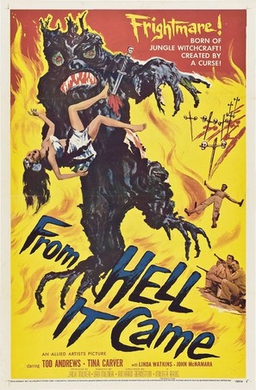
Horror Film Review: From Hell It Came (dir by Dan Milner)


“And to Hell it can go!” — The Critics

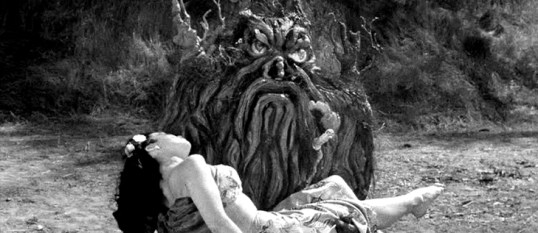
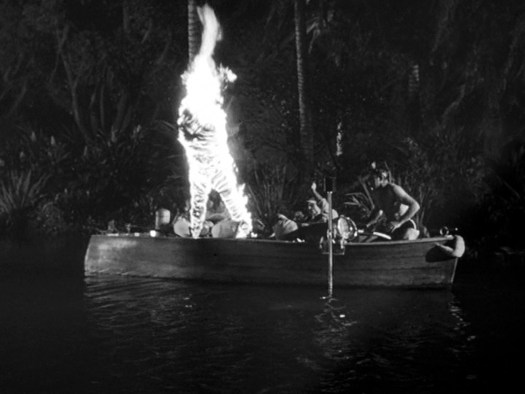
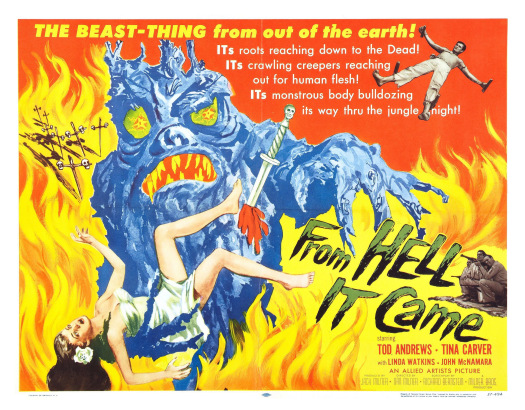
Sometimes, you’ll come across something that simply defies easy description.  It’s something that actually has to be seen to be believed.  I could describe to you the monster at the center of 1957’s From Hell It Came but I don’t know that, even with my extensive vocabulary, I really have the capability to capture just how absurd and weird this thing is.

In this case, a picture says more than a thousand words ever could:

The monster in From Hell it Came is a walking tree that has a rather angry (not to mention immobile) face.  After Prince Kimo is framed for the murder of his father, the chief of a tribe that lives on a South Sea island, he is sentenced to execution.  He announces that he will seek revenge on everyone who framed him.  He’s then stabbed in the heart and encased in the trunk of a hollow tree.  (Apparently, the knife is left in his heart which seems kind of unnecessary but who am I to argue?)  Later, Kimo comes back as a walking tree who tosses his enemies into quicksand.  The knife is still sticking out of the tree, which would suggest that Kimo was physically transformed.  However, the native insist that Kimo has actually become one of their legendary monsters, the fearsome Tabanga.

Along with the natives, there is also a group of American doctors on the island.  They’ve been sent to conduct research and to also give the natives medicine to help them deal with an outbreak of the plague.  The natives don’t trust the medicine.  They trust the magic of their medicine men.  Since this film came out in 1957, the doctors react to this by rolling their eyes and talking down to everyone.  If there’s one thing that has remained consistent over the decades, it’s that the worst way to get people to do anything is to talk down to them.

The doctors are the first to discover the tree stump that will eventually become the Tobanga.  They take the stump back to their laboratory, where they discover that the stump is radioactive due to some nearby atomic tests.  The next day, the stump comes to life and leaves the laboratory.  One of the most interesting things about this film is that the scientists are skeptical about the natives claim that the tree stump is one of their legendary monsters come to life but they are willing to accept that radiation created a walking stump.  Radiation bringing a tree stump to walking life actually makes even less sense than magic doing it.

While the tree is killing its enemies, the American doctors deal with their own drama.  For instance, Dr. Terry Mason (Tina Carver), is a woman and that greatly disturbs her male colleagues, all of whom  can’t understand why she’s not currently married and raising a family.  Meanwhile, Mrs. Mae Kilgore (Linda Watkins, an American actress who played the role with an amazingly bad British accent) owns the local trading post and is not happy about having a killer tree wandering around the island.  Mrs. Kilgore is prone to saying things like, “I saw the bloomin’ thing!”

In the end, the Americans finally figure out how to deal with the murderous tree.  “Your American magic is better,” the current chief of the natives says.  “Hell yeah!” I shout in response, “AMERICA!”  From Hell It Came is a thoroughly ludicrous movie but, once you watch it, you’ll never forget that tree.


Late Night Retro Television Review: CHiPs 1.18 “Cry Wolf”


Welcome to Late Night Retro Television Reviews, a feature where we review some of our favorite and least favorite shows of the past!  On Mondays, I will be reviewing CHiPs, which ran on NBC from 1977 to 1983.  The entire show is currently streaming on Freevee!

This week, someone is calling in false emergencies and neither Baker nor Ponch are going to let him get away with it!

Episode 1.18 “Cry Wolf”

(Dir by John Florea, originally aired on February 16th, 1978)

A creepy weirdo named Walt (Brad David) is angry at the world.  He hasn’t been able to get a job since he got out of prison and his sister is always giving him a hard time.  Walt deals with his anger by driving up to police call boxes and phoning in reports of imaginary accidents.  For every call, the fire department and the highway patrol waste precious recourses responding.  Getraer wants the caller caught and he’s placed Jon in charge of the task force to take him down.

This is one of those episodes where the emphasis is on how all the various departments work together to keep people safe.  Whenever Walt places a call, we’re presented with a montage of cops and firemen racing to be the first one to arrive at the “accident.”  Though the show makes clear that Walt is not thinking straight and that he’s not in a good place mentally, the emphasis is still on how many resources are wasted on his calls.

It gets so bad that Jon and Ponch start to assume that every call is a prank.  When someone calls in to say that a helicopter has crashed on the highway, Jon is shocked to discover that a helicopter actually has crashed.  He and Ponch rush the plane’s cargo — rare blood for an operation — to a local hospital and are scolded for showing up late.  That’s the danger of crying wolf.  When Walt is finally caught by Baker and Ponch, he attempts to jump off a bridge.  Baker and Ponch stop him, of course.  As they pull him back to safety, Baker says that Walt is lucky they weren’t busy answering a false call.

This was a good episode for Baker, as he also got a subplot in which a minor motorcycle crash led to him meeting and dating an X-ray technician named Karen Rayburn (Kathryn Holcomb).  Baker and Karen were a cute couple and there was something undeniably charming about how nervous Baker got whenever he had to flirt.  Larry Wilcox was not the most expressive actor but his stiff demeanor was put to good use in this episode.

This was not a bad episode.  Since the majority of the episode focused on one storyline, this episode felt more cohesive than some of the ones that came before it.  As usual, the main highlight was watching Baker and Ponch weave their way in and out of traffic.  The scenery was lovely and there was even an exploding helicopter!  You can’t go wrong with that.

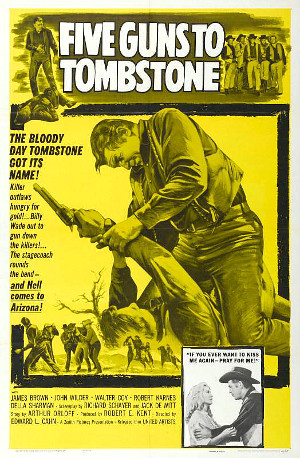
Five Guns To Tombstone (1960, directed by Edward L. Cahn)


Outlaw Matt Wade (Robert Karnes) escapes from prison and rejoins his old gang.  They ride out to Tombstone, Arizona, stopping off at the ranch of Matt’s brother, Billy Wade (James Brown).  Billy used to be an outlaw but eventually he hung up his guns, settled down, got married, and now he’s raising Matt’s teenage son, Ted (John Wilder).  Ted, who thinks that his father has just been paroled, is excited to see Matt but Billy doesn’t want Ted being led into a life of crime.  When Matt and the gang rob a bank, they frame Billy for the crime.  With the townspeople looking to lynch him and Ted drifting towards the wrong path in life, Billy has no choice but to pretend to be a part of the gang until he can dig up the evidence to clear his name.

If this sounds familiar, thank you for reading yesterday’s review of Gun Belt.  Released seven years after Gun Belt, Five Guns To Tombstone tells the exact same story as Gun Belt and, in many case, it features the exact same dialogue.  The only difference is that some of the names have been slightly changed.  The gang leader in Gun Belt was named Ike Clinton.  In this Five Guns To Tombstone, his name is Ike Garvey.  Billy Ringo becomes Billy Wade and Wyatt Earp because Marshal Sam Jennings.  Otherwise, it’s pretty much the exact same film.

Which one is the better film, Gun Belt or Five Guns To Tombstone?  Both films have plenty of two-fisted, gun-slinging action and a good cast of western character actors but I’d probably have to give the edge to Five Guns To Tombstone because John Wilder is more convincing in the role of the outlaw’s son than Tab Hunter was in Gun Belt.  Tab Hunter was young and callow and annoying but John Wilder is the type of confused kid that anyone could relate to.

Five Guns To Tombstone was one of the 9 films that Edward L. Cahn directed in 1960.  As with most of Cahn’s films, the action seems rushed but that’s appropriate for the story that Five Guns To Tombstone is telling.  (It’s also understandable.  When you’re directing 9 films a year, you don’t have the luxury of taking your time.)  Like Gun Belt, this is hardly a classic but western fans should enjoy it.

30 Days of Noir #3: Footsteps in the Night (dir by Jean Yarbough)


The 1957 film Footsteps in the Night opens in a small motel apartment in Los Angeles.

Jazz blares from a record player.  Playing cards are spread across a table.  A cigarette burns in an ashtray while a stack of poker chips sits undisturbed nearby.  When the apartment’s resident, Henry Johnson (Douglas Dick) steps into the room, he nearly stumbles over the dead body that’s lying in the middle of the floor.

Henry looks down at the body.  Is he shocked?  Is he scared?  Is he regretful?  Is he guilty?  It’s impossible to tell from his somewhat perturbed but mostly blank facial expression.  He takes in the scene and then promptly turns out the lights.

The dead man is Henry’s neighbor, Fred Horner (Robert Shaye).  When the police arrive, Detectives Andy Doyle (Bill Elliott) and Mike Duncan (Don Haggerty) immediately deduce that someone murdered Fred in the middle of a poker game.  Since everyone says that Henry was not only a degenerate gambler but that he also frequently got into arguments with Fred, Henry becomes the number one suspect.  Not helping Henry’s case is the fact that he’s disappeared and his girlfriend, Mary Raiken (Eleanore Train), won’t reveal where he’s hiding.

It seems like an open-and-shut case but Doyle has his doubts.  The case against Henry is almost too perfect and Doyle wonders if maybe they’re overlooking something.  As Doyle and Duncan continue to investigate, they discover that Fred Horner was an angry and misanthropic man.  They also discover that there’s a salesman named Bradbury (James Flavin) who is staying at an adjacent hotel and who bears a strong resemblance to the dead man….

Clocking in at just 62 minutes, Footsteps in the Night is a fast-paced police procedural with elements of film noir tossed in for good measure.  While I was doing some research for this review, I discovered that Footsteps in the Night was actually the fifth and final film in which Bill Elliott played Detective Andy Doyle.  Before taking on the role of Doyle, Elliott appeared in several westerns and he plays Doyle much like an ideal frontier sheriff.  He’s a no-nonsense lawman who solves cases with common sense and doesn’t have much time for wild speculation.  Dan Haggerty backs him up as the equally no-nonsense Mike Duncan.  As opposed to the modern tendency to celebrate cops who “break the rules,” Footsteps in the Night emphasizes the professional, by-the-book attitude of Doyle and Duncan.  If you were ever murdered, Duncan and Doyle are the type of cops that you would want assigned to the case.

As for their number one suspect, Henry may claim to have just been an innocent bystander but his gambling addiction makes him less than trustworthy in the eyes of many cops.  It’s only when Doyle and Duncan start to dig into the case that they discover just how cruelly Fred manipulated Henry’s addiction.  In the best tradition of many murder mysteries, Footsteps in the Night not only leaves you wondering who the murderer may have been but also whether or not the victim may have gotten what he deserved.

Footsteps in the Night is a good police procedural.  I look forward to watching and reviewing the other four films in which Bill Elliott played Detective Doyle as well.

http://www.youtube.com/watch?v=sTwVORuKuJ0

Halloween Havoc!: THE CREATURE WALKS AMONG US (Universal-International 1956)


gary loggins's avatarcracked rear viewer

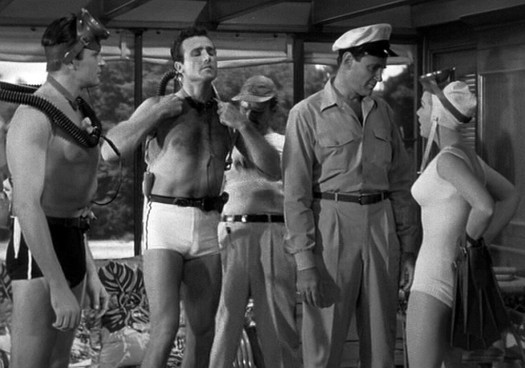
THE CREATURE WALKS AMONG US – and he’s not too happy about it! Can’t say that I blame him, as once again he’s used and abused by humans, kidnapped from his watery home, suffers third degree burns, and transformed into a landlubber! This third and final entry in The Gill-Man saga unfortunately isn’t as good as its two predecessors, with too much melodramatic nonsense spoiling what was an intriguing premise.

Dr. Bill Barton (Jeff Morrow ) leads a search in the Florida Everglades for the Creature, who escaped Ocean Harbor Oceanarium in the last film. Along with Barton are geneticist Dr. Tom Morgan (Rex Reason), Dr. Borg (Maurice Manson), Dr. Johnson (James Rawley), and macho guide Jed Grant (Gregg Palmer ). Also on board is Barton’s wife Marcia (Leigh Snowden), a beautiful blonde trapped in a loveless marriage with her insanely jealous, controlling prick of a husband.

The Creature…

View original post 460 more words

Horror on TV: Kolchak: The Night Stalker 1.18 “The Knightly Murders” (dir by Vincent McEveety)


Tonight on Kolchak….

The armor of a 12-century knight is possessed and determined to keep anyone from harming the museum in which it is currently housed.  This includes anyone who might want to build a nightclub nearby.  With the armor trying to prevent Chicago from enjoying disco, it’s up to Carl Kolchak to report the story and solve the case!

I like this episode because it features a holy ax.

This episode originally aired on March 7th, 1975.

Enjoy!

http://www.youtube.com/watch?v=f0SUWOkBeJY

Halloween Havoc!: FROM HELL IT CAME (Allied Artists 1957)


gary loggins's avatarcracked rear viewer

I’ve seen a lot of movie monsters in my time. Vampires and werewolves, zombies and mutated bugs, but nothing prepared me for the horror of… Tabanga, the Terrible Tree Monster and star of FROM HELL IT CAME! I’ve seen a lot of Grade ‘Z’ “so-bad-they’re-good” movies as well, and let me tell you, this one’s right up there with the best of the worst. This was the last film from Milner Brothers Productions (who brought you the equally ludicrous PHANTOM FROM 10,000 LEAGUES) and rightly so. FROM HELL IT CAME is so inept it makes Ed Wood’s epics look like Cecil B. DeMille spectaculars!

So there’s this tribe of suspiciously Caucasian-looking natives living on this South Seas island, okay. The very Caucasian Kimo (Gregg Palmer, ZOMBIES OF MORA TAU) is staked to the ground, accused of poisoning his chieftain father with the white man’s “bad medicine”. This is only a ruse by witch doctor Tano…

View original post 405 more words

Embracing the Melodrama Part II #20: Magnificent Obsession (dir by Douglas Sirk)


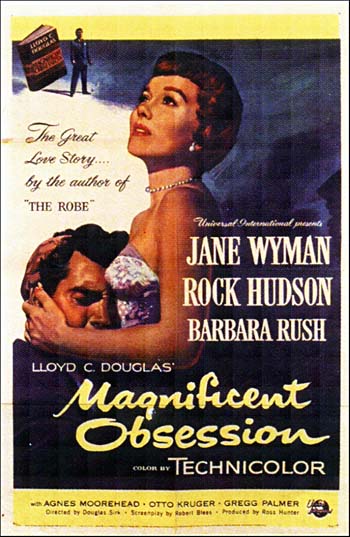
Magnificent_obsessionThere’s a scene early on in the 1954 melodrama Magnificent Obsession in which formerly carefree millionaire Bob Merrick (Rock Hudson) meets with an artist named Edward Randolph (Otto Kruger).  We know that Randolph’s brilliant because he speaks in a deep voice, tends to be unnecessarily verbose, and often stares off in the distance after speaking.  Bob wants to know about a dead doctor who was a friend of Randolph’s.  Randolph explains the late doctor’s philosophy of doing anonymous good works.  Bob’s mind is blown.  (Hudson, who was never the most expressive of actors, conveys having his mind blown by grinning.)

“This is dangerous stuff,” Randolph warns him, “One of the first men who used it went to the cross at the age of 33…”

And a heavenly chorus is heard in the background…

And that one line pretty much tells you exactly what type of film Magnificent Obsession is.  It’s a film that not only embraces the melodrama but which also holds on tight to make sure that the melodrama can never escape.  There’s not a single minute in this film that is not hilarious overwritten.  It’s not just Randolph who tends to be portentous in his pronouncements.  No — everyone in the film speaks that way!

The dead doctor is dead specifically because of Bob.  Apparently, the doctor had a heart attack but the local hospital’s only resuscitator was being used to save the life of Bob who, while the doctor was dying, was busy recklessly driving a boat.

Helen (Jane Wyman), the doctor’s widow is, at first, bitter towards Bob and when Bob offers to donate $250,000 to the hospital, Helen refuses to accept his check.  This leads to Bob doing a lot of soul-searching and eventually having his life-changing conversation with Randolph.  Excited at the prospect of doing anonymous good works for the rest of his life, Bob tracks down Helen and tries to tell her that he’s a changed man.  Helen, however, wants nothing to do with Bob and ends up getting hit by a car while running away from him.  Helen survives but now, she’s blind!

Now, at this point, you might think that Bob has done enough to ruin Helen’s life.  At least, that’s the way that Helen’s family views it and when Bob attempts to visit her in the hospital, they order him to go away.

Eventually, Helen comes home from the hospital and starts to adjust to a life without eyesight.  One day, she meets a man on the beach and they start up a tentative romance.  What she doesn’t realize, at first, is that the man is Bob!  By the time she does realize who the man is, Helen has fallen in love with him.  However, she feels that it wouldn’t be fair to Bob to pursue a relationship with him and she leaves him.

So, of course, Bob’s response is to go to medical school and become a neurosurgeon.  Many years later, Helen has a brain tumor and needs an operation to survive.

Can you guess who her surgeon turns out to be?

Magnificent Obsession is almost a prototypical 1950s melodrama.  It’s big, it’s glossy, it’s self-important, and undeniably (and occasionally unintentionally) funny.  Even the total lack of chemistry between Hudson and Wyman somehow adds to the film’s strange charm.  It’s hard not to admire a film that starts out over-the-top and just grows more excessive from there.

Watching Magnificent Obsession is a bit like taking a trip into a parallel, technicolor dimension.  It’s strange, fascinating, and far more watchable than it should be.