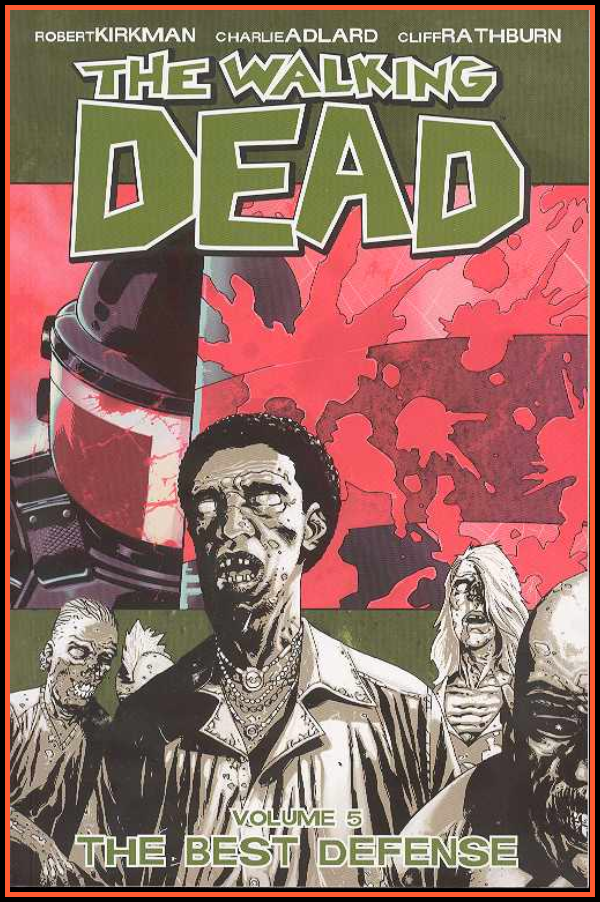
Review: The Walking Dead Volume 5 (by Robert Kirkman)


[Some Spoilers Within]

The first four volumes of Robert Kirkman’s have led Rick Grimes and his group from the encampment right outside of Atlanta to an abandoned prison which have now become their new sanctuary from the dangers of the outside world. We’ve seen the group lose people to the dangers of the zombies which have now claimed the world. They’ve also gained some new people which in turn has also caused some major conflicts to the group dynamics.

The series’ 5th collected volume (titled The Best Defense) takes place sometimes after the dramatic revelation by Rick Grimes to the group which ends the 4th volume. The Best Defense begins a new story-arc which would last right up to the very last pages of the 8th volume of the series. This was the volume which helped bring back some of the series’ fans who had begun to leave due to the overly dramatic and soap opera-ish narrative of the last volume. While the conflict which began between major characters in the last volume still remain a new surprising discovery of other possible survivors and another fortified compound brings the group back together for a common purpose. While this return towards cooperation was welcome development I did like the fact that Kirkman still kept the conflicts hanging in the air like a sword about to drop at the first wrong step.

Some fans and critics have spoken about how Kirkman’s writing style is actually very bad when compared to other top writers in the comic book industry. Yes, he’s not in the same league as a Warren Ellis, Grant Morrison, Garth Ennis and Alan Moore, but in the type of story he’s trying to tell his style seems to work. He does have a way to put up a lot of exposition with every page in the series. For some this was a sign of a lazy and weak writer who doesn’t allow the images to help tell the story. While at times I will agree as the series can get heavy with dialogue in the end it doesn’t bother me as much. Zombie films, even the best ones, rely and lean heavily on exposition. It’s actually such a surprise for a horror subgenre to have so much dialogue and people actually expect it. The same could be said for this series. The heavy exposition is not a bother for most and actually welcomed by its readers.

With this volume introducing a new outside force as the big baddie for the next major story-arc, Kirkman has easily shown he understands the zombie genre and how the zombies themselves don’t even count as the main danger for humans trying to survive this new apocalyptic world. This is especially true with the new character of The Governor who, in just a handful of issues in this volume, has cemented himself as one of the best villains to appear in any entertainment media in the past 10 years. Here’s to hoping that Frank Darabont in his tv adaptation of this series for AMC doesn’t mess around too much with this character. The Governor definitely makes one wonder if humanity actually deserves to continue as a species and not just march towards extinction.

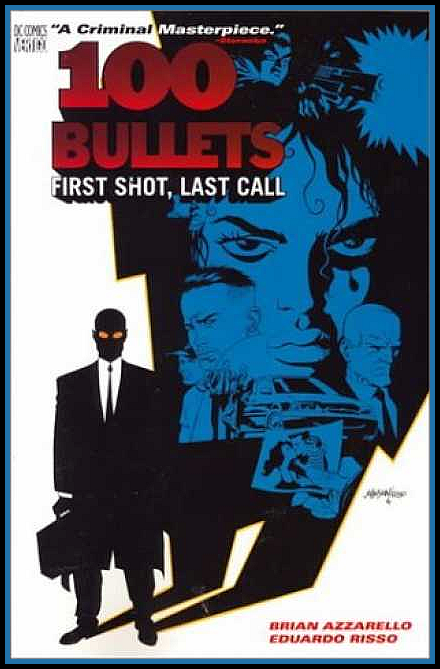
Review: 100 Bullets Vol. 1 – First Shot, Last Call


I missed out on the initial release for 100 Bullets, but I’ve since rectified that problem.

Brian Azzarrello’s 100 Bullets continues the long line of excellent mature comic titles from DC Comic’s Vertigo line. Azzarrello’s hardboiled, crime-thriller noir series brings to mind classic detective-noir works by Hammett, Spillane and Chandler. It’s a more complex continuation of the hyper-noir series Frank Miller began with his Sin City series. I’ve heard people say that this series was better than Sin City and to some respect it was. The stories in each issue contained in this first volume (issues 1 through 5) were abit more complex in nature and execution than Miller’s more simple noir tales. The five stories in this collected volume also laid the basic groundwork for what’ll turn out to be one long-running series lasting exactly 100-issues. Where Sin City‘s simplicity in its storytelling and artwork lay its strength, it’s in the complexities in the tales and the detailed, but economical artwork that 100 Bullets shined through.

In First Shot, Last Call we’re introduced to the gamemaster of the tale: Agent Graves. Looking like an ever-present government agent who has seen all that life has thrown at him and ready for more, Agent Graves picks a recently paroled Latino lass by the name of Dizzy Cordova with a proposition. He offers Dizzy an attache case with a gun and 100 bullets that’re untraceable and definite proof that certain individuals caused her heartache and grief that has ruined her life. He only offers her the attache case, its content and the proof within. The choice is Dizzy’s to make on what she should do with what’s offered her. This set-up and premise is the beauty of 100 Bullets. The story’s basically a morality tale of choices offered to the characters. Will they use the offer to exact vengeance and get away with it scott-free, or will they refuse the offer and live on with their life. The choice of revenge really doesn’t bring back lost time and loved ones and only feeds the need for retribution. Agent Graves doesn’t really force Dizzy’s hand, but a supporting character knowledgable of the offer does — for his own agenda not yet known — prods, pushes and guides her to picking the more primal choice. Dizzy’s choice in the end was both understandable and in the end inevitable.

The second story arc deals with Lee Dolan who also has had his life turned upside-down by people unknown to him. His life and family taken away by the stink of a child pornography accusation in the past. Agent Graves makes him the same offer of the attache case and its untraceable 100 bullets. Dolan’s reaction to this offer is different from that of Dizzy’s, but in the end his ultimate choice doesn’t give him the same resolution and new life path that Dizzy made. It’s a tribute to Azzarrello’s great writing that the decision both Dizzy Cordova and Lee Dolan made were understandable when taken into context of their personalities and yearning to fix the problem that led them to their current state in their lives.

To complement Azzarrello’s words perfectly were Eduardo Risso’s artwork. It would be a misnomer to say that Risso’s art style was minimalist like those of Frank Miller’s woodcut-engraving style for Sin City or Mike Mignola’s chiasroscuro-style for his Hellboy series. There’s a sense of the cinematic in Risso’s work. The scenes were always drawn with a mind for action even when it’s just people standing around. Risso has quite the filmmaker’s eye in how he’s drawn 100 Bullets which just adds to its noirish feel. The characters and environment were drawn not to scale and real-world proportion, but just enough not to look cartoonish. I would agree that there’s an abundance for cleavage on the women drawn, but Risso doesn’t do it gratuitously. Instead he uses this detail to showcase the sexuality of the strong female characters. It paints the female characters like Dizzy Cordova and Megan Dietrich with a sense of both strength and sensuality without pandering to the teenage boy demographic. Plus, he gives these ladies their own personality and character with how he draws them. Dizzy truly has the Latina sensual curves while Megan has the icy-cold Aryan beauty that serves her well.

100 Bullets: First Shot, Last Call was a great discovery and a wonderful beginning to a very mature, intelligent and hardhitting comic series. Congratulations must got to its creator Brian Azzarrello for writing such great characters and memorable stories. I can’t forget the work of his artist and partner-in-crime, Eduardo Risso. Risso’s artwork has stamped themselves in my mind as the only way to see 100 Bullets in. Both Azzarrello and Risso complement each other well and their continued collaboration right up to the end of the series helped make this series one of the best of the past decade.

Review: A History of Violence (dir. by David Cronenberg)


“In this family, we do not solve our problems by hitting people.” — Tom Stall

David Cronenberg’s A History of Violence opens like a familiar American story but soon transforms into something far darker and more complex—a meditation on how violence reshapes identity and reality itself. The film begins in small-town Indiana where Tom Stall, a mild-mannered diner owner, becomes an overnight hero after killing two violent spree killers who attempt to rob his restaurant. These killers—Billy and Leland—serve as the initial violent intrusion that shatters Tom’s peaceful world and propels the narrative forward. Their actions attract the attention of Carl Fogarty, an East Coast mobster whose relentless pursuit gradually forces Tom and his family to confront a buried, violent history. This confrontation unravels the fragile facade of domesticity and sets the stage for the film’s profound exploration of identity, perception, and the primal tensions beneath civilization.

Cronenberg’s direction is a study in restraint and precision. Far from glamorizing violence, the film presents it as brutally efficient and intimately physical. Cronenberg himself described the action sequences as neither choreographed nor aestheticized but raw, unembellished, and quick—realistic portrayals of violence drawn from street-fighting techniques rather than cinematic spectacle. This choice heightens the emotional impact, making every outbreak of violence feel sudden, close, and devastatingly human. The opening extended shot of the spree killers, for example, follows them in a languid, almost eerie calm before revealing their cold-blooded brutality, establishing an unsettling tone early on. Cronenberg’s camera work—often tight and intimate—immerses viewers in moments where violence erupts not as a fantasy but as a harsh reality, forcing the audience to reckon with its consequences rather than its thrill.

Viggo Mortensen anchors the film with a layered performance that seamlessly navigates the duality of Tom Stall—a man striving for peaceful normalcy—and the darker instincts touched by his mysterious past. Mortensen’s portrayal moves fluidly between the affable family man and the capable, restrained force beneath, embodying the film’s exploration of how violence shapes identity and perception. His physicality and subtle shifts in tone reveal a man perpetually caught between two worlds, never fully belonging to either. Maria Bello as Edie complements Mortensen beautifully, delivering a performance rich in emotional complexity. Her character oscillates between nurturer and survivor, revealing a raw, sometimes unsettling vulnerability beneath her composed exterior. Bello’s nuanced acting gives weight to the evolving dynamics of fear, desire, and trust within their marriage, especially evident in scenes that contrast tender intimacy with underlying tension.

The supporting cast enriches the film’s moral landscape. Ed Harris brings a quiet menace to Carl Fogarty, embodying violence as a cold, business-like inevitability rather than a source of pleasure or spectacle. William Hurt’s portrayal of Richie Cusack is especially memorable—his eight-to-ten-minute screen time is electrifying, providing a darkly charismatic figure who embodies familial loyalty intertwined with brutal pragmatism. Hurt’s performance deftly balances charm and cruelty, offering one of the film’s starkest reminders of violence’s cyclical nature within families. These actors contribute to the film’s thematic depth, portraying violence as a heritage passed down and a force that both defines and corrodes.

Cronenberg’s screenplay, coupled with Howard Shore’s minimalist score, emphasizes mood and psychological tension over action set pieces. The film refuses to indulge in excessive gore or prolonged combat; instead, it presents violence as a disruptive force that shatters normalcy and forces internal reckonings. A notable subplot involving Tom’s teenage son and a school bully underscores the generational transmission of violence and fear, reinforcing the idea that violence’s impact extends beyond immediate events to shape social and familial identities.

One of the film’s most powerful effects is the way it forces viewers to reconsider notions of safety, civility, and identity. Tom’s line, “In this family, we do not solve our problems by hitting people,” starkly contrasts with his son’s chilling rejoinder, “No, in this family, we shoot them.” This exchange encapsulates the film’s core tension—the desire to reject violence while simultaneously being shaped by its inescapable presence. Moments of quiet domesticity are undercut throughout by an ever-present undercurrent of menace, illustrating Cronenberg’s thesis that violence is not merely an event but a contagion of perception and reality.

Ultimately, A History of Violence is a film of dualities—between past and present, civility and savagery, love and fear. Cronenberg’s direction delicately balances these tensions, crafting a film that is at once a taut thriller and a profound psychological study. The performances, especially those of Mortensen and Bello, give the film its emotional resonance, while the supporting cast strengthens its examination of violence’s personal and social ramifications. By the film’s haunting conclusion, viewers are left with a haunting question: can anyone truly escape the shadows cast by violence, or are we forever altered by its imprint?