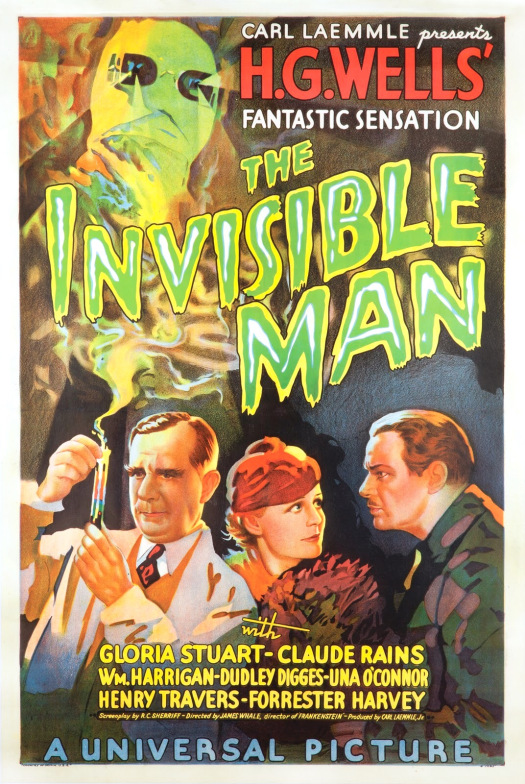
James Whale’s FRANKENSTEIN set the bar high for horror, and his follow-up THE OLD DARK HOUSE is one of the blackest comedies ever made. But with THE INVISIBLE MAN, Whale raises that bar by combining gruesome terror with his macabre sense of humor. THE INVISIBLE MAN doesn’t get the respect of other icons in the First Horror Cycle (Frankenstein’s monster, Dracula, Imhotep), but Claude Rains’s outstanding performance as the mad scientist Jack Griffin, driven to insanity by the chemicals he’s pumped into his veins, is as sick and deranged as any you’ll find in the genre… and the fact Rains does much of his acting using only his voice is an amazing feat, and a testament to the man’s acting genius.
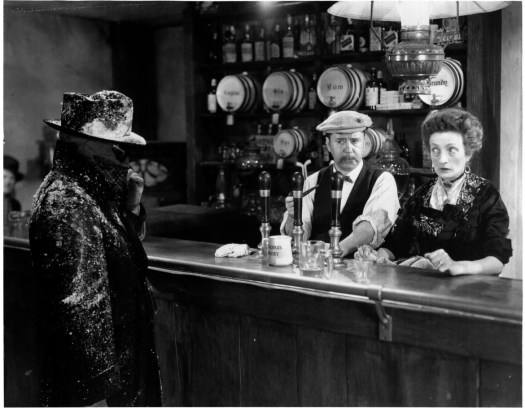
Whale’s opening shot sets the eerie tone, as a solitary figure, his face swaddled in bandages, trudges through a snowstorm and enters the Lion’s Head Inn seeking solitude. The…
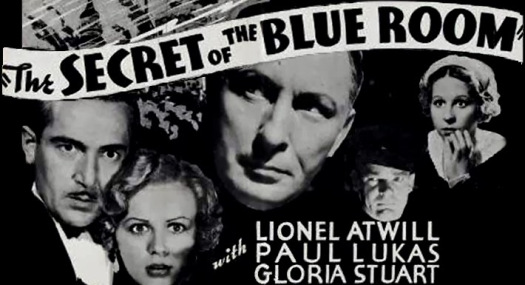
The horror cycle of the early 1930’s cast its dark shadow on other film genres. SECRET OF THE BLUE ROOM is one of those “old dark house/locked room” mysteries showing that influence; it’s a creepy, atmospheric little movie about mysterious murders, with horror vet Lionel Atwill front and center among the suspects. There aren’t any “monsters” here, but some good chills courtesy of director Kurt Neumann, who later directed the 1950’s sci-fi horrors KRONUS, SHE DEVIL, and THE FLY .
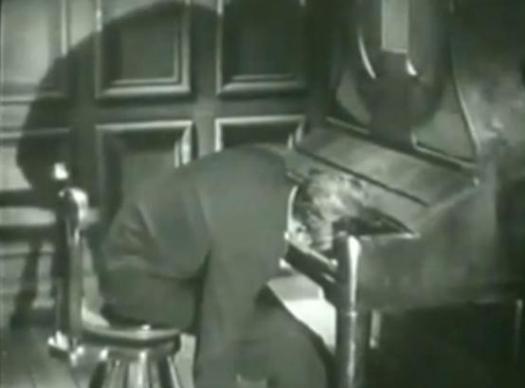
It’s a dark and stormy night (naturally!) at Castle von Hellsdorf, and Irene, daughter of Master of the House Robert, is celebrating her birthday with three suitors: Captain Walter Brink, Frank Faber, and Tommy Brandt, while outside, a mysterious stranger lurks. The conversation turns to ‘The Blue Room’, kept under lock and key after three strange (some say supernatural) murders occurred many years ago, always at One AM. Tommy, eager…
I haven’t posted anything on The Ritz Brothers since January of 2016 , so when TCM aired a trio of their films this weekend, I chose to review what I consider their best solo effort, 1937’s LIFE BEGINS IN COLLEGE. This was their first name-above-the-title movie, and features Harry, Jimmy, and Al at their zaniest, with the added bonus of comedienne Joan Davis as a kooky coed with her sights on Native American football hero Nat Pendleton.
Collegiate musical comedies were a popular sub-genre in the 30’s: COLLEGE HUMOR, PIGSKIN PARADE, COLLEGE SWING, COLLEGE HOLIDAY, et al, so it seemed the perfect milieu for the Ritzes to showcase their peculiar brand of nuttiness. The story is typical campus corniness, as George “Little Black Cloud” Black arrives at Lombardy College (crashing his motorcycle for an entrance) wanting to join the football team, and immediately developing a rivalry with football team captain…
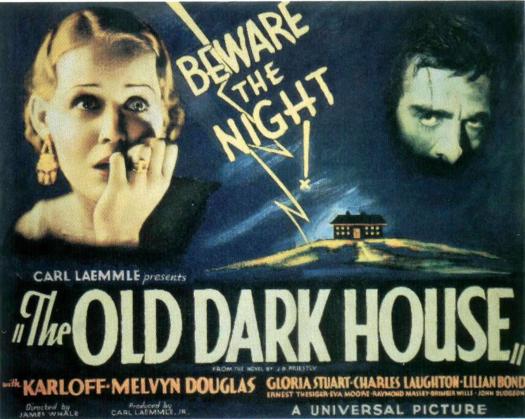
William Henry Pratt was born on November 23, 1887, but horror movie icon Boris Karloff was “born” when he teamed with director James Whale for 1931’s FRANKENSTEIN. The scary saga of a man and his monster became a big hit, and Universal Studios boss Carl Laemmle Jr. struck while the horror trend was hot, quickly teaming the pair in an adaptation of J.B. Priestley’s 1927 novel THE OLD DARK HOUSE. This film was considered lost for many years until filmmaker and Whale friend Curtis Harrington discovered a print in the Universal vaults. Recently, a 4K restoration has been released courtesy of the Cohen Film Collection, and a showing aired on TCM this past Halloween. I of course, having never seen the film, hit the DVR button for a later viewing.
THE OLD DARK HOUSE has not only been restored to its former glory, but is a delightful black comedy showcasing…
Lisa asked me to review an old best picture nominee for today’s movie a day so I picked Here Comes The Navy, because hardly anyone has ever heard of it and I usually like old service comedies.
Chesty O’Connor (James Cagney) is a construction worker who thinks that he is tougher than anyone in the Navy. When Chesty gets into a fight with Chief Petty Officer Biff Martin (Pat O’Brien), Chesty enlists in the Navy just to get on his nerves. Chesty brings his friend Droopy (Frank McHugh) with him. With Biff determined to force him out of the service, Chesty bristles against the rules of the Navy. But then Chesty meets and falls in love with Dorothy (Gloria Stuart), Biff’s sister. Chesty loses his bad attitude, proves that his shipmates can depend on him, saves Biff’s life when an airship landing goes wrong, and even gets to marry Biff’s sister.
Here Comes The Navy is a typical 1930s service comedy, distinguished mostly by the wiseguy presence of James Cagney. It is the type of movie where men have names like Chesty, Biff, and Droopy. Warner Bros. made a hundred versions of this story and Here Comes The Navy was certainly one of them.
Here Comes The Navy was produced with the full cooperation of the U.S. Navy, so it’s not surprising that it feels like a recruiting film. The sailors are all happy to do their bit to protect the American way of life and the commanding officers are all tough but fair. The majority of the movie was filmed on the USS Arizona, which would be sunk seven years later during the Japanese attack on Pearl Harbor. Here Comes The Navy also features some scenes shot on the USS Macon, an airship that would crash a year later.
It’s hard to guess how Here Comes The Navy came to be nominated for best picture. It’s okay but, for the most part, it’s for James Cagney completists only.
The 1933 Universal horror film, The Invisible Man, never seems to get as much attention as Frankenstein, Dracula,The Wolf Man, or The Mummy. Perhaps it’s because the invisible man really isn’t a supernatural monster. He’s just a scientist who has turned himself invisible and is now going mad as a result. Or maybe it’s because there have been so many crappy films that have used invisibility as a plot point that the reputation of the original Invisible Man suffers by association.
For whatever reason, The Invisible Man never seems to get spoken about in the same breathless, gleeful manner as some of the other Universal monsters. But I have to admit that, though I usually can’t stand movies about invisibility, I rather like The Invisible Man.
Based on a novel by H.G. Wells, The Invisible Man opens with a mysterious man (played by Claude Rains) arriving in a small English village. He checks into a small inn and soon, everyone in the village is scared of him. It’s not just his haughty attitude or his habit of ranting about his own superiority. There’s also the fact that he is literally covered, from head to toe, in bandages. He always wears gloves and dark glasses. He insists that he’s doing important research and demands to be left alone.
The inn keeper (Forrester Harvey) and his histrionic wife (Una O’Connor) put up with the mysterious man until he falls behind on his rent. However, once confronted, the mysterious man announces that he’s not going anywhere. When the police and a mob of villagers arrives, the man starts to laugh like a maniac. He unwraps the bandages around his head and…
THERE’S NOTHING UNDERNEATH!
Well, there is something there. It’s just that the man is invisible so no one can see what’s underneath. It turns out that the man is Dr. Jack Griffin, a chemist who has been missing for several days. He’s created an invisibility serum but he can’t figure out how to reverse the effects. Even worse, the serum is driving him insane. Griffin’s fiancée, Flora (Gloria Stuart), and her father, Dr. Cranley (Henry Travers), are searching for Jack but Jack doesn’t particularly want to be found. Jack is more interested in exploring how he might be able to use invisibility to conquer the world…
The Invisible Man is historically important because it was the film that brought Claude Rains to Hollywood. Rains has previously made films in the UK but this was his first American film. Think of how different film history would have turned out if The Invisible Man had, as originally planned, starred Boris Karloff. Without Claude Rains coming to America, who would have played Louis in Casablanca? Who would have played Sen. Paine in Mr. Smith Goes To Washington or Alex Sebastian in Notorious? Of course, we don’t really see Claude Rains’s face until the very end of The Invisible Man. Instead, we just hear his voice but what a voice Claude had! He delivers his dialogue with just the right amount of malicious sarcasm.
I like The Invisible Man. For modern audiences, it’s not particularly scary. (Though I do find the idea of being unknowingly followed by an invisible person to be a little unnerving…) However, unlike a lot of other old horror films, you can watch The Invisible Man and see why it would have been scary to an audience seeing it for the very first time. In 1933, a time when film was still a relatively new medium and audiences had yet to become jaded by special effects, here was a man unwrapping his bandages to reveal that there was nothing underneath! That had to have freaked people out!
The Invisible Man was directed by James Whale and the film features the same demented sense of humor that distinguished The Bride of Frankenstein. The villagers are portrayed as being so hysterical that you can’t help but think that maybe Griffin has a point about being surrounded by fools. By the time the local constable declares, “What’s all this then?,” you can’t help but start to sympathize with Jack Griffin.
There’s been a lot of bad invisibility movies made but The Invisible Man is not one of them. It may not be as well remembered as some of the other Universal horrors but it’s definitely one worth seeing.


 Lisa asked me to review an old best picture nominee for today’s movie a day so I picked Here Comes The Navy, because hardly anyone has ever heard of it and I usually like old service comedies.
 Through the Shattered Lens