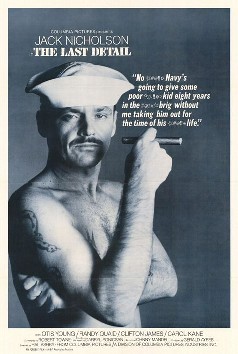
 Billy “Badass” Buddusky (Jack Nicholson) and Richard Mulhall (Otis Young) are two Navy lifers stationed in Virginia. On shore patrol, they’ve been assigned to transport a 18 year-old seaman to a Naval prison in Maine. The kid has been dishonorably discharged and sentenced to eight years in the brig for trying to steal $40 from a charity box. (The charity was a favorite of the wife of his commanding officer.) Buddusky and Mulhall are expecting to find a hardened punk but instead, they end up escorting Larry Meadows (Randy Quaid), a timid teenager who suffers from kleptomania and who doesn’t seem to understand just how bad things are going to be for him for the rest of his life. Not only is he going to do eight years in the brig, surrounded by hardened criminals, but his dishonorable discharge is going to follow him for the rest of his life.
Resenting having to take Meadows to prison and also feeling that he’s getting a raw deal, Buddusky and Mulhall decide to make a few stops on their way to Maine, so that Larry can enjoy what little time he has left and hopefully lose his virginity before being locked up. In between brawling with Marines, visiting a brothel (where a young Carol Kane plays one of the prostitutes), and hanging out with a group of hippies (one of whom is played by Gilda Radner), Meadows comes to think of Buddusky and Mulhall as being his best friends. Unfortunately, for Meadows, both Buddusky and Mulhall have their job to do.
Hal Ashby’s road picture is a character study of three men who are all lifers, even if they don’t realize that. Both Buddusky and Mulhall hate the Navy but they also can’t relate to anyone who isn’t a member of the service. Meadows’s entire future has been pre-determined because he tried to steal $40 but he doesn’t realize it until its too late. When the film came out, it was controversial due to its “colorful” language. In an interview, screenwriter Robert Towne defended the frequent profanity because, as he put it, when you’re in a situation you hate, “that’s what you do. You bitch.” Hal Ashby’s loose direction captures the road trip feel as the three leads reluctantly head to their ultimate destination.
The Last Detail features one of Jack Nicholson’s best performances. Buddusky is cynical and doesn’t trust anyone other than Mulhall but even he knows that Larry Meadows deserves better than to spend eight years in the brig. Along with lending his star power to the film and standing by director Hal Ashby when Ashby was arrested for marijuana possession, Nicholson also played a big role in the casting of Randy Quaid as Larry Meadows. (The other final contender for the role was John Travolta but Nicholson insisted on Quaid). The 6’5 Quaid towers of Nicholson and Young, making him look as if he could escape any time that he wants. But Larry is so naive that he doesn’t want to make any trouble for his “friends.” Though this wasn’t his first film, The Last Detail is the film that made Quaid one of the busiest character actors of the 70s and 80s and it also, at least temporarily, made him a part of the Jack Nicholson stock company.
Both sad and funny, The Last Detail is one of the best films of the 70s and features Jack Nicholson at his most unforgettable.


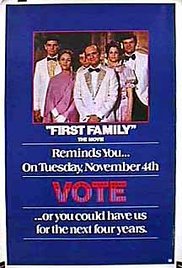 Like any newly inaugurated President, Manfred Link (Bob Newhart) faces many new challenges. The biggest challenge, though, is keeping control of his family and his White House staff. His wife (Madeline Kahn) is an alcoholic. His 28 year-old daughter (Gilda Radner) is so desperate to finally lose her virginity that she is constantly trying to sneak out of the White House. General Dumpson (Rip Torn) wants to start a war. Press Secretary Bunthorne (Richard Benjamin), Ambassador Spender (Harvey Korman), and Presidential Assistant Feebleman (Fred Willard) struggle and often fail to convince everyone that all is well.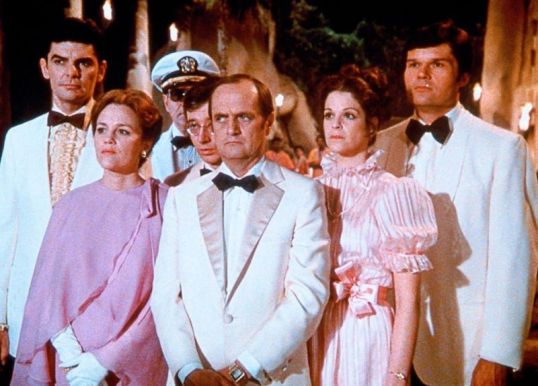

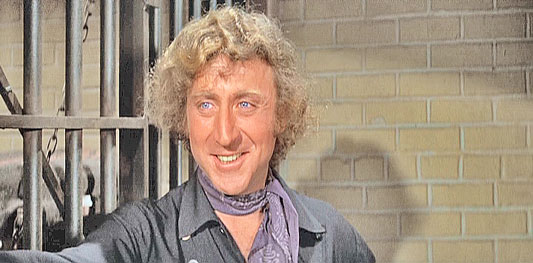

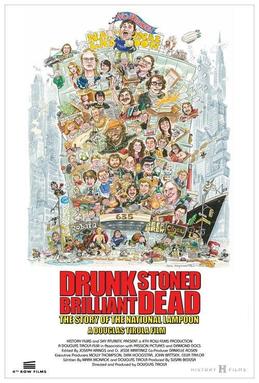 The documentary Drunk Stoned Brilliant Dead pays tribute to National Lampoon. Founded in 1970, National Lampoon was published for 28 years and, at the height of its popularity, its sensibility redefined American comedy. When it came to National Lampoon, nothing was sacred and nothing was off-limits. The success of National Lampoon led to a stage show called Lemmings and The National Lampoon Radio Hour, which featured everyone from John Belushi and Bill Murray to Chevy Chase and Harold Ramis. Michael O’Donoghue, famed for his impersonations of celebrities having needless inserted into their eyes, went from writing for the Lampoon to serving as Saturday Night Live‘s first head writer. National Lampoon’s Animal House, Vacation, and Caddyshack are three of the most influential film comedies ever made. Everyone from P.J. O’Rourke to John Hughes to The Simpsons‘ Al Jean got their start at National Lampoon.

 Through the Shattered Lens