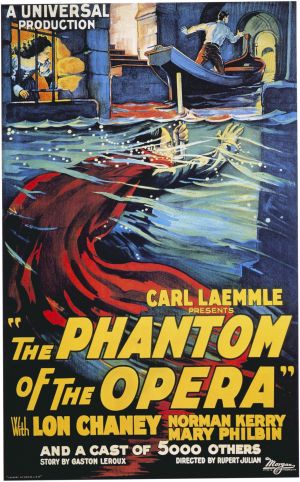
Today’s horror movie on the Shattered Lens is both a classic of silent era and one of the most influential horror films ever made. It’s one that I previously shared in 2013, 2015, 2016, 2108, 2019, 2020, 2021, and 2022 but it’s such a classic that I feel that it is worth sharing a second (or fifth or even a sixth or perhaps an ninth) time.
First released in 1925, The Phantom of the Opera is today best known for both Lon Chaney’s theatrical but empathetic performance as the Phantom and the iconic scene where Mary Philbin unmasks him. However, the film is also a perfect example of early screen spectacle. The Phantom of the Opera was released during that period of time, between Birth of the Nation and the introduction of sound, when audiences expected films to provide a visual feast and Phantom of the Opera certainly accomplishes that. Indeed, after watching this film and reading Gaston Leroux’s original novel, it’s obvious that the musical was inspired more by the opulence of this film than by the book.
This film is also historically significant in that it was one of the first films to be massively reworked as the result of a poor test screening. The film’s ending was originally faithful to the end of the novel. However, audiences demanded something a little more dramatic and that’s what they got.
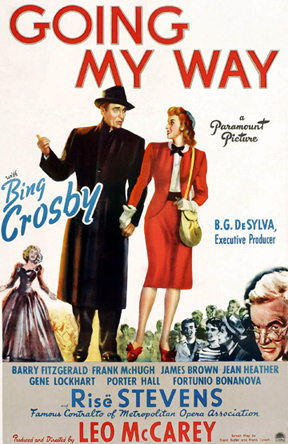
Last night, continuing my effort to watch 38 movies in 10 days (and, for the record, I have 7 days left as of today), I watched the 1944 musical-comedy-drama Going My Way.
Going My Way tells the episodic story of Father Chuck O’Malley (Bing Crosby), a priest from St. Louis who is assigned to take charge of a struggling parish in New York City. O’Malley is meant to replace Father Fitzgibbon (Barry Fitzgerald), a stubbornly old-fashioned priest who is struggling to keep up with a changing world. Though O’Malley is to take charge of the parish’s affairs, Fitzgibbon is to remain the pastor. However, the compassionate O’Malley doesn’t tell Fitzgibbon about the arrangement and allows Fitzgibbon to believe that O’Malley is only meant to be his assistant.
It’s obvious from the start that Fitzgibbon and O’Malley have differing approaches. Fitzgibbon is a traditionalist. O’Malley, on the other hand, is a priest who sings. He’s a priest who understands that the best way to prevent the local teens from forming a street gang is to convince them to start a choir instead. When it appears that 18 year-old Carol (Jean Heather) is “living in sin,” it is the nonjudgmental O’Malley who convinces her to marry her boyfriend.
And, slowly but surely, Fitzgibbon and O’Malley start to appreciate each other. O’Malley is even able to convince Fitzgibbon to play a round of golf with him, while Fitzgibbon tells O’Malley about his love for his mother in Ireland.
What’s interesting is that we learn very little about O’Malley’s past. In many ways, he’s like a 1940s super hero or maybe a less violent and far more ethical version of one of Clint Eastwood’s western heroes. He shows up suddenly, he fixes things, and then he moves on. Instead of a cape or a poncho, he wears a collar.
(And, of course, he doesn’t kill anyone. Actually, that’s probably a lousy analogy but I decided I’d give it a try anyway…)
At one point, O’Malley does run into an opera singer named Genevieve Linden (Rise Stevens). He and Genevieve (whose real name is Jenny) talk briefly about their past and it becomes obvious that they once had a romantic relationship. We don’t learn the exact details but it does bring some unexpected melancholy to an otherwise cheerful film. It reminds us of what O’Malley gave up to become a priest.
Fortunately, Genevieve is more than happy to help out with O’Malley’s choir, even arranging for them to meet with a record executive (William Frawley). The executive doesn’t have much interest in religious music but then he hears Bing O’Malley sing Swinging On A Star.
It’s a bit strange to watch Going My Way today because it is a film that has not a hint of cynicism. There’s no way that a contemporary, mainstream film would ever portray a priest as positively as Father O’Malley is portrayed in this film. Indeed, it says something about the world that we live in that I instinctively cringed a little whenever O’Malley was working with the choir, largely because films like Doubt and Spotlight have encouraged me to view any film scene featuring a priest and an pre-teen boy with suspicion. O’Malley is the ideal priest, the type of priest that those of us who were raised Catholic wish that we could have known when we were young and impressionable. Bing Crosby does a pretty good job of playing him, too. Watching Going My Way felt like stepping into a time machine and going to a simpler and more innocent time.
In the end, Going My Way is a slight but watchable film. It doesn’t add up too much but, at the same time, it’s always likable. Though the film may be about a priest, the emphasis is less on religion and more on kindness, charity, and community. Going My Way was a huge success at the box office and even won the Oscar for best picture.
Personally, I would have given the Oscar to Double Indemnity but Going My Way is still a likable movie.
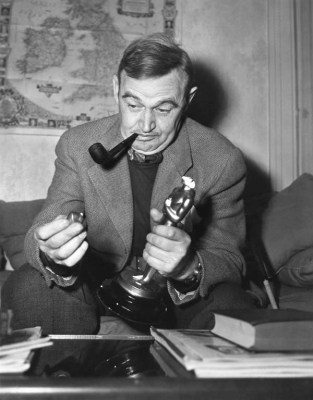
Speaking of likable, the Academy was so impressed with Barry Fitzgerald’s performance that they actually nominated it twice! He got so many votes in both categories that Fitzgerald ended up nominated for both Best Actor and Best Supporting Actor. Subsequently, the Academy changed the rules and decreed that a performance could only be nominated in one category. As for Fitzgerald, he won the Oscar for best supporting actor. He later broke the Oscar while practicing his golf swing.
Barry and Oscar
(Don’t worry. The Academy sent him a replacement.)
Last year, I published 60 film reviews under the heading of Embracing the Melodrama. Embracing the Melodrama was one of the first review series that I had ever done and I had so much fun doing it that I figured, “Why not try it again?”
In other words, welcome to Embracing the Melodrama, Part II!
Over the next three weeks, I will posting, in chronological order, 128 reviews of films that embrace the melodrama. As before, these reviews will be in chronological order and they will include everything from Oscar winners to grindhouse exploitation to made-for-television dramas. It should be fun!
And, considering that we’re talking about 128 reviews here, it should at least help me make a dent in my goal to see every single movie that has ever been made.
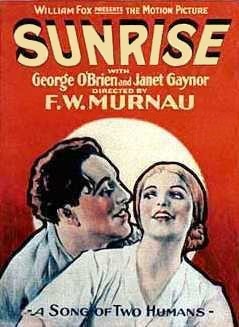
Let’s start things off by taking a quick look at the 1927 silent film, Sunrise. Directed by German expressionist F.W. Murnau, Sunrise is widely considered to be one of the greatest films ever made and for once, popular opinion is correct. The film tells a simple story. The Woman From The City (Margaret Livingston) takes a vacation out in the country. (We know she’s dangerous because she wears black lingerie.) She stands outside of a farmhouse and whistles. Soon, the Man (George O’Brien) steps out of the farmhouse and joins the Woman. Inside the farmhouse, the Wife (Janet Gaynor) can only dream of what life was like when she and the Man first fell in love.
The Man and the Woman meet at the edge of the lake and kiss as the moon shines down on them. They’re having an affair, though the film — in its dream-like way — leaves it ambiguous as to just how long the affair has been going on. (Indeed, the film almost seems to suggest that The Woman has sprung from the Man’s subconscious, a creation of his darkest desires.) The Woman wants the Man to murder his wife and come back to the city with her. At first, the Man refuses but, as the Woman talks to him, he starts to visualize the city. And, make no mistake about it — the city that the man visualizes is a scary place that resembles the dreamworld of The Cabinet of Dr. Caligari. But, at the same time, it’s also a lot more fun than the farm.
Now, you may be wondering why this familiar sounding tale is considered to be one of the best films of all time. The story itself is simple and deliberately allegorical. The film is less about the story and more about how Murnau tells it. Murnau fills the screen with hauntingly surreal images that are both beautiful and frightening at the same time. When the title cards appear on-screen, the lettering literally fades in and out and adds to the entire movie’s dream-like feel. Watch the scene below where the Woman first suggests killing the Wife and the Man visualizes the city:
Infatuated with the Woman, the Man plans to drown the Wife but, at the last minute, has a change of heart. The Wife, however, flees to the city herself. The Man follows her and attempts to win back her love. The city itself changes when the Man and the Wife are in it together. What seemed dark and threatening under the influence of the Woman is now revealed to be fun and vibrant. The film transforms from being an early example of film noir to being a screwball comedy.
How many other films can you think of that feature both a murderous femme fatale and a drunk pig?
And yet, as much joy as the Man and the Wife find in the city, both the farm and the Woman await their eventual return. And there’s a storm coming…
Interestingly enough, at the first Oscar ceremony, two awards were given for Best Picture of the year. The first award — for Outstanding Production — went to Wings, a big budget action spectacular about World War I. The other award — for Unique And Artistic Presentation — went to Sunrise. I’ve read a lot of speculation about which film the Academy meant to name the best of the year but, to me, it’s fairly obvious that the Academy meant for Outstanding Production to honor the year’s big blockbusters while Unique and Artistic Presentation would honor the “art” films.
And, to be honest, I think that, way back in 1928, the Academy had the right idea. Why should they only give out one award for best picture, as if all films can be judged by only one standard? Why not give out separate awards for the best comedy or the best thriller or the best film made for a certain amount of money? Why not bring back the Oscar for Unique and Artistic Presentation?
For whatever reason, the Academy discontinued the Unique and Artistic Presentation Award after the 1st ceremony and, in the future, only one film would be named best of the year. Since Outstanding Production eventually become known as Best Picture, Wings has been immortalized as the first film to win best picture.
And, nothing against Wings, but the Academy would have been smarter to have gone with Sunrise. Certainly, it would have won them the respect of future film students.
 Through the Shattered Lens