What Lisa Watched Tonight #215: Baywatch The Movie: Forbidden Paradise (dir by Douglas Schwartz)


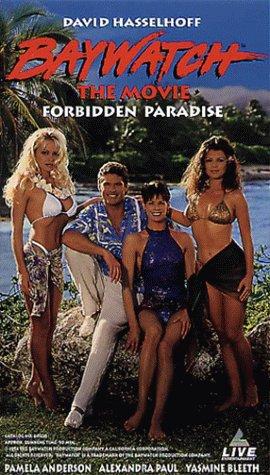
Earlier tonight, I watched the 1995 film Baywatch The Movie: Forbidden Paradise.
Why Was I Watching It?

The H&I network has been airing Baywatch every weekday at 5 and 6. I’ve been watching because the pure, unapologetic silliness of the show is a good way to unwind from whatever stress or annoyance I may have had to deal with during the day. Today, they aired Forbidden Paradise, which was originally released theatrically in Europe and straight-to-video in the United States. (To quote John Redcorn, “We are already straight-to-video. There is nowhere else left to go.”) A few months after its theatrical release, Forbidden Paradise was broadcast as a two-part episode of Baywatch, even though it featured characters who had since left the show. I imagine that was a bit confusing for some viewers.

(Or maybe it wasn’t. I doubt the majority Baywatch’s audience was particularly concerned with continuity.)

What Was It About?

The Baywatch team goes to Hawaii! Well, not all of them. Actually, it’s just Mitch (David Hasselhoff), CJ (Pamela Anderson), Stephanie (Alexandra Paul), Caroline (Yasmine Bleeth), Logan (Jaason Simmons), and Matt (David Charvet). They’re supposed to be taking part in a lifeguard exchange program but, as usual, it turns out that Stephanie is the only one who actually gives a damn about doing her job.

Instead, CJ considered whether or not she wants to model for a dorky photographer. Logan becomes obsessed with winning a surfing competition while Caroline obsesses on why Logan is always obsessing on stuff. Mitch and Matt end up getting lost in the jungle and briefly taken prisoner by a bunch of native villagers. It all leads to a chase through the jungle and an engagement on the beach. Stephanie helps that Hawaiian lifeguards save someone from drowning. At least Stephanie takes her job seriously.

What Worked?

Baywatch The Movie: Forbidden Paradise was actually filmed on location in Hawaii so the scenery was gorgeous. It was also apparently shot in approximately the same location as Lost so, whenever I got bored with the plot, I could think about Sawyer and the Others. This was especially true while David Hasselhoff and David Charvet were being chased through the jungle by all of the angry villagers. I felt like the Smoke Monster was going to pop out at any moment.

As with anything involving Baywatch, it could be argued that the whole film was so ludicrous that it worked as a self-parody. I’m certainly tempted to make that argument but I’m not really sure if any of the self-parody was intentional. That’s the great mystery when it comes to Baywatch.

What Did Not Work?

If you consider this movie to be a self-aware parody, than it all worked.

If you consider it to be an actual movie, with a plot and characters that you’re supposed to care about and interesting dialogue, than none of it worked. I mean, it’s Baywatch. It’s the adult version of Saved By The Bell. It’s entertainingly shallow but it’s never exactly good.

Probably the film’s biggest flaw is that the pacing is totally off. It seems to take forever for the film’s plot to actually get started and then, once it does, it keeps going off on these strange detours. For some reason, a lot of screen time is devoted to a model named Holly (Hedi Mark) and a remarkably unlucky photographer named Carlton Edwards (Ricky Dean Logan).

Myself, I was disappointed that David Chokachi (who played Cody, the lifeguard best-known for wearing a speedo in the opening credits) wasn’t even in the film.

“Oh my God! Just like me!” Moments

I’ve been to Hawaii! Seriously, I had a great time and I look forward to returning soon.

Lessons Learned

I refuse to learn anything from Baywatch.
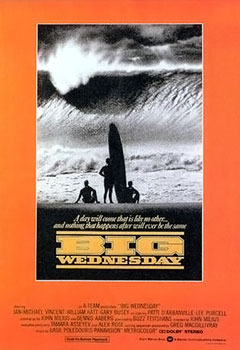
A Movie A Day #165: Big Wednesday (1978, directed by John Milius)


If there is a male bonding hall of fame, Big Wednesday has to be front and center.
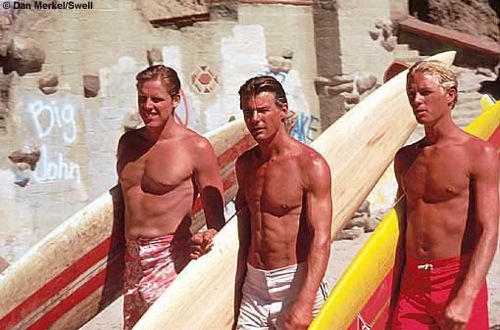
This episodic movie follows three legendary surfers over twelve years of change and turmoil.  Jack Barlowe (William Katt) is the straight arrow who keeps the peace.  Leroy “The Masochist” Smith (Gary Busey) is the wild man.  Matt Johnson (Jan-Michael Vincent) is the best surfer of them all but he resents both his fame and the expectation that he should be some sort of role model for the younger kids on the beach.  From 1962 until 1974, the three of them learn about love and responsibility while dealing with cultural turmoil (including, of course, the Vietnam War) and waiting for that one legendary wave.

After writing the screenplays for Dirty Harry and Apocalypse Now and directing The Wind and The Lion and Dillinger, John Milius finally got to make his dream project.  Big Wednesday was based on Milius’s own youth as a California surfer and he has said that all three of the main characters were based on different aspects of his own personality.  Expectations for Big Wednesday were so high that Milius’s friends, George Lucas and Steven Spielberg, exchanged percentages points for Star Wars and Close Encounters of  The Third Kind for a point of Big Wednesday.  The deal turned out to be worth millions to Milius but nothing to Lucas and Spielberg because Big Wednesday was a notorious box office flop.  Warner Bros. sold the film as a raunchy comedy, leaving audiences surprised to discover that Big Wednesday was actually, in Milius’s words, a “coming-of-age story with Arthurian overtones.”

I can understand why Big Wednesday may not be for everyone but it is one of my favorite movies.  It is one of the ultimate guy films.  Some of the dialogue and the narration may be overwrought but so are most guys, especially when they’re the same age as the surfers in Big Wednesday.  We all like to imagine that we are heroes in some sort of epic adventure.  The surfing footage is amazing but it is not necessary to be a surfer to relate to the film’s coming-of-age story or its celebration of the enduring bonds of friendship.  Katt, Vincent, and Busey all give great performances.  Considering their later careers, it is good that Big Wednesday is around to remind us of what Gary Busey and Jan-Michael Vincent were capable of at their best, before their promising careers were derailed by drugs and mental illness.  Be sure to also keep an eye out for infamous 70s character actor Joe Spinell as an army psychiatrist, a pre-Nightmare on Elm Street Robert Englund, playing a fellow surfer and providing the film’s narration, and Barbara Hale, playing the patient mother of her real-life son, William Katt.

One final note: At a time when the shameful stereotype of the psycho Vietnam vet was becoming popular and unfairly tarnishing the reputation of real-life vets, Big Wednesday was unique for featuring a character who not only joins the Army but who appears to return as a better person as a result.

Review: Conan the Barbarian (dir. by John Milius)


Khitan General: “Conan, what is best in life?”
Conan: “To crush your enemies, see them driven before you, and to hear the lamentations of their women!”

1982 premiered what has to be one of my favorite films ever. It was a film that was year’s in the making and had as one of it’s producers the eccentric and powerful Hollywood icon, Dino De Laurentiis. It also starred who was then a very much unknown Austrian bodybuilder-turned-actor in Arnold Schwarzenneger. To round out this unusual cast of characters producing this film would be the maverick screenwriter-director John Milius not to mention a young writer still fresh from Vietnam, Oliver Stone. During it’s production there were conflicts between producer and director as to the tone of the film right up to who should actually play the lead character. It’s a good thing that Milius was the ringmaster of this group of characters as his personality was able to steer things to what finally ended up as the film legions of fans have known and seen throughout the decades since it’s release. Conan the Barbarian was, and still is, a fantasy film of quality which still remains as action-packed and full of flights of fancy in the beginning of 2011 as it did when it premiered in 11982.

Milius and Stone adapted the stories of Robert E. Howard while adding their own flourishes to the iconic Cimmerian character. While many Howard purists were aghast at how these two writers had turned a character who was muscular but also athletic and lean into the hulking muscle-bound one Schwarzenneger inhabited the final result would silence most of these critics. The film kept the more outlandish backstory of Howard’s writing, but left enough to allow the film’s story and background to remain something out of Earth’s past prehistory. It was a film which was part origin tale for the title character, part coming of age film and part revenge story.

The film begins with a sequence narrated by iconic Asian-actor Mako as he tells of the beginnings of his liege and master Conan and the high adventures which would soon follow. Conan the Barbarian actually has little dialogue in the very beginning outside of that narration and a brief interlude between a young Conan and his father about the meaning of the “riddle of steel”. Most of the film’s beginning is quite silent in terms of dialogue. This didn’t matter as film composer Basil Poledouris’ symphonic score lent an air of the operatic to the first ten to fifteen minutes of the film. It’s here we’re introduced to James Earl Jones’ Atlantean-survivor and warlord in Thulsa Doom whose barband scours the land trying to find the meaning to the “riddle of steel”. The destruction of Conan’s village and people is the impetus which would drive the young Conan to stay alive through years of slavery, pit-fighting and banditry. He would have his revenge on Thulsa Doom and along the way he meets up and befriends two other thieves in Subotai (Gerry Lopez) and Valeria (Sandahl Bergman whose presence almost matches Schwarzenneger’s in intensity and confidence).

The rest of the film sees these three having the very tales of high adventures mentioned of in the film’s beginning narration and how an unfortunate, albeit succcesful robbery of a cult temple, leads Conan to the very thing he desires most and that’s to find Thulsa Doom. It’s here we get veteran actor Max Von Sydow as King Osric in a great scene as he tasks Conan and his companions to find and rescue his bewitched daughter from the clutches of Doom. In King Osric we see a character who may or may not be a glimpse into Conan’s future, but as Conan’s chronicler says later in the film that would be a tale told at another time.

Conan the Barbarian is a film that was able to balance both storytelling and action setpieces quite well that one never really gets distracted by the dialogue that at times came off clunky. Plus, what action setpieces they were to behold. From the initial raid by Doom and his men on Conan’s village right up to the final and climactic “Battle of the Mounds” where Doom and his men square off against Conan and his outnumbered friends in an ancient battlefield full of graveyard mounds. The film is quite bloody, but never truly in a gratuitous manner. Blood almost flows like what one would see in comic books. Conan is shown as an almost primal force of nature in his violence. In the end it’s what made the film such a success when it first premiered and decades since. It was Howard’s character (though changed somewhat in the adaptation) through and through and audiences young and old, male and female, would end up loving the film upon watching it.

This film would generate a sequel that had even more action and piled one even more of the fantastical elements of the Howard creation, but fans of the first film consider it of lesser quality though still somewhat entertaining. The film would become the breakout role for Arnold Schwarzenneger and catapult him into action-hero status that would make him one of the best-known and highest paid actor’s in Hollywood for two decades. It would also catapult him to such popularity that some would say it was one of the stepping stones which would earn him seven years as California’s governor at the turn of the new millenium.

In the end, Conan the Barbarian succeeds in giving it’s audience the very tales of myths and high adventures spoken of by Conan’s chronicler. It’s a testament to the work by Milius and Schwarzenneger couple with one of the most beloved and iconic film scores in film history by Basil Poledouris that Conan the Barbarian continues and remains one of the best films of it’s genre and one which helped spawn off not just a sequel but countless of grindhouse and exploitation copies and imitation both good and bad. The film also is a great in that it helped bring audiences to want to learn more about the character of Conan and as a lover of the written word the impact this film had on Howard’s legacy is the best compliment I can give about this film.