The Human Duplicators (1965, directed by Hugo Grimaldi)


Who’s an android and who’s not!?

It’s hard to keep track in The Human Duplicators.  Dr. Kolos (Richard Kiel) is an alien who is sent down to Earth.  He thinks that he’s not an android but how can he be sure?  He goes to the laboratory of Dr. Vaughan Dornheimer (George Macready) and tells Donheimer that they will be working together to create androids that are perfect duplicates for humans and that Kolos will be the “master.”  But then an android is built of Dornheimer himself and android Dornhiemer declares that he is the master.  Kolos is distracted because he’s fallen in love with Dornhiemer’s daughter, a blind pianist named Lisa (Dolores Faith).

Glenn Martin (George Nader) of the National Intelligence Agency is assigned to figure out what is happening at the Dornhiemer mansion and, wouldn’t you know it, there’s already an android version of Glenn.  Glenn’s girlfriend is played the brassy Barbara Nichols, a comedic actress who was briefly groomed to be the next Marilyn Monroe and who comes on like the star of a burlesque show.  Glenn’s boss is Austin Wells and he’s played by Hugh Beaumont, which makes this film feel like a weird episode of Leave It To Beaver where Wally has to save the world.  I don’t think the bad guys ever duplicate Hugh Beaumont and that’s good because real trouble could be created by an evil version of Ward Cleaver.

The presence of Richard Kiel and Hugh Beaumont is really the only thing that The Human Duplicators have going for it.  There are plenty of fights between Glenn and the androids but it turns out that the androids are easy to beat into oblivion so there’s not much suspense or excitement to be found.  At times, it feels as if it’s trying to be an episode of The Avengers just without the wit of Patrick Macnee or the charm of Diana Rigg.  The Human Duplicators seems to take itself very seriously and I’m not sure why.

After The Human Duplicators, Richard Kiel later went on to play Jaws in The Spy Who Loved Me and Moonraker.  Hugh Beaumont retired from the movies.

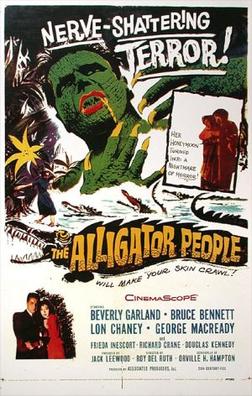
Horror Film Review: The Alligator People (dir by Roy Del Ruth)


You know what the worst bayou is?

Bayouself.

Thank you!  I’ll be here all night and don’t forget to tip your server!

Anyway, the 1959 film, The Alligator People, largely takes place in the bayous of Louisiana.  Nurse Jane Marvin (Beverly Garland) is suffering from amnesia so she allows two psychiatrist to give her a dose of truth serum and then, when she’s in a hypnotized state, she proceeds to remember her former life as Joyce Webster.

Joyce married a handsome and seemingly perfect man named Paul Webster (Richard Crane) but, right when they were about to go on their honeymoon, he received a telegram that disturbed him.  After he made a phone call, he vanished from Joyce’s life.  Joyce did some research of her own and discovered that Paul’s former home was the Cypresses Plantation in the small town of Bayou Landing, Louisiana.

When Joyce travels down to Bayou Landing, she discovers that there’s really not much there, other than a bunch of hungry alligators.  She meets the owner of the plantation, Lavinia Hawthorne (Frieda Inescort).  She also meets the handyman, Manon (Lon Chaney, Jr.), a one-handed brute who spends most of his day shooting at alligators.  And, eventually, Joyce comes across her husband but Paul is no longer the man that she remembers.

Paul’s skin is scaly and he only comes out at night.  It turns out that Paul was, long ago, injected with a serum that would allow him to grow back a missing limb.  The serum worked as far as the limb was concerned but an unfortunate side effect is that Paul is now turning into an alligator!  Dr. Mark Sinclair (George Macready), the man who came up with the serum in the first place, is hopeful that he can reverse the process but, to do so, he’s going to need a lot of radioactive material.

Complicating things is that Manon has decided that he wants Joyce for himself and he’s certainly not going to compete with some alligator man for her attention.  Of course, Joyce despises Manon from the first moment she sees him but Manon’s not that smart.  Can Paul be cured before Manon destroys everything?

The Alligator People is one of those 1950s B-movies that is probably better-known for its name than anything else.  That said, when taken on its own terms, it’s an entertaining watch.  It was one of the final films to be directed by Roy Del Ruth, who had previously been one of Hollywood’s top directors of musicals and comedies.  There’s not much music or deliberate comedy to be found in The Alligator People but Del Ruth does manage to capture the humid stillness of the bayous.  As always, Beverly Garland gives a strong performance as a determined woman who isn’t going to be told what to do and Richard Crane is about as convincing as one can be while turning into an alligator.

As for Lon Chaney, Jr, he plays Manon as being a total monster and he gives a convincing performance, even if it is hard not to mourn the loss of the shadings that he brought to his monster roles while he was with Universal.  Manon is a rough and determinedly unintelligent character, one who exists only to destroy.  Significantly, he’s not one of the Alligator People.  Instead, he’s just a man who doesn’t care about anyone but himself.

The Alligator People is an effective B-movie, full of a bayou atmosphere.

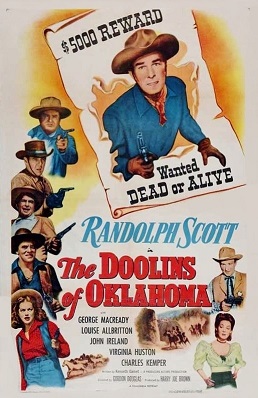
The Doolins of Oklahoma (1949, directed by Gordon Douglas)


Randolph Scott stars in The Doolins of Oklahoma, a fictionalized account of the career of the real-life western outlaw, Bill Doolin.

Doolin (played, naturally, by Randolph Scott) may have once rode with the fearsome Dalton Brothers but, according to this film, he was actually just an ordinary, salt of the Earth type who wanted to settle down with the right woman and lead a normal life. It looks like he might get that opportunity after the Daltons are killed and Doolin tires of leading his own gang of outlaws. Doolin settles in a Oklahoma town, takes a new name, and falls in love with Elaine (Virginia Hutton). But when both the members of his old gang and a veteran lawman (George Macready) show up in town, Doolin learns that the past cannot be escaped.

The plot of The Doolins of Oklahoma is nothing special, though it’s portrayal of the outlaws being more honorable than law enforcement may have been surprising in 1949. The main thing that distinguishes The Doolins of Oklahoma is the cast, which is full of western veterans like John Ireland, Noah Beery Jr., Charles Kemper, Frank Fenton, and Jock Mahoney. Not surprisingly Randolph Scott is ideally cast as a weary cowboy who just wants to settle down and live the rest of his life in peace. Scott is well-matched by MacReady, as the marshal who will not let anything stand in the way doing his duty as a member of law enforcement. Gordon Douglas directs crisply and energetically and every member of the main cast gets at least one big moment in which to distinguish themselves. The Doolins of Oklahoma may not be a groundbreaking film but it will be enjoyed by fans of the western genre.


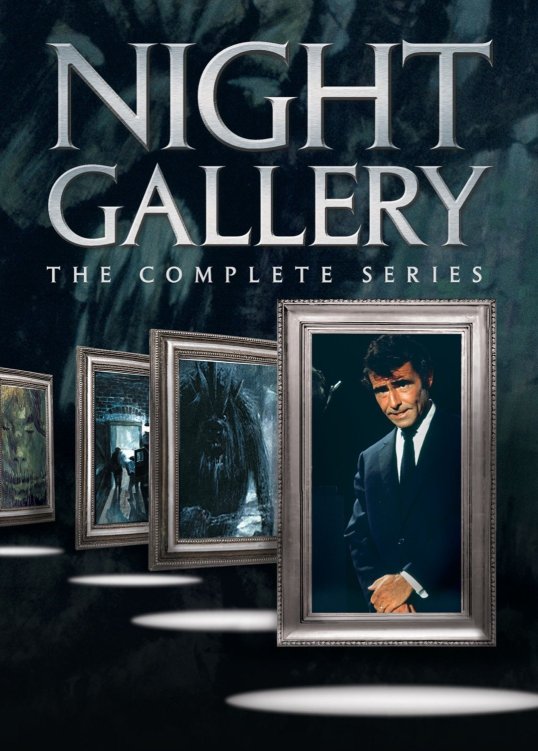
Film Review: Night Gallery (dir by Boris Sagal, Barry Shear, and Steven Spielberg)


Night Gallery was a horror anthology series that aired on NBC in the early 70s.  Each episode featured Rod Serling, of Twilight Zone fame, serving as the curator of a museum where all of the paintings have a somewhat macabre theme.  (One could even say that the museum was a …. wait for it …. night gallery!)  Serling would give each painting a properly pithy introduction and then the audience would see the story behind the artwork.  It was a bit like the Twilight Zone, except the Night Gallery episodes were in color, they were all horror-themed, and, for the most part, they steered away from social commentary.  The series ran from 1970 and 1973 and it still airs in syndication and on some of the retro stations.  (I believe it currently airs on Comet TV.)  Even if it wasn’t as consistently good as Twilight Zone, it’s still a pretty fun little series.

Two Christmases ago, I was gifted  Night Gallery: The Complete Series on DVD.  Though I’ve watched several episodes from the DVD, I recently realized that I have never actually sat down and watched every episode in order.  With the world currently shut down due to the pandemic (a development that, if we’re going to be honest, sounds like something Rod Serling would have used on the Twilight Zone), I figured what better time to watch the entire series then now?

I started out by watching the Night Gallery pilot film.  This originally aired on November 8th, 1969, a full year before Night Gallery became a weekly series.  It features three different stories (all written by Rod Serling) of the macabre.  As with every episode of the subsequent series, each story is introduced by Serling standing in front of a painting.  In the pilot, though, the museum is rather bare and the painting’s are a bit minimalist.  I have to admit that, as a lover of the baroque, I was a bit disappointed in that aspect of the pilot.

But what about the stories themselves?  Read on!
The Cemetery (dir by Boris Sagal)

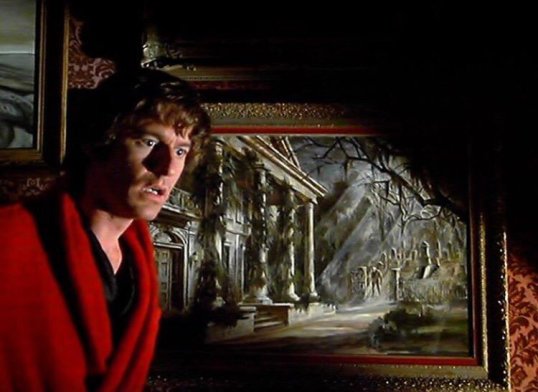
The first story was The Cemetery, a cheerfully gruesome little tale that featured Roddy McDowall and Ossie Davis.  McDowall plays Jeremy, a spoiled young man who murders his uncle so that he might inherit the dead man’s estate.  At first, it looks like McDowall’s plot is a complete success but then McDowall notices a painting of the family graveyard hanging above a staircase.  (To be honest, it seems odd to hang a painting of a graveyard in the foyer but I guess that’s something old rich people do.)  The painting keeps changing.  One minute, the painting looks normal.  The next minute, it features a newly dug grave.  And then something emerging grave.  And then something heading towards the house….

Is Jeremy losing his mind or is the painting warning him that his uncle has risen from the dead and is seeking revenge!?  You’ll probably be able to guess the answer long before poor Jeremy but no matter.  This is a fun little horror story and it benefits from two enjoyably arch performances, from McDowall and, in the role of a butler who may have an agenda of his own, Ossie Davis.
Eyes (dir by Steven Spielberg)

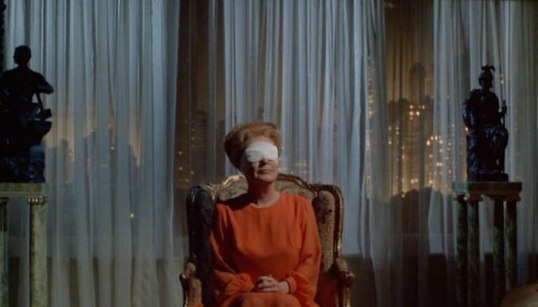
Of the three stories presented in the pilot, Eyes probably gets the most attention from critics because it not only stars Joan Crawford in one of her final performances but it was the professional directorial debut (if you don’t count Amblin’) of 22 year-old Steven Spielberg.  Spielberg apparently had some issues dealing with the veteran crew members, many of whom didn’t like the idea of taking orders from a 22 year-old.  (It probably didn’t help that pictures from that era suggest that Spielberg looked several years younger than his age.  Let’s just say that it’s easy to understand why he eventually grew that beard.)  I’d like to think that Joan Crawford yelled at everyone and defended Spielberg and maybe even Rod Serling came down with Luca Brasi and said, “You’re going to the give this kid the respect he deserves or your brains are going to be all over that union contract.”  I don’t know if that’s true but it’s a nice thought.

That said, Eyes is pretty good.  Even if the crew doubted him, Spielberg proved himself as a director with this story.  It’s about a hateful and selfish woman (Joan Crawford) who happens to be both rich and blind.  She has manipulated a doctor into performing an experimental operation that will allow her to see.  The only catch is that the operation will only be good for 22 hours and a donor (Tom Bosley, as a bookie who is in trouble with the mob) will be required to give up his eyes so that Crawford can have those 22 hours.

On the one hand, this is very-much a Rod Serling-type tale.  It’s easy to imagine Eyes, with its belief in karma and its final macabre twist, as a Twilight Zone episode.  At the same time, Spielberg very much brings his own signature style to the film, livening up dialogue-heavy scenes with interesting camera angles and getting good performances from Crawford, Barry Sullivan, and Tom Bosley.  Eyes is a clever story but, for modern viewers, the most interesting thing about it will be discovering that, even at the age of 22, Spielberg already had a clear directorial style.
The Escape Route (dir by Barry Shear)

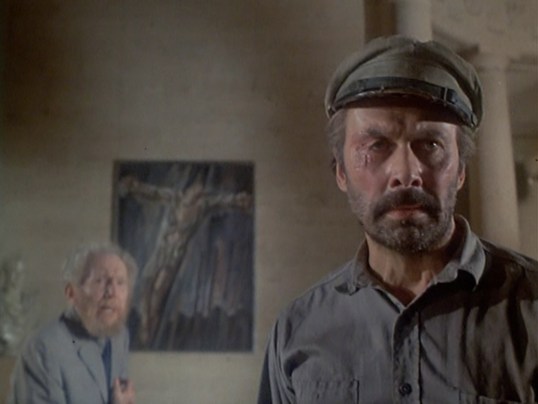
The Escape Route is about an Nazi war criminal named Joseph Strobe (played by Richard Kiley) who is hiding out in South America and spending all of his time nervously looking over his shoulder.  One day, he enters a museum where he finds himself drawn to two paintings.  One painting features a man who has been crucified in a concentration camp, which we learn was Strobe’s trademark back when he, himself, was a camp commandant.  The other painting features a fisherman in a peaceful setting.  Even though Strobe imagines himself as the peaceful fisherman, his attention keeps getting redirected to the painting of the concentration camp.  Soon, Strobe realizes that a survivor of the camp (played by Sam Jaffe) is also in the museum and that he is studying the painting as well.

Compared to Eyes and especially The Cemetery, The Escape Route may seem like a rather low-key story but it has a power that sneaks up on you.  Hiding out (as many real-life Nazi war criminals did) in South America, Strobe is full of excuses for his past and he may indeed be sincere in his wish that he had just become a fisherman as opposed to a brutal Nazi.  But, in the end, Strobe can neither escape his past nor his final punishment.  Justice cannot be escaped, no matter how hard Strobe tries to outrun it.  In the end, there is no escape for the wicked.  Richard Kiley and Sam Jaffe both give excellent performances.  The Escape Route will stick with you.

As a series, Night Gallery was a bit uneven but the pilot stands as a classic of its type, featuring three short films that all deserve to be remembered.

As for me, I’m going to try to watch an episode or two a day.  I may review a few more Night Gallery episodes here on the Shattered Lens.  As I said, the series itself was a bit uneven and not every episode is as good as the pilot.  Still, there’s definitely some gems to be found in the Night Gallery and I’ll share them as I come across them.
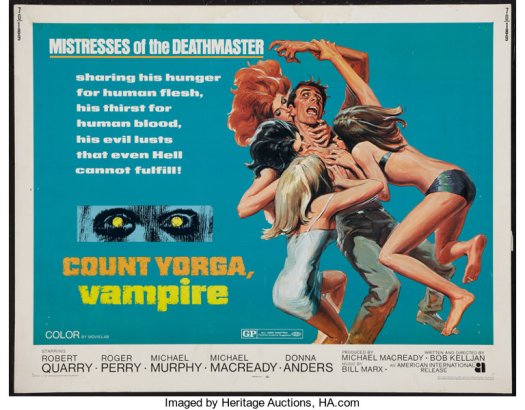
Bloody Good Show: Robert Quarry as COUNT YORGA, VAMPIRE (AIP 1970)


gary loggins's avatarcracked rear viewer

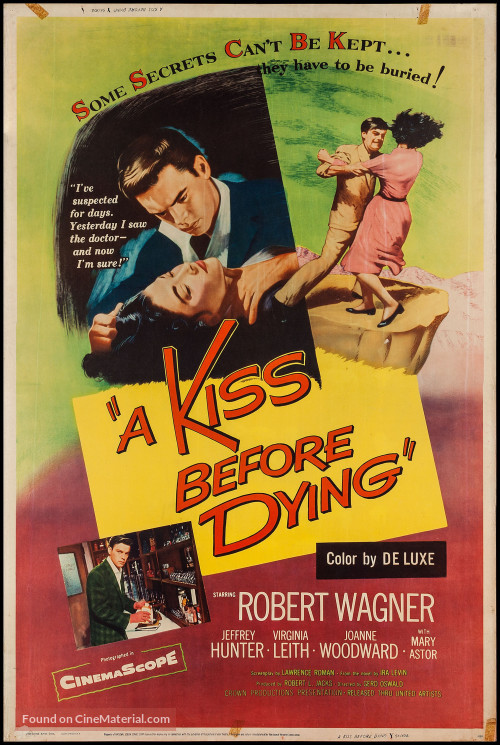
Robert Quarry’s screen career wasn’t really going anywhere by 1970. He had a good part in 1956’s soapy noir A KISS BEFORE DYING , but mostly he was relegated to uncredited bits in movies and guest shots on episodic TV. Quarry kept busy on the stage, until being approached by producer/actor Michael Macready to star in THE LOVES OF COUNT IORGA, originally envisioned as a soft core porn flick with horror elements. The actor said he would accept the job but only if it were turned into a straight modern-day vampire tale, and thus was born COUNT YORGA, VAMPIRE, launching Quarry into a new phase as a 70’s horror movie icon.

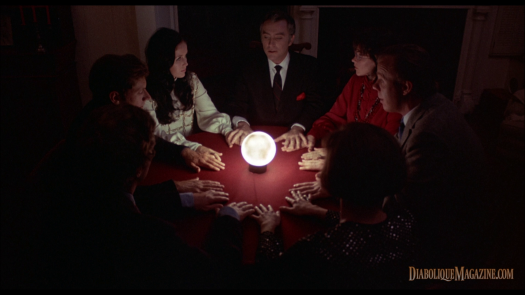
The plot is an updated version of Stoker’s DRACULA, with a few changes. Here, the Bulgarian-born Count Yorga is a recent transplant to California, and we first meet him conducting a séance on behalf of Donna, whose late…

View original post 758 more words

Silk Purse: MY NAME IS JULIA ROSS (Columbia 1945)


gary loggins's avatarcracked rear viewer

Columbia Pictures cranked out 52 films in the year 1945, mostly ‘B’ movies with titles like LET’S GO STEADY, I LOVE A MYSTERY, EVE KNEW HER APPLES, ROCKIN’ IN THE ROCKIES, TEN CENTS A DANCE, and THE ADVENTURES OF RUSTY, along with their continuing series featuring Blondie, Boston Blackie, The Crime Doctor, The Durango Kid, and The Whistler. They were programmers, budget jobs, designed to fill a double bill  and a theater’s seats, bread-and-butter movies with no pretenses to reach any artistic heights.

MY NAME IS JULIA ROSS was one of those programmers, a quickie cashing in on the success of the previous year’s hit GASLIGHT. Whereas MGM’S psychological thriller boasted stars Ingrid Bergman and Charles Boyer directed by George Cukor, Columbia headlined their contract players Nina Foch and George Macready , good, competent actors but hardly box office draws. And in place of Cukor, Joseph H. Lewis sat in…

View original post 485 more words

Halloween Havoc!: ALIAS NICK BEAL (Paramount 1949)


gary loggins's avatarcracked rear viewer

The worlds of supernatural horror and film noir collided to great effect in ALIAS NICK BEAL, John Farrow’s 1949 updated take on the Faust legend. The film wasn’t seen for decades due to legal complications, but last August the good folks at TCM broadcast it for the first time. I have been wanting to see this one for years, and I wasn’t disappointed! It’s loaded with dark atmosphere, a taut screenplay by hardboiled writer/noir vet Jonathan Latimer , and a cast of pros led by a ‘devilish’ turn from Ray Milland as Nick Beal.

The Faust character this time around is Joseph Foster, played by veteran Thomas Mitchell . Foster is an honest, crusading DA with political ambitions. When he says aloud he’d “give my soul” to convict racketeer Hanson, Foster receives a message to meet a man who claims he can help. Summoned to a seedy tavern on…

View original post 607 more words

Horror on TV: Thriller 2.4 “The Weird Tailor” (dir by Herschel Daugherty)


On tonight’s episode of Thriller, we see what happens when an aspiring sorcerer (George MacReady) accidentally kills his son.  In order to brings his son back to life, he has to have a special suit made by the weird tailor of the title (played by Henry Jones).

This is one of the better episode of Thriller.  For once, the use of the word “weird” in the title is not a misnomer!  This one was written by Robert Bloch, who adapted his own short story.  It originally aired on October 16th, 1961.

http://www.youtube.com/watch?v=UO4JK90dQss

Soapy Noir: A KISS BEFORE DYING (United Artists 1956)


gary loggins's avatarcracked rear viewer

A KISS BEFORE DYING is part soap opera, part film noir, and 100% 50’s kitsch! Based on the best selling debut novel by Ira Levin (who went on to give us ROSEMARY’S BABY and THE STEPFORD WIVES), it’s also the debut of director Gerd Oswald (who went on to give us AGENT FOR HARM and BUNNY O’HARE !).  Lawrence Roman’s screenplay has some suspense, but his characters are all pretty dull and dumb, except for Robert Wagner’s turn as a charmingly sick sociopath.

Wagner is college student Bud Corliss, from the wrong side of the tracks, dating rich but naïve Dorie Kingship (Joanne Woodward) to get his hands on dad’s copper mine loot. And when I say naïve I’m not just whistling Dixie; this girl’s downright dense! Bud, after learning she’s pregnant, decides the best thing to do is not marry her, but bump her off. He whips up some poison…

View original post 563 more words

A Movie A Day #189: Knock On Any Door (1949, directed by Nicholas Ray)


Knock On Any Door opens with the murder of a policeman in New York City. Nick Romano (John Derek) is arrested for the crime. Nick is a troubled young man who has grown up in the slums and is fond of saying that his goal is to “Live fast, die young, and leave a good-looking corpse.” Now on trial for his very life, Nick reaches out to lawyer Andrew Morton (Humphrey Bogart), who once unsuccessfully defended Nick’s father in a similar criminal trial. At first, Morton wants nothing to do with Nick but he changes his mind, partially out of guilt over Nick’s father and partially because Morton himself came from the same slums that produced Nick. Even as the district attorney (George Macready) goes for blood, Morton argues that Nick isn’t a menace but instead a victim of a society that left him with little choice but to become a criminal.

Knock Any Door is heavy-handed but, for fans of Humphrey Bogart and Nicholas Ray, this is an essential film. Bogart produced this film himself and the subject matter was very important to him.  Bogart, the classic tough guy with a heart of gold, gives one of his best performances, delivering his closing statement with such conviction that it is impossible not to be moved.  Though Ray’s direction is often heavy-handed and the courtroom scenes are sometimes too stagey, Knock On Any Door sees him exploring the same themes that he would later explore in Rebel Without a Cause and with the empathy that made that later film a classic.