Late Night Retro Television Review: Friday the 13th: The Series 3.13 “Midnight Riders”


Welcome to Late Night Retro Television Reviews, a feature where we review some of our favorite and least favorite shows of the past! On Fridays, I will be reviewing Friday the 13th: The Series, a show which ran in syndication from 1987 to 1990. The entire series can be found on YouTube!

This week, the show attempts a change of pace!

Episode 3.13 “Midnight Riders”

(Dir by Allan Eastman, originally aired on January 29th, 1990)

An odd episode, this one.

Jack, Micki, and Johnny head out to a small town so that Jack can look up into the night sky and see a once-in-a-lifetime convergence of the stars.  However, possibly as a result of the convergence (it’s never really made clear), a bunch of dead motorcycle riders are resurrected and they rumble into town, seeking vengeance on everyone who took part in the death of their leader.  If the bikers can kill every one of them, their leader will be resurrected.  Finally, the ghost of Jack’s father (Dennis Thatcher) shows up and works with Jack to stop the bikers.  It turns out that Jack and his father had a difficult relationship.  Ryan had a difficult relationship with his father.  Johnny was falsely accused of murdering his father.  We’ve never met Micki’s father but he’s probably a jerk too.

The weird thing about this episode is that it didn’t feature a cursed antique.  Instead, Jack and the crew went to a small town and supernatural stuff started happening shortly after they arrived.  That’s okay, I guess.  In theory, there’s nothing wrong with trying something new.  But, at the same time, the cursed antiques were what set this show apart from all of the other supernaturally-themed television series out there.  Personally, even when the antique’s curse makes no sense, I still enjoy seeing what the show comes up with.

This episode had a lot of atmosphere and a typically good performance from Chris Wiggins.  The ghost bikers were never quite as intimidating as they should have been, despite all of the murders.  If anything, they reminded me a bit too much of Sometime They Come Back.  This episode was a change of pace and, as if often the case with things like this, it didn’t quite work.  Here’s hoping next week will have a cursed antique!

Late Night Retro Television Review: Friday the 13th The Series 2.3 “And Now The News”


Welcome to Late Night Retro Television Reviews, a new feature where we review some of our favorite and least favorite shows of the past! On Fridays, I will be reviewing Friday the 13th: The Series, a show which ran in syndication from 1987 to 1990. The show can be found on YouTube!

This week, Jack is on vacation so Ryan and Micki try to retrieve an antique on their own.  Near disaster ensues.  I swear, why is Jack always running off?  How can you take a vacation when your job is to literally save the world?  You know who never got a decent vacation?  Atlas.

Anyway, onto the episode….

Episode 2.3 “And Now The News”

(Dir by Bruce Pittman, originally aired October 14th, 1988)

With Jack on vacation, it falls to Micki and Ryan to track down the latest antique, a cursed radio that will reveal information to its owner as long as the owner uses the radio to kill a certain number of people.  (The radio brings people’s greatest fears to life.  So, if you’ve got a thing about snakes, watch out!)  Micki and Ryan discover that the radio is currently in the possession of Dr. Avril Carter (Kate Trotter), who works at the local mental hospital and who is murdering patients so that the radio will help her with her research.  Dr. Carter really wants to win that Nobel Prize.

Ryan and Micki really probably should have waited for Jack to come back because their attempts to get the radio back leads to one disaster after another.  Ryan even manages to get electrocuted while trying to climb over the hospital’s security fence.  Micki, meanwhile, does manage to get into the hospital but she is soon reminded that the majority of the patients are serial killers and perverts.

The best thing about this episode is that radio actually has a voice.  Henry Ramer provides the voice of the “radio announcer,” who says stuff like, “And now the news …. after this murder” and such.  At the end of the episode, it even taunts Dr. Carter when she fails to kill the required number of people and announces that Carter will never win a Nobel Prize.  (The radio then proceeds to electrocute her.)  In a nice touch, the announcer continues to talk to Ryan and Micki even when they’re taking it down to the vault.  It offer to help them out in their quest, in return for a certain amount of murders.  Micki and Ryan end up tossing the radio back and forth between the two of them.  The episode even ends with a freeze frame of the radio in the air.  Hopefully, they got it into the vault eventually.

This was a fun episode.  The mental hospital was a atmospheric location, the radio was an inspired antique, and Kate Trotter gave a good performance as the villainous Dr. Carter.  After two less than enthralling episodes, And Now The News was a definite return to everything that worked about the first season.

Late Night Retro Television Reviews: Check It Out! 1.12 “Skip to the Loo”


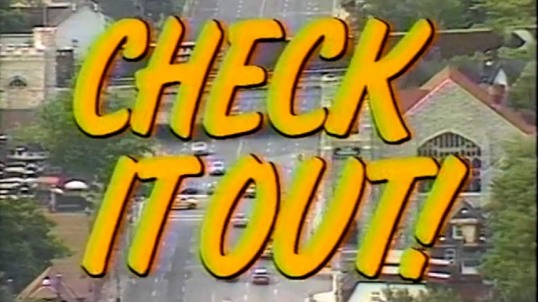
Welcome to Late Night Retro Television Reviews, a feature where we review some of our favorite and least favorite shows of the past!  On Saturdays, I will be reviewing the Canadian sitcom, Check it Out, which ran in syndication from 1985 to 1988.  The entire show is currently streaming on Tubi!

We’ve got a weird one tonight!

Episode 1.12 “Skip to the Loo”

(Dir by Alan Erlich, originally aired on December 18th, 1985)

This episode opens with Howard feeling a bit concerned.  As he explains to Edna, an old army buddy visited him the previous night.  Mad Mike Mulroney climbed through Howard’s window with three dead Dobermans around his neck.  Having just escaped from prison, Mad Mike asked Howard to do him a favor and give his son, Brandon, a job.  Howard felt that he had to agree because Mad Mike saved Howard’s life while they were serving in Korea.  Why, Howard cries, why did I let him do that!?

Brandon (Jeremy Ratchford) shows up and turns out to be as fearsome as his father.  Howard suggests that Brandon fill in for bagboy Murray, who is on vacation.  Brandon replies that he was hoping he could be a bouncer.  Brandon then proceeds to literally toss a lot of people out of the store.  Realizing that Brandon should not be on the sales floor, Howard suggests that Brandon spend the day in the meat locker where he can beat up the meat, Rocky Balboa-style.

Meanwhile, nerdy Herman Fastback (Howard Busgang) is trying to set the world record for skipping rope in the store.  Unfortunately, the world record is 12 hours and Herman keeps getting distracted and having to start over.  As well, Brandon keeps coming out the meat locker and taunting him.

When it’s time for the store to close, Christian agrees to spend the night in the store so that Herman can continue to set his record.  The next morning, Christian wakes up in a shopping cart and discovers that all of the cash registers have been emptied and the employee locker room has been ransacked.  Herman has disappeared and Brandon is dead in the meat locker!  When Howard and Alf come to work, they surmise that Herman robbed the store and then killed Brandon.

No one is that upset about Brandon being dead.  In fact, Howard doesn’t call the police and just leaves the body in the meat locker.  But then Mad Dog (George Buza) shows up in full military gear and announces that he is just a few hours from heading to South America, where he plans to overthrow another country’s government.  He tells Howard that he’s a mercenary and “I kill people for a living.”  Mad Dog asks how Brandon is doing.  It takes a while but eventually, Howard admits that Brandon is dead.

Mad Dog is not extremely upset about his son dying but he does request that Howard give him a funeral in the store.  Realizing that Mad Dog will probably kill him otherwise, Howard agrees.  He closes down the store and then Brandon’s frozen body is wheeled into the break room.  Howard conducts a respectful funeral.  Mad Dog is touched.

This episode was so strange that it was only during the end credits that I realized that Herman apparently got away with not only robbing the place but also killing Brandon.  In fact, I don’t think Howard or anyone else at the store bothered to call the police about any of this.  Instead, they just left Brandon in the meat locker.  I’ve never worked in a grocery store so I have to admit that I’m not the expert on these things but I think leaving a corpse inside a storage area would have to be a health code violation of some sort.

It’s difficult to dislike anything that’s this cheerfully weird.  This episode full embraced its own absurdity and, for that reason, it worked quite well.  We’re about halfway through the first season of Check It Out! and the best episodes are definitely the weird ones.

Next week …. well, I don’t know what’s happening next week.  Hopefully, they will have gotten Brandon’s body out of the store.

The TSL’s Grindhouse: Fast Company (dir by David Cronenberg)


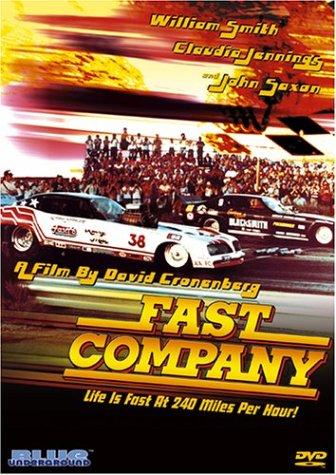
Released in 1979, Fast Company is a Canadian film about fast cars and the fast-living people who drive them.  Lonnie Johnson (William Smith) is a veteran drag racer who is so good at his job that his nickname is “Lucky Man.”  He rarely loses a race.  He’s never without an adoring fan or two, though he always remains loyal to his girlfriend, Sammy (Claudia Jennings).  Lonnie is so lucky that, even when one of his cars explodes, he walks away without even a scratch.

Lonnie and his protégé, Billy (Nicholas Campbell), are being sponsored by Fast Company, an international oil consortium.  The money is okay but Lonnie is getting old and he would like to step back and spend some more quality time with Sammy.  Unfortunately, the team boss is Phil Adamson (John Saxon) and the viewers knows that Phil is a bad guy because he’s played by John Saxon and, instead of driving to the races, he pilots his own private plane.  When Lonnie starts to rebel against Phil’s management, Phil schemes to not only replace him and Billy with rival driver Gary Black (Cedric Smith) but he also plots to repossess Lonnie’s prized car!

Okay, so it’s kind of a silly and predictable film.  In fact, there’s really only two reasons why Fast Company is remembered today.  

One is because it was the last film to feature B-movie star Claudia Jennings before her death in a traffic accident. Jennings was nicknamed the “Queen of the B movies” and, over the course of her brief career, appeared in a lot of films about fast cars.  She gives a likable performance as Sammy, even if the film’s script doesn’t really give her much to do.

Secondly, this film was directed by David Cronenberg.  This was Cronenberg’s first time to direct a film that he hadn’t written.  This was his first job as a “director for hire” but, interestingly enough, it was while directing this film that Cronenberg first worked with some of his most important future collaborators, including cinematographer Mark Irwin and actor Nicholas Campbell.  Cronenberg directed Fast Company in between Rabid and The Brood and Fast Company might as well take place in a different universe from either of those films.  To be honest, there’s not much about this film that would lead anyone to suspect that it had been directed by Cronenberg if they hadn’t already seen his name in the credits.  Cronenberg’s signature style is really only evident when the camera lingers over the scenes of the mechanics working on the cars.  In those scenes, there’s a hint of the Cronenberg that everyone knows, the Cronenberg who is fascinated by both the relationship between man and machine and how things work inside the body of both the driver and the car.

For the most part, Fast Company is a typical 70s racing film, one that was made for drive-in audiences and which makes no apologies for that fact.  (Nor should it.)  There’s a lot of shots of denim-clad Canadians cheering as their favorite driver crosses the finish line.  William Smith brings a world-weary dignity to the role of Lonnie Johnson but, while John Saxon is always fun to watch, Phil Adamson is so evil that he threatens to throw the tone of the film out of whack.  The light-hearted scenes of Lonnie, Billy, and head mechanic Elder (Don Francks) don’t always seem to belong in the same movie with scenes of John Saxon scheming to cheat and risk the lives of his drivers.  

In the end, though, the important thing is that the cars are fast and so is this quickly paced movie.  I’m enough of a country girl that I have to admit that I have a weakness for fast cars that leave a cloud of dust behind them.  On that level, I enjoyed the film and really, that’s the only level that matters when it comes to a film like Fast Company.

The TSL’s Horror Grindhouse: Diary of the Dead (dir by George Romero)


I have to admit that I was a little bit hesitant about watching the 2007 film, Diary of the Dead.

It wasn’t that I don’t like zombie movies.  In fact, it was the complete opposite.  I love zombie films and Night of the Living Dead is one of my favorites.  George Romero, of course, went on to make several sequels to Night of the Living DeadDawn of the Dead, Day of the Dead, and Land of the Dead are certifiable horror classics.  However, I had heard mixed things about the two zombie films that Romero directed after Land of the Dead.  Seeing as how Diary of the Dead was Romero’s second-to-last film before he passed away in 2017, I was worried that I would watch the film and discover that I hated it.  I didn’t want experience anything that would tarnish Romero’s cinematic legacy.  It didn’t help my expectations that Diary of the Dead is a found footage film and the conventions of the found footage genre tend to get on my last nerve.

(Seriously, nothing makes me throw a shoe at a screen quicker than the sound of someone in a horror movie saying, “Are you filming this?”)

But you know what?

I did watch Diary of the Dead and it’s actually not bad.  It may not reach the heights of Romero’s other zombie films but it’s definitely a worthwhile companion piece.  It opens with news reports about the start of the zombie apocalypse, meaning that Diary of the Dead is meant to take place at roughly the same time as Night of the Living Dead.  (Never mind that Diary of the Dead is full of references to YouTube and blogs and other things that most people probably couldn’t even imagine when Night of the Living Dead first came out.)  A group of film students are in the woods, filming a terrible mummy movie when they first hear reports of the dead coming back to life.  Some say that there’s no way it could be true.  Others say that something must be happening but surely the dead aren’t actually coming back to life.  They soon discover that the dead have indeed returned.

We follow the students as they travel across Pennsylvania, trying to find a place that’s safe from the Dead and discovering that there’s literally no such place left in America.  Along the way, they also discover that the government has no intention of telling the people the truth about what’s happening.  In fact, a group of national guardsmen turn out to be just as dangerous as the zombies.  In their efforts to survive, the students are forced to rely on an underground network of bloggers and video makers.

Diary of the Dead has all of the usual zombie mayhem that you would expect from a film like this but, at the same time, it’s got a lot more on its mind than just the dead returning to life.  Much as he did with Land Of The Dead, Romero uses Diary of the Dead to comment on the state of America under the Patriot Act.  With the government using the zombie apocalypse as an excuse to suspend civil liberties and increase their own power, the film’s characters are forced to depend on new and independent information sources.  It’s not hard to see the parallel that Romero is making between the War on the Living Dead and the War on Terror.  As well, making all of the characters film students allows for some discussion about whether or not horror films should simply concentrate on being scary or whether they should also attempt to deal with real-world issues.  The film leaves little doubt where Romero came down on that issue.

On the negative side, Diary of the Dead struggles a bit to overcome the limitations of its low budget and none of the characters are as compelling as Ben in Night of the Living Dead or Fran in Dawn of the Dead.  At times, you find yourself wishing that Diary of the Dead featured just one actor who was as into their role as Duane C. Jones or Ken Foree were in Night of the Living Dead and Dawn of the Dead, respectively.  But Diary of the Dead still features enough zombies and enough of Romero’s trademark political subtext to be an acceptable addition to Romero’s vision of the apocalypse.