Film Review: Cast Away (dir by Robert Zemeckis)


“WILSON!”

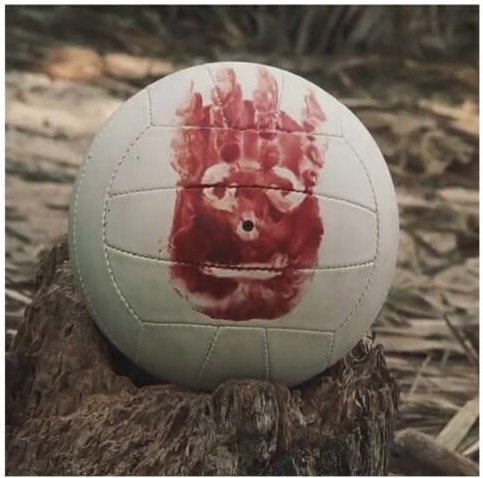
Seriously, I’m usually pretty well-behaved when I watch a movie but every time I see the 2000 film Cast Away, I find myself thinking, “Protect Wilson!  You must protect Wilson!”  And then, every time, I feel the sting of tears in my eyes as Wilson, with that red-face and that understanding attitude, goes floating away.

Wilson is a volleyball.  When a FedEx executive named Chuck Noland (played by Tom Hanks) finds himself stranded on a desert island, Wilson becomes his only companion.  A stain from Chuck’s bloody palm creates something that resembles a face on Wilson’s rubber surface and Chuck spends a lot of time talking to Wilson.  It’s how Chuck maintains his sanity, even as he loses weight, sheds most of his clothes, and grows a beard.

Chuck learns how to make fire.  He learns how to catch fish.  He is able to survive due to the supplies that he gathers from the FedEx packages that were being carried on the plane that crashed into the island.  But Chuck never stops dreaming of returning home to his girlfriend (Helen Hunt).  Eventually, Chuck finds the courage to try to make the journey back to civilization.  He brings Wilson with him but ultimately, this is something that Chuck is going to have to do on his own.  Of course, Chuck has failed to consider that he’s been gone for years.  He is presumed dead.  On the Island, time seemed like it was frozen.  For the rest of the world, life has continued.

Cast Away is a film that a lot of people, especially online film commentators, tend to criticize.  The complaint is usually that the film is essentially a commercial for FedEx, that it’s not believable that Tom Hanks could survive on that island for as long as he did, and that the film itself has a weak ending.  I’ll concede that the film does make FedEx look like the nicest corporation on Earth.  (FedEx’s CEO appears as himself, which should tell you something about how the company is presented.)  And I will admit that the film’s time-advancing jump cut, which abruptly takes Hanks from being clean-shaven and husky to being thin and bearded, does leave a lot of unanswered questions.  But I will always defend the film’s ending.  The film ends on a note of ambiguity but how else could it have ended?  Everyone thought Chuck Noland was dead.  His girlfriend had every right to get on with her life and, in fact, it would have been psychologically unhealthy for her if she hadn’t.  As for that final shot, it’s an acknowledgment that Chuck doesn’t know what lies ahead of him in the future.  All he knows is that he life isn’t over yet.  It’s a melancholy ending.  It’s a frustrating ending.  But it’s also the only way the film could have ended and therefore, it’s a perfect ending.

Cast Away is a film that I will always defend and it’s also a film that really only could have worked with Tom Hanks in the lead role.  He plays Chuck as being the ultimate everyman, an affable guy who was just trying to do his job and whose survival of the initial plane crash was largely due to luck.  Hanks is one of those actors who is instantly sympathetic and Cast Away uses his screen persona to good effect.  You want him to survive because he’s Tom Hanks.  He may be playing a character named Chuck Noland but ultimately, he’s Tom Hanks.  He survived being trapped in space.  Surely, he can survive being stranded on an island.  The majority of the film is just Hanks talking to himself.  This would have brought out the worst in so many actors but Tom Hanks makes it work.  And yes, he’ll bring tears to your eyes as he watches Wilson float away.  That’s the power of a good actor.

As for Wilson, I like to think that he washed up in Pensecola.  Recently, I played a little volleyball on a beautiful Florida beach.  Was that you, Wilson?
 

Back to School Part II #20: Secret Admirer (dir by David Greenwalt)


Secret_admirer

After I finished watching Girls Just Want To Have Fun, it was time for the 1986 film, Secret Admirer!

Secret Admirer is a fairly good example of a film that is dependent upon the idiot plot.  Every plot complication could have been avoided by the characters not being idiots.  The entire storyline could have been resolved within five minutes if some of the characters had been willing to ask questions before jumping to assumptions.  Idiot plots tend to fun when they deal with teenagers, largely because, when you’re that age, you can get away with being an idiot.  That’s part of the charm of being a teenager and why nobody ever wants to grow up.  When you’re a teenager, you’re not expected to have any common sense or knowledge of the real world so you can get away with a lot more.  At the same time, idiot plots involving adults tend to be annoying because adults really should know better.  The idiot plot of Secret Admirer involves both teenagers and adults and, as a result, the film is half-charming and half-annoying.

Smart but shy Toni (Lori Loughlin) has a crush on her lifelong friend, the sweet but kinda stupid Michael (C. Thomas Howell).  So, Toni writes Michael an incredibly eloquent love note and slips it into his locker.  When Michael finds the note, he assumes that it was written by Debbie (Kelly Preston), who is pretty and popular but only dates college students.  When Michael attempts to write a response to Debbie, he is sabotaged by his limited vocabulary, lack of eloquence, and general dimness.  Luckily, Toni finds the note and, wanting to spare Michael any embarrassment, rewrites it for him.  Debbie is so touched by Toni’s note that she goes out on a date with Michael.  Toni is forced to stand in the background and watch while the boy she loves falls for a girl who is obsessed with shopping.  (Secret Admirer suggests that this obsession indicates that Debbie is shallow but seriously, who doesn’t love to shop?)  Will Toni tells Michael that she loves him or will she leave him so that she can spend a year studying abroad?  (Personally, I would leave and have fun exploring Europe but then again, I also love to shop so obviously, Toni and I have conflicting worldviews.)

But that’s not all!  Michael’s dad, George (Cliff DeYoung), also finds the note and assumes that it was written to him by Debbie’s mom, Elizabeth (Leigh Taylor-Young).  Of course, Debbie’s father, a police detective named Lou (the always gruff Fred Ward), also comes across the note and becomes convinced that George and Elizabeth are having an affair.  He somewhat forcibly recruits George’s wife, Connie (Dee Wallace Stone), to help him expose George and Elizabeth for being the cheaters that he believes them to be….

I got annoyed with the parents fairly quickly.  It’s always fun to watch Fred Ward grimace and glare at people but otherwise, all of the adults were way too stupid and their behavior reminded me of that terrible episode of Saved By The Bell where the exact same thing happens to Mr. Belding.  Secret Admirer works best when the adults are pushed to the background and the film concentrates on the relationship between Toni and Michael.  They’re a sweet couple and you really want to see them end up together.  Michael may be stupid but he’s still really cute and the film is perfectly charming whenever it concentrates on him and Toni.

Incidentally, Michael has several friends.  They all ride around in a van and look through old issues of Playboy together.  Most of the friends are interchangeable but I did like Ricardo (Geoffrey Blake), just because he was wearing a suit and a fedora for no particular reason.  Ricardo didn’t really get to do much but his fashion sense made a definite impression.

By the admittedly high standards of 80s teen films, Secret Admirer is a minor film.  It’ll never be mistaken for Sixteen Candles or Pretty In Pink.  That said, it’s still an entertaining and occasionally sweet film.  You’ll want to skip over the scenes involving the adults but the scenes involving C. Thomas Howell and Lori Loughlin are perfectly charming.

http://www.youtube.com/watch?v=iFtxW9WNs9k