This review might be a bit biased, as I’m a fan of actor Jim Cummings’ work. I loved The Wolf of Snow Hollow and his brief cameo in Halloween Kills. The moment Francis Galluppi’s Last Stop at Yuma County was released on Apple Films, I bought it. Not even a rental. At 90 minutes, it’s a short crime thriller that fits in well with those late night gems you may come across.
On his way home to celebrate his daughter’s birthday, a Knife Salesman (Cummings) arrives at a gas station in Yuma County, Arizona, only to find that the station’s gas truck is a bit delayed. He decides to wait for the truck in the the gas station’s diner. Additionally, the news on the radio is going around about a recent heist of a nearby bank. Similar to movies such as Legion or Tales From the Crypt Presents : Demon Knight, the Diner makes a great setting for a standoff when the two robbers make an appearance – played by Richard Brake (Barbarian) and Nicolas Logan (I Care a Lot). Can the Knife Salesman and the local waitress, Charlotte (Jocelin Donahue, The House of the Devil) make it through the day and save themselves?
For his first production, Galluppi handled things well, I felt. The shots are evenly paced, well lit and framed in such a way where it doesn’t feel like the camera lingers too much or is too shaky. The strongest part of The Last Stop in Yuma County are the characters. Cummings, Brake, and Logan are the stand outs, but everyone contributes to the story in their way. The film dances between drama and comedy pretty quick, which had me chucking in moments before getting jolted back to reality with the ever changing situation.
If the movie has any kind of drawback, it’s that some of the story’s elements aren’t fully closed up by the time the film ends. It’s not a terrible thing, considering where the focus of the story moves, but a little more closure would have been nice. Outside of that, The Last Stop at Yuma County is worth the watch.
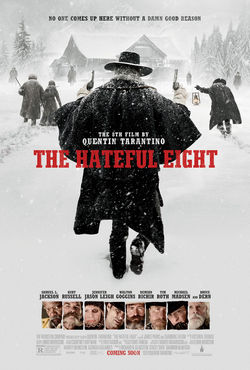
Remember how I said that it was intimidating to admit that The Big Short didn’t do much for me as a viewer? Well, it’s even more intimidating for me to admit that I felt much the same way about The Hateful Eight as well.
Nearly everyone I know loves The Hateful Eight and, going into it, I really wanted to love it as well. After all, this is — as the opening credits remind us — Quentin Tarantino’s 8th film! Tarantino is one of my favorite directors. I thought his last film, Django Unchained, was a masterpiece and one of the most important films ever made about slavery. Like many of you, I’ve followed all the details of the making of The Hateful Eight, from the initial script leak to the controversy over Tarantino’s comments on the police. I was excited because the cast looked great and was full of veteran actors — like Kurt Russell, Jennifer Jason Leigh, and Bruce Dern — who all seemed likely to benefit from the Tarantino touch. (Say what you will about Quentin Tarantino, it cannot be denied that he’s given good roles to talented actors who are rarely given the opportunities that they deserve.) When I heard that Ennio Morricone was going to be providing the score, I got even more excited. Morricone and Tarantino; it seemed like the perfect combination for greatness.
Well, Morricone’s score is spectacular. There’s talk that Morricone might finally win an Oscar for his work on The Hateful Eight and I certainly don’t have a problem with that. (Hopefully, Morricone will have learned a lesson from the Golden Globes and, if he is nominated, he will either come to the ceremony himself or arrange for someone other than Tarantino to accept for him.) And Jennifer Jason Leigh takes full advantage of her role, giving a truly ferocious performance.
But otherwise, The Hateful Eight just didn’t do much for me. It’s not that I disliked the film. There was a lot that worked but, for whatever reason, The Hateful Eight never enthralled me the way that past Tarantino films have. The Hateful Eight left me saying, “Is that it?”
A lot of my reaction to The Hateful Eight has to do with the film’s length. Taking place, for the most part, in only one location and structured more like a play than a film, The Hateful Eight would be a great 90 minute murder mystery. Instead, it lasts nearly 3 hours and, at times, the film drags interminably. As usual, Tarantino plays with time and, at one point, stops the action so that we can see what happened earlier in the day. Unfortunately, as opposed to other Tarantino films, we don’t really learn anything new from this flashback and you get the feeling that it was included most because flaskbacks are a Tarantino trademark and because he wanted to find a way to work a somewhat pointless Zoe Bell cameo into the film.
As for Tarantino’s widely acclaimed script, I have to admit that I got kind of bored with this talky film. Yes, the actors were all good and it’s always fun to listen to Samuel L. Jackson be a badass but the dialogue itself was largely repetitive and occasionally, the film itself threatened to turn into Tarantino-on-autopilot.
(Interestingly enough, Tarantino’s script features several creative euphemisms for oral sex and the characters come up with a handful of different ways to point out that Jackson is black but, when it comes to Jennifer Jason Leigh’s character, nobody can come up with anything more imaginative than repeatedly calling her a bitch. While, unlike some critics, I don’t think The Hateful Eight is a misogynistic movie, I do have to admit that I was rolling my eyes around the fifth time that Leigh’s character was called a bitch and kept rolling them for the entire movie. For a writer well-known for his ability to come up with colorful and memorable insults, Tarantino’s refusal to come up with anything more imaginative than “bitch” just felt lazy.)
What can I say? The Hateful Eight just didn’t do much for me. However, I do think that the film looked great and I certainly hope that Morricone and Leigh are at least nominated for their excellent work. I look forward to Tarantino’s next film but I doubt I’ll be revisiting The Hateful Eight any time soon.
(By the way, with this review, I am now officially caught up on reviewing the films of 2015!)
I love my home state of Texas and I love movies. Therefore, it has always upset me that most movies set in Texas get the state totally wrong. That’s not exactly shocking. Unlike the rest of the states, there’s actually a lot of variety to Texas. We’re a big state and we’re home to a lot of people. Unlike some place like Vermont, Texas is a world all its own and it’s not surprising that most outsiders are incapable of getting their mind around that and instead find themselves embracing simple-minded clichés and stereotypes. That’s perhaps why the best films about Texas tend to be ones that were actually made by Texans. If you want to see the real Texas — flaws and all — than I suggest watching the films of Richard Linklater or perhaps Wes Anderson’s Rushmore.
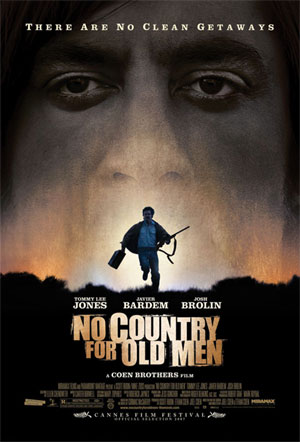
And yet, it took two outsiders to write, produce, and direct one of the best films ever made about Texas. The 2007 best picture winner No Country For Old Men was largely the work of two brothers from Minnesota, Joel and Ethan Coen. It’s not only one of the best films about my home state but it’s also one of the best films of the past decade.
Based on a novel by Cormac McCarthy, No Country For Old Men tells the story of three determined men in South Texas whose lives are interconnected despite the fact that three of them spend almost the entire movie one step behind each other. In fact, despite a few brief encounters where their paths meet, it can be argued that, at no point, do any of them truly interact with each other face-to-face.
Llewelyn Moss (Josh Brolin) is the type of person that anyone who has ever lived in Texas will have met. He’s a hard-working, plain-spoken man, the type who drives a pickup, owns a gun, and likes to begin and end the day with a beer. He lives in a trailer with his wife, Carla Jean (Kelly MacDonald, who may be Scottish but speaks here with an almost flawless Texas accent). Llewelyn’s not a bad guy but he’s not as smart as he thinks and, like a lot of folks down here, he doesn’t like the idea of being told what to do. In fact, he’d almost rather die for his trouble than admit to making a mistake. When Llewleyn comes across the aftermath of a drug deal turned violent, he takes off with a suitcase that contains $2,000,000. After barely escaping the remaining drug dealers (and the scene where Llewelyn is chased by a pit bull is a classic), Llewelyn sends Carla Jeans to stay with her sick mother and then he grabs the suitcase and heads over to the next county. It quickly becomes apparent, to the viewers at least, that Llewelyn has absolutely no idea how to get out of the mess that he’s found himself in.
And it’s quite a mess because Anton Chigurh (Javier Bardem) has been hired to track down the money. Perhaps one of the greatest movie villains of all time, Chigurh is an almost unstoppable force of death and destruction. Chigurh pursues Llewelyn across Texas, killing almost everyone who he meets along the way. Interestingly enough, just as Llewelyn continually makes excuses for his own greed, Chigurh also makes excuses for his murderous activities, seeming to obsess over the role of fate and chance. Whereas Llewelyn refuses to give up the suitcase, even though it means that he’s putting his own wife in danger, because he insists that he can figure out a way to keep the money, Chigurh occasionally dodges responsibility for his own actions by flipping a coin and putting the blame on fate.
And finally, there’s Sheriff Ed Tom Bell (Tommy Lee Jones), who is both the most decent and the most ineffectual male character to be found in the film. He’s an old-fashioned lawman, the type who, had this film been made in the 50s or the 60s, would have been played by Gary Cooper and would have both vanquished Chigurh and given Llewelyn and Carla Jean marriage advice as well. In the world of No Country For Old Men, however, Ed is almost always one step behind both Chigurh and Llewelyn. Instead of saving the day, Ed spends most of the movie shocked and saddened by the violence around him. As the film draws to its conclusion, he’s left to wonder whether any one man can make a difference. He’s left to literally wonder whether his area of South Texas has truly become no country for old men.
I recently rewatched No Country For Old Men on TCM and I was surprised to discover just how well this film holds up, even after repeat viewings. If anything, the film actually improves on repeat viewings. Once you know how the story is going to end (and, in a fashion typical of both the Coens and Cormac McCarthy, No Country For Old Men does not have a traditional ending), it’s easier to see all of the things that you may have been too overwhelmed to appreciate the first time, like Kelley McDonald’s performance as Carla Jean and Stephen Root’s cameo as Chigurh’s shady employer.
However, for me, the main reason that I appreciate No Country For Old Men is because it is one of the few films that actually manages to get South Texas right. My mom was born and grew up in South Texas, in the town of Benavides to be exact. I’ve spent a lot of time down there. The portrait that No Country For Old Man paints of South Texas is not always flattering but it is largely accurate. No County For Old Men captures both the region’s terrifying violence and its natural beauty. It’s honest about the fact that there are men like Anton Chigurh but, at the same time, you occasionally meet an Ed Tom Bell as well. And, of course, there’s a Llewelyn Moss in every town. He’s the one who you meet and you hope — often against your better instincts — that he won’t get in over his head.
The Academy named No Country For Old Men the best film of 2007. For once, the Academy was right.

 Through the Shattered Lens