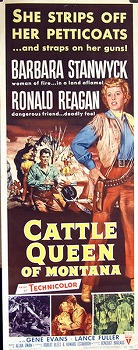
Cattle Queen of Montana (1954, directed by Allan Dwan)


Pop Jones (Morris Ankurm) and his daughter Sierra Nevada (Barbara Stanwyck) leave their ranch in Texas and head up to Montana to take over some land that Pop has inherited.  Evil Tom McCord (Gene Evans) wants the land for himself and conspires with a member of the local Blackfoot tribe, Natchakoa (Tony Caruso), to take it over.  After a surprise attack leaves Pop dead, Sierra is nursed back to health by Colorados (Lance Fuller), the son of the Blackfoot chief.  Sierra tries to reclaim her land from McCord, with the eventual help of the mysterious gunslinger Farrell (Ronald Reagan).

There are a lot of reasons why this B-western doesn’t really work, a huge one of them being that Barbara Stanwyck was several years too old to be playing Morris Ankrum’s innocent daughter.  The biggest problem though was casting Ronald Reagan as a mysterious gunslinger.  Farrell is a character who is supposed to keep us guessing.  We’re not supposed to know if he’s a good guy or a bad guy.  But as soon as Ronald Reagan shows up and starts to speak, we know everything we need to know about Farrell.  There was nothing enigmatic or even dangerous about Ronald Reagan’s screen persona.  He came across as being more open and honest as just about any other actor from Hollywood’s Golden Age.  For the role of Farrell, it appears that he went a day without shaving and he tried not to smile while on-camera but he’s still good old dependable Ronald Reagan.  That pleasantness and lack of danger may have kept him from becoming an enduring movie star but it did serve him very well when he moved into the political arena.

Cattle Queen of Montana was one of the 200 westerns that Allan Dwan directed over his long career.  It’s not one of his more interesting films, though he does manage a few good action sequences.  A far better Dwan/Reagan collaboration was Tennessee’s Partner, which was released four years after this film.

Retro Television Reviews: Dragnet 1966 (dir by Jack Webb)


Welcome to Retro Television Reviews, a feature where we review some of our favorite and least favorite shows of the past!  On Sundays, I will be reviewing the made-for-television movies that used to be a primetime mainstay.  Today’s film is 1969’s Dragnet 1966!  It can be viewed on YouTube!

“This is the city….”

So begins Dragnet, a television movie version of the classic cop show that was the Law & Order of it’s day.  Dragnet began as a radio program in 1949 before making it’s way over to television in 1951.  Each episode starred (and the majority were directed by) Jack Webb, who played a no-nonsense cop named Joe Friday.  Friday narrated every episode, dropping trivia about the history of Los Angeles while also showing viewers how the cops went about catching criminals.  Despite what is commonly believed, Joe Friday never said, “Just the facts, ma’m,” but he did investigate each case with the cool determination of a professional who kept his emotions under control.  The majority of Dragnet’s episodes were based on actual cases that were worked by the LAPD, hence the opening declaration of, “The story you are about to see is true.”

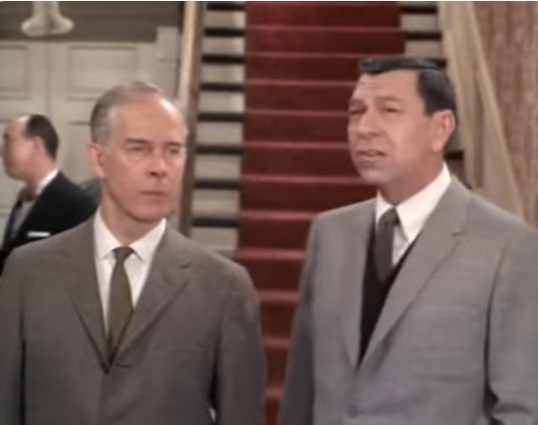
On television, Dragnet originally ran from 1951 to 1959, during which time Dragnet also became the first television series to be adapted into a feature film.  Jack Webb decided to relaunch Dragnet in 1966 and he produced a made-for-television movie that followed Friday and his latest partner, the far more talkative Bill Gannon (Harry Morgan), as they worked multiple cases over the course of one long weekend.  The pilot movie did lead to a new show, one that lasted from 1967 to 1970 and which is today fondly remembered for scenes of Friday and Gannon debating the merits of the legal system with hippies.  However, for whatever reason, the 1966 pilot movie was not actually aired until 1969.

The made-for-TV movie features Friday and Gannon searching not for LSD dealers and draft dodgers but instead for a crazed photographer (Vic Perrin) who hires women to pose for him and then ties them up and takes their picture right before her murders them.  The photographer is based on real-life serial killer Harvey Glatman and Perrin is perfectly creepy in the role.  Though Friday never loses his composure, his disgust at the photographer and his crimes is palpable and it adds an extra charge to the scene where, in the middle of a drenching rain storm, Friday tries to sneak up on the trailer where he believes the photographer is holding his latest victim.  It’s actually a pretty exciting scene and definitely one that will take by surprise anyone who thinks of the 60s Dragnet as just being a campy exercise in establishment resentment.

Of course, catching a serial killer is not all that Friday and Gannon deal with.  It’s a long weekend so Friday and Gannon end up investigating the murder of a French tourist and Friday helps a younger, black detective deal with a racist criminal.  (The scene where Friday stands up to the racist was obviously meant to answer those who claimed the LAPD was a racist organization.)  At the start of the film, Joe almost gets collared into working security for a visiting Russian diplomat and the Russian’s paranoid security team is contrasted to the level-headed and capable men of the LAPD.  Some of these scenes are better than others.  The French tourist subplot features some truly risible acting and the scene with the racist is well-intentioned but still feels a bit condescending in its portrayal of the black detective needing Friday to help him deal with the suspect.  That said, I did enjoy listening to Bill Gannon talking about his plans for retirement and how working for the LAPD was destroying his teeth.  Harry Morgan’s folksy humor was always the perfect counterpart to Jack Webb’s perpetually rational Friday.

Finally, I appreciated that the movie featured a scene with Friday and Gannon went undercover at a lonely hearts club.  If you’ve watched the 1960s version of Dragnet, you know that, for all the times that Friday and Gannon went undercover, they never really put much effort into it.  I mean, they didn’t ever bother to take off their jackets!

Though I was disappointed by the lack of hippies, Dragnet 1966 was still not only a good police procedural but also a fun time capsule of its era.

Retro Television Reviews: Fantasy Island 3.3 “Tattoo: The Love God/Magnolia Blossoms”


Welcome to Retro Television Reviews, a feature where we review some of our favorite and least favorite shows of the past!  On Tuesdays, I will be reviewing the original Fantasy Island, which ran on ABC from 1977 to 1986.  The entire show is currently streaming on Tubi!

This week, Mr. Roarke tries to kill Tattoo!

Episode 3.3 “Tattoo: The Love God/Magnolia Blossoms”

(Dir by Earl Bellamy, originally aired on Sept. 21st, 1979)

This week’s episode of Fantasy Island opens with Tattoo driving his mini-car across the island and nearly running over a group of Islanders.

Tattoo has every reason to be excited!  This week, he is getting his fantasy.  Using a fake name (Dr. H.L. Oottat — spell the last name backwards), Tattoo requested a chance to come to the Island and live out his fantasy of being irresistible to women.  At first, Mr. Roarke pretends as if he had no idea that Dr. Oottat was actually Tattoo but, by the end of this episode, it’s pretty clear that Roarke not only knew who Oottat was but that he also saw this fantasy as his best chance to kill off his troublesome assistant.

Seriously, how else can you explain how Mr. Roarke grants Tattoo his fantasy.  Tattoo wants women to find him attractive.  (That’s actually kind of sad.  Poor Tattoo!)  So, Mr. Roarke arranges for a bunch of native Islanders to mistake Tattoo for their legendary love god, Nooyeeowee.

Words goes out that Nooyeeowee has returned to the Island.  A group of Islanders take Tattoo to their village.

The chief explains that, as the Love God, Tattoo is not only responsible for deciding who in the tribe will marry who but that his presence will also guarantee successful fishing expeditions.  Unfortunately, Tattoo is also expected to be able to fly.  When one of the islanders, jealous because Tattoo has stolen his girlfriend, accuses Tattoo of being a fraud, Tattoo is told to prove his powers by taking flight.  Instead, with the help of a native girl, Tattoo gets in a canoe and flees back to the main island.

Mr. Roarke acts as if he’s happy to have his assistant back but let’s be honest here.  Mr. Roarke has shown, on numerous occasions, that he cannot be fooled or tricked by anyone.  Are we to believe that Mr. Roarke didn’t realize that the letter from Dr. Oottaat was actually from Tattoo?  After three seasons of listening to their passive-aggressive banter, it should be obvious to anyone that Roarke and Tattoo actually hate each other.  Personally, I think Mr. Roarke was hoping Tattoo wouldn’t be able to escape.

As for the second fantasy, it features Pamela Franklin and Lisa Hartman as two women who want to become Southern belles by returning to what they consider to be the most romantic time and place in US. History, Civil War-era Georgia….

Uhmm…. yeah.  This is definitely a fantasy that would not be allowed today.  But, back in 1979, Roarke sends the women back to Civil War era Altanta so that they can both pursue a romance with the two Confederates of their dreams.  Lisa Hartman falls hard for Dack Rambo, who is made up to look like Clark Gable.  Pamela Franklin falls just as hard for Christopher Connelly, who is made up to look like Leslie Howard.  Unfortunately, their night at the plantation is ruined by the arrival of an evil Union captain, played by Luke Askew.

Sadly, the fantasy ends before the belles get a chance to marry their men.  But no worries!  It turns out that the two men were also on the Island to live out their fantasies of fighting for the Confederacy during the Civil War.  So, everything works out….

This was a weird episode and, as I mentioned earlier, it’s definitely one that would not be made today.  I can only imagine how Twitter, if it had existed back then, would have reacted to the Civil War fantasy and the frequent appearances of Dixie on the soundtrack.  To be honest, though, the the two belles were less in love with the Confederacy and more just obsessed with Clark Gable and Leslie Howard.  Tattoo’s fantasy was actually the cringier of the two, with Tattoo pretending to be a God just to get laid and its suggestion that the Islanders will basically just worship anyone that they can convince to come to their village.

(Why don’t they worship Mr. Roarke then?  I mean, he has literal magic powers!)

As I said, this episode was just very weird.  1979, you know?

Wyoming Renegades (1955, directed by Fred F. Sears)


Brady Sutton (Philip Carey) used to be one of the most feared members of the Hole in the Wall Gang.  He robbed banks with Butch Cassidy (Gene Evans) and the Sundance Kid (William Bishop) and he developed a reputation for being a ruthless outlaw.  But that’s in the past.  Brady has spent three years in prison and now, he’s ready to return home, marry Nancy (Martha Hyer), and go straight.  Though most of the townspeople don’t trust Brady, he’s managed to find a sponsor in newcomer Charlie Veer (Douglas Kennedy), who has given Brady the money to open his own blacksmith shop.

Unfortunately, Brady might be done with the Hole in the Wall Gang but they’re not done with him.  When Brady spots some members of the gang in town, he realizes that they’re casing the bank.  Despite Brady’s attempts to warn the sheriff, the town assumes that Brady must be in on the plot.  Brady grows so frustrated that he finds himself tempted to go back to his old ways.  Meanwhile, Charlie is suddenly very interested in being introduced to the infamous Butch Cassidy himself.

Wyoming Renegades is a straight-forward, B-western.  The plot is nothing special but Philip Carey and Douglas Kennedy both give good Western performances and Gene Evans is memorably evil as Butch Cassidy.  For those who only know the characters as Paul Newman and Robert Redford’s performances in Butch Cassidy and the Sundance Kid, the most interesting thing about Wyoming Renegades will be seeing Cassidy and Sundance portrayed as being sadistic and humorless villains.  The truth about Cassidy and his gang is probably somewhere in-between the fun-loving rogues played by Newman and Redford and the unforgiving bastards presented in Wyoming Renegades.  In reality, it’s said that Butch Cassidy always tried to avoid killing people while Sundance rarely hesitated to draw his gun and start firing.

As for Wyoming Renegades, the ending does feature an unexpected twist, with Nancy proving herself to be more than just a docile love interest.  Fans of classic television will want to keep an eye out for a young Aaron Spelling, playing a loathsome outlaw named Petie Carver.

Dirty Deeds Done Dirt Cheap: ARMORED CAR ROBBERY (RKO 1950)


gary loggins's avatarcracked rear viewer

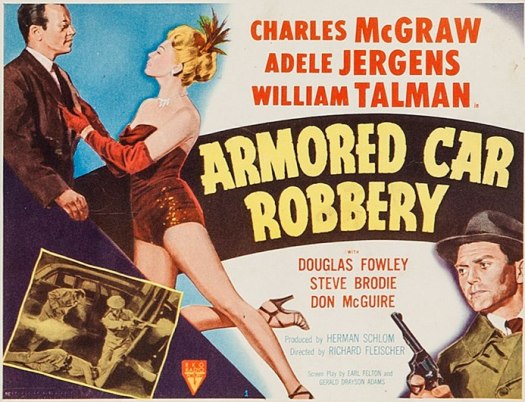
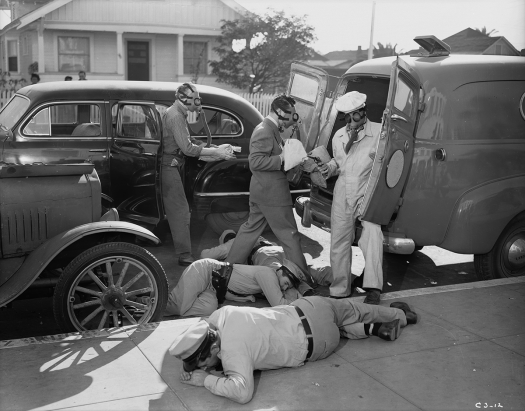
Looking for a tough, no-frills ‘B’ crime drama? Look no further than ARMORED CAR ROBBERY, which is just what it says it is, the planning, execution, and aftermath of said dirty deed, with a cast of rugged mugs and hard-hearted dames directed by Richard Fleischer during his salad days at RKO. The movie echoes Robert Siodmak’s CRISS CROSS in its heist scene, and I’m sure Stanley Kubrick watched and remembered it when he made his film noir  masterpiece THE KILLING .

Make no mistake, ARMORED CAR ROBBERY isn’t on a par with those two films. It is, however, an enjoyable little 67 minutes of cops vs crooks. Criminal mastermind Dave Purvis assembles a gang of low-lives to pull the caper off, killing a cop in the process. The cop’s partner, Lt. Jim Cordell, is now determined to hunt the crooks down and avenge him. One of the participants, Benny McBride…

View original post 402 more words

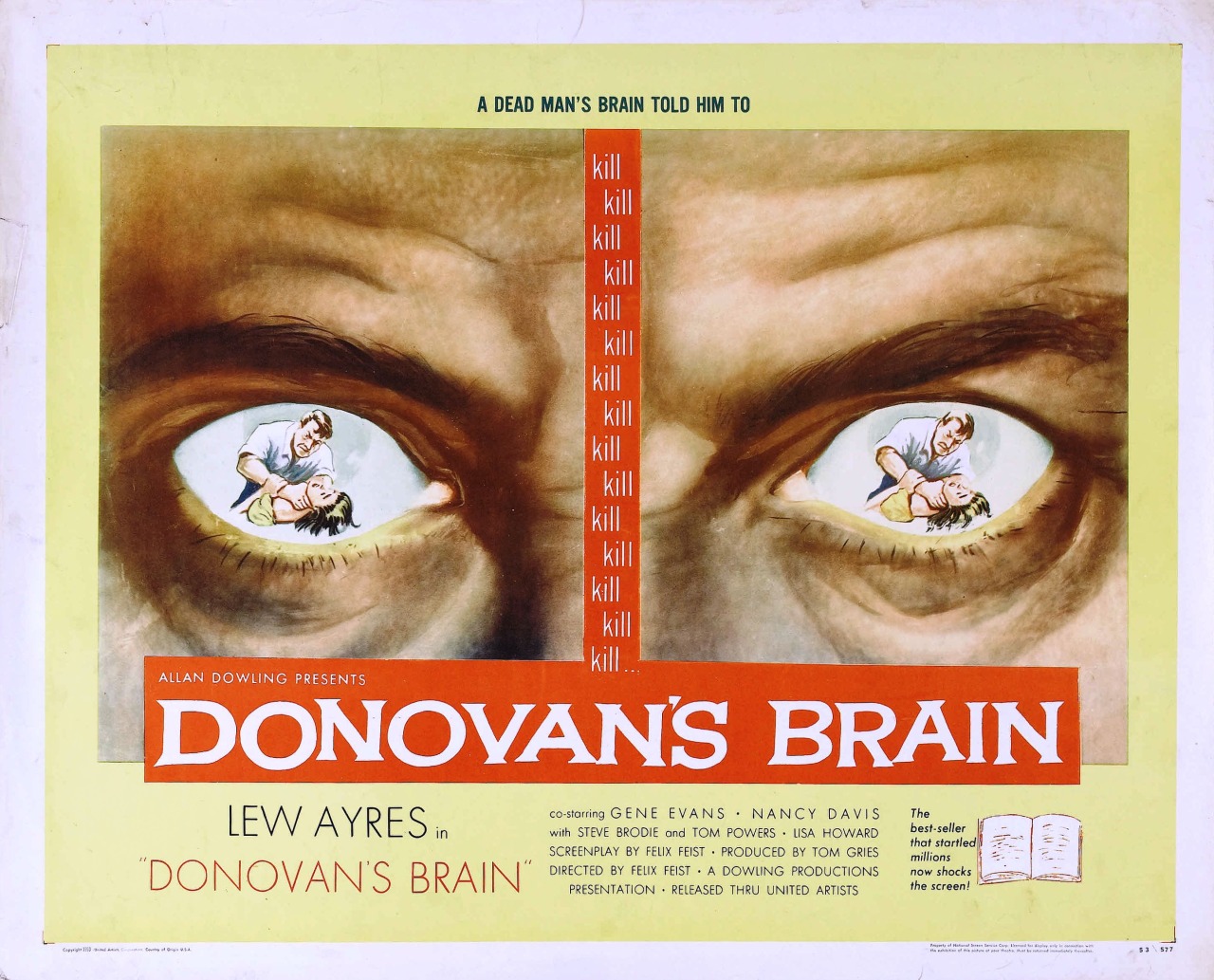
Halloween Havoc!: DONOVAN’S BRAIN (United Artists 1953)


gary loggins's avatarcracked rear viewer

donovan1

No, this is not a movie about the mind of the 60’s Scottish folk singer responsible for “Sunshine Superman” and “Mellow Yellow”. DONOVAN’S BRAIN is a sci-fi/horror hybrid based on the 1942 novel by Curt Siodmak, responsible for THE WOLF MAN and other Universal monster hits. It was first made as a 1944  Republic Pictures effort titled THE LADY AND THE MONSTER with Erich Von Stroheim (why Universal didn’t buy the rights is a mystery to me). This is one of those rare cases where the remake is better than the original!

donovan22

The story concerns Dr. Pat Cory, a scientist experimenting with keeping the brain of a monkey alive without a body. After several failures, Cory and his assistant, alcoholic Dr. Frank Schratt, have finally succeeded. A nearby plane crash leaves three dead, and multi-millionaire Warren H. Donovan in critical condition. Donovan dies on the table, but his brain is still registering…

View original post 466 more words

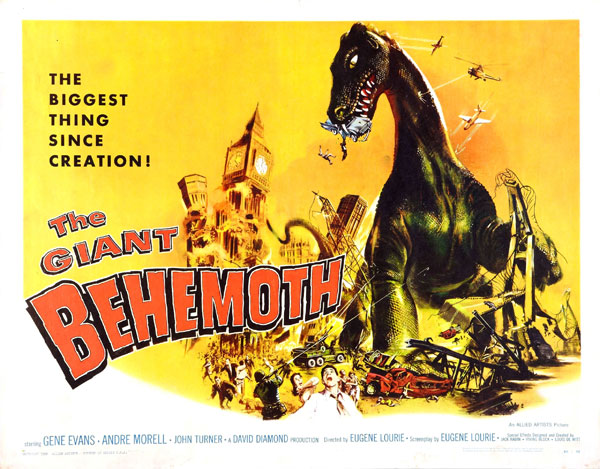
On Willis O’Brien and THE GIANT BEHEMOTH (Allied Artists 1959)


gary loggins's avatarcracked rear viewer

behe1

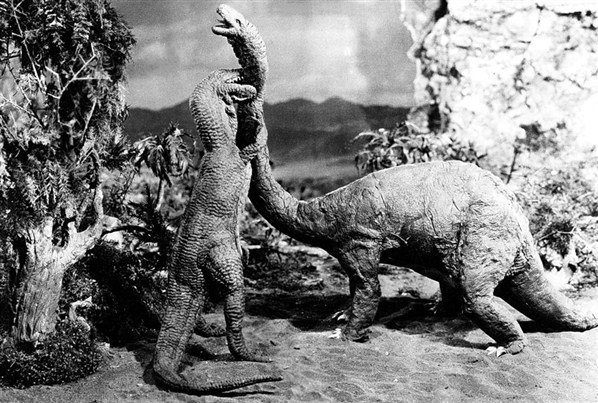
Willis O’Brien was the pioneer stop-motion animation wizard who fathered the immortal KING KONG . For that alone, he will be remembered as one of Hollywood’s giants. O’Brien started at the dawn of film, working for the Thomas Edison Company. He created an early dinosaur movie THE GHOST OF SLUMBER MOUNTAIN, which was cut down to eleven minutes by one Herbert Dowley, who took credit for O’Brien’s work. His crowning silent achievement was 1925’s THE LOST WORLD, an adaptation of the Arthur Conan Doyle adventure story that astounded filmgoers of the era.

behe2

That same year, O’Brien married Hazel Collette, who bore him two sons. The O’Brien’s marriage was not a happy one, and they divorced in 1930. Hazel was mentally unstable, and diagnosed with tuberculosis the following year. Willis, whose drinking and philandering contributed to the marriage’s deterioration, remained devoted to his boys, especially young Willis Jr., who was born tubercular, and eventually lost his eyesight. After…

View original post 578 more words

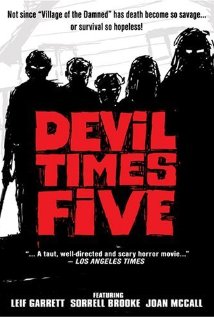
The Daily Horror Grindhouse: The Devil Times Five (dir by Sean MacGregor and David Sheldon)


dt5

Initially released in 1974 and also known as Peopletoys, Tantrums, and The Horrible House on the Hill, Devil Times Five is one of a handful of films made about murderous children targeting and killing adults.  In the case of Devil Times Five, the children are five escapees from a mental hospital and the adults are a group of largely unlikable people who have gotten snowed in at a ski lodge.

(In a film like this, it helps that the victims are all too unlikable to really care about.)

When watching Devil Times Five, it helps to know a little something about what went on behind the scenes.  Apparently, original director Sean McGregor was fired when it turned out that, after several weeks of filming, he only had 38 minutes of usable footage.  Several weeks later, a second director, David Sheldon, was brought in to reshoot a good deal of the movie.  Unfortunately, by the time that Sheldon arrived, the majority of the cast had moved onto other projects and the main killer kid (Leif Garrett) had gotten his hair cut for another movie, meaning that he had to wear an ill-fitting wig for the reshoots.

And the end result is a truly weird movie, one that is full of odd continuity errors and strange scenes that were obviously only included to pad out the film’s running time.  Among the most obvious of the continuity errors is the insistence that the characters are snowed in despite the fact that there appears to be hardly any snow on the ground outside.  (This, of course, was largely due to the fact that the reshoots were done in sunny California.)  As for the padding, perhaps the most infamous example is the scene where the five children attack and beat to death their doctor.  This entire scene is shown in slow motion.  It lasts five minutes.

Seriously — and if you doubt me on this, be sure to read Stacie Ponder’s review of the film over on Final Girl — five minutes is a really long time.  It’s certainly a long time to watch someone get beat to death, especially when the scene is underlit and sepia-toned.  It starts out as disturbing but, after the 2nd minute or so, it just gets boring.  And then about 4 minutes in, you start to laugh because you’re just like, “How much longer can this crap go on?”  And then, at the 4:30 mark, you start to get bored again.  Around the 4:55 mark, I realized that I had forgotten who they were killing or why.  And then it was finally over.  Yay!

Incidentally, this is one of those films where, whenever one of the kids is going to kill someone, the kid suddenly starts moving in slow motion.  It was kind of like the music in Jaws.  If the kid picked up an axe but was still moving at normal speed, you knew not to worry.  But the minute that slow-mo started, you knew someone was about to die.

Of course, it takes a while to get around to the killings.  Devil Times Five clocked in at about 88 minutes.  I would guess that roughly 65 of those minutes were pure filler.  We spend a lot of time getting to know the adults at that ski lodge and, for the most part, they’re loathsome.  The oldest and grumpiest of them is even called Papa Doc, perhaps after the infamous Haitian dictator. (And let’s not even start on the film’s nominal hero, Rick, who has a pornstache, a comb over, and an extended nude scene.)  All of the adults spend a lot of time talking about their crumbling marriages and their dying dreams and it’s all very angsty for slasher film about a bunch of killer kids.  There’s even an extended cat fight between Julie (Joan McCall) and Lovely (Carolyn Staller), which involves a lot of rolling around on the floor while the 70s “wah wah” soundtrack plays in the background.

Once the killings do start, however, Devil Times Five actually starts to live up to its potential.  These are some mean little kids!  Once they start their rampage, we get axes in the back, spears to the throat, immolation, death by swing, and one really disturbing scene involving a bunch of bear traps. However, Devil Times Five is probably best known for the piranha scene.  You can legitimately wonder why someone would keep piranhas at a ski lodge but there’s still no denying that you don’t want to take a bath with them.

(Making the piranha scene all the more icky that the victim in the bathtub is played by the mother of two of the actors who played the killers.)

Devil Times Five makes for a strange viewing experience.  It starts out as nothing but filler and then suddenly, almost out of nowhere, the entire film goes batshit crazy.  Devil Times Five has slipped into the public domain, so you can watch it for free on YouTube if you want.  But I suggest tracking down the Code Red DVD, which comes with a fascinating commentary track and an entertaining and candid interview with several members of the cast.

DevilTimesFive3

Embracing the Melodrama Part II #46: Walking Tall (dir by Phil Karlson)


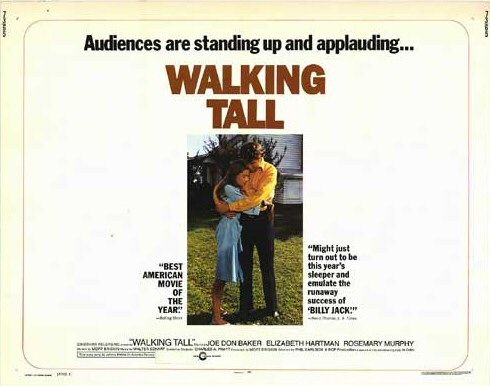
Walking_Tall_(1973_film)About 50 minutes into the 1973 film Walking Tall (not to be confused with the 2005 version that starred Dwayne Johnson), there’s a scene in which newly elected sheriff Buford Pusser (Joe Don Baker) gives a speech to his deputies.  As the deputies stand at attention and as Pusser announces that he’s not going to tolerate any of his men taking bribes from the Dixie Mafia, the observant viewer will notice something out-of-place about the scene.

Hovering directly above Baker’s head is a big, black, almost phallic boom mic.  It stays up there throughout the entire scene, a sudden and unexpected reminder that — though the film opens with a message that we’re about to see the true story of “an American hero” and though it was filmed on location in rural Tennessee — Walking Tall is ultimately a movie.

And yet, somehow, that phallic boom mic feels oddly appropriate.  First off, Walking Tall is an almost deliberately messy film.  That boom mic tells us that Walking Tall was not a slick studio production.  Instead, much like Phil Karlson’s previous The Phenix City Story, it was a low-budget and violent film that was filmed on location in the south, miles away from the corrupting influence of mainstream, yankee-dominated Hollywood.  Secondly, the phallic implications of the boom mic erases any doubt that Walking Tall is a film about men doing manly things, like shooting each other and beating people up.  Buford does have a wife (Elizabeth Hartman) who begs him to avoid violence and set a good example of his children.  However, she eventually gets shot in the back of the head, which frees Buford up to kill.

As I said earlier, Walking Tall opens with a message telling us that we’re about to watch a true story.  Buford Pusser is a former football player and professional wrestler who, after retiring, returns to his hometown in Tennessee.  He quickly discovers that his town is controlled by criminals and moonshiners.  When he goes to a local bar called The Lucky Spot, he is unlucky enough to discover that the bar’s patrons cheat at cards.  Buford is nearly beaten to death and dumped on the side of the road.  As Buford begs for help, several motorists slow down to stare at him before then driving on.

Obviously, if anyone’s going to change this town, it’s going to have to be Buford Pusser.

Once he recovers from his beating, Buford makes himself a wooden club and then goes back to the Lucky Spot.  After beating everyone up with his club, Buford takes back the money that he lost while playing cards and $50.00 to cover his medical bills.  When Buford is put on trial for armed robbery, he takes the stand, rips off his shirt, and shows the jury his scars.  Buford is acquitted.

Over his wife’s objections, Buford decides to run for sheriff.  The old sheriff, not appreciating the competition, attempts to assassinate Buford but, instead, ends up dying himself.  Buford is charged with murder.  Buford is acquitted.  Buford is elected sheriff.  Buford sets out to clean up his little section of Tennessee.  Violence follows…

On the one hand, it’s easy to be snarky about a film like Walking Tall.  This is one of those films that operates on a strictly black-and-white world view.  Anyone who supports Buford is good.  Anyone who opposes Buford is totally evil.  Buford is a redneck saint.  It’s a film fueled by testosterone and it’s not at all subtle…

But dangit, I liked Walking Tall.  It’s a bit like a right-wing version of Billy Jack, in that it’s so sincere that you can forgive the film’s technical faults and frequent lapses in logic.  Walking Tall was filmed on location in Tennessee and director Phil Karlson makes good use of the rural locations.  And, most importantly, Joe Don Baker was the perfect actor to play Buford Pusser.  As played by Baker, Pusser is something of renaissance redneck.  He’s a smart family man who knows how to kick ass and how to make his own weapons.  What more could you ask for out of a small town sheriff?

In real life, Buford Pusser died in a mysterious car accident shortly after the release of Walking Tall.  Cinematically, the character of Buford Pusser went on to star in two more films.