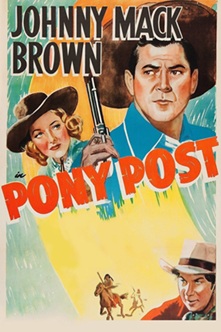
Pony Post (1940, directed by Ray Taylor)


In the days of the Old West, Griff Atkins (Stanley Blystone) manages a Pony Express station but, because of his gambling debts, he actually encourages the Indians and the outlaw Richard brothers (John Rockwell and Ray Teal) to attack the Pony Express riders and steal their horses.  Major Goodwin (Tom Chatterton) tries to put a stop to all this by firing Griff and putting Cal Sheridan (Johnny Mack Brown) in charge.  Griff and the Richard brothers continue their outlaw ways and eventually, the head of one of the relay stations is killed in one of their raids.  While the dead man’s daughter, Norma (Nell O’Day), investigates the murder, Cal works to bring peace the line and falls in love with Goodwin’s daughter, Alice (Dorothy Short).  Meanwhile, aspiring Pony Express rider Shorty (Fuzzy Knight) tries to invent a trampoline system that will help him to mount a horse.

No matter how bad things get in the west, you can always count on Johnny Mack Brown to bring some order and to get it done in less than an hour.  Johnny Mack Brown was always a good hero and that’s the case here.  Eventually this film has all of the horse riding and tough fighting that fans of the genre expect from these westerns but, for a short movie (it only runs for 59 minutes), it still seems to take a while for it to really get going.  The first half of the movie is more about Fuzzy Knight singing songs and trying to become a rider than it is about anything else.  I usually enjoy Fuzzy’s antics but, like the B-western themselves, they are definitely an acquired taste for most viewers.
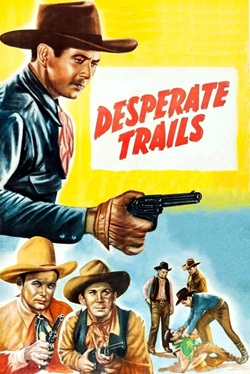
Desperate Trails (1939, directed by Albert Ray)


The frontier town of Denton has become lawless, plagued by murders, robberies, and cattle rustling.  The town’s sheriff (Russell Simpson) just cannot seem to bring peace to the streets.  That’s because the sheriff is secretly responsible for all the crime.  He’s working in cahoots with the town banker (Clarence Wilson) and he’s sets his sights on taking over a ranch owned by Frances Robinson.  As was so often the case with B-westerns, it all comes down to stealing someone else’s land.

The federal government sends Marshal Johnny Mack Brown to bring some order to the town.  Working undercover, Brown gets hired as Robinson’s ranch and he quickly chases off all of the bad ranchhands,  He brings his friend, singing cowboy Bob Baker, onboard to work as the ranch foreman.  With Fuzzy Knight providing comic relief, Brown sets out to thwart the next stagecoach robbery and to expose the evildoers of Denton.

This was the first western that Brown made with Universal Pictures.  Bob Baker, who had previously been the star of the studio’s B-westerns, was demoted to second lead and, eventually, he quit making films for Universal all together.  Unlike Baker, who was angry at being demoted, Fuzzy Knight was always happy to provide sidekick duty and would go on to co-star in all of Brown’s Universal westerns.  From the start, Brown and Knight had the chemistry that made them a good B-movie team.

Desperate Trails is a typical B-western but, as always, Brown elevates things with his performance.  From the minute that Brown rides into town, he screams authenticity.  He’s pretty tough in this film, which includes a scene where he coolly takes care of a gang of outlaws with just one rifle.  The best performance here comes from Russell Simpson, who gets angrier and angrier as the film goes on and all of his plans fall apart.

For fans of the B-western genre, Desperate Trails has a lot of entertainment to offer.

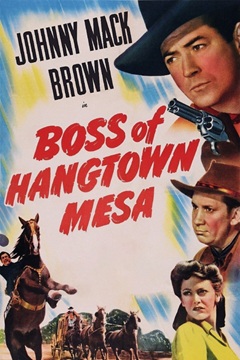
Boss of Hangtown Mesa (1942, directed by Joseph H. Lewis)


The telegraph company has come to the frontier town of Hangtown Mesa and soon, the citizens will be connected to the rest of the world.  The wealthy men who run the town don’t want that to happen because then people might discover how corrupt they are.  They hire a gunman known as the Utah Kid (Hugh Prosser, not looking much like a kid) to come to town and kill the owner of the telegraph line, John Wilkins (Henry Hall).  The Utah Kid steals the clothes of engineer Steve Collins (Johnny Mack Brown) and frames him for Wilkins’s murder.  With the help Betty Wilkins (Helen Deverell) and traveling medicine man Dr. J. Willington Dingle (Fuzzy Knight), Steve sets out to clear his name.

This is a pretty good Johnny Mack Brown western.  The plot isn’t half-bad as far as Poverty Row westerns are concerned and director Joseph H. Lewis keeps things lively.  Lewis not only gets good performances from his cast but he also makes Hangtown Mesa seem like an actual, growing frontier town.  Lewis even manages to create some suspense as The Utah Kid and Steve Collins switch identities.  Comparing Lewis’s westerns to the ones directed by Sam Newfield shows how much difference a good director can make, even within the confines of a poverty row production.  Even Fuzzy Knight is used well!

Boss of Hangtown Mesa is one of the better Johnny Mack Brown westerns, featuring a good story and an interesting idea behind it as it shows how far the bad guys will go to keep their own private fiefdom from connecting with the rest of the world.  Brown is convincing, whether he’s riding a horse or holding a gun.  He’s playing an educated man here, an engineer, but Brown is still a cowboy through-and-through.

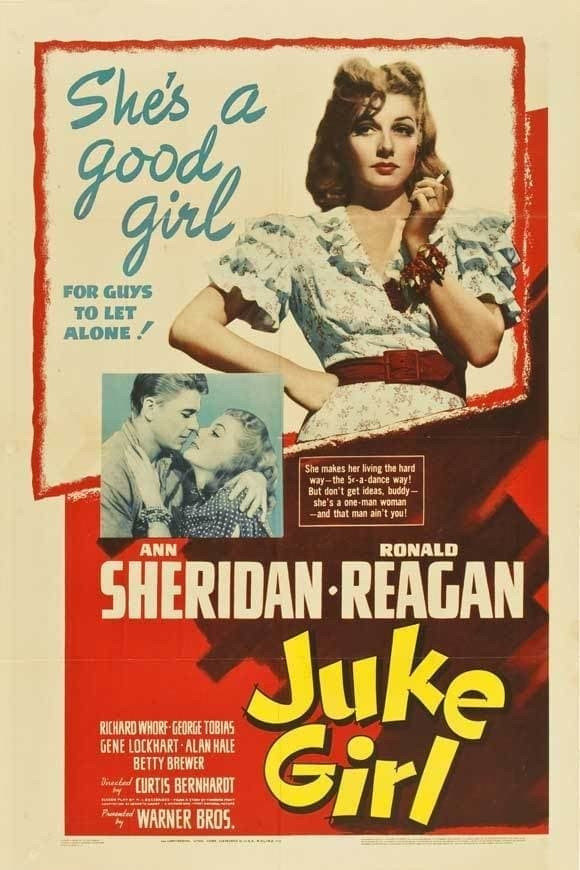
Juke Girl (1942, directed by Curtis Bernhardt)


Farm workers Steve (Ronald Reagan) and Danny (Richard Whorf) arrives in Florida, looking for work.  The whole town is controlled by the corrupt Henry Madden (Gene Lockhart) but the honest Steve would rather work for Nick (George Tobias), who treats his workers fairly.  While Steve romances Lola Mears (Ann Sheridan), who works at a “juke joint,” he also tries to organize the other workers into demanding better conditions.  When Madden frames Steve and Lola for a murder, the entire town turns against them.

This is not a bad Warner Bros. melodrama.  As with a lot of Warner Bros. films, the heroes are the poor workers who have found themselves exploited by wealthy men like Madden.  As played by Ronald Reagan, Steve is no radical firebrand.  He is just someone who wants the workers to get a fair shake and who wants to help decent bosses like Nick make a living despite the efforts of Madden to put them out of business.  As was so often the case with his movies, Reagan is an affable hero without ever actually being compelling.  Gene Lockhart is the dependably hateful villain and the cast is full of dependable character actors, including Faye Emerson, Alan Hale, Howard Da Silva, and Fuzzy Knight.

Ann Sheridan is really the main reason to Juke Girl and she’s as sexy and tough as ever.  There’s a reason why this movie was named for her character’s profession, even though its really only a minor part of the film.  Sheridan is the main attraction here and she gives a strong performance as a bad girl who is actually good underneath it all.  Her character worries that settling down with Steve will mean a lifetime of struggling to make ends meet but she sees that Steve is worth it by the end of the movie.  The town may not be worthy of either of them but Steve and Lola are meant to be together.

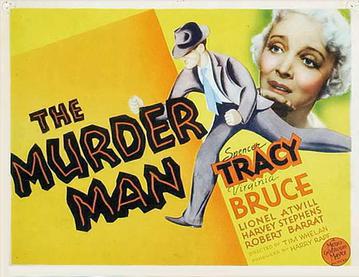
Film Review: The Murder Man (dir by Tim Whelan)


Seven minutes into the 1935 film, The Murder Man, 27 year-old James Stewart makes his film debut.

He’s playing a reporter named Shorty and, since this is a 30s newspaper film, he’s first seen sitting at a table with a bunch of other cynical reporters, the majority of whom seem to be alcoholics and gambling addicts.  Suddenly, words comes down that a corrupt businessman named Halford has been assassinated, shot by an apparent sniper.  (It is theorized that he was shot from one of those carnival shooting gallery games, which was somewhat oddly set up on a street corner.  Maybe there was shooting galleries all over place in 1935.  I supposed people had to do something to keep their spirits up during the Depression.)  While the other reporters run to the scene of the crime, Shorty is on the phone and calling his editors to let them know that a huge story is about to break.

Steve Grey (Spencer Tracy) is the reporter assigned to the story.  Crime is his beat and everyone agrees that no one’s better at covering criminals and understanding what makes them tick.  Unfortunately, it’s not always easy to track Steve down.  He’s a hard drinking reporter and lately, he’s been concerned about the collapse of his father’s business.  Still, when Steve is finally tracked down, he throws himself into covering the story and speculating, in print, about who could have killed Halford.  In fact, his girlfriend (Virginia Bruce) worries that Steve is working too hard and that he’s developing a drinking problem.  She suggests that Steve needs to take some time off but Steve is driven to keep working.

It’s largely as a result of Steve’s actions that a man named Henry Mander (Harvey Stephens) is arrested and convicted of Halford’s murder.  Steve should be happy but instead, he seems disturbed by the fact that he is responsible for Mander going to jail.  When his editor requests that Steve go to Sing Sing to interview Mander, a shocking truth is revealed.

Admittedly, the main reason that I watched The Murder Man was because it was the feature film debut of James Stewart.  (Stewart previously appeared in a comedy short that starred Shemp Howard.)  Stewart is only in a handful of scenes and he really doesn’t have much to do with the main plot.  To be honest, Shorty’s lines could have been given to anyone.  That said, Stewart still comes across as being a natural on camera.  As soon as you hear that familiar voice, you can’t help but smile.

Even if Stewart hadn’t been in the film, I would have enjoyed The Murder Man.  It’s fast-paced mystery and it has a decent (if not totally unexpected) twist ending.  It’s one of those films from the 30s where everyone speaks quickly and in clipped tones.  Casual cynicism is the theme for the day.  Spencer Tracy gives a wonderful performance as the hard-drinking and troubled Steve Grey and the scene where he meets Mander in prison is surprisingly moving.  Clocking in at only 68 minutes, The Murder Man is a good example of 30s Hollywood.

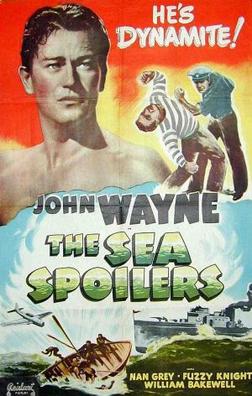
The Sea Spoilers (1936, directed by Frank R. Strayer)


Bob Randall (John Wayne) is a coast guard boatswain, headquartered in Alaska where he and the members of his crew battle evil seal poachers like oily Phil Morgan (Russell Hicks).  When Randall returns to port after his latest patrol, he has to deal with two disappointments.  First off, he is passed over for a promotion to commanding officer, even though everyone knows that he deserves it.  Instead, the promotion goes Lt. Commander Mays (William Blakewell), the son of a commander (George Irving).  Mays doesn’t even want the job.  He’s scared of the water and he’d rather fly airplane as a part of the Coast Guard’s aviation force.  Bob is disappointed but he’s a professional and he’s going to support Mays.  Secondly, Bob’s girlfriend (Nan Grey) witnesses a murder and is kidnapped by Phil Morgan.  Bob and his sidekick (dependable western mainstay Fuzzy Knight) go undercover as fisherman to try to find her.

The Sea Spoilers was the first of six B-movies that John Wayne did for Universal.  Wayne, who had been stuck in the B’s for a while, was trying to prove that he was more than just a singing cowboy so, in this one, he plays a tough and ready sailor.  Wayne is convincing in the role, even if the movie is really just a western set in what was then modern day Alaska.  Though only 30, Wayne shows the no-nonsense professionalism that would become his trademark once he became one of the world’s biggest movie stars.  Unlike some of Wayne’s early films, it’s possible to see the icon that John Wayne would eventually become while watching him here.  The Sea Spoilers is only 66 minutes long but fans of the Duke should enjoy it.

Finally, The Sea Spoilers was written by George Waggner.  Waggner would later go on to direct the original Wolf Man.

Chip of the Flying U (1939, directed by Ralph Staub)


In this B-western, Johnny Mack Brown plays Chip Bennett, the foreman of the Flying U Ranch.  The ranch is owned by J.G. Whitmore (Forrest Taylor) and his daughter (Doris Weston), who has just returned from college and who has eyes for Dusty (Bob Baker), a singing ranchhand.

Ed Duncan (Anthony Warde) and his gang are in the arms smuggling business.  To make their business a success, they need access to the ranch, which sits on the shore of a lake.  Knowing that Chip would never let them take over, Duncan tries to frame Chip for a bank robbery and murder.  Chip responds by kidnapping two of Duncan’s men, leading to a final and explosive shootout.

Chip of the Flying U is a western that doesn’t seem to know what era it’s supposed to be taking place in.  Chip, Duncan, and all of the other ranch hands dress like they’re in the late 1800s.  Doris Weston dresses like she’s just stepped out of a 1930s photoshoot.  Duncan is trying to smuggle hand grenades, which were invented in 1908 but not commonly used until World War I.  The movie’s time period is all over the place but that was frequently the case with the B-westerns of the 30s.  Shot on studio backlots and for a very low budget, these films were not concerned with historical accuracy.  Instead, they were about shootouts and a few songs.  Chip of the Flying U offers up both, along with Fuzzy Knight as the comedic sidekick who turns out to be very good with a rifle.

With lots of horse chases and bloodless shoot-outs and not too much romance, this movie may seem creaky by today’s standards but probably thrilled the kids who caught while spending an afternoon at the movies in 1939.  Today, the appeal of movies like this is that the good guys are unquestionably good and the bad guys are unquestionably bad.  They remind us of a simpler time that may have never existed but we all hope it did.

Marshal of Heldorado (1950, directed by Thomas Carr)


Heldorado, Arizona is a frontier town with a problem.  The Tullivers, led by Mike (Tom Tyler), keep robbing the bank and running off anyone who agrees to be the town’s marshal.

The Colonel (Raymond Hatton) and the Mayor (Fuzzy Knight) are at their wits end until a bison hunter named Lucky (Russell Hayden) comes riding into town in search of work.  They hire Lucky to be their new marshal, paying him $200 a week and allowing him three free drinks a day.

They also give Lucky a cabin to stay in but when Shamrock Ellison (James Ellison), a dandy from up north, rides into town on a donkey, Lucky decides to rent him the cabin.  When Ellison arrives at the cabin, he finds two Tulliver brothers looking for the stolen money that they hid in the fireplace.  The brothers try to shoot Ellison but accidentally end up shooting themselves instead.

When Ellison says that he wants to keep a low profile, Lucky takes credit for killing the two Tullivers.  When Mike shows up looking for revenge, Lucky has a change of heart and gives all the credit for Ellison.  Lucky makes Ellison his deputy but what he doesn’t know is that Ellison is actually a government agent who has been sent to Heldorado to clean the town up.

This B-western does a good job of mixing comedy with action.  It was one of many films that Ellison and Hayden made together and Hayden’s bluster plays off well against Ellison’s more serious performance.  Much of the humor comes from Ellison having to keep the other townspeople from realizing that he’s a crack shot who knows how ride a horse as well as anyone in town.  As well, Fuzzy Knight has his moments as the always drinking mayor.  The action scenes are well-choreographed and there’s even a suspenseful scene where Ellison gets a shave from a barber who is actually a relative of the Tullivers.  As always, the beautiful Julia Adams is a welcome addition to the cast as the Colonel’s daughter, who falls for Ellison.  For fans of the genre, there’s plenty of entertainment to be found in this brisk, 50-minute western.

Badlands of Dakota (1941, directed by Alfred E. Green)


This B-western takes place in the legendry frontier town of Deadwood.  It’s a town that’s patrolled by General George Custer (Addison Richards) and which is home to Wild Bill Hickok (Richard Dix) and Calamity Jane (Frances Farmer).  When outlaw Jack McCall (Lon Chaney, Jr.) and his gang start disguising themselves as Sioux and start robbing stagecoaches, young homesteader Jim Holliday (Robert Stack) is appointed town marshal.  Unfortunately, Jim’s older brother, Bob (Broderick Crawford), has gotten involved with McCall and his gang.  Bob has also never forgiven Jim for marrying Anne (Ann Rutherford), the woman that Bob loved.  Jim struggles to get the town to take him seriously.  When Jim tries to put out a fire that’s threatening to burn down several businesses, the citizens laugh at him and shoot a hole in the water hose.  No one said that the people of Deadwood were smart.  Ann wants to leave town but McCall and his gang are growing more brazen in their attacks and when one of Jim’ mentors is murdered, Jim has no choice but to get justice and revenge.  Meanwhile, the real Sioux grow tired of being blamed every time a stagecoach is robbed and they launch their own attack on the town.

Though the plot may be predictable, Badlands of Dakota is memorable for the cast that was assembled to bring its familiar story to life.  Along with those already mentioned, the cast also includes Andy Devine as a saloon owner, Hugh Hubert as the town drunk, Fuzzy Knight as the town’s stagecoach driver, and the folk band, The Jesters, as the town’s entertainment.  They all do their part to bring the town of Deadwood to life.  Frances Farmer steals the film with her tough and unsentimental portrayal of Calamity Jane and Lon Chaney, Jr. is an effectively hard-edged villain.  This was one of Robert Stack’s first films and he’s appropriately stiff and upright as Jim.  Jim is the only honest man in Deadwood, which also means that Jim is fairly boring when compared to everyone else around him.  It’s also difficult to accept him as being Broderick Crawford’s younger brother, though Crawford does a good job of portraying the personal betrayal that Bob feels when he discovers that Jim has married Anne.

Not surprisingly, Badlands of Dakota plays havoc with history.  This is especially true when it comes to Addison Richards’s sober and reasonable portrayal of a middle-aged General Custer.  (The real-life General Custer died when he was only 36 and could reportedly be slightly erratic.  Not to mention, Custer died the same year that Deadwood was founded so it’s doubtful that he ever visited the city, much less had a personal friendship with Wild Bill Hickok and Calamity Jane.)  Still, there’s a lot here to entertain fans of B-westerns.  Along with all of the familiar faces in the cast, there’s also a sequence with an out-of-control stage coach that makes good use of rear projection and the film’s final gun battle is exciting and well-directed.  It’s a quick 76 minutes, full of all the action and bad history that a western fan could hope for.

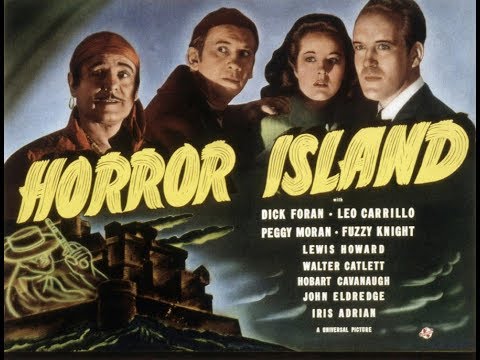
Halloween Havoc!: HORROR ISLAND (Universal 1941)


gary loggins's avatarcracked rear viewer

Universal Pictures kept cranking out the horrors, but HORROR ISLAND isn’t one of them. It’s as misleading a title as Hollywood ever produced, more of a comedy/mystery with some “old dark house” elements thrown in for good measure. This little ‘B’ was released as a double feature with MAN MADE MONSTER, and while its good for what it is, it ain’t horror!

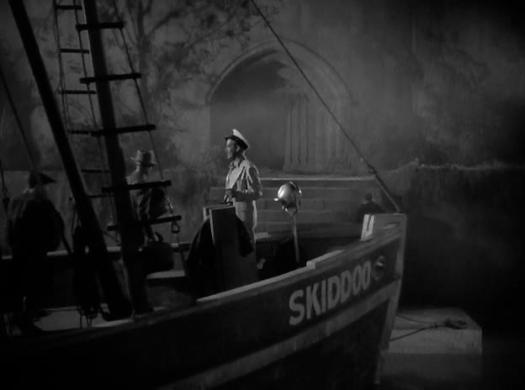
Atmospherically directed by George Waggner and shot by Universal workhorse Woody Bredell , HORROR ISLAND  begins spookily enough with a peg-legged sailor trodding the docks attacked by the mysterious Phantom. Rescued from the briny water by hard-pressed for cash entrepreneur Bill Martin and his pal Stuff Oliver, we learn the sailor is Tobias Clump, a Spaniard who claims he has half a map of Sir Henry Morgan’s buried treasure – and The Phantom just stole the other half! Bill happens to have inherited Morgan’s Island, where twenty…

View original post 240 more words