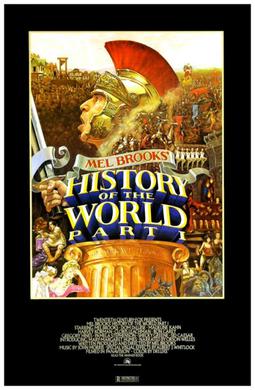
The History of the World, Part I (1981, directed by Mel Brooks)


Overlong, wildly uneven, gimmicky too a fault, and often laugh out loud funny with a mix of jokes that range from the crude to the sublimely clever to the surprisingly sentimental, The History of the World, Part I is the ultimate Mel Brooks films.

Narrated by Orson Welles and featuring five historical stories and a collection of coming attractions, The History of the World Part I follows man from his caveman origins to the French Revolution and the thread that ties it all together is that humanity always screws up but still finds a way to survive.  Moses (Mel Brooks) might drop and break one of the three tablets listing the 15 Commandments but he’s still able to present the other ten.  Stand-up philosopher Comicus (Mel Brooks) might make the mistake of poking fun at the weight of Emperor Nero (Dom DeLuise) but he still makes his escape with Josephus (Gregory Hines), Swiftus (Ron Carey), and Miriam the Vestal Virgin (Mary-Margaret Humes) and ends up serving as the waiter at the Last Supper.  (“Jesus!”)  The Spanish Inquisition may have been a catastrophe but it also gave Torquemada (Mel Brooks) a chance to show off his performance skills.  The French Revolution may have been a bloodbath but the future still held promise.  Ask for a miracle and he’ll show up as a white horse named Miracle, no matter what era of history you’re living in.

The humor is very Mel Brooks.  During the Roman Empire sequence, Madeline Kahn plays Empress Nympho.  Jackie Mason, Harvey Korman, Cloris Leachman, Spike Milligan, Jan Murray, Sammy Shores, Shecky Greene, Sid Caesar, Henny Youngman, and Hugh Hefner all make cameo appearances.  Carl Reiner is the voice of God.  John Hurt plays Jesus.  The film ends with the promise of a sequel that will feature “Jews in Space.”  Not every joke lands.  The entire caveman sequence feels forced.  But when the film works — like during The Inquisition production number — it’s hard not get caught up in its anything-goes style.  The entire Roman Empire sequence is probably more historically accurate than the typical Hollywood Roman epic.  That’s especially true of Dom DeLuise’s naughty performance as Emperor Nero.

Mel Brooks is 99 years old today and he says that he has at least one more film to give us, a sequel to Spaceballs.  I’m looking forward to it!  I’m also looking forward to rewatching and enjoying all of the films that he’s already given us.  The History of the World, Part I may not have initially enjoyed the critical acclaim of his earlier films but, in all of its anarchistic glory, it’s still pure Mel Brooks.
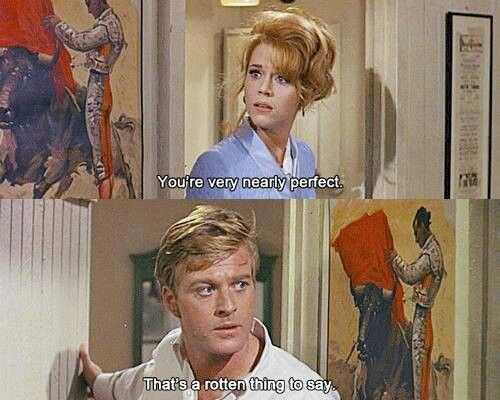
Love on the Shattered Lens: Barefoot In The Park (dir by Gene Saks)


The 1967 film, Barefoot in the Park, tells the story of two newlyweds.

Paul Bratter (Robert Redford) may have a terrible last name (seriously, Bratter?) but he’s an up-and-coming lawyer with a bright future.  He’s a little bit uptight and doesn’t seem to have the greatest understanding of human nature but he’s handsome and he’s charming and he means well.  Paul has just recently married Corie (Jane Fonda).  Corie is a free spirit who cringes at the idea of conformity.  Having been raised by a judgmental mother who has always told her that she will never be good enough to make it on her own, Corie has decided to murder Paul and steal all of his money by insisting that they live in a drafty apartment that’s on the fifth floor of an New York apartment building that doesn’t have an elevator.  If climbing up the stairs doesn’t kill Paul, the fact that the skylight has hole in it probably will.  Helping Corie with her plan is her eccentric neighbor, Victor Velasco (Charles Boyer).  When Paul comes home one day to discover Victor lifting up his lingerie-clad wife, Victor says, “We are heating up the apartment.”  Corie assures Paul that they’re just trying to get the radiator to start working but we know the truth….

Okay, that’s actually the Lifetime version of Barefoot in the Park.  The real Barefoot in the Park is a charming, lighter-than-light adaptation of Neil Simon’s famous play.  (If I’m biased towards the play, it’s because I once played Corie in a heavily edited version of the play that we put on in high school.  I was the perfect Corie, if I may say so myself.)  As played by Robert Redford, Paul is charming but uptight and, as played by Jane Fonda, Corie is a free spirit who doesn’t really seem to have much common sense about the realities of living in New York City.  (Running barefoot in Central Park?  Probably not a good idea in 1967.)  They do end up living on the fifth floor and there are a lot of jokes (in fact, there’s probably too many jokes) about people getting out of breath from having to climb all of the stairs.  There’s also a broken skylight, which is a problem since it snows in New York.  However, Corie never deliberately plots to kill Paul.  Instead, she tries to set her mom (played, in an Oscar-nominated performance, by Mildred Natwick) up with Victor.

Barefoot in the Park is probably one of those films that seemed semi-daring when it was originally released in 1967 (“Look!  A honeymoon sex joke!  Look!  Corie’s walking around in Paul’s shirt!  Look!  Paul looks like he’s about to say a forbidden word!”) but today, it seems like an old-fashioned but likable fantasy about what’s like to be a newlywed in New York.  The city’s beautiful and full of romance.  The dialogue is witty and zippy.  (Zippy’s a word, isn’t it?)  Charles Boyer overacts in the most charming way possible and Mildred Natwick has some good moments as Corie’s mom.  (To appreciate Natwick’s peformance, it helps to imagine what the film would have been like if Shelley Winters had played the role.)  Most importantly, Robert Redford and Jane Fonda have got an amazing chemistry and, as they were both young in 1967 and considerably less weather-beaten than they are today, it’s hard to imagine a more beautiful couple.  Though Gene Saks’s direction is visually flat and, cinematically, the film never quite breaks out of its stage-bound origins, the chemistry of Redford and Fonda and Boyer and Natwick carry you through the occasional rough patch.

Seriously, I kind of love this movie!

Horror on the Lens: The Golem: How He Came Into The World (dir by Paul Wegener and Carl Boese)


Golem_1920_Poster

Yesterday, for our Horror on The Lens, we featured It!, a British film what happens when Roddy McDowall discovers the legendary Golem.

Today, we are very proud to present another film about the Golem, one that is definitely held in higher critical regard than It!  (Sorry, Roddy!)  The 1920 German film The Golem: How He Came Into The World is, for lack of a better term, an origin story for the Golem, one that shows how the Golem was originally brought to life to protect the Jewish people from persecution and how it was later corrupted by a combination of the dreaded demon Astaroth and pretty human jealousy.

The Golem is also a landmark of both German Expressionism and horror cinema, a dream-like tribute to both the power of the human imagination and the strength and resilience of the Jewish people.  This is one of those films that everyone should watch at least once.

And yes, it is a silent movie.  So, put your favorite music on in the background and watch The Golem!

http://www.youtube.com/watch?v=ArHM_UArtPI