Retro Television Reviews: Half Nelson Episodes 1 & 2 “The Pilot”


Welcome to Retro Television Reviews, a new feature where we review some of our favorite and least favorite shows of the past! On Fridays, I will be reviewing Half Nelson, which ran on NBC from March to May of 1985. Almost all nine of the show’s episodes can be found on YouTube!

The year was 1985 and actor/singer Joe Pesci was at an interesting place in his film career.

In 1980, Joe Pesci was nominated for Best Supporting Actor for his performance as Robert De Niro’s brother in Raging BullRaging Bull was Pesci’s second film and he earned critical acclaim for his performance as the second most angry member of the LaMotta family.  In the years immediately following his first Oscar nomination, Pesci went on to play character roles in a handful of other films, including Dear Mr. Wonderful, Easy Money, Once Upon A Time In America, and Eureka.  While no one could deny Pesci’s talent or his unique screen presence, it was also obvious that Hollywood wasn’t quite sure what to do with him.  While Pesci was apparently high on everyone’s list when it came to playing gangsters with hair-trigger tempers, no one was willing to give Pesci a starring role.

Fortunately, television always has room for an Oscar nominee and, in 1985, Half Nelson came calling.  Created by veteran television producers Glen A. Larson and Lou Shaw, Half Nelson was a detective show.  Joe Pesci starred as Rocky Nelson, a tough New York cop who relocated to Los Angeles to pursue his acting career.  While waiting for his big break, Rocky worked for Beverly Hills Security and lived in Dean Martin’s guest room.  And when I say that Rocky was living in Dean Martin’s guest house, what I mean is that Dean Martin actually appeared on the show, playing himself.

NBC liked the idea enough to air the pilot film and then schedule the show as a mid-season replacement.  Audiences were a bit less interested in the show and Half Nelson was canceled after only 8 weeks.  Pesci went on to win an Oscar for Goodfellas and he never starred in another television show.  Half Nelson would probably be forgotten if not for the fact that someone recently came across the opening credits on YouTube.  When shared on Twitter, this video went viral as “the most 80s thing” ever created.

After I watched that video, I knew I simply had to review Half Nelson as soon as I finished up The Brady Bunch Hour.  Fortunately, almost all of the episodes have been uploaded to YouTube so, for the next few weeks, I’ll be taking a look at Half Nelson, starring Joe Pesci!

Episodes 1 & 2 “The Pilot”

(Dir by Bruce Bilson, originally aired on March 24th, 1985)

Half Nelson begins in New York City, with NYPD’s finest, Detective Rocky Nelson (Joe Pesci), disguising himself as a waiter and sneaking into a mafia-owned restaurant.  After punching out two guards, Rocky enters a backroom and discovers a group of guys with a lot of heroin.  Rocky arrests them and becomes a hero.  As Rocky explains in a voice-over, it’s the biggest drug bust in history.  When Hollywood asks for the rights to the story, Rocky insists that he be allowed to audition for the lead role.  Rocky quits the NYPD and heads out to Los Angeles.  Rocky’s going to be a star!

And, at first, it seems like Rocky’s dream might actually come true.  The film’s director (played by the veteran TV character actor, George Wyner) watches Rocky’s audition and announces that Rocky has the screen presence and talent of Al Pacino.  Unfortunately, Rocky is also only 5’3.  “You’re too short to play Rocky Nelson,” the director explains.

“But I am Rocky Nelson!” Rocky exclaims.

Despite the fact that Rocky’s telling the truth, it doesn’t matter.  A tall British actor is cast in the film.  As a dejected Rocky leaves the audition, he’s approached by a security guard who offers Rocky a job with Beverly Hills Patrol, a private security firm.  Rocky’s skeptical until the security guard mentions that Rocky will get to live in Dean Martin’s guest house.

We jump forward six months.  Rocky is now a trusted employee of Beverly Hills Patrol.  When he’s not working as a bodyguard, he’s auditioning for roles.  At the office, his boss is Chester (Fred Williamson) and the office manager is Annie O’Hara (Victoria Jackson).  Chester is cool and all-business.  Annie is flighty and has an obvious crush on Rocky.  She also gives Rocky a pit bull named Hunk.  Hunk is very loyal but also very quick to attack anyone who isn’t Rocky.  I don’t know if a show could get away with a comic relief pit bull today but whatever.  Hunk is a cute dog with a ferocious bark.

In just six months, Rocky has become surprisingly well-known in L.A.  Some of that might be because he lives with Dean Martin.  Martin appears in three scenes of the pilot and, to be honest, he definitely looks and sounds a bit worse for wear.  Half Nelson was Dean’s final acting role.  (He died ten years after the show was canceled.)  But even though Dean was clearly not in the best shape when he appeared in the pilot, his natural charisma still shines through and there’s a lot of pleasure to be found in his scenes with Joe Pesci.  For one thing, Pesci himself seems to be genuinely excited about acting opposite Martin.

Along with becoming friends with Dean Martin, Rocky has also befriended Parsons (George Kennedy), a Los Angeles police chief who is eager for Rocky to quit the Beverly Hills Patrol and to join the LAPD.  Rocky turns down the offer, however.  Rocky is done with police work.  He’s going to be a star!

Of course, he’ll also find time to solve some crimes along the way.

For instance, in the pilot, Rocky investigates the death of his best friend and co-worker, Jerry (Nicholas Surovy).  Parsons insists that all the evidence shows that Jerry murdered his girlfriend, Monika (Morgan Brittany), and then shot himself.  However, Rocky doesn’t think Jerry would do something like that.  When Jerry’s father (veteran screen actor Rory Calhoun) asks Rocky to find the people who killed his son, Rocky doesn’t have to be asked twice.

It turns out that Jerry and Monika were taking money from a tabloid magazine publisher (Terry Kiser).  They had a video tape that would have been very embarrassing to some prominent Angelinos, including a businessman (Rod Taylor), a restauranter (Tony Curtis), a general (Mills Watson), an astronaut (Gary Lockwood), and a television executive (Bernie Kopell).  Rocky assumes that the people on the tape ordered the murders but then he learns that, while the general did send two government agents to find the tape, he also made clear that no one was supposed to be killed.  Instead, someone else who wanted the tapes committed the murders on his own.

Searching for the killer means that Rocky will have to assume many disguises and show off his acting skills.  As an actor, he’s able to wander into the local movie studio and not only raid their wardrobe department but also borrow their cars.  Over the course of the film, Rocky disguses himself as both a cowboy and a traffic cop.  He also drives a Ferrari, a Cadillac, a jeep, a motorcycle, and KITT, the talking car from Knight Rider.  (KITT, unfortunately, does not talk in Half Nelson.)  On the one hand, the use of disguises is a little bit silly because Joe Pesci is always going to be Joe Pesci regardless of what costume he is wearing.  The pilot’s silliest scene involves Rocky dressed up like a cop to confront two men who have been following him.  Somehow, they fail to pick up on the fact that the 5’3 cop with the New York accent is the same 5’3 New Yorker who they’ve been tailing for the last few days.  And yet, it’s one of those things that’s so ludicrous that you can’t help but think that the show was showing a bit of self-awareness and commenting on just how ludicrous most television shows tend to be.

Eventually, Rocky figures out that the killer is …. SPOILER ALERT …. Parsons!  That’s right.  The same police chief who kept offering Rocky a job with the LAPD turned out to be the murderer for whom Rocky was looking.  What’s interesting is that, after realizing that Parsons is the killers, Rocky doesn’t arrest Parsons or attack him or do any of the other things that a typical TV detective might.  And Parsons doesn’t try to flee or fight.  Instead, the two men take a leisurely drive and talk about life, morality, and regret.  Parsons talks about how he was once an honest cop but Los Angeles corrupted him.  Rocky expresses some sympathy and says that he hates that he discovered that Parsons was the murderer.  It’s a well-acted and surprisingly well-written scene.  When Rocky asks Parsons about the murders, Parsons replies, “I had to empty my gun, just to drown out their screams.”  (Yikes!)  Parsons lets Rocky out of the car and tells him, “Don’t let them get to you, kid.”  Parsons then drives the car over a cliff as Roberta and Chester (who have been tailing Parsons) run up to Rocky.

“Hard to believe that a man like that would kill himself!” Roberta says.

“That’s just the funeral,” Rocky replies as Parsons car explodes, “He died a long time ago.”

Wow, that’s dark!  Fortunately, the mood is lightened during the show’s final scene, in which Rocky’s pit bull attacks boxer Larry Holmes.

The pilot for Half Nelson was nicely done.  It set up the series and it gave us an introduction to the characters, which is exactly what a pilot is supposed to do.  The cast showed off their chemistry and the final scene between Parsons and Rocky indicated that the show had the potential to be something more than just another mid-80s detective show.  The pilot’s greatest strength, not surprisingly, was Joe Pesci.  Pesci has played so many mobsters and crooked lawyers that it’s easy to forget what a likable actor he can be.  The pilot featured Pesci at his most amiable and it also gave him a chance to show off his comedic timing.  All-in-all, the pilot was a success and I could understand why NBC would have ordered more episodes after watching it.

But what about the series?  Would the series live up to the promise of the pilot or would it just become another generic detective show?  We’ll find out over the next 8 weeks!

Film Review: Warrior of the Lost World (dir by David Worth)


The 1983 Italian film, Warrior of the Lost World, opens with a long title card that explains that society has collapsed, due to radiation, disease, wars, and multiple bank bail-outs.  The world of the future is a dangerous place, where the roads are ruled by dangerous scavengers.  It’s a world where survival is not guaranteed and only those who are willing to fight will live to see another day and….

Well, look, I’ll be honest.  It was a really long title card and, as anyone who knows me can tell you, I don’t have a particularly long attention span.  I read about the radiation and the diseases and then I kind of zoned out.  The important thing to know is that the film takes place in the future and that the film was made in the wake of the international success of The Road Warrior.  In the early 80s, the Italian film industry briefly abandoned zombies to make movies about people driving cars through a post-apocalyptic landscape.  In fact, I initially assumed that David Worth was a pseudonym for someone like Enzo Castelleri or even Umberto Lenzi.  David Worth is actually a cinematographer who worked on a few Clint Eastwood films and who went to Italy to make his directorial debut with Warrior of the Lost World.  After this film, Worth went on to direct Kickboxer and handful of others.

(One thing that’s always interesting about watching these films is discovering that people were speculating about the collapse of society long before 2023.  It’s kind of nice to be reminded that people have always been panicking about something, even while society itself continued to survive and grow.)

Robert Ginty stars as The Rider, a man so tough that he doesn’t even need a name.  The Rider and his motorcycle travel across the country.  The Motorcycle can talk, though it’s screechy voice might make you wish that it couldn’t.  It warns The Rider whenever there’s danger nearby.  When a bunch of punk rock rejects attempt to attack the Rider, his motorcycle identifies them as being “dorks.”  Later, when the Rider is looking at a woman who he has just saved from death, the Motorcycle orders, “Kiss the girl!”  The Motorcycle has a weird quirk where it says everything three times.  The Rider talks back to the Motorcycle but he always mumbles all of his lines, to the extent that it’s often difficult to really understand what he’s saying.  It’s hard not to get the feeling that Robert Ginty couldn’t believe that he was actually having to pretend as if he was a heart-to-heart with a motorcycle.

(The Rider’s bike is actually named Einstein but, to me, it will always by The Motorcycle.)

After the Rider crashes into a wall, he’s nursed back to health by a bunch of old people who are trying to organize a rebellion against the evil Prossor (Donald Pleasence), who rules the State of Omega.  Prossor has kidnapped the rebellion’s leader, Prof. McWayne (Harrison Muller, Jr).  The old people want The Rider to accompany McWayne’s daughter, Natasia (Persis Khambatta), to Prossor’s city.  The Rider whines about being asked but eventually agrees to do so.  I’m not sure why The Rider agrees to help because The Rider seriously never stops complaining about how inconvenient the whole journey is.  While The Rider does manage to rescue McWayne, Natasia gets left behind so, of course, the Rider has to do it all over again.  Fortunately, it turns out that the Omega army isn’t quite as competent as everyone claims that they are.  In fact, outsmarting Prosser is so easy that you can’t help but wonder why no one bothered to it before.

Warrior of the Lost World is not necessarily a good movie but, when watched with a group of friends and with the right snarky attitude, it is a fun movie.  The action and the plotting is just so over-the-top and ridiculous that it’s hard to look away from the screen and Robert Ginty seems so genuinely annoyed by every little thing that happens that it’s hard not to wonder if maybe The Rider read the script before heading off to confront Prossor.  An extended sequence is devoted to everyone singing the Rebellion’s national anthem, the great Donald Pleasence rants like a pro, Fred Williamson has a largely pointless cameo, and the film features what appears to be a 20-minute kiss between The Rider and Natasia.  (The Motorcycle watches.)  If you can’t have fun while watching Warrior of the Lost World, I just don’t know what to tell you.

Film Review: Mr. Mean (dir by Fred Williamson)


In the 1977 film, Mr. Mean, Fred Williamson plays the title role.

He’s a former employee of the Cosa Nostra who now works as a sort of private investigator.  He’s cool.  He’s hip.  He’s sexy.  He’s Fred Williamson!  But the best thing about him is that his name actually is Mr. Mean.  Everyone in the film literally calls him “Mr. Mean.”  He introduces himself as being “Mr. Mean.”  The people who are closest to him occasionally leave out the “Mister” and just call him “Mean.”

The film begins with a woman approaching Fred Williamson on a basketball court and saying to him, “Hey, is your name Mr. Mean?”

Later, when he calls his office to check his messages, he tells his secretary, “This is Mr. Mean.”

When he goes to his favorite bar, he’s approached by two members of Ohio Players, the band behind Fire and Love Rollercoaster.  They tell him that they are such big fans of him and his reputation that they’ve actually written a song about him.  The song is called “Mr. Mean.”  They proceed to play the song over the opening credits.  For his part, Mr. Mean does not appear to be impressed.  That said, I imagine the Ohio Players were probably happier to be playing for Mr. Mean and than for the Brady Bunch.

Mr. Mean is summoned to Italy by a mob boss who wants Mr. Mean to do one last job.  He wants Mr. Mean to assassinate a rival gangster, Huberto (Lou Castel).  Mr. Mean explains that he may be a fighter and lover but he’s not a killer.  However, Mr. Mean then learns that Huberto has been running a scam charity, stealing money that people are donating to help fight hunger in Africa.  Mr. Mean takes on the contract.  However, Huberto knows that Mr. Mean is in Italy to take him out so Huberto hires an assassin named Rommell (Raimund Harmstorf) to take out Mr. Mean first.

Judging from the endless shots of Mr. Mean casually walking through Rome, it doesn’t appear that either man is in much of a hurry to get the job done.  Mr. Mean even takes time to pursue a romance with the mysterious Rene (Crippy Yocard).  What little action there is comes to a complete halt so the film can give us a lengthy scene of Mr. Mean and Rene walking along the beach.  Eventually, it turns out that Rene has a secret of her own and, for a few minutes, it seems like Mr. Mean might become yet another Fred Williamson film to feature a sudden downbeat finale.  But no worries!  Mr. Mean may be mean but he’s also clever!

(Actually, Mr. Mean turns out to be a surprisingly nice guy so I’m not really sure how he got that nickname.)

The film’s plot is next to impossible to really summarize because the plot doesn’t make any sense.  The story feels like it was made up on the spot, probably because it was.  Reportedly, Fred Williamson shot this film while he was in Italy to make Inglorious Bastards.  He would spend the week working on Bastards and then, on the weekend, he would borrow the film’s equipment and crew and secretly work on Mr. Mean.  He wrote the script while filming.  The result is a film that meanders without adding up to much.  The main theme of Mr. Mean appears to be that Fred Williamson was Fred Williamson’s biggest fan.

Mr. Mean is one of Fred Williamson’s lesser films.  Though he didn’t necessarily have a wide range as an actor, Fred Williamson had charisma and a lot of style and confidence.  All of that is on display in Mr. Mean but the film itself is impossible to follow and ultimately just feels like an extended home movie.  Mr. Mean just isn’t mean enough to be memorable.

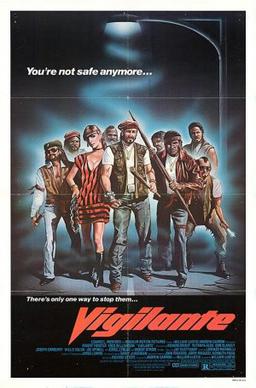
Vigilante (1982, directed by William Lustig)


The year is 1982 and New York City has gone to Hell.  While honest, hard-working people try to make a living and take care of their families, the streets are ruled by gangs and drug dealers.  The police and the legal system impotent in the face of intimidation and corruption.  Maybe it’s time for the citizens to take the streets back, by force if necessary.

That’s what Nick (Fred Williamson) and most of his friends believe.  Eddie Marino (Robert Forster) disagrees.  He says that people taking the law into their own hands will just lead to more violence and death.  The vigilantes will become just a bloodthirsty as the criminals.  While Eddie is debating policy with Nick, Eddie’s wife (Rutanya Alda) is threatening to call the police on a Che Guevara look-alike who she spots trying to set a gas station attendant on fire.  Eddie’s wife is stabbed.  His son is killed.  And when the man responsible is allowed to walk by a crooked judge, Eddie’s courtroom outburst leads to him being sent to jail.

Eddie spends 30 days in jail, fighting off predators and befriending a mysterious inmate named Rake (Woody Strode).  When Eddie is finally released, his traumatized wife no longer wants to be married to him but Eddie has found a new purpose in life.  Working with Nick, Eddie tracks down and murders the men who have destroyed his family.

One of the many films to be inspired by the success and enduring popularity of the original Death Wish, Vigilante is a classic of its kind.  Director William Lustig wastes no time in establishing New York City as being a graffiti-decorated war zone where good is fighting a losing war against evil and most of the victims are just innocent bystanders.  The New York of Vigilante looks even worse than it did in Lustig’s previous film, Maniac.  (Maniac’s Joe Spinell plays one a crooked lawyer in Vigilante.)  The action is brutal and bloody.  While Forster fights for his life in prison, the people who killed his son are allowed to run free.  It’s not subtle but, by the time Forster finally walks out of jail, you’ll be more than on his side and ready to see him get his revenge.  With his trademark intensity, Robert Forster is believable as someone who goes from aborhing to violence to being a stone cold killer who doesn’t even flinch when he shoots a defenseless man.  As Nick, Fred Williamson is his usual confident self.  Williamson may not have much range as an actor but he has such a forceful screen presence that he dominates any scene in which he appears.

Vigilante is a grim film, with Eddie ultimately going further than almost any other screen vigilante before him.  It’s also a deeply satisfying film because it appeals to everyone’s desire for revenge.  In the real world, vigilantes are often as dangerous as the people they’re trying to keep off the streets.  In the movies, though, they’re easy to root for.  They present easy and direct solutions to complex problems.  Even a film as dark as Vigilante works as a sort of wish fulfillment.  With crime on the rise and the constant news reports about innocent victims who just happened to be in the wrong place at the wrong time, it’s easy to root for Nick and Eddie as it once was for Paul Kersey.

Lisa Reviews A Palme d’Or Winner: M*A*S*H (dir by Robert Altman)


With the Cannes Film Festival underway, I have been watching some of the past winners of the prestigious Palme d’Or.  On Thursday night, Jeff and I watched the winner of the 1970 winner of the Grand Prix (as the Palme was known at the time), Robert Altman’s M*A*S*H.

There are, of course, three versions of M*A*S*H.  All three of them deal with the same basic story of Dr. Hawkeye Pierce and his attempts to maintain his sanity while serving as a combat surgeon at the 4077th Mobile Army Surgical Hospital during the Korean war.  All three of them mix comedy with the tragedy of war.  However, each one of them takes their own unique approach to the material.

The one that everyone immediately thinks of is the old television series, which ran for 11 seasons and which can be found on Hulu and on several of the retro stations.  The television series starred Alan Alda as Hawkeye.  I’ve watched a handful of episodes and, while the episodes that I’ve seen were undeniably well-acted and well-written and they all had their heart in the right place, the show’s deification of Hawkeye can get to be a bit much.  Not only is Hawkeye the best surgeon at the 4077th, he’s apparently the best surgeon in all of Korea.  In fact, he may be the best surgeon on the entire planet.  Not a single thing happens in the camp unless Hawkeye is somehow involved.  When a nurse is killed by a landmine in one episode, the focus is not on the other nurses but instead on how Hawkeye feels about it.  When bombs are falling too close to the camp, the focus is again only on Hawkeye and how much he hates the war.  If you didn’t already know that he hated the war, Hawkeye will let you know.  Wish Hawkeye a good morning and he’ll yell at you about how many people are going to be wounder by the end of the day.  Even when one agrees with Hawkeye, the character’s self-righteousness can be a bit much.

Less well-known is the first version of M*A*S*H, a short and episodic novel that was published in 1968.  The novel was written by Dr. Richard Hornberger, who actually had served in Korea at a M*A*S*H unit and who reportedly based Hawkeye on himself.  The book is a rather breezy affair.  Reading it, one can definitely tell that it was inspired by someone telling Hornberger, “Your stories about Korea are so funny and interesting, you should write them down!”  The book avoids politics, reserving most of its ire for military red tape.  Hornberger was a Republican who so disliked Alan Alda’s interpretation of Hawkeye that, when he wrote a sequel to M*A*S*H, he included a scene in which Hawkeye talked about how much he enjoyed beating up hippies.

And then there’s the version that came in between the book and the television series, the 1970 film from Robert Altman.  The film retains the book’s episodic structure while also throwing in the anti-war politics that would define the television series.  (Though the film was set in the 50s, Altman purposefully made no attempt to be historically accurate because he wanted it to be clear that this film was more about Vietnam than Korea.)  From its opening, the film announces its outlook, with shots of helicopters carrying severely wounded (possibly dead) soldiers to the camp while a song called Suicide is Painless plays on the soundtrack.  The song was written by director Robert Altman’s fourteen year-old son, Mike.  Reportedly, it took Mike five minutes to come up with the lyrics.  When the instrumental version of the song was later used as the theme song for the television series, Mike Altman made over a million dollars in royalties.

The film opens with Hawkeye Pierce (Donald Sutherland) and Duke Forrest (Tom Skerritt) arriving at the 4077th MASH in a stolen jeep and it ends with them getting sent home in the same jeep.  Though Duke is set up to be a major character, he soon takes a backseat to another surgeon, the unfortunately nicknamed Trapper John (Elliott Gould).  Much as with the television series, the movie centers around Hawkeye and Trapper John’s antics.  When they’re not in the operating room, they’re drinking, carousing, and playing pranks that are far more mean-spirited than anything the television versions of the characters would have ever done.  (Indeed, the book and movie versions of Hawkeye probably would have hated Alan Alda’s Hawkeye.)  Unlike the television version of Hawkeye, the film’s Hawkeye is not the best surgeon in Korea.  In fact, he’s not even the best surgeon at the 4077th.  (That honor goes to Trapper.)  Instead, he’s just one of many doctors on staff.  They’re rotated in and then, at the end of their tour, they’re rotated out.  Hawkeye loses as many patients as he saves.  The film’s doctors are not miracle workers, nor are they crusaders.  Instead, they are overworked, neurotic, often exhausted, and frequently bored whenever there aren’t any wounded to deal with.  The film emphasizes that the doctors are as professional inside the Operating Room as they’re rambunctious outside of it.  Unlike the television series, Hawkeye doesn’t joke while working.  He’s usually too busy trying to stop his patients from bleeding to death to tell jokes or to complain about the war that brought them to the OR.

Indeed, the film version of M*A*S*H communicates its anti-war message not through indignant speeches but instead through bloody imagery.  The operating room scenes don’t shy away from showing the ugliness of war and they are occasionally so visceral that they almost seem to shame the audience for have laughed just a few minutes earlier.  One of the film’s more famous (and controversial) sequences features Hawkeye driving Frank Burns (Robert Duvall) to insanity by crudely taunting him about his affair with head nurse Margaret Houlihan (Sally Kellerman).  Burns attacks Hawkeye, a response that actually seems rather justified even if it is played for laughs.  A scene of Burns being driven out of the camp in straitjacket is followed by a close-up of a geyser of blood erupting from a wounded soldier’s throat.  It’s a jarring transition but one that makes a stronger anti-war statement than any self-righteous monologue would have.  While Hawkeye and Trapper are taunting Burns and Margaret, soldiers are still being sent off to die.

The humor in M*A*S*H is often brutally misogynistic.  Margaret is described as being “a damn good nurse” but is continually humiliated because she believes in maintaining military discipline.  One can disagree with her emphasis on following all of the proper regulations while also realizing the Hawkeye and Trapper’s treatment of her is unreasonably cruel.  The scene where Trapper and Hawkeye expose her while she’s taking a shower is especially difficult to watch and there’s no way to justify their actions.  It’s frat boy humor, the type of stuff that you would expect from a bunch of former college football players, which is what we’re told Hawkeye and Trapper are.  (That, of course, is another huge difference between the film and television versions of the characters.)  That said, it’s debatable whether or not were supposed to find either Hawkeye or Trapper to be heroic or even likable.  As a director, Robert Altman shied away from making films with unambiguous heroes or villains.  Just as Margaret could be a “damn good nurse” and a “regular army clown” at the same time, Hawkeye can be both a dedicated doctor and a bit of a jerk.

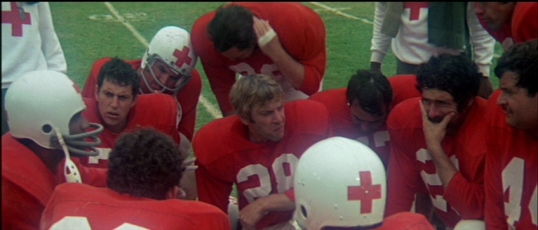
After 90 minutes of bloody operating room scenes and Trapper and Hawkeye making crude jokes, M*A*S*H suddenly becomes a sports film as the the 4077th plays a football game against their rivals, the 325th Evac Hospital.  The change of tone can be a bit jarring but it’s perhaps the most important sequence in the film.  For a few hours, the doctors bring “the American way of life” to Korea and the end result is a game that’s played for money and which is only won through cheating and deception.  (Future blaxploitation star Fred Williamson made his film debut as the ringer who the 4077th recruits for the game.)  For all of the broad comedy of the game, it’s followed by a shot of the doctors playing poker while a dead soldier is transported out of the camp, wrapped in a white sheet.  Football may provided a distraction.  The money may have provided an incentive.  But the war continued and people still died.

Much of M*A*S*H‘s humor has aged terribly but the performances still hold up and the anti-war message is potent today.  Though Sutherland and Gould are undeniably the stars of the film, M*A*S*H is a true ensemble film, full of the overlapping dialogue and the small character performances that Robert Altman’s films were known for.  One reason why the film works is because it is an immersive experience, the viewer truly does feel as if they’ve been dropped in the middle of an operating field hospital.  Though Hawkeye and Trapper may be at the center of the action, every character, from the camp’s colonel to the lowliest private, seems to have their own story playing out.  This a film where paying attention to the little things happening in the background is often more rewarding than paying attention to the main action.  I particularly liked the performances of David Arkin as the obsequies Staff Sergeant Vollmer and Bud Cort as Pvt. Warren Boone.  Boone, especially, seems to have an interesting story going on in the background.  The viewer just has to keep an eye out for him.  Also be sure to keep an eye out for Rene Auberjonois, who reportedly improvised one of the film’s best-known lines when, after Margaret demands to know how Hawkeye reached a position of authority in the army medical corps, he deadpanned, “He was drafted.”

One of the first major studio films to be openly critical of the military and the war in Vietnam, M*A*S*H won the Palme d’Or, defeating films like Investigation of a Citizen Above Suspicion and The Strawberry Statement.  Unlike many Palme winners, it was also a box office success in the United States.  Though controversial, it received an Oscar nomination for Best Picture.  However, unlike the Cannes jury, the Academy decided to honor a different film about war, Patton.

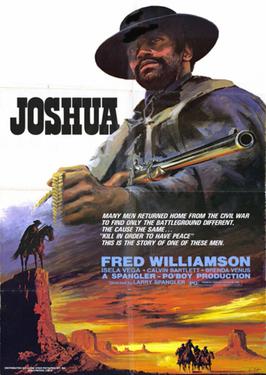
Joshua (1976, directed by Larry Spangler)


One day, as the American Civil War is drawing to a close, a group of outlaws besiege a homesteader’s cabin.  While they allow the homestead to survive, they kill his maid, Martha (Kathyrn Jackson) and they kidnap his mail order bride (Brenda Venus).  The very next day, Martha’s son, Joshua (Fred Williamson), arrives home from serving in the Union Army.  As soon as Joshua find out what has happened, he grabs his late father’s rifle, jumps on his horse, and set off for revenge.  When the sheriff warns him that the gang is violent, bloodthirsty, and large, Joshua replies, “I just finished fighting a war, Sheriff.  I’ve killed twice that.”

Joshua finds Fred Williamson doing what he does best.  Dressed in all black and not showing a hint of emotion, Williamson dominates the screen as he rides across the countryside and finds creative ways to kill the members of the gang.  Along the way, he also meets and has a brief fling with Maria (Isela Vega), a female gunslinger.  Even though Joshua proves time and again that he can handle himself while fighting several men at once, he chooses to take the members of the gang out one-by-one.  He savors getting his revenge, as only Fred Williamson could.  (Also, if Joshua took out the entire gang at one time, it would be a really short movie.)

Williamson wrote the script for Joshua and produced it through his own production company.  That probably explains why no one else in the film really has a chance against Joshua.  There’s really nothing, from firing a gun to battling a rattlesnake to tracking a group of cold-blooded killers, that Joshua doesn’t do well.   Not a lot happens in Joshua but Williamson does a good job of playing the taciturn title character and he nails the scene where he tells a naive cowboy that killing is not something to take likely.  As always, Fred Williamson is the epitome of cool.  Unfortunately, the film drags whenever Williamson isn’t on screen and the members of the gang are pretty much indistinguishable from each other.  People looking for a serious or realistic western will be disappointed but if you just want to watch Fred Williamson be Fred Williamson for 90 minutes, Joshua fits the bill.

Original Gangstas (1996, directed by Larry Cohen)


Original Gangstas opens with shots of the deserted streets and burned-out store fronts of Gary, Indiana and narration telling us how a once great American city came to be in such disrepair.  The steel plant closed and put much of the city out of work.  While the politicians and the police looked the other way, violent street gangs rose up and took over entire neighborhoods.  Now, Gary is a shell of its former self.  Even the local movie theater has closed down.  The narrators tells us that the last movie to play at the theater was Star Wars.

Led by Spyro (Christoper B. Duncan) and Damien (Eddie Bo Smith, Jr.), the Rebels are the most feared and powerful gang in Gary.  They rule through violence and intimidation.  Talk to the police and your business is liable to get torched and you’re likely to get shot.  However, Spyro and Damien have finally gone too far and now, two men who previously escaped from Gary are returning to town to dish out some justice.

John Bookman (Fred Williamson) is a former football player who wants to avenge the shooting of his father.  Jake Trevor (Jim Brown) is a boxer who once killed a man in the ring and who wants revenge for the death of his son.  When they were young men, John and Jake were the original Rebels and now they’re getting the old gang back together again.  With the help of Laurie (Pam Grier), Bubba (Ron O’Neal), and Slick (Richard Roundtree), the original gangstas are going to take back the streets of Gary.

Original Gangstas was released at a time when, largely thanks to the influence of Quentin Tarantino, people were just starting to feel nostalgic for the old blaxploitation movies.  The main appeal of the film, not surprisingly, is that it brings together so many of the great blaxploitation stars and sets them loose in what was then the modern era.  (Jim Kelly is missed.)  When John and Jake talk about how they’re responsible for the Rebels, they could just as easily be talking about how they’re responsible for both all of the independent crime films that came out in the wake of Reservoir Dogs and Pulp Fiction.

Original Gangstas is a tribute to both the Blaxploitation genre and the oversized personalities that made that era so memorable.  Neither Fred Williamson, Jim Brown, nor Richard Roundtree were particularly good actors but they all had so much screen presence and such an innate sense of cool that it didn’t matter whether they could convincingly show emotion or not.  (Original Gangstas gives all of the big dramatic scenes to Pam Grier, who was not only naturally cool but a damn good actress to boot.)  The minute Fred Williamson lights his cigar, he control the entire movie.  He and Jim Brown make a good team and Original Gangstas is an entertaining and violent trip down memory lane.

That’s Blaxploitation! 13: BLACK CAESAR (AIP 1973)


gary loggins's avatarcracked rear viewer

1972’s blockbuster smash THE GODFATHER began an onslaught of gangster movies released to your neighborhood theaters and drive-ins trying to capitalize on that film’s success. American-International Pictures was right in the thick of it, and since Blaxploitation was all the rage at the time, why not combine the two hottest genres? Producer/director/genius Larry Cohen already had a script written for Sammy Davis Jr., but when Sammy backed out, AIP Boss of Bosses Samuel Z. Arkoff signed Fred “The Hammer” Williamson to star as the Godfather of Harlem, BLACK CAESAR.

BLACK CAESAR is a semi-remake of the 1932 classic LITTLE CAESAR starring Edward G. Robinson, updated for the Blaxploitation/Grindhouse crowd and spun around on it’s head by Larry Cohen. You already know how much I enjoy Cohen’s work, and the auteur doesn’t fail to deliver the goods with this one. Casting the charismatic former NFL star Williamson was a bonus, and…

View original post 358 more words

The TSL’s Grindhouse: No Way Back (dir by Fred Williamson)


Jesse Crowder’s back!

You may remember Jesse Crowder as the super cool and unflappable private detective from Death Journey.  Jesse was a Los Angeles cop but now he works independently.  There’s literally nothing that Jesse can’t do.  Ride a horse?  Ride a motorcycle?  Slow motion kung fu?  Jesse can do it all and he usually do it without bothering to button up his shirt.  Jesse is such a badass that he can kill more people in the time it takes for him to light a cigar than most people will kill in their entire lifetime.

The 1976 film No Way Back is the second Jesse Crowder film.  Once again, Fred Williamson both directs and stars as Jesse.  Williamson is in almost every scene of the film and when he’s not killing bad guys or having sex or just posing with his shirt off, he’s listening to people talk about what a badass he is.  In short, No Way Back is a vanity project but it’s a vanity project with a sense of humor.  Watching the film, you get the feeling that Williamson knows that No Way Back is kind of silly but, at the same time, he’s having fun and he wants everyone watching to have fun too.

No Way Back‘s plot involves a missing man and a lot of money.  Henry Pickens (Charles Woolf) worked at a bank but, one day, he grabbed a briefcase full of money, jumped in a car driven by his girlfriend (Tracy Reed), and disappeared.  Everyone was shocked but you know who was really shocked?  His wife!  Mildred Pickens (Virginia Gregg) and Henry’s brother both want to know to where Henry has vanished.  They hire Jesse, perhaps finding solace in his catch phrase: “You pay the bill, I’ll deliver it.  Legal, illegal, moral or otherwise.”

Not surprisingly, it doesn’t take long for Jesse to figure out that Perkins is in San Francisco.  Jesse lights his cigar and heads for the Bay City.  However, Jesse isn’t the only one looking for Henry Pickens.  There’s also a gangster named Bernie (Stack Pierce) who is determined to get the money for himself.  Much as in Death Journey, it doesn’t matter where Jesse goes or how he gets there.  As soon as he arrives, he people are trying to kill him.  Unfortunately, for them, no one can kill Jesse Crowder.

It all leads to a savage gun battle in the desert.  Fred Williamson jumps up on a horse, unbuttons his shirt, and rides across the screen.  People are betrayed.  People get shot.  Fortunately, no one can touch Jesse Crowder…

Anyway, No Way Back doesn’t really make any sense.  If you happen to watch this film (and I saw it on YouTube), just try to keep track of why Henry stole all of that money in the first place.  However, the plot isn’t really that important.  This film is all about Fred Williamson beating up gangsters and walking around without a shirt on.  It’s a dumb action movie but it never pretends to be anything different and the film’s total lack of pretension is enjoyable.  That’s always a good thing.

http://www.youtube.com/watch?v=RAlWgEPC3RU

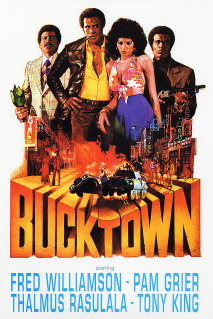
The TSL’s Grindhouse: Bucktown (dir by Arthur Marks)


Welcome to the town of Buchanan!

It’s a small Southern town, popularly known as Bucktown.  It’s a town where you can literally get anything, as long as you know who to pay off.  Upon arriving, don’t be surprised if a little kid approaches you and asks you what you’re looking for.  He can get it for you.  That kid had connections!

The population of Buchanan is almost entirely African-American but all of the cops are white.  Under the leadership of the redneck police chief (Art Lund), the cops have turned Buchanan into their own private kingdom.  If you want to do anything in Buchanan, you have to be ready to pay the cops for protection.  Refuse and you’ll get arrested.  Continue to refuse and you’ll probably end up getting shot.

Obviously, someone needs to clean up Buchanan?  But who!?

How about Duke Johnson (Fred Williamson)?  Duke’s brother owned the hottest nightclub in Bucktown, Club Alabama.  Or, at least he did until he announced he wasn’t going to pay anymore protection and he ended up getting gunned down by the cops.  When Duke arrives in town, he thinks that he’s just going to stay long enough to attend the funeral and sell his brother’s bar.  However, when Duke find out that he has to wait 60 days until he can sell the bar, he decides to stick around.  Not only does he move in with his brother’s former lover, Aretha (Pam Grier), but also reopens the Club Alabama.

Soon, the cops are coming around and demanding their share.  However, they quickly discover that no one tells Duke Johnson what to do.  Like all good action heroes, Duke has friends all over the country.  He places a call to Roy (Thalmus Rasulala) and soon, Roy, TJ (Tony King), and Hambone (Carl Weathers) show up in Bucktown.  They quickly wipe out the corrupt police force.  The local citizens are so happy that they make Roy the new police chief and his men the new police force.

Unfortunately, that turns out to be a mistake.  Apparently, giving some totally random dude complete and total authority to enforce the law in whatever he sees fit isn’t always the best way to handle things.  Roy and his men quickly become just as corrupt as the old redneck policemen.  The only thing protecting Duke is his friendship with Roy but even that is endangered when T.J. decides that he wants Aretha for himself.  T.J. decides to turn Roy and Duke against each other.  It all eventually leads to an epic fist fight, with the winner earning the right to remain in Bucktown…

(Of course, you may be wondering why anyone would want to remain in Bucktown as the place is kind of a dump, regardless of who’s in charge.)

Released in 1975, Bucktown is a pretty basic action film but I liked it because it appealed to all of my anti-authoritarian impulses.  There have been so many movies about what it takes to clean up a town but there haven’t been many made about what actually happens after all of the corrupt cops and greedy businessmen have been kicked out.  Thalmus Rusulala was great as the charismatic but dangerous Roy and Tony King, a favorite of Italian exploitation fans everywhere, was an effective villain.  Pam Grier doesn’t get to do much but she does the best with what she’s provided.  Of course, the entire film is dominated by Fred Williamson, who may not have been a great actor but who had an undeniable screen presence.  Williamson struts through the film like the hero of stylish Spaghetti western.

Bucktown is an entertaining 70s action film.  Though it doesn’t deeply explore any of the issues that it raises, it still deserves some credit for raising them.  If nothing else, it’s a film that shows why Fred Williamson retains a cult following to this day.