The Fabulous Forties #2: Second Chorus (dir by H.C. Potter)


I’m currently in the process of watching and reviewing all 50 of the films in Mill Creek’s Fabulous Forties DVD box set.  Yesterday, I got things started by reviewing Port of New York.  Today, I’m looking at the set’s 2nd film, 1940’s Second Chorus.
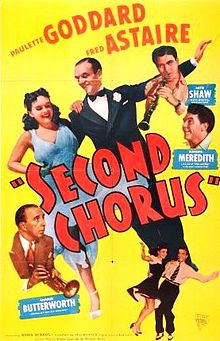
Second_Chorus_poster

As much as I love all of my Mill Creek box sets, watching Second Chorus reminded me of one of the drawbacks of watching a Mill Creek release.  Since Mill Creek specializes in films that have fallen into the public domain, a lot of their DVDs are more than a little rough.  The Mill Creek version was obviously transferred from a seriously deteriorated print.  As a result, the picture is often dark or blurry while the sound is occasionally iffy at best.  That’s a shame because Second Chorus is an entertaining little film.

In Second Chorus, Fred Astaire and Burgess Meredith both play college students.  (Burgess is the wacky one while Fred is … well, he’s Fred Astaire.  He’s confident, he’s suave, and he’s always ready to perform.)  Fred appears to be in his late 30s while Burgess looks closer to 50 but, fortunately, their age is meant to be a part of the joke.  Fred and Burgess have intentionally failed their final exams for seven years so that they can stay in school and continue to lead the college jazz band.  They are perennial college students and who hasn’t known a few of them?  (Apparently, in 1940, there was no such thing as academic suspension.)

When a debt collector comes looking for them (apparently, Burgess bought a set of encyclopedias that he never paid for), Fred manages to charm the collector’s secretary (Paulette Goddard) away from him.  Paulette agrees to serve as Fred and Burgess’s manager and even manages to get them a job with real-life band director Artie Shaw.  (Shaw plays himself and seems to be perpetually annoyed whenever he’s on screen.)  Will Fred finally accept some responsibility, act maturely, hold down a job, and maybe win the heart of Paulette Goddard?

Now, I should point out that, while I enjoyed Second Chorus, Fred Astaire apparently considered Second Chorus to be the worst film that he ever made.  While Second Chorus is definitely no Top Hat, I think that Fred Astaire was being a little too harsh in his assessment. The music is good, the dancing is fun to watch, and the plot … well, who really cares about the plot? It’s undoubtedly a silly film that has very little going on underneath the surface but Astaire and Meredith make for a surprisingly effective comedy team.

And while nondancer Paulette Goddard may not have had as effective a chemistry with Fred as Ginger Rogers (but then again, who did?), I still loved watching them perform the I Ain’t Hep To That Step But I’ll Dig It number.  This entire number was reportedly filmed in one take.  Goddard had little dance experience but it didn’t matter because her partner was Fred Astaire and Fred was so good that he could make anyone look like a natural.

Second Chorus is an entertaining little movie.  Just avoid the Mill Creek transfer.
Cleaning Out The DVR #28: Top Hat (dir by Mark Sandrich)


(For those following at home, Lisa is attempting to clean out her DVR by watching and reviewing 38 films by the end of this Friday.  Will she make it?  Keep following the site to find out!)

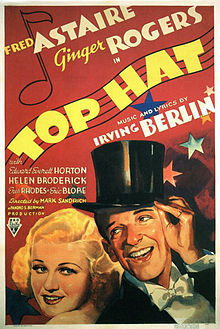
220px-TopHatORGI

The 1935 film Top Hat is a film that, much like An American In Paris, is pure joy.

Top Hat features Fred Astaire as Jerry Travers, a famous dancer who has come to London to star in a show that’s being produced by his friend, Horace Harwick (Edward Everett Horton).  (Oddly enough, Gene Kelly also played a character named Jerry in An American In Paris.)  Jerry may be sophisticated and refined but he’s still enough of an American that, upon leaving a snooty British club that insists on total silence, he still breaks up the tedium with some impromptu tap moves.

Back at his hotel, Jerry is practicing a tap routine and makes such a racket that he ends up waking up the guest staying in the room below him, Dale Tremont (Ginger Rogers).  When Dale goes upstairs to complain, Jerry immediately falls in love with her.  Soon, he is pursuing her all over London, trying to win her heart.  Eventually, he even follows her to Venice.

And Dale is definitely attracted to Jerry.  Whenever they get near each other, they start dancing.  (Needless to say, whether they’re dancing or talking or merely looking at each other from across the room, Astaire and Rogers have wonderful chemistry.)  However, Dale thinks that Jerry is actually Horace.  And Horace happens to be married to her friend, Madge (Helen Broderick.)  Convinced that Jerry is pursuing an adulterous affair with her, the indignant Dale makes plans to marry the Italian fashion designer, Alberto Beddini (Erik Rhodes).

The plot is typical screwball comedy stuff and the fact that you don’t even end up getting annoyed with all the misunderstandings is a testament to the abilities of Astaire, Rogers, and their wonderful supporting cast.  Even if not for the dancing, Top Hat would be a success because of the chemistry between the actors and film’s mix of sophistication with just pure silly fun.  I imagine that for audiences dealing with the daily realities of the Great Depression, Top Hat offered a wonderful escape.  And you know what?  It still provides a wonderful escape for today, as well.

(Wouldn’t it be nice if we could just dance this presidential election away?)

And then, of course, there’s the dancing.  That really is the main reason that we’re here, right?  Check out a few scenes.  They’ll make you happy.

(Incidentally, I’m a bit disappointed that YouTube does not feature more from Top Hat.)

Top Hat was nominated for best picture, though the award itself went to Mutiny On The Bounty, a film that did not feature quite as much dancing.

Embracing the Melodrama #28: The Towering Inferno (dir by John Guillermin)


The_Towering_Inferno_1974-500x300

I have a weakness for the old, all-star disaster movies of the 1970s.  It could be because those movies remind me of how fragile life really is and encourage me to make the most of every minute.  Or maybe it’s because I have my phobias and, by watching those movies, I can confront my fears without having to deal with a real-life tornado, hurricane, tidal wave, avalanche, or fire.

Or maybe I just have a weakness of glitz, glamour, and melodrama — especially when it involves a huge cast of stars and character actors.  Yes that’s probably the reason right there.

Case in point: the 1974 best picture nominee, The Towering Inferno. 

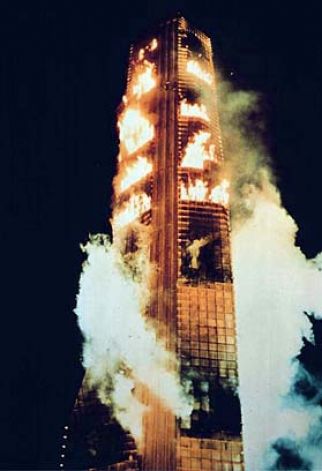
As is the case with most of the classic disaster films, The Towering Inferno is a long and big movie but it has a very simple plot.  The world’s tallest building — known as the Glass Tower — has been built in San Francisco.  On the night of the grand opening, a fire breaks out, trapping all the rich and famous guests on the 135th floor.  Now, it’s up to the fire department to put out the fire while the trapped guests simply try to survive long enough to be rescued.  Some will live, some will die but one thing is certain — every member of the all-star cast will get at least 15 minutes of screen time and at least one chance to scream in the face of the film’s still effective special effects.

628x471

As for the people trapped by the towering inferno, we don’t really get to know them or their motivations.  (Add to that, once the fire breaks out, everyone pretty much only has one motivation and that’s to not die.)  As a result, we don’t so much react to them as characters as we do to personas of the actors who are playing them.

Steve-McQueen-in-The-Towe-001

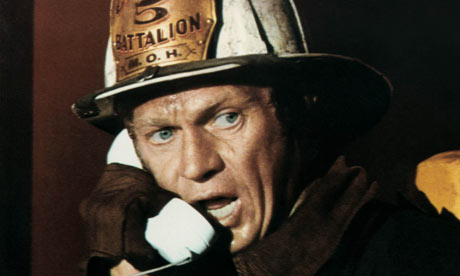
For instance, we know that Fire Chief O’Halloran is a fearless badass and a natural leader because he’s played by Steve McQueen.  McQueen brings a certain blue collar arrogance to this role and it’s a lot of fun to watch as he gets progressively more and more annoyed with the rich people that he’s been tasked with rescuing.

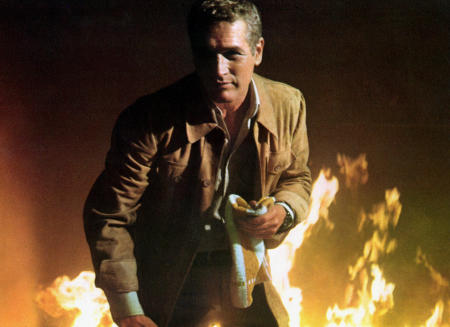
We know that architect Doug Roberts is a good guy because he’s played by Paul Newman.  Reportedly, Newman and McQueen were very competitive and, in this movie, we literally get to see them go-head-to-head.  And, as charismatic as Newman is, McQueen pretty much wins the movie.  That’s because there’s never a moment that O’Halloran isn’t in charge.  Doug, meanwhile, spends most of the movie begging everyone else in the tower to exercise the common sense necessary to not die.  (Unfortunately, despite the fact that he looks and sounds just like Paul Newman, nobody in the tower feels like listening to Doug.  If Towering Inferno proves anything, it’s that most people are too stupid to survive a disaster.)

paul-newman-inferno1

The tower’s owner, James Duncan, is played by William Holden so we know that Duncan may be a ruthless businessman but that ultimately he’s one of the good guys.  Holden gets one of the best scenes in the film when, after being told that people in the building are catching on fire, he replies, “I think you’re overreacting.”

Roger Simmons is Duncan’s son-in-law and we know that he’s ultimately to blame for the fire because he’s played by Richard Chamberlain.  Roger might as well have a sign on his back that reads “Doomed.”  The same can be said of publicity executive Dan (Robert Wagner) and his girlfriend, Lorrie (Susan Flannery).

The_Towering_Inferno_1974_Faye_Dunaway_Mike_Lookinland

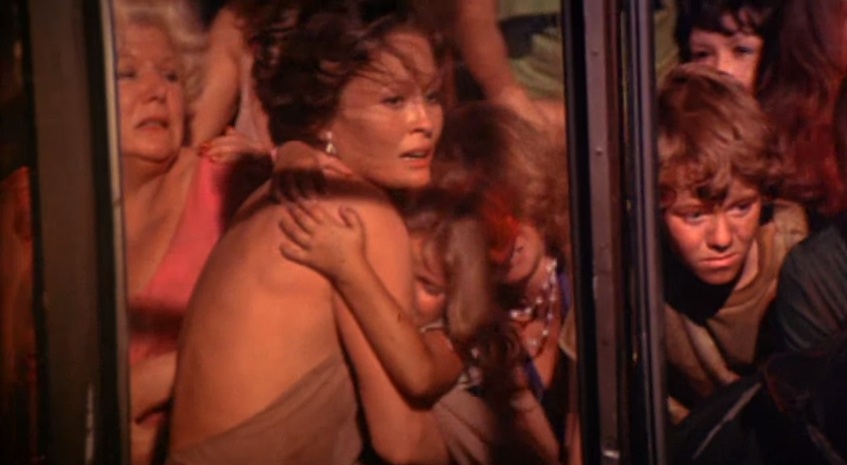
Faye Dunway is Susan.  She is Doug’s fiancée and she really doesn’t do much but she does get to wear a really pretty dress.  The same can be said of Susan Blakely, who plays Roger’s dissatisfied wife, and Jennifer Jones, who plays a recluse.  And good for them because if you’re going to be stuck in an inferno without much to do, you can at least take some comfort in looking good.

Then there’s Fred Astaire, who does not dance in this film.  Instead, he plays a kind-hearted con artist who ends up falling in love with Jennifer Jones.  Fred Astaire received his only Oscar nomination for his brief but likable performance in The Towering Inferno.

And finally, there’s the building’s head of security, Jernigan.  We know that he’s a murderer because he’s played by O.J. Simpson and … oh wait.  Jernigan is actually probably the second nicest guy in the whole film.  The only person nicer than Jernigan is Carlos, the bartender played by Gregory Sierra.

OJ

The real star of the film, of course, is the fire.  In the 40 years since The Towering Inferno was produced, there’s been a lot of advances in CGI and I imagine that if the film was made today, we’d be watching the fire in 3D and it would be so realistic that we’d probably feel the heat in the theater.  That said, the fire effects in The Towering Inferno are still pretty effective.  Now, I have to admit that I have a phobia (and frequent nightmares) about being trapped in a fire so, obviously, this is a film that’s specifically designed to work itself into my subconscious.  But that said, the scenes with various extras thrashing about in the flames are still difficult to watch.  There’s a scene where Robert Wagner and Susan Flannery find themselves trapped in a blazing reception area and it is pure nightmare fuel.

The Towering Inferno 9

The Towering Inferno is an undeniably effective disaster film.  At the same time, when one looks at the 1974 Oscar nominees, it’s odd to see The Towering Inferno nominated for best picture along with The Godfather Part II, Chinatown, and The Conversation.  Unlike those three, The Towering Inferno is hardly a great film.

But it is definitely an entertaining one.

toweringinferno2