4 Shots From 4 Films is just what it says it is, 4 shots from 4 of our favorite films. As opposed to the reviews and recaps that we usually post, 4 Shots From 4 Films lets the visuals do the talking!
Today, I’m using this feature to take a look at the history of the Academy Award for Best Picture. Decade by decade, I’m going to highlight my picks for best of the winning films. To start with, here are 6 shots from 6 Films that won Best Picture during the early days of the Academy Awards! Here are….
6 Shots From 6 Best Picture Winners
Sunrise: A Song of Two Humans (1927, dir by F.W. Murnau, DP: Charles Rosher and Karl Struss)
Wings (1927, dir by William Wellman, DP: Harry Perry)
All Quiet On The Western Front (1930, dir by Lewis Milestone, DP: Arthur Edeson)
It Happened One Night (1934, dir by Frank Capra, DP: Joseph Walker)
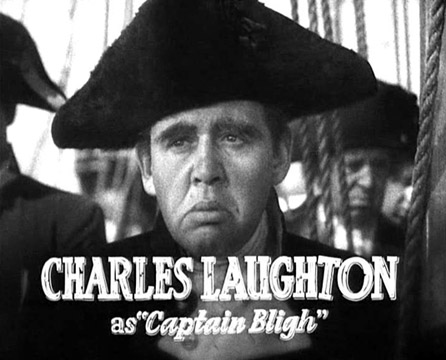
Mutiny on the Bounty (1935, dir by Frank Lloyd, DP: Arthur Edeson)
Gone With The Wind (1939, dir by Victor Fleming, DP: Ernest Haller)
First broadcast in 1981, The Wave stars Bruce Davison as Ben Ross, a high school social studies teacher who conducts a social experiment.
Frustrated by the fact that he can’t answer his students questions of how the German people could have allowed the Holocaust to occur, Ben decides to teach his students a lesson. He starts by introducing a bunch of seemingly arbitrary rules to his classroom, concerning the proper way for students to sit at their desks and to address the teacher. Ben is somewhat surprised to see how quickly his students adapt to the new rules, even taking pleasure in showing how quickly and efficiently they can follow orders. The next day, Ben tells his students that they are now members of The Wave, a national youth organization with membership cards and a secret salute.
And that is when all Hell breaks loose. Ben only meant to show his students what it’s like to be a member of a mass movement but the students take The Wave far more seriously than Ben was expecting. Soon, other students are joining The Wave. When the popular football players announce that they are a part of The Wave, others are quick to flock to the organization. The formerly likable David turns into a fanatic about bringing people into the organization. Robert, a formerly unpopular student, revels in his new job of reporting anyone who deviates from the rules of The Wave. When a student reporter writes an article that is critical of the organization, she and the school paper are targeted. Has Ben’s social experiment spiraled out of control?
42 years after it was originally produced, The Wave remains a powerful and sobering look at how people can be manipulated into doing things as a mob that they would never do as an individual. If anything, the film feels more relevant today than it probably did in 1981. The character of Robert, in particular, is a familiar one. He’s someone with no self-esteem who latches onto a movement and finds his identity by taking down others and accusing them of failing to follow the rules. One can find people like Robert all over social media, searching through old posts for any example of wrongthink that they can broadcast all through their social world. It’s tempting to smirk at how quickly the members of The Wave sacrificed their freedom and their ability to think for themselves but it’s no different from what we see happening in the real world every day. (Indeed, if the film had been made just two or three years ago, The Wave would probably be the people policing whether or not the rest of us were observing quarantine and wearing our facemasks correctly.) People like to feel that they belong to something, even if that means sacrificing their humanity in the process.
Featuring a good performance from Bruce Davison as the well-meaning teacher who is both fascinated and terrified by the experiment that he’s set in motion, The Wave can be viewed below:
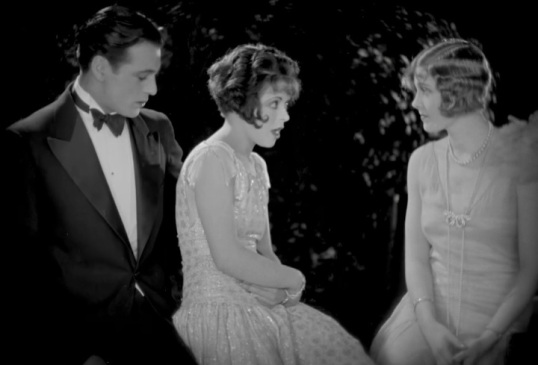
The 1927 silent melodrama, Children of Divorce, opens at a private Catholic boarding school in Paris. It’s a place for rich and idle parents to dump off their children while they enjoy the City of Lights. Jean Waddington is dropped off at the school and struggles to make friends until she meets the vivacious Kitty Flanders. Jean and Kitty bond because they are both children of divorced parents. (Kitty says that she has only one mother but that’s she’s had four different fathers.) Jean meets Ted Larrabee, who is Kitty’s neighbor back in New York and who has also been dumped off at the school by his divorced parents.
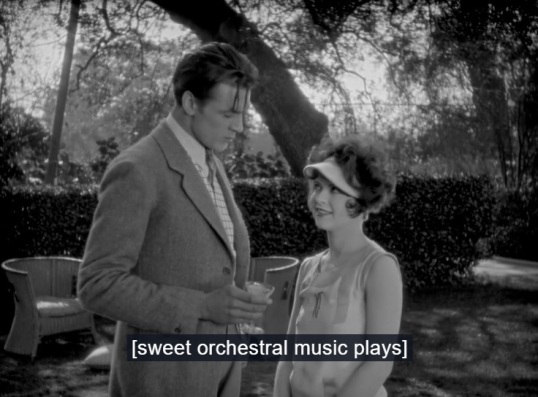
Flash forward a few years and Kitty (Clara Bow), Jean (Esther Ralston), and Ted (Gary Cooper) are all young adults. Kitty is in love with Prince Vico (Einar Hansen) but the Prince’s father refuses to allow Vico to consider marrying her because Kitty’s mother (played by future gossip columnist and Queen of Hollywood, Hedda Hopper) is not rich. Believing that the only way that she’ll ever be happy is if she marries a rich man, Kitty set her eyes on Ted. Ted, however, wants to marry Jean but Jean says that she’ll only consider marrying Ted if he gets a real job and proves that he can do something more than just live off of his father’s money.
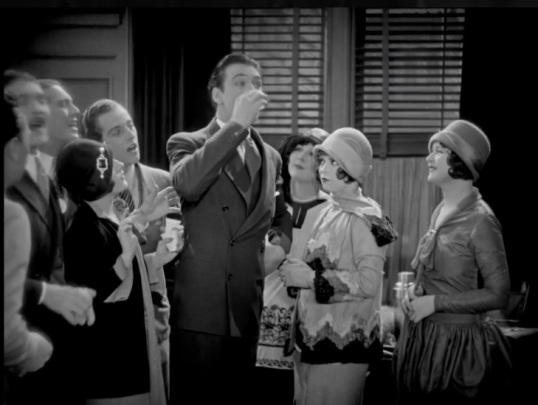
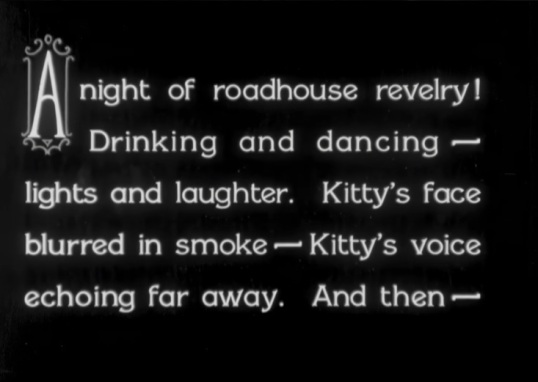
Ted starts his own architectural firm and proves that he’s capable of hard work. However, when Kitty convinces Ted to celebrate his success by going out drinking with her….
Ted wakes up with a hangover. He soon discovers that he’s also woken up with a wife! While he was drunk, he married Kitty! Ted is stunned. Jean is heart-broken. She begs Kitty to grant Ted a divorce so that she can marry him but Kitty reveals that she has no intention of ever getting divorced. As she explains it, Kitty has been raised to marry a rich man, Ted is rich, and now, she’s married to him. Why would Kitty want to give that up? When Ted says that he’ll file for the divorce, Jean tells him that she can’t marry a man who would leave his wife and then she leaves for Europe….
Of course, that’s not the end of the story. This wouldn’t be a silent melodrama if it ended that simply. Instead, years later, Kitty does come to see the error of her actions and she also discovers that her true love remains Prince Vico. But, by that point, it’s too late and, of course, Jean still refuses to marry a divorced man. Kitty seeks redemption in the most extreme was possible….
Clocking in at a brisk 70 minutes, Children of Divorce is a wonderful showcase for Clara Bow, who was born 118 years ago on this date. Gary Cooper is properly handsome and sincere as Ted and Esther Ralston is lovely if a bit boring as Jean but the film ultimately belongs to Clara Bow, who brings so much vitality and energy to her role that it doesn’t matter that Kitty tricks Ted into marrying her and destroys all of Jean’s romantic dreams. Most viewers will instantly sympathize with Kitty and, to be honest, it’s kind of hard not to be on her side. Kitty has fun. Kitty refuses to let society stand in her way. While Jean makes a list of demands about what she needs Ted to do before she can even consider marrying him, Kitty encourages Ted to loosen up and enjoy his success. Kitty is the one who I think most viewers, at the very least, would want to be friends with. While Jean tries to run away from her problems, Kitty is determined to live her best life. Indeed, Kitty’s ultimate redemption is all the more effective because, once again, Kitty is the one who is making things happen while Ted and Jean just passively accept the conventions of society.
Clara Bow was one of the greatest of the silent film stars and Children of Divorce shows why. As opposed to many of the other actresses of the day, Clara Bow was convincingly cast as women who were willing to do whatever needed to be done to find happiness. Sadly, Clara Bow’s later years were not happy ones. She deserved better than the world gave her. Watching her in films like this one and It feel like looking out a window into the past, a time when it seemed like anything was possible.
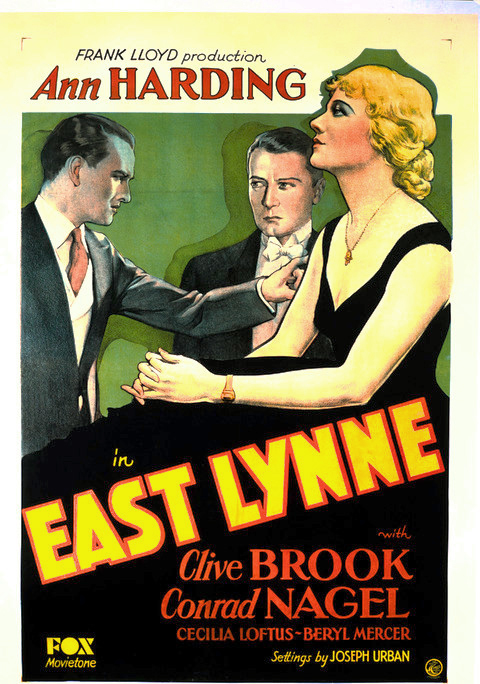
In the history of the Academy Awards, East Lynne is a curiosity.
Released in 1931, East Lynne was one of the five films to be nominated for Best Picture at the fourth annual Academy Awards. Best Picture was the only nomination that East Lynne received, which of course leaves you to wonder just what exactly was so good about it. Why was it nominated as opposed to something like A Free Soul, which received nominations for Best Actress and Director and which won the Best Actor Oscar for Lionel Barrymore? East Lynne was a success at the box office but so were The Public Enemy, Little Caesar, and Scarface. None of those classic gangster films made much of an impression with the Academy but all of them are better remembered today than East Lynne.
One reason why East Lynne has fallen into obscurity is because it’s not an easy film to see. There is only one complete print of East Lynne still in existence. It’s housed at the UCLA’s Instructional Media Lab but it can only be viewed by appointment. There are, however, a few bootleg copies on DVD. The picture is grainy. The sound is inconsistent. Even worse, the bootleg is missing the last 12 minutes of the film. Still, for those of us who don’t live near UCLA, that bootleg copy is the only convenient way to watch East Lynne.
That’s how I watched it. (I also looked up how the film ended so I know where the story eventually led, despite those missing 12 minutes.) Having now seen the film, I can now say that it makes even less sense that the film was nominated because it’s pretty bad. I can only imagine that it received its nomination as a result of Fox Film Corporation (which would later merge with 20th Century Pictures to be come 20th Century Fox) demanding that its employees vote for it.
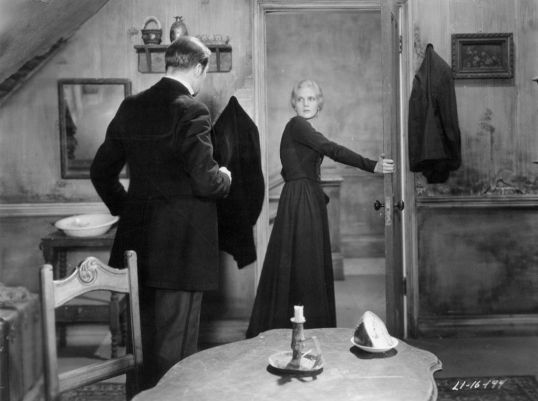
Based on a Victorian novel that had already been filmed several times during the silent era, East Lynne tells the story of Lady Isabella (Ann Harding), a British noblewoman who marries a stuffy attorney named Robert Carlyle (Conrad Nagel). From the beginning it’s an awkward marriage. Isabella is sociable and popular and wants to enjoy life. Carlyle is a humorless jerk. Not even the fact that they live in a nice mansion called East Lynne provides much comfort.
When Isabella accepts a kiss from a cad named Captain William Levinson (Clive Brook), Isabella’s sister-in-law uses it to drive a wedge between Isabella and Carlyle. Carlyle, being a jerk, kicks Isabella out of the house and takes custody of their child. Now viewed as being a figure of scandal, Isabella goes abroad with Levinson. (Since this is a pre-code film, going abroad amounts to going to a then-racy show in Vienna.) However, through a series of improbable events, Levinson ends up dead and Isabella ends up very slowly going blind. However, Isabella is determined to see her child just once more before losing her sight so it’s up to her to convince a maid to sneak her back into East Lynne late at night….
And then the bootleg version of the film ends! Now, I did my research and I discovered — here’s your SPOILER ALERT — that the film apparently ends with a blind Isabella stumbling over a cliff and her husband realizing too late that maybe he was kind of a jerk. I’m kind of sorry that I didn’t get to see that. I may have to book a flight to UCLA.
Anyway, from what I did see, East Lynne is a creaky old film. This is one of those films where you can tell that the cast was still adjusting to the new sound era. Ann Harding’s screen presence is a bit too insubstantial to keep the film’s melodramatic story grounded and neither Conrad Nagel nor Clive Brook seem to be worth all of the trouble that Isabella goes through. Frank Lloyd’s direction is painfully slow and stagy, though things do pick up briefly when the action moves to Vienna. Worst of all, the film is pretty much on Carlyle’s side. He’s a jerk, the movie says, but Isabella should have made more of an effort to keep him happy. Welcome to 1931!
East Lynne lost the best picture race to Cimarron, which was another fairly forgettable film. Though there were plenty of good films to choose from in 1931, it doesn’t appear that the Academy nominated any of them. Of course, that wouldn’t be the last time that would happen.
So, I’ve been cleaning out the DVR for the past week. Fortunately, I’m going to be off work for this upcoming week, which should give me a lot of extra film-watching time. That’s a good thing because I’ve got 36 movies that I’ve recorded on the DVR since Thursday and, over the past seven days, I’ve only watched 13 of them! That’s 23 movies to go and I hope to be finished by the end of the next week.
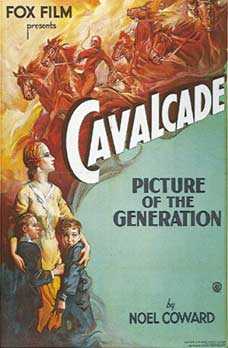
The 11th film that I found on my DVR was the 1933 film, Cavalcade. I recorded it off of FXM on April 3rd.
The main reason that I recorded Cavalcade was because it was the 6th film to win the Oscar for Best Picture. Now, I have to admit that I wasn’t expecting much from Cavalcade. It’s a film that many Oscar historians tend to list as being one of the lesser best picture winners. Cavalcade is often unfavorably compared to the films that it beat — movies like I Am A Fugitive From A Chain Gang, A Farewell To Arms, Little Women, and The Private Life of Henry VIII. Cavalcade was the first British to ever win the Best Picture and its victory is often cited as the beginning of the Academy’s love affair with British productions.
And really, Cavalcade couldn’t be more British if it tried. Based on a play by Noel Coward, Cavalcade follows two families through several decades in British history. One family is wealthy and is anchored by a patriarch who is knighted in the Boer War. The other family is lower middle class, anchored by a patriarch who starts out as a butler but who eventually manages to open up his own pub. Through the eyes of these two families, we view what, in the 1930s, was recent British history.
For modern viewers, it may be helpful to watch Cavalcade while consulting Wikipedia. For instance, the film starts with the two father figures preparing to leave to fight in the Boer War and I’m sorry to admit that I really wasn’t totally sure what that was. I had to look it up in order to discover that it was a war that the British fought in South Africa.
But you know what? That’s not really a complaint. I may not have known what the Boer War was before I started the film but that had changed by the time that I finished watching Cavalcade. Several times, I’ve mentioned on this blog how much I love history but watching Cavalcade made me realize that I still have more to learn. Even more importantly, it encouragds me to learn. That’s always a good thing.
Certain other historical events were more familiar. As soon as I saw the title card announcing that the date was 1914, I knew that I would soon be seeing a World War I montage. And, as terrible as World War I was (though, naturally, the film refers to it as being “the Great War,” and, for a few moments, I considered the fact that there was a time when nobody thought there would ever be a second world war), I was actually kind of happy for the montage because it got the characters out of the drawing room and out of the pub. Cavalcade is a very stagey film. Though there are a few attempts to open up the action, you’re always very aware that you’re essentially watching a filmed play.
Of course, the film’s best historic moment comes when a recently married couple goes on their honeymoon. We see them standing on the deck of a cruise ship, talking about how much they love each other and how wonderful life will be. They then step to the side and we see the name of the ship: RMS Titanic.
In many ways, those dismissive Oscar historians are correct about Cavalcade. It’s stagey and it’s old-fashioned and some of the performances are better than others. But, dammit, I liked Cavalcade. As the upper class couple, Diana Wynyward and Clive Brook made for a likable couple and they got to exchange some sweet-natured dialogue at the beginning and the end of the film. Add to that, it was a film about history and I love history.
Cavalcade is hardly a perfect film and it probably didn’t deserve to win best picture. But it’s still better than its reputation suggests.
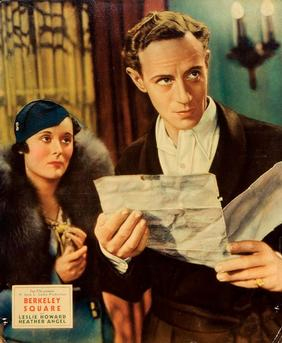
For today’s final entry in Embracing the Melodrama Part II, we take a look at the 1933 film, Berkeley Square.
Berkeley Square opens in 1784. An American named Peter Sandish (Leslie Howard) has come from New York to England. Stopping off at an inn, he explains that he’s on his way to London. He has distant relations who live in a mansion located in Berkeley Square and it’s been arranged that Peter is going to marry his cousin, Kate Pettigrew (Valerie Taylor). As Standish talks, he’s interrupted by another man who excitedly announces that a Frenchman has flown across the English Channel in something called a “balloon.”
“It’s beginning,” Peter says, “A new age of speed and innovation…”
Suddenly, the film jumps forward over a hundred years. In 1933, Standish’s descendant — also named Peter and also played by Leslie Howard — has inherited the family’s old house at Berkeley Square. He’s spent several days locked away in the mansion, obsessively reading the first Peter’s diary and refusing to see his fiancée, Marjorie (Betty Lawford).
It turns out that Peter — much like Owen Wilson in Midnight in Paris — is frustrated with the modern world and desperately wants to live in the past. He believes that if he continues to stay in the house, he will eventually be transported back to 1784. When a friend points out that, even if time travel was possible, Peter would end up changing the past, Peter explains that he’s memorized the first Peter’s diary and, therefore, he knows everything that he needs to say and do.
And then, one night, Peter suddenly does find himself in 1784. Having taken his ancestor’s place, he meets the Pettigrews, makes plans to marry Kate, and attempts to adapt to 18th century London society.
Unfortunately, this turns out to be not as easy as he thought. Despite his best efforts, Peter keeps using 1930s slang and alluding to events that will happen in the future. At first, he explains away his habit of using modern phrases by saying that he’s using common New York expressions. However, the increasingly suspicious Kate takes a list of Peter’s phrases to the U.S. Ambassador (who is none other than future President John Adams) and is informed that nobody in New York speaks that way. As well, Peter’s insistence on regular bathing is viewed as odd by the members of upper class London society. (“I heard he used three buckets of water,” someone accusingly whispers.) Soon, Kate is convinced that Peter has been possessed by a demon.
An even bigger problem for Peter is that he’s not in love with Kate. Instead, he’s fallen in love with Kate’s headstrong younger sister, Helen (Heather Angel). When Helen discovers that Peter is from the future, Peter is forced to decide whether to continue to stay among the “living ghosts” or whether to return to his own time.
Berkeley Square shows on up on TCM fairly frequently and I absolutely love it. To a certain extent, of course, this is because I’m a secret history nerd and there’s a part of me that will always wish that I could travel in time and experience the past firsthand. (That said, after watching Berkeley Square, I don’t think I could handle 18th century hygiene. Agck!) But the main reason that I love Berkeley Square is because I love a good romance. And this is such a romantic film! Heather Angel and Leslie Howard have a really sweet and likable chemistry and, with his performance here, Howard shows why he would be the perfect choice to play the earnest, well-meaning, and ultimately tragic Ashley Wilkes in Gone With The Wind.
Keep an eye out for Berkeley Square. You won’t be sorry.
It’s been a strange Oscar season and it could get even stranger. Several critics and industry insiders are speculating that, on February 24th, Argo might win the Oscar for best picture without winning in any other category. As strange as that may sound, Argo would not be alone in achieving this distinction. In the past, 3 films have won best picture without winning anything else.
Mutiny on the Bounty, the best picture of 1935, is one of those films.
Based (rather loosely, according to many historians) on a true story, Mutiny on the Bounty tells the story of one of the most controversial events in maritime history. The HMS Bounty leaves England in 1787 on a two-year voyage to Tahiti. The Bounty is manned by a disgruntled crew (many of whom have been forced into Naval service) and is captained by a tyrant named William Bligh (Charles Laughton). Bligh has little use for the majority of his crew and thinks nothing of having a man whipped until he is dead for even the pettiest of infractions.
Blight’s lieutenant is Fletcher Christian (Clark Gable), a compassionate man who disapproves of Bligh’s methods. As the voyage continues, Christian grows more and more vocal with his disgust towards Bligh. When the ship finally reaches Tahiti, Christian falls in love with a local Tahitian girl and defies Bligh’s direct orders so that he can spend time with her.
It’s only after the ship leaves Tahiti and Bligh’s tyranny leads to the death of an alcoholic crew member that Christian finally leads the mutiny of the film’s title. The rest of the film is divided between Bligh’s surprisingly heroic efforts to survive after being set adrift in a lifeboat and Christian’s attempts to avoid being captured by British authorities. Caught up in the middle of all of this is Christian’s friend (and audience surrogate), Roger Byam (Franchot Tone).
Mutiny on the Bounty was one of the biggest box office hits of 1935 and it received 8 Academy Award nominations, including Best Picture, Best Director, and a record-setting 3 nods for Best Actor with Clark Gable, Charles Laughton, and Franchot Tone all receiving nominations. However, out of those 8 nominations, Mutiny only won the award for Best Picture while John Ford’s The Informer took home the Oscars for Best Director and Actor. Mutiny on the Bounty was the third (and, as of this writing, the last) best picture winner to fail to win any other categories.
For a film that lost dramatically more awards than it won, Mutiny on the Bounty still holds up pretty well. Director Frank Lloyd keeps the film moving at a quick pace and perfectly captures not only the misery of the Bounty but the joyful paradise of Tahiti as well. Lloyd is at his best during the short sequence of scenes that depict Bligh’s efforts to reach safety after being forced off of the Bounty. During this sequence, the audience is forced to reconsider both Captain Bligh and everything that we’ve seen before. It introduces an intriguing hint of ambiguity that is not often associated with films released in either the 1930s or today.
Of the three nominated actors, Clark Gable and Charles Laughton both give performances that remain impressive today. In the role of Fletcher Christian, Gable is the literal personification of masculinity and virility. Meanwhile, in the role of Bligh, Laughton is hardly subtle but he is perfectly cast. If Gable’s performance is epitomized by his charming smile than Laughton’s is epitomized by his constant glower. Wisely, neither the film nor Laughton ever make Bligh out to be an incompetent captain. As is shown after the mutiny, the film’s Bligh truly is as capable a navigator and leader as everyone initially believes him to be. Unlike many cinematic tyrants, Blight’s tyranny is not the result of insecurity. Instead, Bligh is simply a tyrant because he can be. Laughton and Gable are both so charismatic and memorable that Franchot Tone suffers by comparison. However, even Tone’s bland performance works to the film’s advantage. By being so normal and boring, Roger Byam is established as truly being the sensible middle between Gable’s revolutionary and Laughton’s tyrant.
Mutiny on the Bounty remains an exciting adventure film and it certainly holds up better than some of the other films that were named best picture during the Academy’s early years. If Argo only wins one Academy Award next Sunday, it’ll be in good company.


 Through the Shattered Lens