Scenes I Love: Apocalypse Now


It’s been awhile since I put up a scene I love from a film I love. Time to change that and what better way to do it than pick a favorite scene from one of the best films ever made: Apocalypse Now.

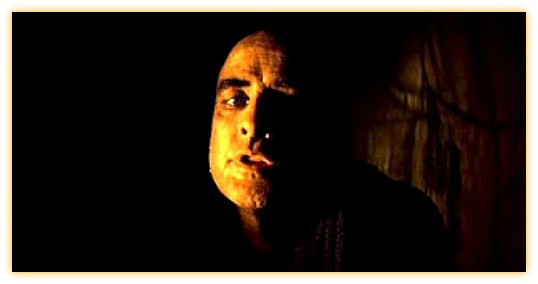
This particular scene occurs in the last act of the film which finally puts Capt. Willard (Martin Sheen) face-to-face with his target in the off-the-reservation Special Forces  commander Col. Kurtz. This is the first time we actually see Marlon Brando in the role of Kurtz in a film that’s been obsessed with his character right from the very beginning. The glimpses we get of Kurtz are fleeting as he remains in the shadows with only his rumble of a voice giving weight to his presence in the scene. I have to admit that even after seeing this film for over a hundred times through the years it’s still pretty difficult to understand some of what he is saying. Yet, when such an occurrence would be a death for a scene it doesn’t for this scene. It only helps highlight just how far down the abyss this former paragon of American military might has put himself in to accomplish a mission given to him by people he dismissively call “grocery clerks”.

There’s no soundtrack to try and manipulate the scene for the audience. It’s just the ambient noises of the jungle and the ancient temple Kurtz and his people have called home. Even the dialogue in the beginning of the scene where Kurtz inquires about where Willard was from was full of menace and hidden dangers. It’s very difficult not to get hypnotized by this scene. There’s not a fake beat to the dialogue between Sheen and Brando. The way the scene unfolds almost acts like a metronome that lulls the viewer until the reveal in the end when we finally see Kurtz’s face in full for the very first time.

Coppola has done great work before this film with hi first two Godfather films but this scene in this film I consider the best he has ever put on celluloid.

Kurtz: Are you an assassin?

Willard: I’m a soldier.

Kurtz: You’re neither, you’re an errand boy, sent by grocery clerks to collect a bill”

Scenes I Love: The Opening of the Godfather


I was recently lucky enough to catch a showing of the classic film The Godfather at the Cinemark West Plano theater down here in DFW and, in honor of that occasion, allow me to present this scene that I love.  This is the opening of The Godfather and it’s one of the best first scenes in cinematic history.  In just a matter of minutes, director Francis Ford Coppola tells us everything that we need to know about Vito Corleone (Marlon Brando) and his business.

Add to that, I love the cat!

A Quickie With Lisa Marie: The Conversation (dir. by Francis Ford Coppola)


As a result of my continuing effort to see every single film ever nominated for best picture, I’ve been lucky enough to both discover and rediscover a handful of excellent films that, for whatever reason, have ended up forgotten and neglected in the years since they scored their nominations.  One of the more recent of these films was Francis Ford Coppola’s masterpiece of a paranoia, the 1974 Best Picture nominee The Conversation.*

The Conversation tells the story of Harry Caul (played by Gene Hackman), a surveillance expert who, along with his colleague Stan (played by the great John Cazale), is hired by a businessman (Robert Duvall) to bug a conversation between Duvall’s much younger wife (played by Cindy Williams) and a man who might be her lover (played by Fredric Forrest).  Harry, we quickly discover, is a man who values his privacy and who manages to find a balance between his unsavory job and his devout religious faith by maintaining an impenetrable shield of detachment from the rest of humanity.  He is a man who hides from the world inside of his apartment, only allowing himself to show the slightest hint of emotion when playing his saxophone.  In one of the film’s best scenes, Harry finds himself awkwardly socializing with a far more sleazy acquaintance (played by Alan Garfield, one of the great character actors of the 70s) and it becomes apparent that Harry may be the best in the business but he’s still the ultimate outsider.

However, Harry is forced to confront the contradictions of his own lifestyle when he listens to the conversation between Forrest and Williams and believes that he might have found evidence that both Forrest and Williams are in fear for their lives.  With Duvall’s operatives demanding the surveillance tapes, Harry Caul soon finds himself becoming more and more paranoid and unstable as he finds it more and more difficult to justify his detachment.  Harry finds himself obsessively listening to the conversation over and over again, going over every possible nuance and emphasis to try to figure out what’s actually being said.  Of course, by the end of the film, it’s obvious to both Harry and the audience that nothing is as simple as it sounds. 

Compared to the Godfather films and Apocalypse Now, the Conversation is a surprisingly low-key and rather muted film.  A lot of this is because, as opposed to the Corleones and Martin Sheen’s Captain Willard, Gene Hackman’s Harry Caul is a complete and total introvert, a man who makes his living by observing a world that he refuses to be a part of.  Though the film works quite well as a thriller, it works best when viewed as a sympathetic character study of a paranoid and anti-social human being.  Hackman full inhabits the role, bringing Harry — with all of his frustrating contradictions and conflicted actions — to oddly vibrant life.  The film ultimately serves as a sad-eyed look at how a good person can justify doing bad things and how the inevitable consequences of those bad things can only be delayed for so long.

On a final note, an impossibly young Harrison Ford shows up here as Duvall’s sinister assistant.  He plays the role with just the right amount of prissy arrogance and he has a great scene where he asks Harry is he wants to try a homemade cookie.  “They’re good,” Ford assures him.

So is The Conversation.

—–

* Of course, another Coppola film — The Godfather, Part II — beat the Conversation for best picture.  However, The Conversation did win the Palme D’Or at Cannes that year.  It was a good year to be Francis Ford Coppola.

Horror On The Lens: Dementia 13 (dir. by Francis Ford Coppola)


For today’s excursion into the world of public domain horror, I offer up the film debut of Francis Ford Coppola.  Before Coppola directed the Godfathers and Apocalypse Now, he directed a low-budget, black-and-white thriller that was called Dementia 13.  (Though, in a sign of things to come, producer Roger Corman and Coppola ended up disagreeing on the film’s final cut and Corman reportedly brought in director Jack Hill to film and re-film additional scenes.) 

Regardless of whether the credit should go to Coppola, Corman, or Hill, Dementia 13 is a brutally effective little film that is full of moody photography and which clearly served as an influence on the slasher films that would follow it in the future.  Speaking of influence, Dementia 13 itself is obviously influenced by the Italian giallo films that, in 1963, were just now starting to make their way into the drive-ins and grindhouses of America.

In the cast, keep an eye out for Patrick Magee, who later appeared as Mr. Alexander in A Clockwork Orange as well as giving a memorable performance in Lucio Fulci’s The Black Cat.  Luana Anders, who plays the duplicitous wife in this film, showed up in just about every other exploitation film made in the 60s and yes, the scene where she’s swimming freaks me out to no end.

(One final note: I just love the title Dementia 13.  Seriously, is that a great one or what?)

What could have been: The Godfather


I don’t know about you but I love to play the game of “What if.”  You know how it works.  What if so-and-so had directed such-and-such movie?  Would we still love that movie as much?  Would so-and-so be a star today?  Or would the movie have failed because the director was right to reject so-and-so during preproduction?

I guess that’s why I love the picture below.  Taken from one of Francis Ford Coppola’s notebooks, it’s a page where he jotted down a few possibilities to play the roles of Don Vito, Michael, Sonny, and Tom Hagen in The Godfather.  It’s a fascinating collection of names, some of which are very familiar and some of which most definitely are not.  As I look at this list, it’s hard not wonder what if someone like Scott Marlowe had played Michael Corleone?  Would he had then become known as one of the great actors of his generation and would Al Pacino then be fated to just be an unknown name sitting on a famous list?

(This page, just in case you happen to be in the neighborhood , is displayed at the Coppola Winery in California.)

The production of the Godfather — from the casting to the final edit — is something of an obsession of mine.  It’s amazing the amount of names — obscure, famous, and infamous — that were mentioned in connection with this film.  Below is a list of everyone that I’ve seen mentioned as either a potential director or a potential cast member of The Godfather.  Consider this my contribution to the game of What If….?

Director: Aram Avankian, Peter Bogdonavich, Richard Brooks, Costa-Gravas, Sidney J. Furie, Norman Jewison, Elia Kazan, Steve Kestin, Sergio Leone, Arthur Penn, Otto Preminger, Franklin J. Schaffner, Peter Yates, Fred Zinnemann

Don Vito Corleone (played by Marlon Brando): Melvin Belli, Ernest Borgnine, Joseph Callelia, Lee. J. Cobb, Richard Conte, Frank De Kova, Burt Lancaster, John Marley, Laurence Olivier, Carlo Ponti, Anthony Quinn, Edward G. Robinson, George C. Scott, Frank Sinatra, Rod Steiger, Danny Thomas, Raf Vallone,  Orson Welles

Michael Corleone (played by Al Pacino): John Aprea, Warren Beatty, Robert Blake, Charles Bronson*, James Caan, David Carradine, Robert De Niro, Alain Delon, Peter Fonda, Art Genovese, Dustin Hoffman, Christopher Jones, Tommy Lee Jones, Tony Lo Bianco, Michael Margotta, Scott Marlowe, Sal Mineo, Jack Nicholson, Ryan O’Neal, Michael Parks, Robert Redford, Burt Reynolds, Richard Romanus, Gianni Russo, Martin Sheen, Rod Steiger**, Dean Stockwell

Sonny Corleone (played by James Caan): Lou Antonio, Paul Banteo, Robert Blake, John Brascia, Carmine Caridi, Robert De Niro, Peter Falk, Harry Guardino, Ben Gazzara, Don Gordon, Al Letteiri, Tony LoBianco, Scott Marlowe, Tony Musante, Anthony Perkins, Burt Reynolds***, Adam Roarke, Gianni Russo, John Saxon, Johnny Sette, Rudy Solari, Robert Viharo, Anthony Zerbe

Tom Hagen (played by Robert Duvall): James Caan, John Cassavettes, Bruce Dern, Peter Donat, Keir Dullea, Peter Falk, Steve McQueen, Richard Mulligan, Paul Newman, Jack Nicholson, Ben Piazza, Barry Primus, Martin Sheen, Dean Stockwell, Roy Thinnes, Rudy Vallee****, Robert Vaughn, Jerry Van Dyke, Anthony Zerbe

Kay Adams (played by Diane Keaton): Anne Archer, Karen Black, Susan Blakeley, Genevieve Bujold, Jill Clayburgh, Blythe Danner, Mia Farrow, Veronica Hamel, Ali MacGraw, Jennifer O’Neill, Michelle Phillips, Jennifer Salt, Cybill Shepherd, Trish Van Devere

Fredo Corleone (played by John Cazale): Robert Blake, Richard Dreyfuss, Sal Mineo, Austin Pendleton

Connie Corleone (played by Talia Shire): Julie Gregg, Penny Marshall, Maria Tucci, Brenda Vaccaro, Kathleen Widdoes

Johnny Fontane (played by Al Martino): Frankie Avalon, Vic Damone*****, Eddie Fisher, Buddy Greco, Bobby Vinton, Frank Sinatra, Jr.

Carlo Rizzi (played by Gianni Russo): Robert De Niro, Alex Karras, John Ryan******, Sylvester Stallone

Virgil “The Turk” Sollozzo (played by Al Letteiri): Franco Nero

Lucas Brasi (played by Lenny Montana): Timothy Carey, Richard Castellano

Moe Greene (played by Alex Rocco): William Devane

Mama Corleone (played by Morgana King): Anne Bancroft, Alida Valli

Appollonia (played by Simonetta Steffanelli): Olivia Hussey

Paulie Gatto (played by John Martino): Robert De Niro*******, Sylvester Stallone

—-

* Charles Bronson, who was in his mid-40s, was suggested for the role of Michael by the then-chairman of Paramount Pictures, Charlie Bluhdorn.

** By all accounts, Rod Steiger – who was then close to 50 – lobbied very hard to be given the role of Michael Corleone.

*** Some sources claim that Burt Reynolds was cast as Sonny but Brando refused to work with him.  However, for a lot of reasons, I think this is just an cinematic urban legend.

**** Despite being in his 60s at the time, singer Rudy Vallee lobbied for the role of the 35 year-old Tom Hagen.  Supposedly, another singer — Elvis Presley — lobbied for the role as well but that just seems so out there that I couldn’t bring myself to include it with the “official” list.

***** Vic Damone was originally cast as Johnny Fontane but dropped out once shooting began and announced that the project was bad for Italian Americans.  He was replaced by Al Martino.

****** John P. Ryan was originally cast as Carlo Rizzi but was fired and replaced with Gianni Russo.  Ryan went on to play the distraught father in Larry Cohen’s It’s Alive.  Russo went on to co-star in Laserblast.

******* Robert De Niro was originally cast in this role but dropped out to replace Al Pacino in The Gang That Couldn’t Shoot Straight.  Pacino, incidentally, had to drop out of that film because he was given the role of Michael in The Godfather.
A Quickie With Lisa Marie: I Knew It Was You: Rediscovering John Cazale (dir. by Richard Shepard)


Despite only appearing in 5 films and dying 8 years before I was born, John Cazale is one of my favorite actors.  You might not recognize his name but, if you love the films of the 70s, you know who John Cazale is because he appeared in some of the most iconic films of the decade.  Though he’s probably best known for playing poor Fredo in first two Godfather films, Cazale also appeared in The Conversation, Dog Day Afternoon, and The Deer Hunter.  All five of his films were Oscar-nominated for best picture and three of them won.  All five are, in their own individual ways, classics of modern cinema and, though he was never more than a supporting player, Cazale gave performances of such unexpected emotional depth that he elevated each of these films just by his very presence.  Tragically, Cazale died at the age of 42 of lung cancer.  At the time, he had just finished filming The Deer Hunter and he was engaged to marry an up-and-coming actress named Meryl Streep.

I Knew It Was You is a documentary that both attempts to tell the story of Cazale’s life as well as pay tribute to him an actor.  While it fails somewhat to do the former, it succeeds flawlessly as a tribute.  The film is filled with footage of Cazale’s legendary performances and watching these clips, you’re struck by not only Cazale’s talent but his courage as well.  As more than one person comments during the documentary, it takes a lot of guts to so completely inhabit a role like The Godfather’s Fredo Corleone.  While other actors might be tempted to overplay a character like Fredo (essentially winking at the audience as if to say, “I’m not a weakling like this guy,”) Cazale was willing to completely inhabit his characters, brining to life both the good and the bad of their personalities.  Watching the clips, you realize that Cazale, as an actor, really was becoming stronger and stronger with each performance.  On a sadder note, this documentary make it  painfully obvious just how sick Cazale was in The Deer Hunter.  The contrast between the nervous, lumbering Cazale of Dog Day Hunter and his gaunt, unbearably sad appearance in The Deer Hunter is simply heart breaking.

The documentary is full of interviews with actors and directors who either worked with or were inspired by John Cazale and you’re immediately struck by the affection that they all still obviously feel for him even 30 years after his death.  Among those interviewed are Steve Buscemi, Al Pacino, Meryl Streep, Robert De Niro, Francis Ford Coppola, Sidney Lumet, Sam Rockwell, and Richard Dreyfuss.  (I thought I knew every bit of Godfather trivia but I learned something new from this film when I found out that Richard Dreyfuss came close to being Fredo before Coppola saw Cazale in a play.)   Perhaps most interesting are the interviews where actors like Pacino, De Niro, and Gene Hackman talk about how acting opposite John Cazale caused them to give better performances than they might have otherwise.  If nothing else, it’s a good reminder that a classic film is, more often than not, a collaborative effort.

Where this documentary drops the ball is in detailing who Cazale was as a person.  Though everyone’s affection for him is obvious, we learn little about what drove the man who was so sad and tragic as Fredo Corleone.  Cazale’s upbringing is covered in about 2 minutes of flashy graphics and his untimely death (and his struggle to complete his Deer Hunter role) is also covered a bit too quickly.  There’s a fascinating and inspiring story there but this documentary only hints at it.  For reasons I still can’t figure out, this thing only lasts 40 minutes.  Even just an extra 15 minutes would have been helpful.

Hollywood director Brett Ratner is also interviewed and I imagine this probably has something to do with the fact that Ratner co-produced this documentary.  So, I guess Ratner is a Cazale fan and good for him but it’s still kinda jarring to see him there with directors like Lumet and actors like Pacino and De Niro.  Ratner, to be honest, is the only one of the people interviewed who actually comes across as having nothing of value to say.  Which isn’t all that surprising when you consider that Ratner is pretty much the golden child of bland, mainstream filmmaking right now.

Still, even if it never reaches the heights of Werner’s Herzog’s My Best Fiend, I still have to recommend I Knew It Was You as a touching tribute to a truly great actor.  As a bonus, the DVD contains two short films featuring a very young and intense John Cazale.  Watching him, you can’t help but mourn that he wasn’t in more movies but you’re so thankful for the legendary performances that he was able to give us.