4 (or more) Shots From 4 (or more) Films is just what it says it is, 4 (or more) shots from 4 (or more) of our favorite films. As opposed to the reviews and recaps that we usually post, 4 (or more) Shots From 4 (or more) Films lets the visuals do the talking.
Hi, everyone! Lisa here with today’s music video of the day!
July 14th is Bastille Day in France so it only seems appropriate to share a video from my two favorite French musical artistes, Daft Punk. That’s right — the robots are French!
Instant Crush was the fourth single to be released off of Daft Punk’s Grammy-winning fourth album, Random Access Memories. It’s a collaboration between the robots and Julian Casablancas. The video was directed by veteran music video director Warren Fu and it brings tears to my eyes every time.
Decade of last.fm scrobbling countdown:
44. Peste Noire (721 plays)
Top track (65 plays): Ballade cuntre les anemis de la France, from Ballade cuntre lo Anemi francor (2009)
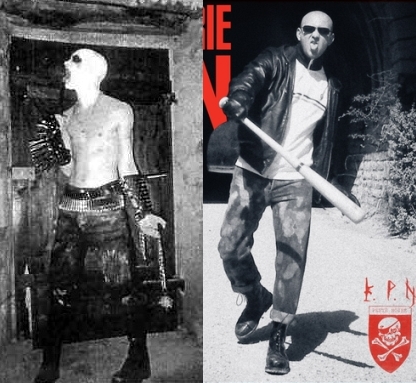
Peste Noire is probably the most French thing to ever happen to metal. Famine has frankly stated, if the interview excerpts I saw were properly translated, that he intentionally aims to make his music as terrible and possible. This is something quite successfully achieved in the nearly unlistenable L’Ordure à l’état Pur, released two years ago. That album seems to me a big “fuck you” to everyone who failed to give Ballade cuntre lo Anemi francor an abysmal rating on Encyclopaedia Metallum. Its unprecedented levels of tastelessness successfully mock modern consumerism through an acute awareness of that about popular culture which inclines us to lose all faith in humanity. (Famine even traded in his traditional black metal/skinhead garb for a nu metal image in the packaging.) Maybe Ballade cuntre lo Anemi francor, released in 2009, was intended to be a parody too, but in that instance Famine let his actually incredible song-writing abilities and aesthetic awareness get in the way of producing anything which can honestly be regarded as terrible. I am rather inclined to call it one of my favorite albums of all time.
One of the most interesting people I have ever had the pleasure of knowing was a highly educated skinhead obsessed with extremely racist, nationalistic bands in the punk/skinhead/RAC sphere. He didn’t share any of their ideologies in the slightest, but he was able to set aside disgust in what they stood for and tap into the sort of raw emotion that drove average working-class individuals to proclaim such extreme views. Ballade cuntre lo Anemi francor might be said to mock this sort of music by maintaining the emotional appeal while deflating the fictionalized history typically necessary for its evocation. It embraces French nationalism as a parody, presumably. At least, it presents a raw, ugly image of the past that hardly meets the standard conditions for pride or beauty. Yet Famine’s vulgar vocals and lo-fi, distorted, “black and roll” instrumentation come coupled with an intense feeling of nostalgia that persists throughout the album. The parody, if it can be called a parody, stems from the presentation of nostalgia for something grotesque, but towards this end Famine committed his artistic talents without restraint. It is a nostalgic ode to a sick, sinister past, juxtaposing musical representations of unjustifiable violence and intolerance to a feeling of warmth and comfort. On the one hand it is deliciously dark, and on the other it is a legitimate embrace of nationalism in its most honest clothes. Ballade cuntre lo Anemi francor is an album that has always fucked with my head, and I love it dearly.
“The verb troll originates from Old French troller, a hunting term.” I kind of want to end right there. But I’ve read reviews of 2009’s Ballade cuntre lo Anemi francor, one of my favorite albums ever, that basically accused Famine of making something intentionally horrible. To just say no, Ballade was a work of genius, L’Odure is their intentionally horrible album, without any justification, would be a bit naive.
I don’t think I can really say what I want to say about L’Ordure without taking a good look at Ballade though, so let me start with the opening song of their 2009 album.
La Mesniee Mordrissoire (on Ballade cuntre lo Anemi francor)
Following a short introduction track, La Mesniee Mordrissoire kicks off perhaps the most dark and disturbing album I’ve ever heard. Famine’s infamously twisted vocals, the peculiar, unnatural way in which the album is distorted, the unity of all of its seemingly random features, the cackles, the ultra-nationalistic chants, the contrast of all this to riffs and beats that are sometimes happy, sometimes longing in an entirely human sort of way, everything about this album is warped beyond belief. And it just gets “better”. I wish I was a psychopath just so I could have the fulfillment of jabbing my victims with a red-hot poker while dancing to track 3. … Ok well, anyway…
I refuse to believe that this album was a fluke. I refuse to believe that Famine’s real intention was to create something really awful and he just by accident shit out a masterpiece. Sure, it might have vastly exceeded his expectations–works of this caliber often surpass their creators–but it was not a complete accident.
At the same time, a lot of what you hear on Ballade couldn’t have been recorded with a straight face by a normal person, and I have no reason to believe Famine isn’t one. I for one don’t think I could chant “sieg heil! sieg heil!” or sing a chorus of “la la la la lala” without busting out laughing regardless of how well it fit my artistic vision. I typically see Famine being accused of immaturity, not of being a radical, but I fail to see why he couldn’t have taken the album seriously and still gotten a kick out of the elements of it which, when taken out of context, are completely ridiculous.
When I say L’Ordure à l’état Pur, translated to something like Garbage in its Pure Form, is horrible, I’m saying that I think Famine intended it to be horrible. I think it has next to nothing conceptually in common with its predecessor. It’s like he’s saying “No, this is immature. Do you see the difference?”
L’Ordure à l’état Pur came packaged with an image change for the band that might clarify the difference.
Cochon Carotte Et Les sœurs Crotte
This is the only song I’m going to sample from L’Ordure à l’état Pur, because I think it’s all you really need to hear to decide whether you want to pick up the whole thing or not. If you can appreciate sound samples from scat pornography, belching noises substituted for drum beats, Famine doing his best impression of an irritated chicken, and really bad techno, maybe this album is for you. Hell, maybe you can kid yourself into thinking the band is making some statement about society. But for me, Famine is just trolling here. Maybe he wanted people to derive some sort of meaning from it all, or maybe he just wanted to sit back and laugh at all the people who try to. I think I’ll not risk falling victim to the latter.
L’Ordure à l’état Pur has a few really great features, but by and large it’s awful. Take the album title literally. You might think there is meaning buried beneath the joke, but that is the joke.
Woody Allen’s latest film, Midnight in Paris, has an appealing premise behind it.
Gil (Owen Wilson) is a Hollywood screenwriter who has come to Paris with his shallow fiancée Inez (Rachel McAdams) and her stuffy Republican parents (played by Kurt Fuller and Mimi Kennedy). Disillusioned with American culture, Gil idealizes the Paris of the 1920s, the Paris that was home to Ernest Hemingway, F. Scott Fitzgerald, and James Joyce. However, Inez and her parents are far less impressed with Paris and, as quickly become clear, with Gil himself. While Inez spends her time with self-important “intellectual” Paul (a bearded Michael Sheen), Gil takes to wandering the streets of Paris at night.
One night, as Gil wanders around Paris, a vintage car approaches out of the shadows and the two well-dressed passengers in the back seat invite Gil to join them. Gil does so and discovers that he’s been transported back to 1920s Paris. He meets everyone from Hemingway (Corey Stoll) to Salvador Dali (Adrien Brody) to F. Scott and Zelda Fitzgerald (Tom Hiddleston and Alison Pill). At the end of the night, Gil finds himself transported back to modern-day Paris. Soon, Gil finds himself sneaking out at midnight every night so he can escape to the past, where he eventually meets and starts to romance an idealistic model named Adrianna (Marion Cotillard). While Gil finds himself torn between his modern life and the past that he loves, he also begins to discover that the inhabitants of the 20s feel the same way about their present as he does about his.
The premise of the film itself is likable and one that I think anyone can relate to. Who doesn’t wish that they could go back in the past and live with all the amazing people who they’ve only read about? Myself, there are many eras that I often fantasize about finding myself in. 1920s Paris is definitely one of them but I’ve also occasionally dreamed of being in 1950s New York, having a threesome with Kerouac and Cassady or maybe being in Paris during the early days of the French new wave, appearing in movies directed by Rollin, Truffaut and Godard. Ever since I read Peter Biskind’s Easy Riders and Raging Bulls, there’s been a part of me that wishes so much I could have been out in Hollywood or New York in the 1970s, hanging out on the beach with directors like Martin Scorsese, William Freidkin, Jon Milius, and even Peter Bogdonavich. (But especially Freidkin, his terrible charisma just radiates from the page.)
Still, Allen is smart enough as a screenwriter to know that everyone tends to idealizes the past, even those who we now idealize in the present. Perhaps my favorite part of the film came when Wilson, while in the 1920s, sees a character getting into a horse-drawn carriage so that she can go back to the time that she idealizes as fiercely as he idealizes the 20s.
Midnight in Paris has a lot to recommend it. Cotillard, despite the fact that she’s played the same idealized French mystery woman about a thousand times, gives a likeable performance and Rachel McAdams is hilariously shallow. Michael Sheen, as well, makes a perfect stand-in for every pompous, self-important jerk who has ever talked down to you. On the basis of his cameo appearance here as Dali, Adrien Brody really needs to consider doing more comedy. He’s a lot more appealing when he’s being funny than when he’s trying to be a leading man.
At the same time, I have to admit that I wanted to like Midnight in Paris more than I actually did. I like Owen Wilson as both an actor and a writer but he’s a little bit miscast here and the end result is that he occasionally seems like he’s trying too hard. You just never buy him and McAdams as a couple and, as such, there’s really not much at stake as far as his romance with Cotillard is concerned.
As well, I found it hard not to be a little bit disappointed with the way Allen presented 1920s Paris. Though they were all well-cast and acted, Hemingway, the Fitzgeralds, Gertrude Stein (Kathy Bates), and all the rest just fell flat as actual characters. Gil gets a chance to go into the past and essentially, he discovers that Hemingway was macho, the Fitzgeralds were neurotic and self-destructive, and that Dali didn’t make much sense. Personally, I would be a bit let down if I got a chance to meet these icons and I discovered that essentially they just acted the exact same way that they acted in various PBS educational programs.
Despite this, Midnight in Paris is still a likable, frequently engaging comedy that works best as a tribute to a legendary and beautiful city that Allen (not to mention myself) obviously loves. Flaws and all, this movie made me want to visit Paris once again (though Florence and Venice remains my favorite cities of all time) and, for that reason alone, it makes Midnight in Paris a film worth seeing.
My favorite film director, France’s Jean Rollin, passed away on December 15th at the age of 72.
There are three types of people in the world: those who love Rollin, those who will eventually love Rollin once their eyes are opened, and those who just don’t matter.
When I first told Arleigh that Rollin had passed, he mentioned that the American director Blake Edwards had died as well. Oddly enough, I sometimes think of my favorite Rollin film — Night of the Hunted (which I reviewed on this site) — as being a rather grim, Grindhouse version of another one of my favorite films, Breakfast at Tiffany’s. The main difference, of course, is that Edwards’ Holly Golightly is allowed to triumph at the end while Rollin’s version is destroyed by an embarrassed mainstream establishment. History, I think, has given us little room for doubt concerning which vision is closer to the truth.
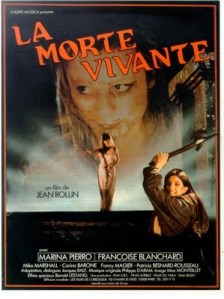
In his best films (Night of the Hunted, The Living Dead Girl, Two Orphan Vampires, Requiem For A Vampire, The Grapes of Death, Fascination, Lost In New York, The Sidewalks of Bangkok, Shiver of the Vampires), Rollin proved himself to be a cinematic poet with an eye for dream-like imagery and a special skill for capturing the mysteries, ambiguities, and ultimate beauty of female friendship and sisterhood.
Je ne crois pas au bon. Je ne crois pas au mal. Je ne crois pas en Dieu. Je crois seulement à l’amour et au Rollin.
Sometimes, I feel that there are only two types of people in the world. There’s the minority who appreciate the dreamlike atmosphere and sensual obsessions that dominate the vampire films of French director (and genius) Jean Rollin.
And then there’s the majority who don’t. We refer to this majority as being “the idiots.”
As for me, Jean Rollin is one of my favorite directors. I’ve previously reviewed his low-budget masterpiece, Night of the Hunted, on this site. I hope, in the future, to review even more of his films.
For now, I’d just like to share a scene from one of his later films, the hauntingly beautiful and elegiac Two Orphan Vampires.
Rollin is a director best known for spending the past five decades making films in which he continually and obsessively returns to a few key themes: the importance of memory, a nostalgia for the innocence of youth mixed with the knowledge that youthful innocence could also be destructive, a fascination with the beach, an obvious love of architecture (Rollin films old castles the way that an American director might film an action sequence), and — most notoriously — the use of two female protagonists who are usually portrayed as possessing a very strong, sister-like bond even though it’s rare that they actually are blood-related.
A good deal of Rollin’s current following comes from men who feel that there’s an erotic element to Rollin’s portrayal of female friendship. And to an extent, they’re right. But to an even greater extent, it doesn’t matter. Regardless of why the relationships between Rollin’s protagonists exists, the important thing is that they are portrayed as sharing an unbreakable bond. Whether they’re linked by lust, friendship, or just memory, Rollin’s women are bonded by a very true, very real love and that’s what makes his movies special to me.
This is what the scene below is all about. The two orphan vampires of the title are two teenage sisters. During the day, they are blind but when the sun goes down, they can not only see but they become vampires as well. Two Orphan Vampires is a surprisingly sad and haunting look at their attempts to survive in a world that has no place for them. In the scene below, after failing in several attempts to get the blood they need to continue to live, each sister resorts to drinking the blood of the other. To me, every thing that Rollin had directed before was leading up to this scene.
(This scene is also prototypical Rollin in that the budget is obviously low, the actors are more than adequate but, at the same time, are obviously not professionals, and the English dubbing is poorly done. And yet the scene itself — especially when seen in the larger context of both the entire film and Rollin’s movies as a whole — is actually more sincere and memorable than the majority of what is produced by the mainstream. In short, this is pure Rollin in that you either get it or you don’t.)
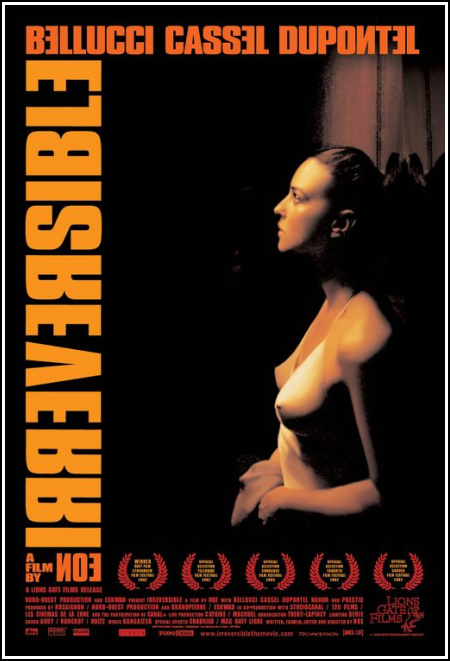
Gaspar Noe’s Irreversible is filmed in the same style as Christopher Nolan’s excellent Memento. With the story unfolding in reverse sequence, the audience’s first impression of the story doesn’t end up being the same once it finishes.
Everyone has made it a point to mention the disturbing and hard-to-watch sodomizing that Monica Bellucci’s character goes through at the hands of a random, strung-out stranger. This 10-minute sequence is as disturbing as any film sequence I have ever had the chance to watch. There is absolutely no feeling of lust or sexiness this scene brings up. A sense of shock, disgust and pain is more appropriate reaction to seeing the lovely Ms. Bellucci’s character go through a very inhumane experience. This scene goes a long way to explaining the film’s beginning where a brutal and equally inhumane murder takes place inside a murky, red-lit, underground gay S&M club.
As the film continues to move backwards in time and shows the viewer the earlier and happier time of Bellucci’s and Vincent Cassel’s characters, the earlier scenes of violence take on a more poignant and sad note. In a space of a day many lives are broken and destroyed, and in the end all because of a random night occurrence in an dingy, lit underpass.
Gaspar Noe’s film is not for everyone and even those daring enough to take a chance to view it will have a hard time sitting through the first half of the film. The film itself takes on a dream-like quality as it begins to unfold. From its nightmarish tone and look to a dreamy last reel. I have heard people call Noe’s film as exploitive and misogynistic in its treatment of its main female character. In the end, Noe’s choice to shoot the rape scene in a realistic fashion and have it linger and linger shows the viewer that evil and ugly things do happen in real life. One either takes it and learn from it or turn away and pretend it never happened.
Irreversible is a film that people will either love or hate. This film doesn’t straddle the center when it comes to viewers reaction to it. Gaspar Noe’s film is not perfect, but overall it provokes the viewer to think on what they’ve seen and felt as the story unfolded.
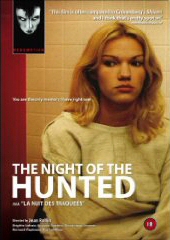
When, at that age of 22, I first saw Jean Rollin’s Night of the Hunted, I cried as much as the first time I saw Titanic at the age of 12. In both cases, the tears were inspired by a “doomed” love story. The main difference between the two films is that I don’t cry over Titanic anymore. But Night of Hunted still brings me to tears every time I see it.
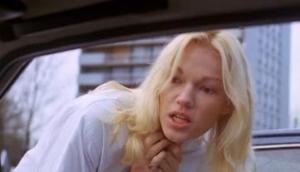
The film opens with the image of a terrified young woman (Brigitte Lahaie) running through a dark forest until she eventually reaches a highway. She’s picked up by a young man (Vincent Gardere) who, being a guy, proceeds to take her back to his apartment in Paris. She confesses that she can’t remember who she is, why she was running, or even being picked up by the young man in the first place. Saying that she needs some sort of memory to fill the emptiness, she proceeds to make love to Gardere. Gardere, being a guy, doesn’t object.
However, he does make the mistake of later leaving Lahaie alone in the apartment afterwards. As soon as Gardere leaves, Lahaie forgets ever meeting him and why she’s even in the apartment in the first place. Even as she tries to figure out what’s going on, the apartment is visited by a doctor who tells Lahaie that she is his patient and that she needs to go with him to a “clinic” where he can treat her. No longer remembering her encounter with Gardere, Lahaie agrees.
Needless to say, the “clinic” turns out to be what Lahie was so desperately trying to escape just a few hours before. We learn that Lahie is merely one of several hundred people who, months earlier, were exposed to a biological warfare experiment gone wrong. Now, as a result, her brain is slowly dying one cell at a time. The clinic is actually a government-run prison where she and her fellow victims have been sent to be forgotten about and to eventually die. Lahie finds herself surrounded by men and women who, as they slowly lose everything that made them unique, revert back to their most primal instincts. While Gardere tries to find her, Lahie struggles to survive just one final night in both the clinic and in the prison of her own fading mind.
Director Jean Rollin is best known for his sexually-themed vampire films but the Night of the Hunted is not as huge a departure for him as it may first seem. One of Rollin’s reoccurring themes is the importance of our memories, no matter how idealized they may sometimes be and this theme is present in every frame of Night of the Hunted.
The lead role is played by Rollin’s frequent muse and collaborator, Brigitte Lahaie. Because the majority of Lahaie’s career has been spent making adult films, she’s never gotten the due she deserves as an actress. Playing a difficult role here, Lahaie is the movie’s greatest strength. She brings a real sincerity and empathy to her role and its impossible to imagine this movie working without her. If nothing else, this movie is a wonderful display of Lahaie’s often underrated talent.
Rollin made the film for very little money and used a cast made up almost entirely of nonprofessionals and French adult film veterans. So, yes the film does sometimes have a grainy look and the editing is definitely jagged. When the characters shoot at each other, it is obvious that they’re firing toy cap guns. To me, however, this works in the film’s favor. The raw quality of the film perfectly mirrors that constant fear and confusion that Lahaie and her fellow prisoners live in. No, the film is not technically perfect but a flawed masterpiece is preferable to uninspired technical perfection any day.
Despite working with a miniscule budget, Rollin captures some haunting images in this film. Never has Paris looked as desolate as in this movie. One of Rollin’s trademarks has always been his own fascination with architecture and, as a result, the cold skyscraper where Lahaie is held prisoner almost becomes a character itself. I’ve always considered Jean Rollin to be horror cinema’s equivalent to Jean-Luc Godard and, with its images of a sterile city run by passionless autocrats, Night of the Hunted brings to mind Godard’s Alphaville.
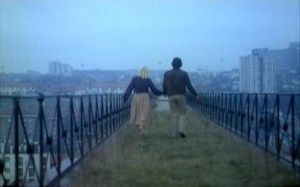
The film’s most haunting image comes at the end and it is this image that brings tears to my eyes every time. Whatever flaws the film may have, Night of the Hunted has one of the best final shots in the history of cinema. Even if everything preceeding it had been worthless, this movie would be worth sitting through just for the stark beauty of the final shot. Night of the Hunted ends on a note that manages to be darkly sad and inspiringly romantic at the same time. It’s an ending that makes Night of the Hunted one of the most romantic films of all time.
Night of the Hunted was released in 1980 and, like the majority of Rollin’s films, was never released in the States. Redemption, however, has released it on DVD (which is how I first saw it in 2008.) While the transfer is undeniably rough, that actually gives the movie a documentary-like quality that works in its favor. The film is in French with English subtitles. As is so often the case with subtitles, a lot of the film’s nuance is sacrificed in translation. Fortunately, the combination of Rollin’s visual sense and Lahaie’s lead performance more than makes up for it.








 Through the Shattered Lens