Review: Lost Odyssey


“When people die, they just… go away. If there’s any place a soul would go… It’s in your memories. People you remember are with you forever.” – Kaim Argonar

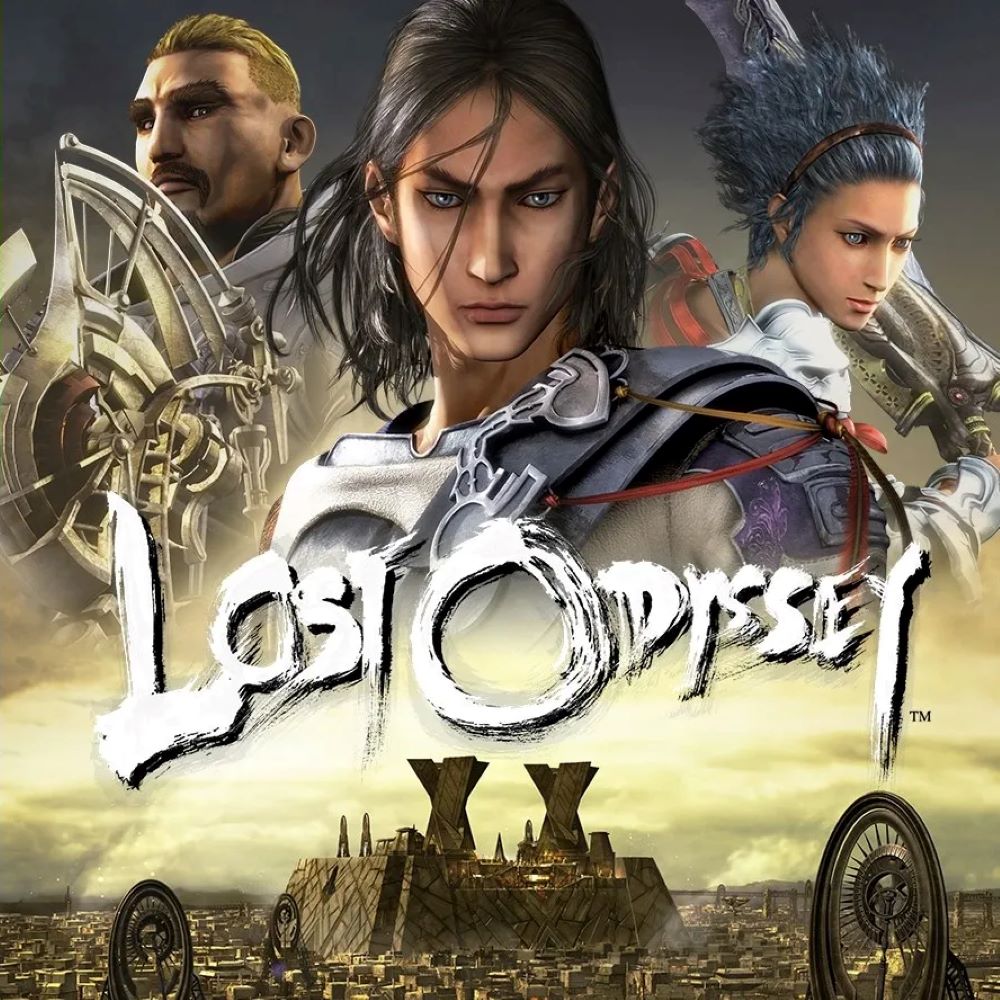
Lost Odyssey stands out as one of those RPGs from the late Xbox 360 era that doesn’t scream for attention with flashy mechanics or boundary-pushing innovations, but instead draws you in through its deeply introspective storytelling and a commitment to emotional depth that feels almost defiant in its restraint. Developed by Mistwalker’s Hironobu Sakaguchi—the mastermind behind the original Final Fantasy games—this title arrived in 2007 as a love letter to classic JRPG traditions, complete with turn-based combat, sprawling world exploration, and a narrative centered on immortality’s quiet horrors. It’s a game that rewards patience, asking players to linger in moments of melancholy rather than rushing toward bombastic climaxes, and in today’s landscape of hybrid action-RPGs like Clair Obscur: Expedition 33, it feels both timeless and a touch nostalgic.

The protagonist, Kaim Argonar, is an immortal wanderer who’s lived for over a thousand years, his memories eroded by time like sand slipping through fingers. This setup immediately sets Lost Odyssey apart, turning what could have been a rote hero’s journey into something far more personal and haunting. Kaim isn’t driven by prophecy or destiny in the typical sense; he’s haunted by fragments of lives long lost, piecing together his past while grappling with the present. Accompanied by a party of fellow immortals and mortals who bring their own baggage—Seth, a fierce queen-turned-revolutionary; Jansen, the wisecracking raconteur and black magic user; Mack, Cooke’s adventurous brother and a spirit magic specialist; Cooke, the earnest white mage sister; and others who evolve from archetypes into fully fleshed-out companions—the story unfolds across a world on the brink of magical and technological upheaval. Wars rage between nations like the Republic of Uhra and the Kingdom of Goht experimenting with dangerous “aether” energy, ancient gaia cults stir forgotten powers from the earth’s core, and a comically over-the-top villain named Gongora pulls strings from the shadows with his dream-manipulating sorcery. But it’s the immortals’ shared curse—living forever while everyone else fades—that grounds everything in raw, relatable humanity, forcing reflections on attachment, regret, and the passage of time.

What truly elevates the narrative are the “Thousand Years of Dreams,” a collection of over thirty short story interludes scattered throughout the game like hidden treasures, all penned by acclaimed Japanese author Kiyoshi Shigematsu. These vignettes replay key moments from Kaim’s (and later other immortals’) pasts: a father’s quiet desperation as his family starves during a harsh winter, a lover’s betrayal amid wartime chaos that shatters trust forever, a child’s innocent wonder abruptly ended by sudden violence in a peaceful village. They’re presented as dream sequences with minimal interactivity—just reading the poignant prose accompanied by subtle animations and ambient sounds—but their impact is profound, blending poetic introspection with raw emotional punches that make loss feel visceral and immediate. Shigematsu, known for his family-centered novels like Naifu and Bitamin F, infuses these tales with his signature themes of everyday struggles, parental love, and quiet resilience, drawing from his own life experiences such as overcoming a childhood stammering disorder. These aren’t mere filler; they mirror and deepen the main plot’s themes of memory, fleeting bonds, and the futility of outliving joy, often landing harder than the epic set pieces like airship chases or gaia temple collapses. In a fair assessment, though, not every dream hits the mark equally—some lean repetitive in their focus on tragedy and separation, and the heavy reliance on text-heavy exposition can test players who prefer more visual or interactive storytelling over contemplative reading.

Comparatively, the core plot treads more familiar JRPG ground, with globe-trotting quests to collect six magic seeds capable of restoring the world’s fading magic, infiltrate enemy strongholds like the White Citadel, and unravel a conspiracy involving dreamless immortals, experimental magic tech, and an impending apocalypse. It’s competently paced for its 40-60 hour runtime (longer for completionists), building to satisfying reveals about Kaim’s origins, the party’s interconnected fates, and the true nature of immortality in a world where magic is dying. Yet it lacks the moral ambiguity that makes contemporaries like Clair Obscur: Expedition 33 so gripping—that game thrives on tough choices where apparent triumphs often sow seeds of future doom, forcing players to question if their “expedition” against the Paintress is true heroism or just delayed hubris. Lost Odyssey flirts with similar existentialism—Kaim repeatedly forms bonds only to anticipate their inevitable fraying—but ultimately resolves in a more optimistic, collective salvation arc centered on hope and reunion. This makes it comforting for fans of straightforward fantasy epics with clear good-vs-evil lines, yet somewhat safe for a tale about eternal life, where deeper philosophical dives into immortality’s ethics, like the morality of intervening in mortal affairs, could have pushed boundaries further without alienating its audience.

The supporting cast shines as a counterbalance, with banter during airship travels and camp rests that humanizes even the most ancient immortals. Take Gongora, the flamboyant antagonist whose Shakespearean monologues, reality-warping sorcery, and personal grudge against his immortal brethren make him a delightfully theatrical foe worth rooting against. Or the mortal siblings Cooke and Mack, whose dynamic starts as lighthearted comic relief—pranks, inventions gone wrong, sibling squabbles—with Mack’s adventurous spirit driving bold escapades while Cooke provides steady white magic support, maturing into poignant growth arcs as they confront loss and responsibility together. Jansen brings levity as the wisecracking raconteur, spinning tales and unleashing black magic with reluctant flair that often steals scenes during downtime. Party chemistry fosters organic moments, like shared reflections on recent dreams or lighthearted ribbing during skill training, that deepen player investment over the long haul. Not all characters resonate equally; some, like the naive inventor Littleton or the initially whiny prince Tolten, lean into tropes without much subversion, leading to occasional eye-rolls amid the stronger portrayals from Seth’s fiery leadership. Still, the innovative “Immortal” skill-sharing system, where immortals permanently absorb abilities from fallen mortals via “Skill Link” beads, ingeniously reinforces the core theme: eternity doesn’t preclude learning, growth, or change through relationships with the temporary.

Combat embodies Lost Odyssey‘s old-school soul, sticking faithfully to turn-based roots with thoughtful layers that demand strategy over button-mashing reflexes. Battles unfold on a grid-like interface where positioning is crucial—front-row tanks like Kaim absorb hits for backline healers like Cooke and her white magic or mages like Jansen with his black magic arsenal, while the signature “Ring” system adds tension to every basic attack or spell: time your button presses precisely to hit colored rings for boosted damage, critical hits, or multi-hit combos. Condition management becomes key, as poison, sleep, paralysis, and weakness can derail even well-planned fights, encouraging thorough prep with items, protective spells, and the flexible “Skill Link” beads that let any character equip enemy-learned abilities like fire immunity or poison breath. Boss encounters ramp up dramatically with multi-phase patterns, status ailment spam, massive HP pools, and environmental hazards, rewarding exploitation of elemental weaknesses (fire vs. ice foes, etc.), party swaps, and layered buffs/debuffs for tense, chess-like victories.

Yet fairness demands noting the system’s notable flaws, which haven’t aged gracefully. Random encounters populate every screen with alarming density, leading to grindy slogs in weaker areas before you unlock enemy visibility via skills or items, and early-game pacing suffers from these constant interruptions amid tutorial-heavy chapters. Load times between battles and zone transitions feel archaic by modern standards—often 10-20 seconds on original hardware—and the lack of auto-battle, speed-up toggles, or robust fast travel exacerbates repetition for completionists chasing ultimate weapons, all 33 dreams, or optional gaia quests. Contrast this with Clair Obscur‘s slick hybrid combat, which fuses turn-based planning with real-time dodges, parries, and QTEs in a fluid “expedition” rhythm inspired partly by Lost Odyssey itself—every fight, from trash mobs to epic bosses, pulses with immediacy and the “dial of fate” mechanic that turns timing into life-or-death dance steps. Lost Odyssey prioritizes cerebral, menu-driven setups—buff-stacking, weakness chains, formation tweaks—over kinetic flair, appealing deeply to tacticians who savor the deliberate pace but alienating those craving Clair-style adrenaline and fluidity. It’s a classic strategic depth versus modern dynamic polish tradeoff, and your mileage will vary sharply based on tolerance for 2007-era JRPG rhythms.

​​

Exploration weaves together standard JRPG fare with moments of quiet wonder—roaming a vast overworld via massive airship (the Nautilus), delving into multi-floor dungeons with hidden chests and switch puzzles, solving environmental riddles involving weight balances, light beams, or wind currents—but injects personality through diverse biomes: mist-shrouded ancient ruins teeming with spectral foes, frozen tundras where blizzards obscure paths, volcanic badlands with lava flows and ash-choked air. Sidequests expand the lore meaningfully, like aiding immortal Seth’s rebel faction in underground networks, delving into sacred gaia shrines for permanent power-ups, or hunting elusive immortal encounters for rare skills, though many lesser ones boil down to repetitive fetch tasks or escort missions. The world map’s sheer scale impresses, hiding optional superbosses like the immortal-hunting Black Knights, treasure troves in hard-to-reach ledges, and secret dream triggers, but frequent backtracking without comprehensive fast travel can drag, especially post-game. Presentation captures the Xbox 360’s graphical peak for its time: cinematic FMV cutscenes rival Hollywood trailers in scope and polish, character models boast fluid animations, expressive facial captures (rare for 2007), and detailed costumes, while environments blend stunning pre-rendered backgrounds with real-time lighting and particle effects for moody, immersive atmospheres. Draw distance limitations, occasional texture pop-in, and lower-res models show their age on HD displays, but the art direction—shadowy, desaturated palettes evoking faded memories and encroaching oblivion—holds up remarkably well.

Nobuo Uematsu’s soundtrack remains the undisputed MVP, a masterclass in emotional orchestration blending sweeping orchestral swells with intimate piano solos and ethnic instrumentation. Battle themes like the pulse-pounding “Battle with Immortal” or tense “Boss Battle” drive adrenaline without overpowering, dream sequences float on delicate harpsichord, strings, and solo vocals for heartbreaking intimacy, and overworld motifs evoke vast, lonely skies over crumbling civilizations. It’s Uematsu post-Final Fantasy at his most evocative and personal, rivaling series highs and clearly influencing modern scores—direct echoes resonate in Clair Obscur‘s painterly OST, where swelling choirs and haunting flutes underscore expedition perils with a similar blend of grandeur, sorrow, and fragile hope. Voice acting offers a mixed bag: highs like Kaim’s gravelly, world-weary delivery from Jeff Kramer or Seth’s commanding fire from Sarah Tancer contrast with occasional stiff accents and wooden line reads in lesser roles. The English localization shines brightest in Shigematsu’s dreams—preserving nuanced melancholy and cultural subtlety—but occasionally clunks in casual banter or expository dumps.

Pacing represents Lost Odyssey‘s biggest double-edged sword, perfectly suiting its themes of slow erosion and reflection but testing modern attention spans. The game’s deliberate rhythm manifests in long linear chapters (Disc 1’s tutorial stretch, Disc 3’s sidequest marathon), mandatory backtracks to missed dreams or seeds, and optional hunts that balloon playtime to 70+ hours without always advancing the central plot. Mid-game lulls, particularly after major reveals like the immortals’ gathering or Gongora’s betrayal, lean heavily on grinding and collection, demanding commitment from players not fully hooked by the dreams. Technical quirks persist too: occasional frame drops in massive battles, finicky ring input timing on controllers, and long save/load cycles remind players of its 2007 origins, though Xbox One/Series backward compatibility smooths some edges with Auto HDR and FPS boosts. The game earned widespread praise for its story depth, Uematsu’s music, and emotional resonance, tempered by critiques of its dated combat pacing, grind, and conservative design in an era shifting toward action hybrids.

Against Clair Obscur: Expedition 33Lost Odyssey feels like the contemplative grandfather to a bold, innovative successor—Clair‘s tighter 20-30 hour sprint packs nonlinear branching choices, grotesque evolutions of its turn-based system, and a fractured, painterly world where expeditions literally rewrite reality through “painted” fates, with its combat’s “dial of fate” parries making every decision feel consequential and irreversible. Lost Odyssey sprawls longer and commits to strict linearity to pace out Shigematsu’s dreams methodically, trading reactive choice systems for patient, interior reflection on grief. Both excel at probing mortality’s sting—Clair through visceral, grotesque horrors and ambiguous victories, Lost Odyssey via intimate, lived-through tragedies—but Mistwalker’s effort prioritizes small-scale, personal grief over systemic reinvention or high-stakes moral quandaries.

Ultimately, Lost Odyssey endures as a balanced, heartfelt gem for JRPG purists and story enthusiasts: stellar writing from Kiyoshi Shigematsu anchors a solid but unflashy package, with Uematsu’s music, immortal hooks, and dream vignettes lingering longest in the mind. It’s not flawless—grindy encounters, safe plotting, and archaic pacing hold it from undisputed masterpiece status—but its emotional core crafts a rare resonance, blending melancholy fantasy with subtle wisdom about time’s toll. In an era dominated by Clair-like hybrids blending action and choice, it reminds why pure turn-based tales still captivate, offering a somber, patient journey for those willing to dream along with Kaim’s thousand years.
Clair Obscur: Expedition 33 Review


“Life keeps forcing cruel choices.” — Verso

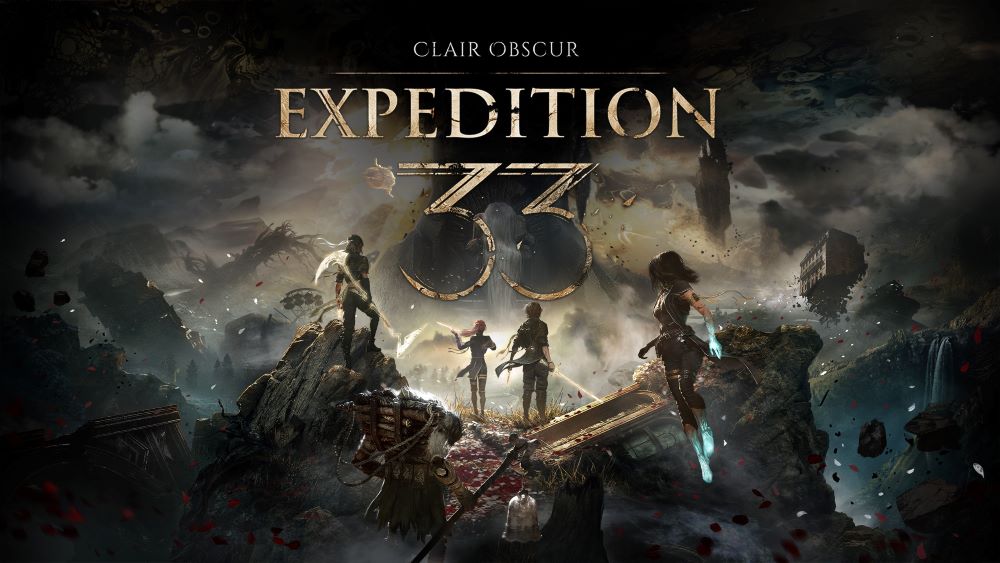
I’ve now played through and finished Sandfall Interactive’s Clair Obscur: Expedition 33, and it stands out as a captivating entry in the JRPG space, blending a deeply melancholic storyline with eye-catching visuals and a combat setup that mixes thoughtful planning with split-second decisions, all within a richly detailed world evoking a fading era of grandeur. At its heart lies the chilling concept of the Paintress, a mysterious entity who annually inscribes a number across the heavens, causing all who reach that age to fade from existence without fanfare or trace. The game’s protagonists band together for a high-stakes voyage aimed at scaling her towering domain and halting this grim tradition before it strikes Year 33, transforming a familiar quest motif into an extended reflection on life’s brevity, rebellion against destiny, and the customs societies invent to endure tragedy. The tone stays approachable, laced with sharp-witted exchanges amid the gloom, while gameplay keeps players actively involved, and echoes of iconic JRPG influences from Hironobu Sakaguchi—like the sweeping epics of Final Fantasy and the poignant depth of Lost Odyssey—shine through in its design choices.

The plot progresses as a gripping blend of escalating peril and introspective pauses, opening in communities that have woven the Paintress’s decree into their daily fabric. Local celebrations honor remaining time, households tally days with subdued anxiety, and affluent districts ponder existence over lavish artworks meant to defy forgetting. Your team gathers from those scarred by previous culls—bereaved kin, displaced souls, wanderers—infusing the group with individual wounds that amplify the shared plight. The path forward involves sidetracks through abandoned sites, fraught dealings with devotees viewing the Paintress as a benevolent force, and ethical dilemmas such as granting mercy to those facing obliteration. Closer to the summit, layers of lore unfold, suggesting the Paintress could stem from a misguided origin or embodied sorrow, prompting the crew to debate whether victory redeems or merely reshuffles catastrophe.

This storytelling prowess draws clear lines to Hironobu Sakaguchi’s legacy, the visionary behind early Final Fantasy triumphs and the overlooked masterpiece Lost Odyssey. The grand-scale conflicts and heartfelt interpersonal ties of Final Fantasy resonate in how Clair Obscur intertwines global peril with private sorrows. Yet Lost Odyssey provides the closest parallel, with its focus on ageless wanderers burdened by sorrow—mirrored here by time-bound lives—employing ethereal sequences and subdued musings to delve into mourning’s toll. The short, evocative tales in Lost Odyssey‘s “Thousand Years of Dreams” parallel the game’s archival entries and memory glimpses, which breathe life into vanished souls: versifiers halted in flow, tinkerers forsaking unfinished marvels, youths denied basic legacies. Studio insights highlight Sakaguchi’s skill in rendering eternal burdens profoundly mortal as a guiding light for crafting the party’s resilient yet fractured ideals.

Central motifs pit surrender to fate against willful resistance, threading seamlessly through dialogues at rest stops and chance meetings to avoid heavy-handedness. Communal resignation appears as sensible resilience rather than weakness—resisting an annual wave proves futile, so adaptation prevails. The travelers represent the flip side: audacious optimism teetering on folly, fueled by unyielding curiosity, akin to Lost Odyssey‘s undying figures rediscovering purpose amid oblivion’s threat. A comrade might grip a memento from a lost relative as rage’s spark; another embraces excess, seeking fleeting thrills since futures dissolve; yet another serves as ethical anchor, cautioning that unchecked revolt harms bystanders. These paths collide poignantly—fractures from panic, mends through peril’s forge, hushed admissions of battling for vitality over triumph, capturing Sakaguchi’s fusion of mythic scope and visceral feeling.

Sorrow and recollection anchor further layers, via retrospective visions and elective records that personalize the toll, nodding to Sakaguchi’s use of intimate narratives to anchor vast realms. This juxtaposes against vibrant holdouts—opulent dances beneath ominous vaults, buskers flaunting flames to taunt twilight—fueling an overarching idea of enactment drawn from his dramatic sensibilities. Existence morphs into a drama directed by the Paintress, participants ad-libbing parts: resolute captain veiling dread, comic veiling remorse in quips, thinker unraveling legends pre-finale. The script deftly merges genuineness and showmanship; raw outpourings yield to lush scores, probing if sentiments endure or merely peak performances—reminiscent of Lost Odyssey‘s detached eternals reenacting humanness.

Optimism faces scrutiny, portrayed with nuance rather than idealization, honoring Sakaguchi’s shift from Final Fantasy‘s luminous quests to Lost Odyssey‘s jaded realism. Initially a binding flame, it frays amid reversals—raids by adherents, glimpses of doomed prior ventures—exposing vulnerabilities. Does opposition uplift, or burden allies with delusion? Nuanced moments abound: euthanizing a settlement embracing mass erasure to spare agony ignites clashes mirroring life’s terminal choices, akin to Lost Odyssey‘s eternal-versus-finite contemplations. Kinship and affection weave closeness—a divided pair riven by self-offering, budding connection strained by farewell drafts—revolving around fleeting hours. Cling or release kin? Impact stems from narrative faith in interpretive space, shunning neat closures per Sakaguchi’s player-trusting ethos.

The orchestral soundtrack stands as one of the game’s true triumphs, composed by the talented Lorien Testard with contributions from a full symphony orchestra that captures the Belle Époque essence in every sweeping string section and haunting motif. Testard’s score masterfully shifts from delicate piano interludes during quiet camp reflections—evoking fragile hope amid numbered days—to thunderous brass crescendos during tower ascents and boss confrontations, perfectly syncing with the emotional highs of defiance and loss. Guest artists like Alice Duport-Percier on vocals add ethereal layers to key themes, such as the Paintress’s ritual melody, which recurs as a leitmotif tying personal grief to cosmic dread. Recorded live with meticulous attention to period instrumentation, including harps and woodwinds for that ornate, fading-elegance vibe, the music doesn’t just accompany; it immerses, turning traversal into symphonic poetry and battles into operatic clashes that linger long after the controller’s down.

Performances soar across the board, with standout work from Charlie Cox as the determined Gustave, bringing a grounded intensity to the engineer’s final-year desperation, and Ben Starr as the enigmatic Verso, delivering a layered mix of menace and vulnerability that keeps you guessing. Jennifer English shines as the fiery Maelle with raw emotional power, while Shala Nyx’s calm yet fierce Sciel adds a steady anchor amid chaos. These voices, alongside gravel-voiced wisdom akin to Andy Serkis and resilient fire reminiscent of others in the cast, lend real heft to reflections on purpose in a counted world, elevating every dialogue into something memorable.

The opulent, twilight-era backdrop enriches motifs, merging Sakaguchi-esque fantasy with continental lavishness for novelty. Elaborate towers rend misty expanses, attire upholds decorum in wreckage, vessels glide as innovation’s specters—all painting a realm in refined decline, staging poise toward closure. Playful quirks—a trader morphing beasts for barter scraps, an aeronaut spouting verse aloft—highlight stubborn spirit, easing gravity sans dilution. Runtime hits 20 hours core, concise yet hinting at untapped depths—like genesis tales or foe quests—primed for expansions, echoing Sakaguchi’s potent brevity.

Gameplay propels via evolved hybrid vigor, building on Sakaguchi-defined norms: menu selections via vibrant dial (strikes, resource skills for ruptures/chains, targeted blasts, aids) merge with instant retorts through evades, counters, leaps versus foe cues, like Lost Odyssey‘s strategy plus timing. Flawless guards restore fuel for climaxes, crafting battles as hazard-harmony flows syncing with tale strains. Traversing covers sparse hubs with patrolling threats in flexible areas—bypass for pace, engage for growth—stats tilt to quickness/endurance edges, execution overriding setups. Initial timing hurdles test, end patterns exact, glitches annoy, yet synergy evokes tale revolt and Sakaguchi innovation.

Aesthetics dazzle: interfaces flare in spectacle—delays, bursts—rendering wins grand, saluting Final Fantasy pomp. Taken as a whole, Sandfall Interactive’s Clair Obscur: Expedition 33 takes a well-established brand of RPG mechanics and storytelling, polishes it with modern hybrid twists, introspective depth, that masterful orchestral score, and stellar voice work, modernizing it into one of the best games of recent years—a somber treasure where fate-drama depths, keen casts, and dynamic clashes in compact form outshine sheer scale, flaunting its Sakaguchi nods boldly while standing tall on its own. Shortfalls in ancillary tales and timing tilt persist, yet for evocative RPGs melding soul and vigor, it endures memorably—affirming grace persists, counted or not.

Square-Enix Announces Final Fantasy VII Remake


Need I say more?

Well, there’s not much to say just yet. The announcement was just made at E3 yesterday. The good news is that, while it’s coming out on the Playstation 4 first, Square-Enix imply that it will be available on multiple platforms eventually. Since I only play PC games, that’s pretty sweet news to me. As far as staff goes, the trailer credits Yoshinori Kitase as producer, Tetsuya Nomura as director, and Kazushige Nojima as writer. This maintains a decent bit of continuity. Original producer Hironobu Sakaguchi is long gone, but Nojima it maintaining his role as writer from the original PSX Final Fantasy VII while Kitase is switching seats from director to producer. Nomura will be the wildcard. He was involved in character design in the original, but he didn’t make his directing debut until Kingdom Hearts.

The bad news is, well, Square-Enix have not exactly been batting 1000 lately. They’ve earned a bad reputation over the past decade or so for rushing products, pushing quantity over quality, and releasing sham smartphone games mainly designed to gouge your wallet. It would be nice to think that a remake of the legendary Final Fantasy VII will receive an extra dose of attention. I mean, in all likelihood this game’s going to make more waves than the upcoming Final Fantasy XV. But considering the original release of Final Fantasy XIV was so terrible that the company issued multiple public apologies, it might be wise to wait for early reviews to trickle in before getting your hopes too high. The narration in the trailer feels hopelessly contrived to me, and that’s not a good foot to start on.

I’m still waiting to learn whether or not the most important staff member returns for this one though: Nobuo Uematsu!

Song of the Day: To Zanarkand (by Uematsu Nobuo)


ToZanarkand

After necromoonyeti helped rekindle memories of days, weeks and months playing Final Fantasy and listening to it’s soundtrack I thought it was only appropriate that the latest “Song of the Day” comes from that very series.

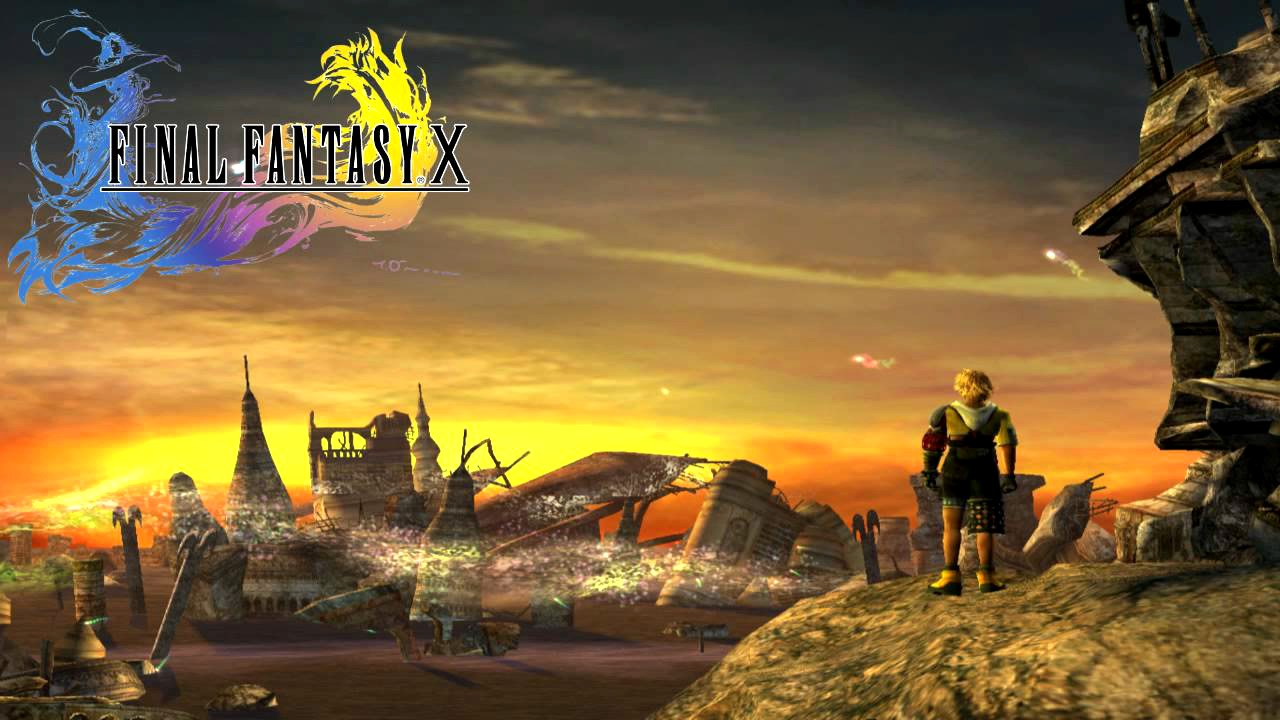
“To Zanarkand” is the theme to Final Fantasy X. An entry in the venerated rpg franchise that has been underrated since it came out in 2001. While the game never reached the sort of acclaim and fan devotion as earlier entries like Final Fantasy IV and Final Fantasy VI (I’m of the few that thought Final Fantasy VII was average, at best) this tenth entry still managed to include a soundtrack that was some of composer Uematsu Nobuo’s best work.

There’s been many version of “To Zanarkand” from the original version included in the game and the first soundtrack release to the HD remastered version and reimaginings like the one from the Distant Worlds II music collection. Yet, the version that speaks loudest to me is the new arrangement by Masashi Hamauzu (same composer whose music necromoonyeti posted about previously) for the Final Fantasy X Piano Collections.

This piano solo version takes the original song and brings it down to it’s emotional core. The other versions are just as powerful, especially the full orchestra version, but the simplicity of the piano solo conveying the themes of loss, sorrow and redemption that the game’s narrative was built on works best for me.

Song of the Day: Masashi Hamauzu – Saber’s Edge, from Final Fantasy XIII


https://www.youtube.com/watch?v=Vz8ZOw392M8

If you frequented this blog back in 2012, you probably remember a 68 post series I ran on the history of video game music. While no one website served as my main source for it all, Final Fantasy Shrine definitely inspired the idea. As that community aged, it developed a unique trend towards game, anime, and film music discussion. I discovered a lot of obscure composers there, and that got the ball rolling for my series. One of the things we’ve been doing on FFShrine for ages now is making music compilations to showcase in a sort of knock-out tournament. Themes have ranged from the predictable mainstream to obscurities like “Best of Tim Follin”, but we never actually did Final Fantasy until last year. It turned out to be surprisingly novel, because I hadn’t heard anything since Square-Enix and Nobuo Uematsu parted ways. “Saber’s Edge”, a battle theme from Final Fantasy XIII composed by Masashi Hamauzu, ended up becoming one of my favorite songs in the series.

It’s been a year now, and (probably because I’ve been staying up until 5am watching a baby with absolutely nothing to entertain me) I decided to resurrect the Final Fantasy music knock-out game for a second run. FFShrine is a lot smaller than it used to be, though, and I’m not expecting much participation. So hey, if you’re bored and want to rehash some old RPG tunes, maybe discover a few new ones, stop by FFShrine and check the game out.

Con Report: Another Anime Convention 2014


Hey all, I’d usually start this post off with me saying why I haven’t made a post in forever.  I’m lazy.  Plus Arleigh forgot to remind me when I’m at home.  Plus again, I have been working my ass off for the most part this year.  But, I figure I started to feel bad about not posting much considering how much Arleigh is paying me.  And then I realized that I’m not being paid anything, so I stopped feeling so bad.

Now, with that out of the way, let’s talk about my adventures at Another Anime Convention in Manchester, New Hampshire during the weekend of October 17-19.  Arleigh and I have attended 5 conventions together, 3 Anime Bostons and 2 Anime Expos in LA.  But there’s still many conventions that I attend solo, even though it’s incredibly expensive.  So, whenever I can, I try and go with someone like Arleigh.  However, small local conventions are just not something that I’d call him out from the wrong coast out to the right coast, especially since both of us are pretty much exclusively interested in Japanese guests.  Small, local conventions on the east coast are not going to get any Japanese guests ever. Anime Boston barely gets any, and they bring in well over 20,000 people.  Another Anime Convention is lucky to get 4,000 people.  But you know what?  The location works so well for that.  The convention is held in the convention center of the Manchester Radisson and even though the attendance is only between 3000 and 4000, it makes it feel every bit as busy as Anime Boston.  Not anywhere near Anime Expo or Otakon, but that’s not a bad thing, because both those conventions are stupidly crowded.

This particular convention has a lot going for it.  For one thing, even though I said it’s nowhere near an AB, since it’s a much smaller venue, it certainly feels every bit as big.  At no time will it take you longer than 10 minutes to get from one end of the convention center to the other, but that’s something that can only be truly appreciated with a smaller convention like this.

So what does this convention have going for it anyways?  Well, let’s say for a moment that you’re a fan of English dubs.  If you want to meet certain dub actors, then this is the place to do it without a doubt.  If English dub actors were my thing, I’d have been able to get several autographs no problem.  Now, even thought it’s a smaller convention, it still would normally be as tough to get an autograph as any convention.  However, AAC does something that I would encourage other larger conventions to do.  And to an extent Anime Expo does this as well.  What I’m talking about is that for an extra upcharge, one can essentially buy extra perks.  Basically for $50 extra, you get a free t-shirt, unlimited line skips (yes, any line, at any time, every time any and every day.  But there are maybe 3 events total over the course of the weekend that that would actually be an issue for), front of line access to guest autographs.  Basically, the perks are there to lord it over the cheap ass normals.  Did I do such?  Oh hell yeah.  If I saw a huge line for a panel, even if I didn’t give half a shit about the panel, I jumped the line just because I could, and I knew I was taking a closer seat away from some skinflint.

Now, Arleigh and I typically go to panels hosted by the Japanese guests and/or panels done by industry, such as your Funimations, Sentai Filmworks, Aniplex of America, or Viz Media.  With none of those industry members present at a small convention like this, I had to go into it with a much different mindset.  And you know what?  I still managed to have a ton of fun and still couldn’t see everything I wanted to.  What I did was take part in things that are in even the giant conventions, but we just never had time for.  For example, I actually went and watched the entire AMV contest, including voting on my favorites.  Because I am always ready to pass the buck, I long ago gave Arleigh the list of AMV winners, so instead of me posting them all, I’d hate to take away future AMV of the Day posts.  Buck officially passed.

One thing I can’t very well pass off to anyone else is the very fundamental thing of cosplay.  I’ll admit, I went into this thinking that the cosplay would be mediocre at best.  I grossly underestimated the dedication of anime fans.  Possibly due to the fact that there were less people around and so those that were there really stepped up their game, there was a big percentage of high class cosplay.  Alright, admittedly there were the predictables like Kill la Kill, and Attack on Titan, which has now become the new Bleach and Naruto, but if there’s quality, then repeatablity doesn’t much matter.  So, for right now, I’d like to regale you with pictures I took during my trip there.  Admittedly, I don’t always know what I took a picture of, but if I don’t know there’s two reasons why I took the picture.  Either the costume is cool looking, or the model is very hot. I’d say it’s up to you to decide, but screw that, I’ll tell you what I thought.

First off, we have a Little Mac cosplay.  This is near and dear to me because I have previously cosplayed as King Hippo.  Obviously King Hippo is a million times better, but hey, Little Mac is still pretty cool.

Pretty decent Zach (seriously, the proper contraction of Zachary is Zack.  Enough with this lazy bullcrap) Galaphanakis.  Frankly, I’ve never seen any of the movies, but even I can recognize somewhat famous movie scenes.

No idea what this is.  Looks pretty elaborate though, so I reward people that take the effort to make a decent costume even if they obviously can’t pull it off.

My hotel room faced out to the courtyard.  As I was up in my room taking a break, I happened to see this Sailor Pluto take a seat. I immediately headed out to try and catch her.  Again, due to it being a small convention, the elevators weren’t crazy busy, so I was able to get out there and get her picture.  If she doesn’t look crazy hot, then that’s due to my poor photography skills and not her own natural hotness.

The first of a few Kill la Kill cosplay photos.

May Chang from Full Metal Alchemist.  The charm point is the panda in her hair.  I love when people take the time to bring out the small details like that.

More KlK cosplay.  Is this the last?  Probably not.  I mean, it was only the hottest anime property in the last year, so obviously no one would ever want to cosplay as it.

Again, I dunno, probably some video game.  If it’s familiar to you, then sure, you know the game.  Either way, she’s pretty nice to look at, no?

Another that I’m not really certain of, but she’s showing her panties for everyone to see.  Do you honestly expect someone with the username of pantsukudasai (panties please) to not immediately see this and need to take a picture?  My picture does not do her justice.  Very hot.  If you’re her and you’re reading this, color me surprised.  What are the odds?  You’re also some anonymous pervert on the internet who likes looking at attractive women in cosplay.

Like I said before, one of the most overdone cosplay in recent times is Attack on Titan.  So if you want to stand out to me, the best way to do it isn’t to be one of a million Potato Girls, nor one of three million Levis, or the same number of Mikasas.  No, if you want to stand out, be like this one and be a half eaten Marco.  Brilliant!

No doubt this will be done often in the next several conventions, but SAO II (Gun Gale Online) Kirito was a novelty at the time, so I was surprised to see anyone with this costume already.

From Chuunibyou demo Koi ga Shitai, I can’t resist a Rika.

Another rare male cosplayer.  Most Sir Crocodile cosplayers don’t bother with the cigar.  If you don’t go with the cigar, then what the hell is the point?  Seriously, to anyone that’s considering it, at the very least buy a cheap cigar.  Oh no, you’ll have to spend a day with tobacco on your lip.  You’re not gonna get cancer from one goddamn day.  Stop being a cop out bitch.  Go with realism.

Generally I don’t take pictures of non anime properties, but I’ve always had a soft spot for Batman and Catwoman.

The girls here spent the entire weekend making chalk art.  All in all, I can’t help but be impressed.

Frozen is pretty much the most popular movie in America and the rest of the world.  It’s the top selling BD in Japan as well.  It’s a shame that there wasn’t snow on the ground, but on the other hand if it was that kind of cold out I probably wouldn’t have gotten these pictures in the courtyard.

Again, keeping it all very topical, we have a cosplay of Luffy, or Lucy.  Honestly, I don’t think people truly appreciate what cosplayers like this do.  Most people aren’t reading the manga as it comes out, so the fact that someone gets a current arc cosplay made up is pretty impressive.

Not the greatest of any one of the Honnouji Academy group, it’s just not often that you see them all grouped together.

Again, I usually don’t pay any mind to non anime cosplay, but here we have Bob Ross. If you don’t know who Bob Ross is, then you are a grade A moron.  Perhaps it’s not nice to insult the readership, but come on, anyone that’s at least been in college should know who the hell Bob Ross is.

Pretty good looking Mami.  Know what would have made her look better?  No head.  Ooops, spoilers.

My goddamn unicorn! If that doesn’t make sense, then please hear my story.  First off, a unicorn refers to something that if you don’t have pics, it didn’t happen.  The backstory to all this goes as such.  I saw this girl while I was having breakfast, heading down to an area where there is only on way to go.  I didn’t sweat it, because I figured small convention, only one access point, I should easily find her and get her picture.  After eating, during which she definitely did not come back that way, I headed down there to find her.  I got distracted because I saw the barrel of that gun and figured I had her, but it turned out I was chasing down a Seras Victoria cosplayer.  Then later in the day, as I was on the second floor waiting for a panel to open, I saw her walk by on the first floor.  I rushed down to the first floor, heading to the direction that she was walking.  Amazingly, I could not find her.  Again, this is a small convention, with a basically small floor area.  Finally, I saw her while I was on the same floor as her and got this picture.  FYI, she’s Sinon from Sword Art Online II.  Again, it’s a fairly new show, so I’m amazed that there is a great quality cosplay as this so soon.  Plus, I’m very impressed that she didn’t go running to security when I told her that I had been hunting her down all day.  Yes, I used those exact terms.  Thank you Sinon for not getting me arrested.  Also, I never saw her again the rest of the day, so I’m glad I was able to get a picture of this unicorn and turn her into reality.

Not the greatest I’ve ever seen, but it’s been so long since I’ve seen any Rinoa cosplay that it’s almost fresh again.

Finishing off the day, and the weekend, we have Shiro from No Game, No Life.  This same girl was busy doing a professional shoot earlier in the day.  I suppose I could have just shot a picture, but that’s not how I roll.  Believe it or not, a guy whose username is begging to see panties does have morals.  Luckily for me, I saw her later on in the day.  During the photoshoot, she was wearing a crown.  I think I got the better picture with her wearing panties on her head, which is actually canon in the show.

(To note, every picture taken here was done with the full permission of the person whose picture was being taken.  If for whatever reason you have changed your mind and do not like the way your picture has been taken, contact me and I will take it down, no complaints or questions asked.)

So, with all that said and done, more has been said than done.  But really, while I wouldn’t say break the bank and fly across country to attend, if you find yourself in the Northeast and hear that Another Anime Convention is gonna be going on that weekend, by all means fish out the $50, plus whatever your hotel costs, and you’ll find yourself having a great time!

A Glorious Fantasy: Finally, a Thief!


Abbreviated boilerplate! Once again I return to this ongoing series, in which I attempt to play through every game in the Final Fantasy franchise that I can get my hands on, from FF1 through Lightning Returns, and a variety of the spinoffs and other titles not included in the ‘main series’. This list continues to undergo revision, and I seriously considered removing Final Fantasy 9 from it for personal reasons. In addition, no MMO titles will be played. Sorry, folks?

I think all of this is extremely important knowledge, and that the human race will be improved by my research. Let’s move on!

Previously on this series!

FfixLogo

The traditional mood music is at hand!

Version Played: Original PSX discs, played using a “slim” PS2 system

Final Fantasy IX is a game that for me, and mine, and my generation of gamers… feels more modern than it actually is. How many among us would be surprised to learn that Final Fantasy IX was released in November of 2000? We are approaching its 15th anniversary. It’s perhaps the newest of the old Final Fantasy games. Except, we don’t think of Final Fantasy VII as old, do we? It is, and we should. Some of us probably do. But that still seems odd to me. Truthfully, Final Fantasy XIII probably has more in common with VII than it does with I. Evolution is an ongoing process, and it’s one that ongoing fans have learned to accept.

But there’s a lot going on in Final Fantasy IX that would be both weirdly prescient and altogether ignorant of the future. It’s an interesting game in many ways.

The core conceit behind FFIX is that it’s a return to the “roots” of the Final Fantasy series. Superficially, there can be no argument about this at all. Final Fantasy IX brings back the saga of the four crystals that rule or shape the world (a premise which every game before Final Fantasy VI incorporates). It’s got airships, it’s got the ATB gauge, you buy and equip weapons and armor, and your abilities are gained as you level. After Final Fantasy V (with its variable Job System), and VI, VII, and VIII… which allowed total freedom of customization to the player given more or less application of effort… Final Fantasy IX has our characters locked into their classes, in a nod to Final Fantasy I and IV.

The designs of both the world elements and (particularly) the characters are also a deliberate reaction against VI, VII and (especially) VIII, which featured increasingly advanced technologies and settings that were undeniably darker than previous Final Fantasy realms. Final Fantasy IX’s – and this is important – surface tone is much goofier. The character designs reinforce that for the entire game. Of course, this game is actually full of some really messed up shit… way more than I remembered there being, in fact. Even in the darkest pits of this game’s soul though, the bobblehead characters work to lessen the impact. There’s nothing creepy about them, for the most part.

The unfortunate side-effect of your characters being “locked in” to their roles is that a certain party composition is virtually required to complete the game. With enough ability gimmickry, you might be able to pass the game’s challenges by overleveling significantly and abusing Auto-Potion, but in general, you will take one of the game’s White Mage characters, Eiko or Garnet. Neither provides any meaningful offense. Garnet has offensive Eidolons, but their MP cost remains prohibitive until perhaps the very end of the game, with a few notable exceptions. Physical fighters like Steiner, Zidane and Freya remain your bread and butter as always, though Black Mage Vivi can certainly contribute. Indeed, my own party for this entire playthrough consisted of Zidane, Garnet, Vivi, and Steiner.

The one nod to character customization available in this title are character “abilities” which are learned off of equipped weapons, armor and accessories. Calling this system “customization” is a bit of a stretch, as all unique character abilities are learned this way (i.e., Garnet’s weapons will teach her White Magic, which Zidane and others cannot learn), along with the same pool of generic abilities for each character. Some abilities are easier to come by than others on certain types of armor. For example, Zidane’s light armor and daggers have easy access to thief abilities, as well as physical combat abilities such as Bird Killer or Golemslayer. You have a limited number of points with which to “equip” learned abilities, and equipping the proper status resistances and combat proficiencies can mean the difference between victory and defeat in many of the game’s areas.

That’s about all there is too it, really.

I have trouble taking the main antagonist of this game seriously, and it turns some of the dramatic moments into silly ones for me. Aside from that, however, it would be difficult to earnestly argue that this game doesn’t live up to what the Final Fantasy brand represents. It’s even a little meatier than its predecessors in VII and VIII in terms of core story, taking a fair amount of time to work through. In addition, some of the battles in IX can be difficult unless you’ve substantially overleveled. Once you’ve identified the best abilities for each situation, you won’t have much of a problem, though this game’s final boss might be the most difficult one I’ve faced, other than the infamous Cloud of Darkness from FF3. As always, your own mileage may vary, but I have a hard time conceiving of ways to make a more infuriating storyline boss.

All of that goes triple for Final Fantasy IX’s superboss, the dreaded Ozma. Although there are many cheesy workarounds available to make him much easier to defeat, he will still feel completely impossible unless everything goes perfectly. I have defeated him, but elected not to do so during this playthrough. I did defeat the other optional boss, Hades, in Memoria, which gives access to the game’s most complete Synthesis Shop. Taking advantage of the items available there will make the game’s final challenges – and Ozma! – quite a bit easier to deal with, and Hades is nothing more than a fairly difficult boss.

On the whole, I found IX to be fairly uneven. Its plot is a bit on the ridiculous side, which I’ve come to realize is an appropriate thing to say about most of the Final Fantasy games. The only ones whose stories have stuck with me so far were IV, VI, and VII, and maybe a little bit of FFT. Will this improve? Hmmm! The gameplay is very straightforward, which is a mixed bag. Eventually you’ll reach a point where you’ll have your ‘strong’ party, and the occasional swap of abilities to protect against local status effects will be enough to find your way. Certainly, I did not find the system here to be nearly as engaging as the ones from VI, VII and VIII, but nor is it entirely without substance (such as in FF1). Still, probably the weakest system to be seen since FFIV’s similarly static model. When the game was fun and interesting, it was fun and interesting, but I did spend periods tiring of the random encounter rate, wishing the graphics were better, and hating the back of Zidane’s face with the scorching power of my brain. Him and his stupid tail.

But I knew going in that this one would be far from my favourite installment. I actually think I enjoyed it more this second, and probably final, time through. So there’s that.

One word of caution for anyone looking to play back through this title: I played on the physical PS2 plugged into my HDTV, and boy did this game look like shit. I highly recommend pretty much any solution but the one I chose. The text was mercifully still quite legible, and the cutscenes scaled nicely, but the in-game graphics… well. Let’s say that I was startled after having played through the nicely-upscaled Steam ports of VII and VIII, and the beautiful PSP version of FFT.

Oh, and join me next time when I discuss the jump to the Playstation 2 with Final Fantasy X!

This game’s soundtrack is far from one of my favourites. It took time just to pick two songs for this piece. Yikes.

A Glorious Fantasy: The Original Klingon


Columnist’s Note: This article has been edited from its original form to include some thoughts about the Master Calculator and the battle with Belias the Gigas in response to compelling arguments made in the comments. This was an important change, and it expands humankind’s capacity for growth.

Abbreviated boilerplate! Once again I return to this ongoing series, in which I attempt to play through every game in the Final Fantasy franchise that I can get my hands on, from FF1 through Lightning Returns, and a variety of the spinoffs and other titles not included in the ‘main series’. This list continues to undergo revision, and I seriously considered removing Final Fantasy 9 from it for personal reasons. In addition, no MMO titles will be played. Sorry, folks?

I think all of this is extremely important knowledge, and that the human race will be improved by my research. Let’s move on!

Previously in this series!

FFT

As is customary, let’s start with some mood music.

Version Played: “War of the Lions” PSP remake, complete with incredibly Shakespearian translation.

Final Fantasy Tactics is sort of the gold standard for tactical RPGs. It is also a game around which many PSX-era Final Fantasy fans rally together as a point of shared joy. In my entire life, I have never met someone who actively disliked this game. That, in and of itself, is incredible. I mean, who doesn’t know someone who dislikes Final Fantasy 7, 8, 9, 10, etc. ? Tactics rises above that crop to my mind for three major reasons.

1) The gameplay mechanics are deservedly the gold standard for tactical RPG play. Yes, I love Fire Emblem too. But there’s something about the job system and the customization available to the player in Tactics which hits the spot. Oh, and you get a variety of broken NPCs if you’d rather just use the cheater sword abilities the AI has been trying to best you with all game. I won’t blame you if that’s how you feel.

2) The story appeals to people in a kind of ‘Game of Thrones’ way. Despite all of the magic present, it’s not utterly fantastic. The focus of the story is on ambitious jackoffs who would sacrifice anything to advance their own ambitions… and one guy who is kind of the opposite. It’s a semi-kind-of-realistic middle ages type setting. It feels to the player like a place that could actually exist, which is simply not the case for other Final Fantasy titles.

3) Ramza Beoulve, despite ultimately not being that interesting, is a very easy protagonist to root for. He doesn’t have the capital-letter ISSUES that plague Cloud and Squall. He doesn’t have a bizarrely oversized head and a tail like Zidane. And he doesn’t narrate the whole game with inner monologues that caused some people to bleed into their brains like Tidus. No, Ramza is quite straightforward, and quite heroic.

But it’s mostly about #1. The mechanics are deep (sort of. They’re deep if you’re not just chasing the absolute optimum party, at any rate). They’re fun to play around with. They can make the game either embarrassingly easy or fairly challenging depending on which route you decide to go. It’s like the awesome job system from Final Fantasy V writ large in the PSX era! Only you also get many NPC characters with unique and interesting skill sets! I chose not to use any of them (except Agrias. I don’t hate myself) in this particular play through, but FFT certainly facilitates any style of play that you like.

The standout mechanic, of course, which you won’t find elsewhere – even in other incarnations of Final Fantasy’s own job system – is the Calculator or Master Calculator job. This job is very straightforward – it uses the battlefield metrics such as elevation, remaining wait time to act, and individual character level, and then devastates targets with magic. The Calculator need not spend MP to do his work, nor is he subject to the questionable charge times that render powerful spells like Holy of limited utility. Instead, the Calculator picks a metric to hit, then which multiple (3, 4, or 5) he wants to lash out at, and then gleefully rains fire down upon eligible targets… friend and foe alike. Because the Calculator class has abysmal stats and is unbelievably, unfathomably slow, I didn’t find it worth the time to train one of my party members in the skills this time around. But veteran players all know that the deployment of a Calculator’s skillset (preferably equipped on a better job: try Black Mage!) on the battlefield can easily win this war almost single-handedly.

Even using weak classes and abilities, and without the timely intervention of Count Orlandeau or the mighty Calculator, it’s perfectly possible to complete Final Fantasy Tactics. Once you have mastered the mechanics of the game and know what truly poses a danger to your group, I like to think the obstacles of this game are fairly easy to navigate. A standout, fairly brutal exception to this is a battle roughly halfway through the game at Riovanes Castle. You should save your game in a different slot before attempting it. In fact, keeping two different saves is always a good idea in this game, to avoid a possible soft lock of your file, where you’re locked into a battle that is too difficult for you to defeat, without the means to leave and level up or acquire better equipment.

There are a couple other possible exceptions, which revolve around a mechanic that simply doesn’t work as well as the designers probably intended. I consider it one of FFT’s flaws that several story battles involve “guest” characters. Early on, this takes the form of Delita and Algus, your supposed friends, who are there to make sure you can’t take a full party of 5 on a mission until the start of Chapter 2. They’re not always helpful, but they also can’t die, so they’re no liability either. Later, however, most such missions involve saving other “guest” characters from getting their dumb asses killed. Unfortunately, since guests are always under the control of the AI… this isn’t always possible. There is one battle (Castle Riovanes Roof. You know what I’m talking about) where the guest character routinely gets killed in the first round of action. Or any any subsequent round. In one shot. By some brazenly unfair enemy characters. This battle can be one of the most frustrating ones in the game because you have very little ability to impact its outcome. Either your “guest” behaves rationally and avoids the deadly enemy assassins… or she doesn’t… and it’s game over. Bummer.

One thing I want to mention in this space, before I get too far afield, is the translation. The original translation for FFT is in the same vein as the Ted Woolsey translations of earlier games. You still get the gist of it, but a lot of it is nonsense. It’s much worse than the original translations for Final Fantasy VII and VIII in this regard. Lots of stuff, even seemingly obvious stuff, is mistranslated, to the detriment of the story. PSP’s War of the Lions is heralded as a vast improvement, and in some ways that’s true. However, having now played both versions, I have to say, there’s a lot to dislike about the War of the Lions translation as well. It may simply be the original material to blame, which is fine, but this translation is insanely talky at times. We might as well be reading the original Shakespeare in some of the cutscenes. Melodrama and unnecessary wordiness abound, and the ultimate effect is a little bit off-putting to a modern player. Don’t misunderstand – by no means did I hate the War of the Lions treatment of the script. I just am not sure that it deserves the near-universal praise that it has received amongst gamers and critics alike. It’s talky. Often unnecessarily so.

By its nature, a game that you can play through with only Ramza and a party of generic characters (in fact, you can dismiss any of the story characters after they’ve formally joined) has to be light on character development. Characters like Agrias, who are central to the plot up until they join, disappear immediately upon doing so. As a result, the only meaty characterization is ultimately of the Beoulve family… Ramza, his sister Alma, and his two other brothers Zalbaag and Dycedarg. They are at the center of the conflict ripping Ivalice apart in any case, and they’re also the characters (along with Ramza’s best friend, Delita) who get the most screen time. Delita receives some additional attention in the War of the Lions, to where you could consider him one of the game’s better-explored characters. Still, you’ll actually find a lot of the most intriguing characterization actually belongs to the game’s various (and, boy, there are a lot of them) antagonists. This is definitely an intriguing reverse from the “norm”, but it works well here.

Ultimately, this is probably one that we can all still agree on. FFT kicks ass. It combines excellent and deep tactical gameplay with an intriguing story that might be a little less clear with the new translation… but certainly isn’t any worse. It might be one of the more cohesive FF plots around. It’s also got at least one more song I’ll share.

Join me next time, as I return to Final Fantasy’s roots, with Final Fantasy IX!

A Glorious Fantasy: Hyper-Realism and Time Travel


Abbreviated boilerplate! Once again I return to this ongoing series, in which I attempt to play through every game in the Final Fantasy franchise that I can get my hands on, from FF1 through Lightning Returns, and a variety of the spinoffs and other titles not included in the ‘main series’. This list continues to undergo revision, and I seriously considered removing Final Fantasy 9 from it for personal reasons. In addition, no MMO titles will be played. Sorry, folks?

I think all of this is extremely important knowledge, and that the human race will be improved by my research. Let’s move on!

ff8-logo

Why not start with some music?

Version Played: Steam-client PC port, with largely unnoticed upscaled resolutions!

Final Fantasy VIII, notable for its awesome FMVs and its mixed reviews, received a lot of hype. A lot of hype. Coming off of the cultural sensation that was Final Fantasy VII, how could it not? Unfortunately, the truth is, Final Fantasy VIII was disappointing for a lot of people. More than enough people for it to be considered a disappointment overall. Even I, who have always loved FF8, have no choice but to admit its faults. We’ll get to those in a minute.

To my mind, that FF8 fell victim to its own hype machine is a shame. Because as a kid, there were very few games that I enjoyed as much or as completely as I enjoyed Final Fantasy VIII. And this is going to lead to my most controversial opinion about this game (well, maybe not, we’ll see). But it’s also an opinion that needs to just get out there. Let’s talk about it. Leave some feedback in the comments. Let’s talk about the protagonist, Squall Leonheart.

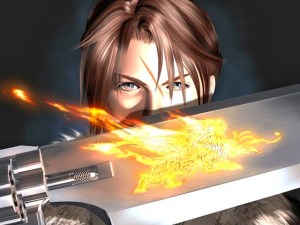
Squall is one hell of  a fighter. But what the hell is his problem?

Squall is one hell of a fighter. But what the hell is his problem?

Ultimately, Squall isn’t that likable. I recognize that now. But I’ve always identified with him on some level. It’s important to remember that the characters in this game are all intended to be teenagers. Teenagers with teenager problems. Squall is misunderstood in his own mind. In everyone else’s, he can’t communicate, so they can’t get to know him, so they misunderstand him. In a lot of ways, he’s a very realistic character. He’s devoted himself to his studies, but he’s awkward around everyone, because he never considered that he might need social or leadership skills, because his childhood taught him not to rely on other people for anything. His arc, over the course of the game, is coming to terms with the fact that people aren’t islands. Everyone needs help sometimes, and together, we can be greater than the sum of our parts. I believe his arc, so I like Squall.

Oh, and there’s a love story with Rinoa.

This is the first Final Fantasy game which has a focus upon a love story of any kind. We’ve seen the theme of love before; Cecil and Rosa create a love triangle of despair with Kain in Final Fantasy IV. Locke sees the love of his life come again in Celes in Final Fantasy VI. Cloud was totally oblivious to the various beautiful women hitting on him in Final Fantasy VII. It’s not until Final Fantasy VIII where we actually explore a love story as a central idea in the plot. Squall and Rinoa meet early in the game, get off to a great start, then fall apart when they get to know each other a little. Only to come all the way back around once they get to know each other a lot. The sequence I personally associate most with their relationship is best captured on video. It can (and probably should!) be argued that this is not only not the most important sequence, but doesn’t even make the top five. Among other highlights, Squall carries a comatose Rinoa on his back across like, literally, half the world, along some train tracks in a probably-futile effort to save her. Later, he attacks head-on a garrison of the most technologically sophisticated troops in the world with uhh… with his steel balls, mostly. Oh, and probably the 255 STR you’ll have Junctioned by then, as it’s very nearly the last bit of the game.

The rest of the characters are kind of incidental to this process. Quistis doesn’t become jilted when she realizes that Squall’s just not that into her. Zell, Selphie, and Irvine don’t grow up. None of them gets an especially deep treatment. Quistis and Zell get to have a little more fun since they’re around early in the game, but there’s just not much for us to know about most of these characters. They’re mercenaries. They’re time-travelers. They’re hyper-realistic.

The hyper-realistic style of FFVIII was another significant departure for the game when it first launched. Obviously, the later technology of the PS2, and the XBox 360 rendered this distinction irrelevant, but it was a big deal at the time, and the relatively lukewarm reception that the realistic character models got informed the design choices in FF9, which ultimately became all about going back to the ‘roots’ of the series. Squall and his friends have realistic proportions, and while on my HD monitor they looked pixelated and kinda crappy… they looked that way on the PSX too. The technology didn’t really exist to bring them to life. While some sequences show off the realistic motion of the characters (Quistis and Rinoa both speak in a lot of subtle gestures), the motions of Squall and Zell – particularly Zell – are often hugely exaggerated, and not really at home with the character models themselves. Luckily, the monsters and Guardian Forces don’t suffer from this same issue – they’re as grand as ever.

I probably mentioned a couple times about the time-travel. I assume at this point everyone has played FF8, but a reminder is always helpful, yes? The basic plot of Final Fantasy VIII is this: In the world, there exists a succession of powerful, female, spellcasters. They are called, creatively enough, Sorceresses. This condition is not genetic, but it is inherited, with the Sorceress either voluntarily relinquishing her powers to another, or when that Sorceress is very near death, they pass on by default. Of the four Sorceresses we meet in Final Fantasy VIII, one is a power-hungry madwoman, one is a time-traveling psychopath, and the other two are possessed by a time-traveling psychopath. Fortunately, since this is a world that knows Sorceresses could go crazy at any time, a man named Cid Kramer established a military academy at Balamb. Balamb Garden, as it is called, trains SeeD, an elite force. To finance Balamb Garden, SeeD undertakes military operations all over the world. SeeD’s true purpose, however, are to be warriors ready to contend with these Sorceresses. That much all seems pretty grounded. Now let’s take a magic carpet ride. All of the party members but Rinoa – but including major Plot MacGuffin Ellone – were raised together in an orphanage. Only none of them remember that because the Guardian Forces (the game’s summons, and the beating heart of the Junction system) steal memories in order to function. The sacrifice for becoming powerful soldiers is a loss of memories, starting with early childhood. Only Irvine actually does remember, he just doesn’t tell anyone, until everyone figures it out. Huh.

Ellone, meanwhile, has the very special power to send people’s consciousnesses back in time. She uses this ability on Squall and his friends repeatedly, sending them back into the bodies of deuteragonist Laguna Loire and his friends Kiros and Ward, who had their own misadventures 20 years earlier. Because time travel, Laguna and his friends survived many battles with the super-powerful SeeDs from the future dumping rocket fuel into their minds. Ellone just wanted to change the past for her own selfish – if understandable – reasons. She failed. But her powers are also very much desired by the time-traveling psychopath Sorceress from the future – Ultimecia – who is trying to cast a spell from three different time periods called Time Compression that does… eh, let’s actually not worry about what it does. We don’t know what it does. “Time Compression” doesn’t sound good for us though. In fact, it’s only good for Ultimecia. That’s all we know. So in order to stop that, we hatch an elaborate plan to let it happen, only, before it finishes, Squall and the gang will go rough Ultimecia up. She has a spooky castle, it has a superboss in it, and Ultimecia herself has got roughly five forms. And some great battle music. She’s also actually pretty hard if you cut a lot of corners on the way to her, and get unlucky during the battle.

So that’s the story of FF8. Only, what may or may not be interesting is that the game isn’t really about most of that stuff at all. It would be disingenuous to say that Laguna Loire’s story doesn’t matter, because you spend a fair amount of time playing as him… but the rest? That’s just stuff that’s going on while Squall tries to grow as a person, he and Rinoa fall in love, and he eventually does a series of very brave and very stupid things in order to rescue her. Then, in the end, she saves him when he’s lost in the vagaries of time travel. Time travel!

Final Fantasy VIII’s take on the battle system is also controversial. What can I say? It’s a controversial game. The Junction system works like this: You have an “inventory” of Magic, up to 100 copies of each spell, rather than using MP or spells per day or whatever else. In general, these spells never get cast, because they are “Junctioned” to your stats, like strength and defense, or your defenses. 100 Firagas to your elemental defense, for example, will put you at about 25% “absorb” on all incoming fire damage. The better the magic, the stronger the effect. Ultima junctions well to just about everything, and if you’re patient enough to accumulate 100 of them, it will raise any stat as high as it can go. So, it’s very customizable, you can basically do whatever with the characters you like best. As with FF7, the specific differences between characters are primarily in Limit Break techniques, although in FF8, Squall’s is so powerful it’s virtually required to defeat the superboss Omega Weapon. So if you’re not familiar with the game, the question you should be asking right now is “how do you get this magic?” Well, the game has a sophisticated system for refining items into spells, said items both being won from battle and from playing the (incredibly addictive) card mini-game, Triple Triad. Oh, how do you get magic before you have the right item? Or if you can’t find the right item? Well… unfortunately… you ‘draw’ it from enemies. As a command in battle. Very slowly.

Oh.

Yep. This is why people hate the Junction system. The first few hours of FF8 – assuming you already know where the right monsters are to draw from – are spent largely of sucking enemies dry of their magic to power yourself up. This process is occasionally helpful through the rest of the game, as if you know where to look, you can get early access to very powerful spells. Bosses often have good spells as well, and there are also several Guardian Forces you must ‘draw’ from bosses throughout the game. Unfortunately, unless your – I think? – Magic stat is pretty good… you’ll draw spells at a rate of 0-5 with each use of the command. You really need 100 of your spells, as the quantity affects the power of the Junction. So drawing sucks. This is where one feature of the Steam version is quite handy; the magic booster! With this turned on, all your party members receive 100 of a bunch of core spells. None of the best stuff, mind you, but some solid spells so that there is NO time lost drawing early in the game. Since the later drawing is entirely optional – everything can be obtained from items, often more easily – the Junction system’s worst feature can just be switched off. All other versions will have to go through the grind.

But FF8 isn’t about the Junction system. Junction is just something you have to deal with. And if you can get past it, you might appreciate the game a little. It’s by no means a bad entry in the series. Its plot is full of holes. Most of its characters are pretty shallow. But there’s some really good stuff at the core of FF8, and it certainly has its place in the development of the franchise as well. I think it deserves a little bit of our love.

And now I shall leave you with another one of FF8’s beautiful cutscenes. Good day.

A Glorious Fantasy: Jobs, Jobs, and more Jobs!


Once again I return to this ongoing series, in which I attempt to play through every game in the Final Fantasy franchise that I can get my hands on, from FF1 through FF13-2, and a variety of the spinoffs and other titles not included in the ‘main series’. This list continues to undergo revision, and I seriously considered removing Final Fantasy 9 from it for personal reasons. But we’ll get there. I promise.

For those who are unfamiliar with my premise, here’s an almost comically thorough recap:

Most people have already played many/most/all of the games that I’m going to write about in this series (weirdly, as I compiled the list of games, I personally have not played a fair number of them). I don’t care. I’m going to look at all (most? I’m bad with structure, we’ll see how long this lasts) of the following things from these games:

– Some objective data. What version of the game did I play, and why did I select that one. This will be less important when I reach the PSX era, but we’re not there yet! One thing I’d like to do is discuss some of the changes between the “original” and the version I end up playing.
– Is the game any good? Seriously! I’m sure some of these games suck! <- Weirdly, most of them do not. Sadly, I believe our time with this bullet point might be done.
– Is the answer to that question, “It just doesn’t hold up”? Why? <– Let's see how Final Fantasy 7's polygons look in 2014.
– How would I place this game in a historical context? I want to watch the series evolve, devolve, side-volve and revolve as I go.
– Did I enjoy this game? What were the emotions and insane facial expressions I went through while playing it?
– How many times I frantically Googled maps for enormous maze-like dungeons because I no longer have the patience to solve them on my own?
– Was it… challenging? Were these games ever hard? Does the challenge ebb and flow?
– No MMORPGs. Sorry FF14 fans, I don’t ‘do’ MMORPGs anymore. Plus, the plan here hopefully doesn't involve spending a bunch of money acquiring and (especially) subscribing to games.

I think all of this is extremely important knowledge, and that the human race will be improved by my research. Let's move on!

FF5

Version played: GBA

When FF5 first became available in the United States via the hilariously subpar PSX port… I did play it. I promise. And aside from the horrific loading times and comically bad cinematics, I enjoyed it. I don’t recall why I stopped playing, or exactly how far into the game I’d progressed… but I do know that I had never actually finished the game when I fired it up on the GBA for this series. I only vaguely recalled the story pieces, and even many of the dungeons, from my prior experience… but it was also distinctly different than coming into the game cold, because I did remember some useful stuff.

The GBA version of FF5 features a much cleaner translation than the PSX port, and one more faithful to the original script. As far as I could tell, that was the only substantive change between the version I played and the original. The GBA version has more content of course, in a bonus dungeon that I didn’t spend too much time on, as well as four new job classes, one of which is only obtained by spending more time in that aforementioned bonus dungeon. I did obtain the other three, however, and got at least some use out of the Gladiator class, which proved to be a fairly potent physical fighter.

The first thing you have to understand about Final Fantasy V is that the game is not at all serious. It is the polar opposite of the heavy, heavy, heavy drama of Final Fantasy IV, with its drearily serious characters and situations, people getting offed all the time, and the mighty Golbez. Instead, the characters spend a fair amount of time goofing around, and the villain is the hammiest of hams. Imagine what you might expect to see if you genetically recombined the most flamboyant bond villain with a cacklin’, teleportin’ evil warlock who is actually a tree. That sounds about right. Will he capture the heroes and put them in easily escapable situations? Yes, my friend, he will! Will he talk incessantly about his evil plans, and how it’s already too late to stop him? You better believe it! Is he actually a tree? Damn straight. Exdeath!

The second thing to understand about Final Fantasy V is that its story is really stupid. No, really, it’s no good at all. It doesn’t make much sense, doesn’t bear any kind of scrutiny, and just kind of arbitrarily bounces the characters from situation to situation with logic that ranges from questionable to absurd. In a way, it all comes together at the end, but it still doesn’t amount to much.

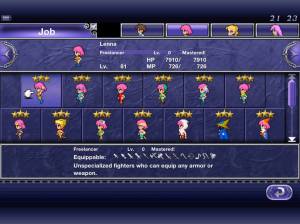
To give you some idea of the Job Menu if you've never seen it.

To give you some idea of the Job Menu if you’ve never seen it.


Given that, why would you bother playing Final Fantasy V? Well, because the game play itself is a mountain of fun. It’s a considerable improvement over all of the previous installments in this area. Why? I’m glad you asked. Because JOB SYSTEM! Yes, the famous Final Fantasy job system makes its triumphant return, and it has been upgraded a lot since the heady days of Final Fantasy III. Not only does Final Fantasy V feature up to 26 jobs (with the GBA jobs), but now each character can master skills (and ultimately entire jobs), then pass those skills around even while in another job. When battling superbosses or the final boss, you might even switch your characters to ‘bare’, which allows you to equip any items in the game, and completely customize your battle abilities. The possibilities here, as you can probably guess, are staggering. There is simply no equal to this level of customization to be found in earlier Final Fantasy titles. It probably seems pretty routine for those who are mostly familiar with the later games in the series, but this literally had no precedent at the time!

Of course, as I said, this job system is shackled to the lame story. The characters are pretty generic, though obviously realized in a way that far surpasses our friends from the NES era, or from the oft-maligned Mystic Quest. Bartz, for example, is afraid of flying. It comes up a couple of times. It doesn’t go much deeper than that. I’m in the very unusual position of having to recommend a Final Fantasy title only for those who like the sound of the job system and its customization options… because a compelling narrative, this ain’t.

Final Fantasy V is also the first game in the series to really introduce the concept of ‘superbosses’. The iconic vision of the super boss is probably still the mighty Emerald and Ruby Weapons from Final Fantasy VII… and truthfully, those battles are far more epic in scope than Final Fantasy V’s Shinryu or Omega. This does not mean that Omega or Shinryu are easy by any means, however. With some luck, a lot of fire protection, some more luck, and a somewhat over-leveled party, I was able to defeat Omega. Essentially, he just puts down an initial barrage of damage which will totally overwhelm an unprepared party of any level. If you can survive this (with Fire Rings and other such items), get a bit of luck that Omega doesn’t use his most powerful possible combination of moves, and then begin to lay down some damage, it actually pans out that he’s not too difficult. Shinryu is another matter. I know of a strategy to kill him, but it involved too many rare steals from rare monsters for my taste. However, from this point on, I will at least attempt Final Fantasy super bosses where available. I’m not putting too many rules on myself.

I can already assure you that I’m unlikely to have the patience to create Nemesis in Final Fantasy X, for example. But I am going to try and make monsters in the Monster Arena, and talk a little bit about that experience. I know from past experience that the games are about to get a good deal more side quest-y… sometimes absurdly so. I will breed chocobos, I will become a world class Triple Triad master, and I will try to remember how to find Ozma so he can kick my ass in Final Fantasy IX (okay, so I’ll probably just look it up on the internet). I plan to talk a little about these side quests, just for fun, and for those who are enjoying this on-going series.

Oh, and I did a fair amount of Googling in Final Fantasy V. Just as a word to the wary, I would point out that Final Fantasy V has many bosses that require a more tactical approach than simply ‘hit things’. It does ultimately boil down to that, of course, but Final Fantasy V shakes things up with some interesting battle mechanics. This really is a game that can entertain you, if you let it.

Just don’t expect the works of Shakespeare.