4 Shots From 4 Horror Films: 2005 — 2007


4 Or More Shots From 4 Or More Films is just what it says it is, 4 shots from 4 of our favorite films. As opposed to the reviews and recaps that we usually post, 4 Shots From 4 Films lets the visuals do the talking!

This October, I’m going to be doing something a little bit different with my contribution to 4 (or more) Shots From 4 (or more) Films.  I’m going to be taking a little chronological tour of the history of horror cinema, moving from decade to decade.

Today, we take a look at 2005, 2006, and 2007!

4 Shots From 4 Horror Films: 2005 — 2007

Land of the Dead (2005, dir by George Romeo, DP: Mirosław Baszak)

The Descent (2005, dir by Neil Marshall, DP: Sam McCurdy)

Inland Empire (2006, dir by David Lynch, DP: David Lynch)

Halloween (2007, dir by Rob Zombie, DP: Phil Parmet)

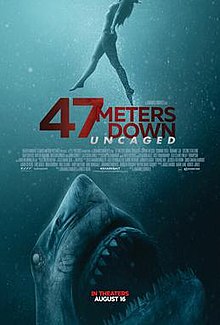
Horror Film Review: 47 Meters Down: Uncaged (dir by Johannes Roberts)


Let us take a moment or two to give some thought to the poor, misunderstood shark.

Sharks have a reputation for being the most dangerous predators in the ocean but, for the most part, sharks just swim around and eat whatever is in front of them.  They are certainly not harmless but they’re also not the clever, calculating monsters that they’ve been made out to be.  As opposed to what all the sequels to Jaws have told us, sharks do not stalk people.  They do not seek revenge.  They do not look at certain humans and think, “That is my mortal enemy.”  A shark will not follow you from New England to the Caribbean just because you’re the widow of the man who killed its cousin.  Sharks look scary and, certainly, you should stay out of the water if one of them is swimming nearby.  But, for the most part, the only thing that one needs to have to avoid being attacked by a shark is common sense.

Unfortunately, none of the characters in the 2019 film, 47 Meters Down Uncaged, have any common sense.  The film tells the tale of Mia (Sophie Nelisse) and her stepsister, Sasha (Corrine Fox).  Mia and Sasha are both students at a new school in Mexico.  Their father, Grant (John Corbett), has been exploring a submerged Mayan city.  Along with their two friends, Alexa (Brianne Tju) and Nicole (Sistine Stallone), Mia and Sasha decide to spend the weekend scuba diving and exploring the ancient city.  The girls have a good time looking at all of the mummies and the sacrificial chamber.  Unfortunately, a great white shark shows up to ruin their fun.  The simplest solution would probably be too leave the city but, because the girls keep screaming and accidentally knocking stuff over, they soon find themselves trapped in the newly collapsed city.  Not only have they upset a shark but they’ve managed to destroy a bunch of valuable historical artifacts.  Way to go!

47 Meters Down: Uncaged was sold as being a sequel to 47 Meters Down, the Mandy Moore/shark film that came out in 2017.  However, other than having the same director, the only thing that the two films have in common is that they both spend a lot of time underwater and they both feature a shark.  In fact, I’m not even sure if they get down to the 47 meters in Uncaged but that’s just because, as an American, I find the metric system to be extremely confusing.  The original 47 Meters Down also had a slightly interesting premise and a good performance from Mandy Moore.  47 Meters Down: Uncaged, on the other hand, is just about four girls who did something incredibly stupid and then did something else incredibly stupid and then just kept on doing every stupid thing that came to mind.  Most people will be cheering for the shark.

That said, it should be noted that Johannes Roberts definitely uses that shark for all that its worth.  The film’s characters may be stupid but the shark itself is scary and generates its share of effective jump scares.  This is one of those diabolically clever sharks that knows how to hide behind corners until someone swims by.  As I mentioned at the start of this review, that’s not exactly realistic shark behavior but it’s definitely effective movie behavior.  The scenes where the shark suddenly emerged from the darkness definitely made jump.  The scene where one of the girls attempted to climb out of the cave and then fell into the water in super slow motion made me laugh.  There’s something to be said for a film that can make you both jump and laugh.

One final note: the sharks lived in that submerged Mayan city for over a hundred years without damaging anything.  Mia, Sasha, and their friends visit the city for less than an hour and manage to destroy the place.  Remember that the next time anyone says anything against the sharks.

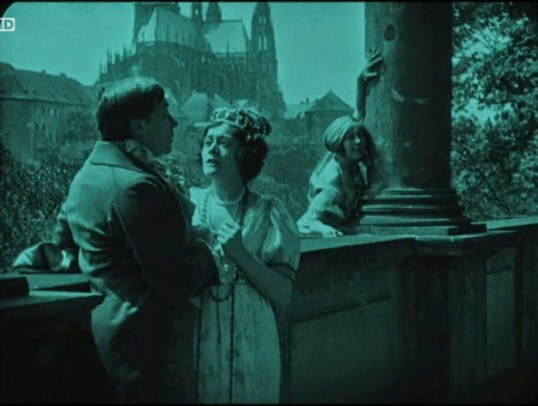
Horror On The Lens: The Student of Prague (dir by Stellan Rye and Paul Wegener)


For today’s horror on the lens, we have a film from 1913!  A German adaptation of Edgar Allan Poe’s William Wilson, The Student of Prague is often considered to be the first feature-length horror film.  Featuring Paul Wegener (who also co-directed the film) in the lead role, this is the story of what happens when the popular but poor Balduin attempts to get rich by dealing with the dark arts.  These things never work out well, as Balduin discovers once his reflection steps out of a mirror and goes out of its way to make Balduin’s life difficult.

Of course, to watch the film today, audiences have to adjust both their expectations and the way that they take in and process cinematic storytelling.  As of this writing, The Student of Prague is 109 years old and it’s definitely a film of its time.  The camera largely remains stationary and, from a modern perspective, the film is rather slow-paced.  And yet, the film’s story remains rather intriguing.  Despite the static camera work, the film manages to create and maintain a properly ominous atmosphere and a scene in which Balduin and Margit attempt to meet in a cemetery is effectively creepy.  Paul Wegener’s performance holds up well.  Largely eschewing the overly theatrical acting style that we usually tend to associate with silent cinema, Wegener gives a nuanced and effectively subtle performance as both Balduin and his doppelganger.  When he’s acting opposite of himself, you don’t think about the fact that you’re witnessing an early camera trick.  Instead, Wegener creates two separate but believable versions of the same character.  The doppelganger represents all of Balduin’s undesirable impulses and everything that has kept Balduin from achieving happiness.  By the end of the film, Balduin can’t live with his doppelganger but he can’t live without him as well.

The Student of Prague is an interesting piece of history and one that every true student of horror should watch and learn from at least once.

And here’s your chance!

Enjoy!

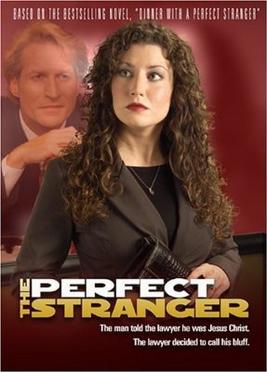
October Positivity: The Perfect Stranger (dir by Jefferson Moore and Shane Sooter)


The 2005 film, The Perfect Stranger, opens with Nikki Cominsky (Pamela Brumley) feeling very stressed and underappreciated.

She’s an attorney and she really should be heading off for work but first, she has to make her daughter’s school lunch.  (Her daughter is not extremely appreciative.)  Meanwhile, her husband has just informed her that he’s canceling their date night because he has to go to a baseball game with a client!  Nikki was so looking forward to going to a nice restaurant.  Finally, to top all off, the neighbors are religious and they keep inviting Nikki to church.  Argggh!  The frustration!

Nikki gets to work and the aggravation continues.  Her administrative assistant calls her “Mrs. Cominskey,” making Nikki feel old.  (“Mrs. Cominskey is my mother-in-law!” Nikki snaps.)  Plus, there’s a weird note on Nikki’s desk.  The note is inviting her to dinner and it is signed Jesus.  At first, Nikki is convinced that her neighbors somehow broke into the office and left the note on her desk.  But then she realizes how weird that sounds.  Instead, she decides that the note is from her husband.  Obviously, he canceled his plans and they’re going to go out to dinner.  Yay!  But why would her husband sign the letter as Jesus?  “He must be joking,” Nikki says, with a laugh.  Okay, then.  Everyone has their own sense of humor.

Nikki heads to the restaurant straight after work and discovers …. that her husband is not there.  Her husband went to the baseball game.  Her husband was not playing a joke on her.  He really is the type of insensitive idiot who would break a date with his wife and go to a baseball game with client.  (You deserve better, Nikki!)  However, her neighbors aren’t there either.  Instead, there’s a blonde man (Jefferson Moore) wearing a suit who says that his name is Jesus and he wants to have a conversation with her.  Nikki’s first instinct is to leave but Jesus offers to pay for dinner.  That changes Nikki’s mind and I guess that’s understandable.  A free dinner is a free dinner!

Nikki and Jesus go on to have the most awkward dinner date ever.  Nikki wants to talk about how annoyed she is with her life.  Jesus wants to talk about Heaven.  Nikki complains about religion.  Jesus tells her that her problem is not with religion but with religious people.  Nikki says that she feels like she could get just as much out of being a Hindu or Muslim as she could out of being a Christian.  Jesus laughs at her.  There’s one long stretch of time when we just see Jesus and Nikki talking but we don’t actually hear what they’re saying.  Maybe they’re discussing the food, which does look pretty good.

The Perfect Stranger is an example of a popular sort of faith-based film, one in which Jesus has dinner or coffeewith an unbeliever and basically spends an hour telling them that they’re stupid.  Jesus always has the advantage in these films, largely because the screenwriter is on his side and the non-believers are usually limited to repeating a bunch of clichés about all the bad things in the world.  That’s certainly the case with The Perfect Stranger, in which Nikki is not only an agnostic but also a bit of a flake.  One gets the feeling that many of these films was made less to reach nonbelievers and more to give believers a chance to laugh at the other side.  Then again, consider how negatively most people of faith are portrayed in mainstream films, one could argue that the faith-based film industry is basically looking at Hollywood and yelling, “I learned it from watching you!”

Anyway, the important thing is that Nikki felt better about her life and she got a free dinner.  Good for Nikki.

TSL’s Horror Grindhouse: Queen of Blood (dir by Curtis Harrington)


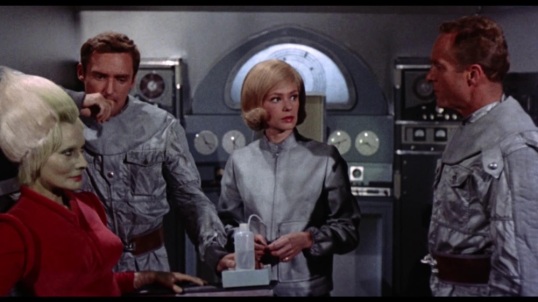
Queen of Blood (1966, dir by Curtis Harrington, DP: Vilis Lapenieks)

Here’s a question: what happens when Roger Corman buys the rights to two Russian science fiction films, decides to jettison basically everything but the special effects footage, and then hires experimental filmmaker Curtis Harrington to shoot an entirely new film around that footage?

You end up with the 1966 film, Queen of Blood!

Not that that’s a bad thing, mind you. Queen of Blood is actually pretty good and director Harrington manages to smoothly integrate the Russian footage with the new footage. Basically, it works out so that you’ll see a Russian shot of the spaceship taking off or landing and then you’ll see a shot of John Saxon, Dennis Hopper, or Basil Rathbone sitting on a set and pretending like they’re in space.

The film opens with Dr. Faraday (Basil Rathbone) discovering that aliens have been transmitting a message to Earth. They’re sending an ambassador to meet with the Earthlings but the aliens’ spaceship ends up crash landing on Mars! Faraday arranges for an Earth spaceship, the Oceano, to go to Mars and rescue the ambassador.

Aboard the Oceano is a cast made up of a few familiar faces. John Saxon plays Allan, who is the de facto leader of the expedition and also engaged to marry Dr. Faraday’s assistant, Laura (Judi Meredith). A young-looking Dennis Hopper is Paul Grant, an astronaut. Don’t get too excited about Hopper being in the cast. Queen of Blood was made when Hopper was still trying to pursue mainstream film stardom so he gives a rather bland performance here. There’s a few scenes where you can tells that Hopper is on the verge of smirking at some of his dialogue but, for the most part, he plays the role extremely straight. Rounding out the crew is Anders (Robert Boon) and Tony (Don Eitner), neither one of whom would go on to star in Easy Rider, Blue Velvet, or Nightmare on Elm Street.

It’s a difficult journey. The Oceano keeps running into Russian-filmed turbulence on the way to Mars. When they do land, they discover that the ambassador (Florence Marly) is waiting for them to rescue her. She doesn’t talk much nor does she have any interest in eating Earth food. She does seem to like every member of the crew except for Laura. Of course, the ambassador’s defining trait is that she likes to drink blood….

All things considered, Queen of Blood works pretty well. While none of the performances are particularly memorable (though Basil Rathbone does bring some old school class to what is essentially a cameo role), Curtis Harrington does a great job creating and maintaining a properly ominous atmosphere. It takes a while for the crew to finally find the Queen of Blood but, when they do, Harrington gets every bit of creepiness that he can out of the character. The film even ends on an appropriately dark note, suggesting that the human race may be just too stupid to survive.

Queen of Blood is an entertaining B-movie. Watch it the next time you’re in the mood for some intergalactic blood-sucking fun!


Horror Scenes I Love: The Church Scene from 28 Days Later


In a film full of disturbing and frightening moments, this is the one that always gets to me.  I think it’s a combination of how apologetic the clueless Jim is and also just the way those heads pop up when he says, “Hello?”

From Danny Boyle’s 28 Days Later:

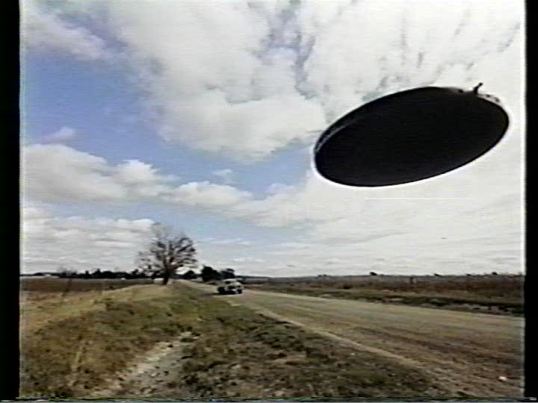
International Horror Review: Starship Invasions (dir by Ed Hunt)


Once, during an interview, the distinguished British horror actor, Christopher Lee, was asked to name the worst film in which he had appeared.

Being a very busy actor who appeared in well-over 200 films, Lee paused for a minute to give it some thought and then eventually said that, in 1977, he had appeared in a Canadian science fiction film in which he played a mute alien who was using a suicide ray to conquer Earth. Though he wasn’t quite sure what the title had been, that was his pick for the worst movie in which he had ever appeared.

Now, considering some of the films in which Lee appeared, that’s a bold statement. Was Lee correct? Was that film — which was entitled Starship Invasions — the worst film in which he ever appeared?

Well …. maybe. It’s certainly not one of his best. Lee plays Captain Ramses, who is the leader of the Legion of the Winged Serpents. The legion’s home planet is about to be destroyed by a supernova so he has taken it upon himself to find a new planet to colonize. Earth looks pretty good to him!

Christopher Lee remembered Ramses as being mute. Actually, he communicates through telepathy. We hear his words but his lips never move. The same is true of every alien that appears in the film. And yes, this could be an example of how different and more advanced the aliens are when compared to the humans but a more likely explanation is that it was cheaper to film the outer space scenes without sound and then just dub in the character’s “thoughts” later.

For reasons that are never quite clear, the Legion of the Winged Serpent abducts several Earthlings before then unleashing their suicide ray. Prof. Allan Duncan (Robert Vaughn) is the UFO expert who investigates the abductions before eventually getting abducted himself by a race of good, gray aliens. The gray aliens are determined to save the Earth from the Legion. It’s never really explained why.

Meanwhile, the suicide ray is causing chaos on Earth as people all over are driven to kill themselves and others. And the ray has just been aimed at Duncan’s wife (played by Helen Shaver) so Allan and the good aliens better hurry up and defeat Ramses and the bad aliens!

Is Starship Invasions really that bad? Well, it’s certainly not …. great. Christopher Lee is properly imposing as Ramses but even he occasionally has a “What have I gotten myself into?” look on his face. Most of all, Starship Invasions is very much a product of the 1970s. When Ramses visits a space station, it looks a lot like an incredibly tacky mix of a fitness center and a cocktail lounge. The fashion of both the Earthlings and the aliens is very much of the era. Robert Vaughn wears a turtleneck that just screams “community college history teacher.” The special effects are rather cheap and the plot never makes much sense. The scenes with the suicide ray, however, are surprisingly effective and the film does have a certain campy charm to it, especially if you’re into low-budget 70s sci-fi. Starship Invasions is probably not Christopher Lee’s worst film. It’s just one of his cheapest.

6 Shots From 6 Horror Films: 2002 — 2004


4 Or More Shots From 4 Or More Films is just what it says it is, 4 shots from 4 of our favorite films. As opposed to the reviews and recaps that we usually post, 4 Shots From 4 Films lets the visuals do the talking!

This October, I’m going to be doing something a little bit different with my contribution to 4 (or more) Shots From 4 (or more) Films.  I’m going to be taking a little chronological tour of the history of horror cinema, moving from decade to decade.

Today, we take a look at 2002, 2003, and 2004!

6 Shots From 6 Horror Films: 2002 — 2004

28 Days Later (2002, dir by Danny Boyle, DP: Anthony Dod Mantle)

The Ring (2002, dir by Gore Verbinski, DP: Bojan Bazelli)

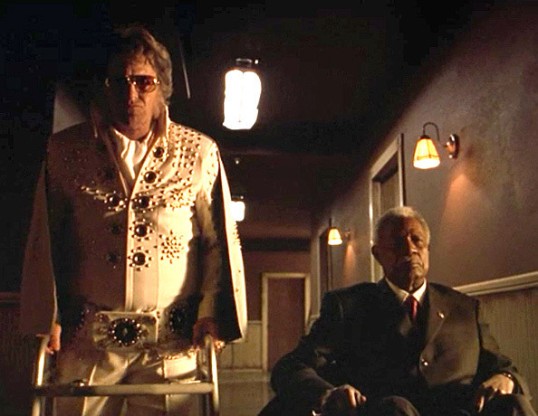
Bubba Ho-Tep (2002, dir by Don Coscarelli, DP: Adam Janeiro)

House of 1,000 Corpses (2003, dir by Rob Zombie, DP: Alex Poppas, Tom Richmond)

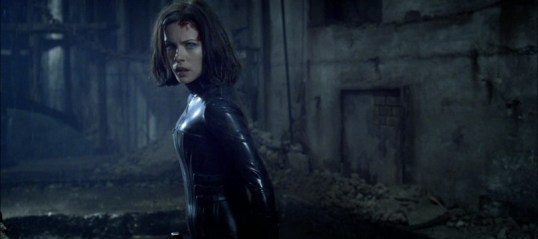
Underworld (2003, dir by Len Wiseman, DP: Tony Pierce-Roberts)

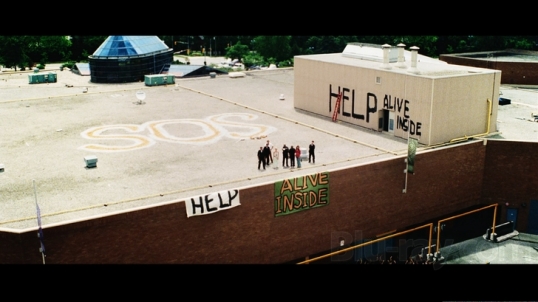
Dawn of the Dead (2004, dir by Zack Snyder, DP; Matthew F. Leonetti)

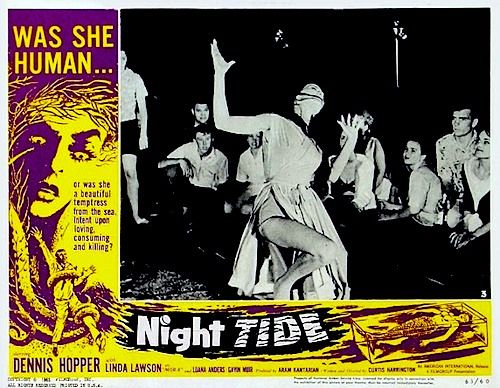
Horror Film Review: Night Tide (dir by Curtis Harrington)


Long before he became Hollywood’s favorite quirky character actor, Dennis Hopper was a young performer who was known for his devotion to the method and for being more than a little difficult. In fact, directors like Henry Hathaway had gotten so frustrated with Hopper and his refusal to “compromise his art,” that, by the time the 1960s rolled around, Hopper had gone from being a promising young star to being virtually blacklisted.  He had gone from scene-stealing turns in Rebel Without a Cause and Giant to struggling to get anyone at the major studios to even admit to knowing who he was.

Unable to get a job on a mainstream film, Hopper teamed up with another unconventional talent, director Curtis Harrington. A film critic-turned-experimental filmmaker, Harrington was talented but, like Hopper, he had a reputation for being an eccentric.  An openly gay artist who was living and working a time when that was still a crime in some states, Harrington gravitated to other outsiders so it was perhaps inevitable that he and Dennis Hopper would become early collaborators and make a film together.

That film was 1961’s Night Tide. Harrington directed while Hopper played Johnny, a naïve young sailor who, while in on leave in Santa Monica, meets a mysterious woman named Mora (Linda Lawson). Mora works as a mermaid at a sideshow. Her boss is the overly possessive and somewhat brutish Captain Samuel Murdock (Gavin Muir). Captain Murdock makes it clear that he doesn’t want Johnny to have anything to do with Mora. Is it because he’s worried about losing Mora or is there another, more supernatural reason?

Johnny hears rumors that the men who fall in love with Mora tend to disappear. Mora, herself, explains that she’s a Siren. Her destiny is to lead sailors to their doom. Johnny tells her that’s ridiculous but what if she’s right?

It’s a strange film, one that moves at its own slow and rather deliberate pace. As Mora, Linda Lawson delivers her lines hesitantly, as one might expect from someone who is having to pretend to be a human being. Meanwhile, Dennis Hopper gives a compelling but nervous performance as Johnny. As written, Johnny is a pretty bland character but Hopper plays up Johnny’s sense of isolation. He’s far from home, he doesn’t know many people in town, and the woman he loves just explained that she’s a sea monster. One can understand why Johnny is a bit jumpy. There’s a few scenes where Hopper’s devotion to the method works against him. He’s convincing when he’s at the center of the scene but a bit too fidgety in the scenes where he just has to listen to other people speak. But, ultimately, Hopper’s performance works. He plays Johnny with a mix of fresh-faced innocence and hints of instability.

As I said, it’s not a conventional film. It moves at its own dream-like pace. The film was shot in black-and-white and that’s the version to see. Avoid the colorized version, in which the colors are so garish that they ruin the film’s surreal atmosphere. Night Tide is an experiment that won’t be for everyone but, when taken on its terms, it’s definitely intriguing.

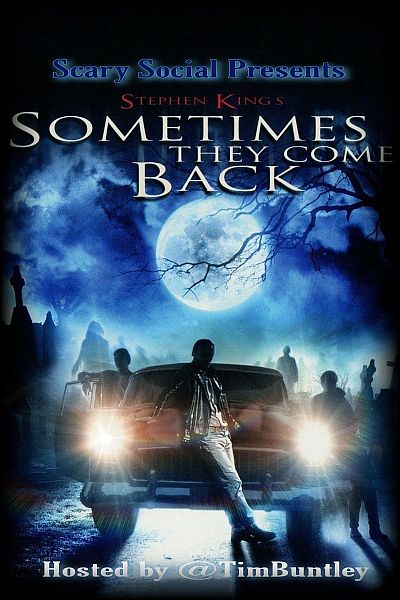
Live Tweet Alert: Watch Sometimes They Come Back with #ScarySocial


As some of our regular readers undoubtedly know, I am involved in a few weekly live tweets on twitter.  I host #FridayNightFlix every Friday, I co-host #ScarySocial on Saturday, and I am one of the five hosts of #MondayActionMovie!  Every week, we get together.  We watch a movie.  We tweet our way through it.

Tonight, for #ScarySocial, Tim Buntley will be hosting 1991’s Sometimes They Come Back!

In this adaptation of a Stephen King short story, the dead refuse to stay dead!

If you want to join us on Saturday night, just hop onto twitter, start the film at 9 pm et, and use the #ScarySocial hashtag!  The film is available on Prime.  I’ll be there co-hosting and I imagine some other members of the TSL Crew will be there as well.  It’s a friendly group and welcoming of newcomers so don’t be shy.