January Positivity: Escape (dir by Paul Emami)


2012’s Escape tells the story of two men who meet in Thailand.

Paul Jordan (C. Thomas Howell) is a doctor who came to Thailand with his wife, Kim (Anora Lyn).  Paul and Kim are both working in a clinic, trying to bring healthcare to the poor and the downtrodden.  They specifically left America because of the death of their newborn.  Paul says that they need to make a clean break and start new lives for themselves.  Paul is an atheist, both because of the death of his child and all of the misery that he sees around him.  Kim is secretly religious.  Though she doesn’t discuss it with Paul, she brings a bible with her and she regularly asks the people back home to pray for them.

Malcolm Andrews (John Rhys-Davies) is a former tech boss who has retired and has been exploring the world with his wife (Puttaya Chaimongkolepetc).  Malcolm is extremely wealthy but also very humble, a kind man who always tries to treat people with decency.  Unlike Paul, he is very religious and has no problem with accepting the idea the God can exist even when the world itself is a complete mess.

When Paul and Malcolm first meet, Paul initially distrusts Malcolm but that soon changes due to the circumstances of their meeting.  They’ve both been kidnapped by outlaws and they’re being held in a bamboo cage in the middle of an island jungle.  Paul has been kidnapped because one of the outlaws has been wounded and is dying.  Paul is expected to keep the man alive, with the understanding being that if the man dies, Paul dies as well.  Malcolm has been kidnapped because the outlaws are hoping to get a huge ransom for him.  Despite their differing views of the world, Paul and Malcolm become friends because, when you’re stuck in  a bamboo cage with someone, you really don’t have much of a choice but to become friends.  In a situation like that, there’s only so long someone can go without making eye contact.

While Paul and Malcolm debate theology and wait for an opportunity to make their escape, their wives try to get the authorities to search for their husbands.  Unfortunately, it turns out that the authorities are almost as incompetent as the outlaws.

Lately, there have been a lot of faith-based films that have attempted to duplicate Hollywood gerne films.  Escape has a religious message but it’s also a thriller about two men trapped in the middle of the jungle.  It’s fairly well-done, though the action does occasionally drag.  (There’s only so many ways that you can film two men talking in a cage.)  The film makes good use of C. Thomas Howell’s bland niceness and the jungle scenery is both beautiful and ominous.  That said, John Rhys-Davies is the main attraction here and he gives a strong and compelling performance as Malcolm.  Regardless of whether you agree with his beliefs or not, you really do want to see him make it back to his wife.

Escape ends on a bit of an abrupt note but it’s still an effective thriller.

Lisa Reviews An Oscar Winner: The Life of Emile Zola (dir by William Dieterle)


The Life of Emile Zola, the winner of the 1936 Oscar for Best Picture of the Year, opens with two French artists living in a drafty apartment.

Emile Zola (Paul Muni) is destined to become one of France’s most popular and important writers.  Paul Cezanne (Vladimir Sokoloff) will eventually become one of the most important artists of the post-impressionist movement.  But for now, they’re just two struggling artists who have sworn that they will never sell out their principles.  They are poor but they’re happy.  That changes for Zola after he meets a prostitute named Nana (Erin O’Brien-Moore) and he uses her life story as the inspiration for a novel.  The book is controversial and its frank content scandalizes France.  The public censor comes close to banning it.  But it also becomes a best seller.  It’s the book everyone secretly owns but claims to have never read.

Zola writes several more books, all about the conditions of the working class in France.  Eventually, he becomes what he claimed he would never be, a wealthy man living in a mansion and having little contact with the poor and oppressed.  Cezanne sees Zola one last time, calling him out for having sold his talent for money.  Cezanne explains that, on general principle, he can no longer be Zola’s friend.

Meanwhile, a quiet and rather meek family man named Captain Alfred Dreyfus (Joseph Schildkraut) has been arrested and accused of being a spy for Germany.  There’s little evidence that Dreyfus is a spy.  Indeed, most of the evidence seems to point to a Major Walsin-Esterhazy (Robert Barrat).  But, because Dreyfus is considered to be an outsider, he is convicted in a show trial and exiled to Devil’s Island.

(In real life, it’s generally agreed that Dreyfus was a victim of anti-Semitism.  As the only Jewish member of the army’s General Staff, Dreyfus was viewed with suspicion by his colleagues even before anyone knew that there was a German spy.  The Life of Emile Zola doesn’t specifically state that Dreyfus was a victim of anti-Semitism, with the exception of a brief moment when one of his accusers looks at his personnel file and says, “He’s not one of us,” while pointing at the word “Jew.”  Otherwise, the fact that Dreyfuss was Jewish is never mentioned in the film.  It’s as if the film is going out of its way to avoid offending the very people that the movie is criticizing.)

After speaking to Dreyfus’s wife (played by Gale Sondergaard, who would later become the victim of a show trial herself when she was blacklisted as a suspected communist), Zola decides to take up Dreyfus’s case.  He publishes an open letter — J’Accuse — in which he states that Dreyfus was not given a fair trial and that Dreyfus is innocent of the charges against him.  Zola finds himself in court, accused of libel.  Zola uses his trial to give Dreyfus the hearing that he never received.  While the army boos his every utterance, the people of France rally to his side.

The Life of Emile Zola is an early example of the type of prestige production that today is often referred to as being an “Oscar picture.”  It tells a true story.  As a film that condemns the treatment of Alfred Dreyfus but avoids stating the obvious reason why Dreyfus was targeted in the first place, it’s political without being radical.  And it features a performance from the most acclaimed actor of the era, Paul Muni.  Muni gives a powerful performance as Zola, holding the viewer’s attention even during the lengthy trial scenes that take up most the second half of the film.  That said, the true star of the film is Joseph Schildkraut, who plays Dreyfus as being a kind and trusting soul who finds himself caught up in a Kafkaesque nightmare.  At one point, Dreyfus is given a gun and told that there’s one way that he can avoid being put on trial for treason.  Schildkraut played the scene so well that I wanted to cheer when he refused to surrender.

The Life of Emile Zola is a big and, at times, self-consciously important production.  It was clearly designed to win a bunch of Oscars and it certainly managed to do that.  Compared to some of the other films nominated that year — The Awful Truth, Dead End, A Star is Born, Lost Horizon, Stage Door, In Old Chicago — The Life of Emile Zola can seem a bit stodgy.  However,  the performances of Muni and Schildkraut continue to make the film worth watching.

Film Review: Voyage of the Damned (dir by Stuart Rosenberg)


In 1939, an ocean liner named the MS St. Louis set sail from Hamburg.  Along with the crew, the ship carried 937 passengers, all of whom were Jewish and leaving Germany to escape Nazi persecution.  The ship was meant to go to Havana, where the passengers had been told that they would be given asylum.  Many were hoping to reunite with family members who had already taken the voyage.

What neither the passengers nor Captain Gustav Schroeder knew was that the entire voyage was merely a propaganda operation.  No sooner had the St. Louis left Hamburg than German agents and Nazi sympathizers started to rile up anti-Semitic feelings in Cuba.  The plan was to prevent the passengers from disembarking in Cuba and to force the St. Louis to then return to Germany.  The Nazis would be able to claim that they had given the Jews a chance to leave but that the rest of the world would not take them in.  Not only would the Jews be cast as pariahs but the Germans would be able to use the world’s actions as a way to defend their own crimes.

Captain Schroeder, however, refused to play along.  After he was refused permission to dock in Cuba, he then attempted to take the ship to both America and Canada.  When both of those countries refused to allow him to dock, Schroeder turned the St. Louis toward England, where he planned to stage a shipwreck so that the passengers could be rescued at sea.  Before that happened, Belgium, France, the Netherlands, and the United Kingdom jointly announced that they would accept the refugees.

Tragically, just a few days after the passengers disembarked, World War II officially began and Belgium, France, and the Netherlands all fell to the Nazi war machine.  It is estimated that, of the 937 passengers on the St. Louis, more than 600 of them subsequently died in the Nazi concentration camps.

The journey of the St. Louis was recreated in the 1976 film, Voyage of the Damned, with Max von Sydow as Captain Schroeder and a collection of familiar faces playing not only the ship’s passengers and crew but also the men and women in Cuba who all played a role in the fate of the ship.  In fact, one could argue that there’s a few too many familiar faces in Voyage of the Damned.  One cannot fault the performances of Max von Sydow, Malcolm McDowell, and Helmut Griem as members of the crew.  And, amongst the passengers, Lee Grant, Jonathan Pryce, Paul Koslo, Sam Wanamaker, and Julie Harris all make a good impression.  Even the glamorous Faye Dunaway doesn’t seem to be too out-of-place on the ship.  But then, in Havana, actors like Orson Welles and James Mason are awkwardly cast as Cubans and the fact that they are very obviously not Cuban serves to take the viewer out of the story.  It reminds the viewer that, as heart-breaking as the story of the St. Louis may be, they’re still just watching a movie.

That said, Voyage of the Damned still tells an important true story, one that deserves to be better-known.  In its best moments, the film captures the helplessness of having nowhere to go.  With Cuba corrupt and the rest of the world more interested in maintaining the illusion of peace than seriously confronting what was happening in Germany, the Jewish passengers of the St. Louis truly find themselves as a people without a home.  They also discover that they cannot depend on leaders the other nations of the world to defend them.

Defending the passengers falls to a few people who are willing to defy the leaders of their own country.  At the start of the film, Nazi Intelligence Chief Wilhelm Canaris (Denholm Elliott) explains that Captain Schroeder was selected specifically because he wasn’t a member of the Nazi Party and could not be accused of having ulterior motives for ultimately returning the passengers to Germany.  Canaris and his fellow Nazis assume that anti-Semitism is so natural that even a non-Nazi will not care what happens to the Jewish passengers.  Instead, Schroeder and his crew take it upon themselves to save the lives of the passengers.  It is not Franklin Roosevelt who tries to save the passengers of St. Louis.  Instead, it’s just a handful of people who, despite unrelenting pressure to do otherwise, step up to do the right thing.  Max von Sydow, who was so often cast in villainous roles, gives a strong performance as the captain who is willing to sacrifice his ship to save his passengers.

Flaws and all, Voyage of the Damned is a powerful film about a moment in history that must never be forgotten.

What Lisa Marie Watched Last Night #228: Dressed to Kill (dir by Lindsay Hartley)


Last night, I turned over to the Lifetime Movie Network and I watched Dressed to Kill!

Why Was I Watching It?

Because it was on Lifetime!  It’s been a while since I’ve really gotten a chance to enjoy a good Lifetime film.  I was planning on getting back into my Lifetime viewing habit last year but 2024 had other plans.  This year, though, I hope to once again get to enjoy my weekly Lifetime fix.

What Was It About?

When Vanessa (Suzanne R. Neff) dies after someone steals her asthma inhaler, she leaves her clothing company not her spoiler daughter Blair (Annie Sullivan) but instead to her loyal and kind-hearted assistant, Amy (Brianna Cohen).  Amy tries to figure out who killed Vanessa.  Was it Blair?  Was it disgruntled seamstress Wanda (Monanik Dugar)?  Or was it Amy’s own boyfriend, Kevin (Moe Sehgal)?

What Worked

First, and most importantly, this film fully embraced the melodrama.  When it comes to Lifetime films, the promise of melodrama is essential and the best films are the ones that shamelessly embrace it.  Director Lindsay Hartley kept the action moving and didn’t waste too much time trying to convince the viewer that they were watching a realistic portrait of life in the fashion industry.

This film actually did keep me guessing as far as who the murderer was.  It’s obvious that the filmmakers understood who most veteran Lifetime viewers would automatically suspect and, wisely, they played around with those expectations.

Monanik Dugar’s performance was Wanda was wonderfully unhinged.  I also liked Annie Sullivan’s performance as the hilariously entitled Blair.  As played by Sullivan, Blair was the influencer from Hell.

What Did Not Work

I probably would have taken the fashion aspect of the movie more seriously if the clothes hadn’t been so …. uhm, well …. ugly.  Of course, it’s all in the eye of the bolder but let’s just say that I would not have worn any of the outfits.

This movie did feature a fashion show but it looked so low-rent that, again, it left me wondering whether it would be better to just let the company go out of business.

“Oh my God!  Just like me!” Moments

I have asthma so, as soon as I saw Vanessa grabbing her inhaler, I knew how she was going to die.  That made me go “Agck!” because, seriously, asthma attacks are always scary.

When I was 18, I had a friend who got a job at a clothing company in Dallas.  At first, I thought that was really exciting but then I visited her at work and discovered that it was a place that designed polyester cabana wear for senior citizens.  Admittedly, that doesn’t have much to do with this movie but I still found myself thinking about it as I watched Dressed To Kill.  At least the company in Dressed to Kill could afford to put on a fashion show.  This place where my friend worked wasn’t even willing to do that,

(For the record, my friend only worked there for two weeks before walking off the job.  Some of that was my fault because I had lunch with her on her final day and, as her lunch hour came to a close, I said, “What if you just didn’t go back?”  Having never had a job before, I was shocked to discover that people still get a final paycheck even if they just leave for lunch and then never come back.  Hmmm, I thought, maybe I’ll get a job someday….)

Lessons Learned

Be careful with those scissors!

Live Tweet Alert: Join #ScarySocial for Twilight Zone: The Movie!


As some of our regular readers undoubtedly know, I am involved in a few weekly live tweets on twitter.  I host #FridayNightFlix every Friday, I co-host #ScarySocial on Saturday, and I am one of the five hosts of #MondayActionMovie!  Every week, we get together.  We watch a movie.  We tweet our way through it.

Tonight, at 9 pm et, Tim Buntley will be hosting #ScarySocial!  The movie?  Twilight Zone: The Movie!

If you want to join us this Friday, just hop onto twitter, start the movie at 9 pm et, and use the #ScarySocial hashtag!  I’ll be there tweeting and I imagine some other members of the TSL Crew will be there as well.  It’s a friendly group and welcoming of newcomers so don’t be shy.

Twilight Zone: The Movie is available on Prime!

See you there

4 Shots from 4 Films: Special George Pan Cosmatos Edition


4 Or More Shots From 4 Or More Films is just what it says it is, 4 shots from 4 of our favorite films. As opposed to the reviews and recaps that we usually post, 4 Shots From 4 Films lets the visuals do the talking!

Today, we celebrate the birth of director George Pan Cosmatos!  It’s time for….

4 Shots From 4 George Pan Cosmatos Films

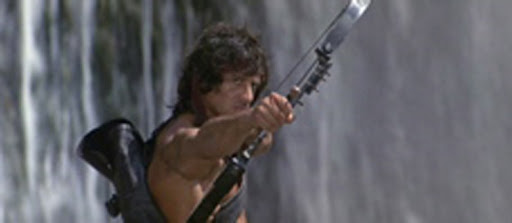
Rambo: First Blood Part II (1985, dir by George Pan Cosmatos, DP: Jack Cardiff)

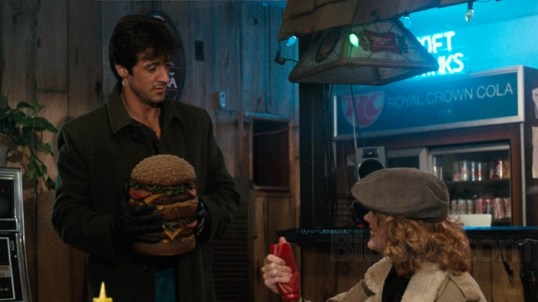
Cobra (1986, dir by George Pan Cosmatos, DP: Ric Waite)

Leviathan (1989, dir by George Pan Cosmatos, DP: Alex Thomson)

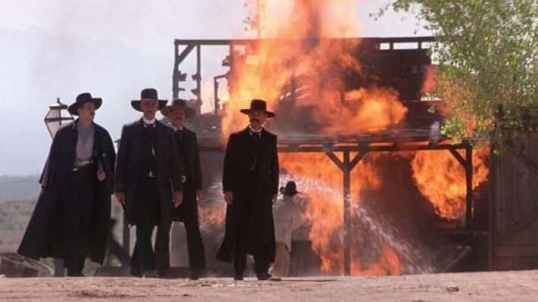
Tombstone (1993, dir by George Pan Cosmatos (and Kurt Russell), DP: William Fraker)

Scenes That I Love: Cobra Eats A Pizza


On this date, in 1941, future director George Pan Cosmatos was born in Italy.  Cosmatos would go on to direct some of the most financially successfully (if critically lambasted) films of the 80s.  He’s also credited as being the director on Tombstone, though it’s generally agreed that Cosmatos largely deferred to Kurt Russell on that film.  (Cosmatos was a last minute replacement for the film’s original director.)

Other than Tombstone, Cosmatos is best-known for the films that he did with Sylvester Stallone.  And today’s scene that I love comes from the 1986 film, Cobra.  In this short but unforgettable scene, we get a chance to learn a little about the Cobra lifestyle.  If you have any doubt that Cobra’s a badass, just wait until you see how eats a pizza.  He handles his guns just as well as he handle a slice of Pepperoni and a pair of scissors.  That Night Slasher better watch out!

Film Review: Tucker: The Man and His Dream (by Francis Ford Coppola)


First released in 1988, Tucker: The Man and His Dream is a biopic about Preston Tucker.

Tucker was an engineer in Detroit who went from designing vehicles for the Army during World War II to trying to launch his own car company.  His ideas for an automobile don’t sound particularly radical today.  He wanted every car to have seat belts.  He wanted a windshield that popped out as a safety precaution.  He want brake pads and he also wanted a car that looked sleek and aerodynamic, as opposed to the old boxy cars that were being pushed out be Detroit.  He wanted a car that got good mileage and he wanted one that could be taken just about anywhere.  Unfortunately, Tucker’s dreams were cut short when he was indicted for stock fraud, a prosecution that most people agree was a frame-up on behalf of the Big Three auto makers.  Tucker was eventually acquitted but his car company went out of business.  Of the 50 cars that Tucker did produce, 48 of them were still on the road and being driven forty years later.

The film stars Jeff Bridges as Preston Tucker, Joan Allen as his wife, Christian Slater and Corin Nemec as two of his sons, Lloyd Bridges as the senator who tried to take Tucker down, Martin Landau as Tucker’s business partner, and Dean Stockwell as Howard Hughes, who shows up for a few minutes to encourage Tucker to follow his dreams regardless of how much the government tries to stop him.  One gets the feeling that the film was a personal one for director Francis Ford Coppola, a filmmaker who has pretty much spent his entire career fighting with studios while trying to bring his vision to the screen.  Tucker fought for seat belts.  Coppola fought for a mix of color and black-and-white in Rumble Fish.  Tucker stood up for his business partner.  Francis Ford Coppola stood up for Al Pacino when no one else could envision him as Michael Corleone.  As is the case with many of Coppola’s films, Tucker: The Man And His Dream is a film that Coppola spent years trying to get made.  It was the film that Coppola originally intended to be the follow-up to The Godfather, with Marlon Brando projected for the lead role of Tucker.  After watching the Tucker, it’s hard not to feel that it worked out for the best that Coppola was not able to make the film in 1973.  It’s impossible to imagine anyone other than Jeff Bridges in the role of Preston Tucker.

“Chase that tiger….chase that tiger….chase that tiger….” It’s a song that Tucker sings constantly throughout the film as the camera spins around him and how you react to Tucker: The Man And His Dream will largely depend on how tolerant you are of Coppola’s stylistic flourishes.  Coppola directs the film as a combination of Disney fairy tale and film noir.  The opening of the film, with Tucker running around in almost a manic state and excitedly telling everyone about his plans, is presented with vibrant colors and frequent smiles and an almost overwhelming air of cheerful optimism.  As the film progresses and Tucker finds himself being targeted by both the government and the other auto companies, the film gets darker and the viewer starts to notice more and more shadows in the background.  The moments of humor become less and less and there’s a heart-breaking moment where Martin Landau, in one of his best performances, reveals just how far the government will go to take down Tucker’s company.  But, in the end, Tucker refuses to surrender and Jeff Bridges’s charming smile continues to fill the viewer with hope.  The film becomes about more than just cars.  It’s a film that celebrates all of the innovators who are willing to defy the establishment.

There’s a tendency to dismiss the majority of Coppola’s post-Apocalypse Now films.  However, Tucker: The Man And His Dream is a later Coppola film that deserves to be remembered.

Film Review: The Valiant (dir by William K. Howard)


In the days after World War I, a man (Paul Muni) stumbles out of an apartment building and then walks down to the local police station.  He informs the officer on duty that he just shot a man.  He refuses to explain why he shot the man and, when asked for his name, he identifies himself as James Dyke.  The office notices a poster for “Dyke & Co.” on the wall and realizes that the man made up his name.  The man is convicted and sentenced to be executed.

The years pass as the man waits for his execution date.  He is a model prisoner, working hard in the garden and writing editorials for the newspapers in which he warns young readers about pursuing a life of crime.  The money he makes, he puts into Liberty Bonds.  He continues to refuse to tell anyone his first name.

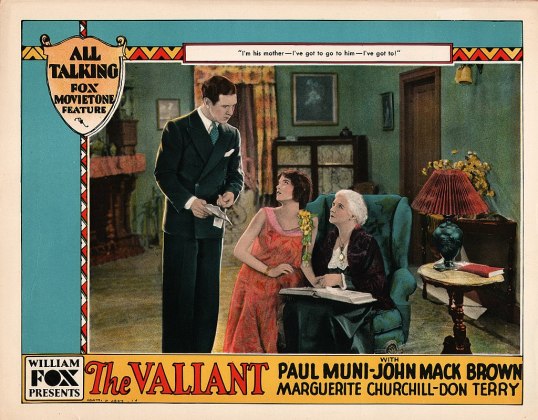
In a small town, an old woman (Edith Yorke) sits in her rocking chair and has visions of all the men who went to war and never returned.  When the woman sees a picture of James Dyke in a newspaper, she thinks that he looks like her son, Joe, who long ago went missing.  The woman’s daughter, Mary (Marguerite Churhill), realizes that her mother is planning to make the trip to the prison to see him before he is executed.  Mary decides to go herself.  She tells her fiancé (John Mack Brown) that she could never get married if it turned out her brother was a murderer.  Meanwhile, the old woman continues to have visions of soldiers marching to war.

At the prison, James Dyke tells Mary that he has no family and he has no past.  But he did serve in World War I and during that time, he met her brother and he saw him die heroically in battle.  Dyke tells her to write to the army for the details of her brother’s death but to be aware that they might not even know whether or not he actually served because the war was such a confusing time that “they don’t know what happened to half the men out there.”  Dyke and Mary continue to talk as the hour of execution draws near….

An adaptation of a one-act play, The Valiant was released in 1929, at a time when America was still coming to terms with the horror of the Great War and Hollywood was still trying to adjust to the arrival of sound.  Though many had assumed that sound films would just be a fad, it turned out that audiences really did like to hear the dialogue as opposed to just reading it.  The Valiant is the type of melodrama that was popular during the silent era and the film does feature title cards that appear between scenes.  “A city street — where laughter and tragedy rub elbows,” one card reads.  Another one announces, “Civilization demands its toll.”  At the same time, it is a sound picture.  The first five minutes of the film are just the Man walking through the city and listening to the sound of cars honking and people talking.  Like many of the early sounds films, it’s obvious that the majority of the cast was not quite sure how they should handle delivering their dialogue.  Some people talk too loudly.  Some talk too softly.  Quite a few deliver their dialogue stiffly and without emotion.  Others use way too much emotion.

The only actor who seems to be fully confident in his ability to perform with sound is Paul Muni, making his screen debut in the lead role.  Muni gives a strong and empathetic performance, one that makes even the most melodramatic of dialogue feel naturalistic.  Muni shows an instinctive knowledge of how to deliver his lines with emotion without going over the top, which was a skill that many of the actors who tried to make the transition to sounds films never learned.  Paul Muni was the first great actor of the sound era, as well as one of the first screen actors to use what would eventually become known as the Method.  Among the actors who were directly inspired by Muni were John Garfield, Montgomery Clift, and Marlon Brando.  Much of modern acting owes a huge debt to the work of Paul Muni.

Seen today, the contrast between Paul Muni’s performance and the film’s staginess can make The Valiant seem like a rather surreal film.  While Muni captures the screen and confidently delivers his lines, everyone else seems hesitant and unsure of how to reply.  The end result is that, to modern audiences, The Valiant can almost seem like a filmed dream.  From the shot of Muni walking down the noisy city street to the sudden appearance of a swing band playing in the prison cafeteria, the film can seem almost Lynchian in its oddness.

The Valiant was a box office success and, according to the notes in the Academy archives, Paul Muni was among the actors considered for the second Best Actor Oscar.  (That year, there were no official nominations and only the winners were announced.)  The Oscar went to Warner Baxter for In Old Arizona but Muni would go on to have an amazing career.

6 Trailers For Pop Music Day


According to the good folks at Checkiday, today is Pop Music Day!  In honor of this prestigious holiday, this week’s edition of Lisa Marie’s Favorite Grindhouse Trailers is all about music!

  1. Head (1968)

First off, we’ve got the trailer for Head, starring the Monkees!  This film was co-written by Jack Nicholson.

2. The Great Rock and Roll Swindle (1980)

In the first film that Julien Temple made about the history of the Sex Pistols, Malcolm McLaren presents himself as being the genius behind the group and tries to keep viewers from noticing that Johnny Rotten refused to have anything to do with the film.

3.Stunt Rock (1978)

I know next to nothing about this film but it was directed by Brian Trenchard-Smith and that’s often a good sign.

4, Sgt. Pepper’s Lonely Hearts Club Band (1978)

Featuring Donald Pleasence singing the longest version of I Want You ever recorded!

5. The Decline of Western Civilization (1981)

From director Penelope Spheeris comes the ultimate documentary about 1980s Los Angeles punk rock.

6. The Decline of Western Civilization Part 2: The Metal Years (1988)

The decline continues.