14 Days of Paranoia #2: Extreme Justice (dir by Mark L. Lester)


What type of justice?

Extreme justice, y’all!

In this 1993 film, Lou Diamond Phillips stars as Jeff Powers.  Who is Jeff Powers?  He’s a cop!  He wants to keep the street safe!  Sometimes, he knows that you have to be willing to break the rules!  He’s a cop who does things his way!

Okay, is that enough exclamation points?  I’m not just using them to be obnoxious.  The film is pretty much just one big exclamation point.  The action is hyperintense and the film is full of characters who always seem like they’re just one step away from exploding.  No one in this film is particularly calm or laid back.  From the start, everything is dialed to eleven and it just keeps going higher and higher.

After Jeff is put on probation for roughing up a suspect, he receives an invitation to join an elite squad of detective.  Led by the charismatic Detective Dan Vaughn (Scott Glenn, giving a performance that is so over-the-top that he yells straight at the camera at one point), the Special Investigative Section is the best of the bed.  Upon joining, Jeff finds himself a member of a sacred fraternity of law enforcers.  Working with men like the always amused Detective Larson (Yaphet Kotto) and the somewhat paranoid Angel (Andrew Divoff), Jeff finds himself tracking some of the biggest criminals in the city.

What Jeff also discovers is that SIS does more than just arrest criminals.  The SIS has been given an unofficial license to kill and they end up executing as many people as they take to jail.  Often times, Vaughn will tells the men to allow a crime to be committed so that they can then dispense their own brand of justice.  In the film’s most disturbing scene, the members of SIS wait until after a woman has been raped in an alley before they move to neutralize her attackers.  When Jeff finally decides that he can’t be a part of all this and tries to reveal what’s going on, he discovers that the SIS has some support in some very high places.  Who cares if the SIS is allowing crimes to be committed or if an innocent person occasionally gets caught in the crossfire?  At least they’re taking care of the criminals!

Extreme Justice is a crude and energetic film and one that is based on some of the stories that spread about the LAPD’s RAMPART division in the 90s.  That the film works is a testament to the performances of Phillips, Kotto, and Glenn and also the direction of Mark L. Lester.  An exploitation vet who occassionally made big studio action films as well, Lester keeps the pace moving at breakneck speed and, even more importantly, he allows both sides to have their say.  While Jeff is upset about SIS’s methods, Detective Vaughn is correct when he says that his unit is targeting the worst of the worst.  It makes for an unusually intelligent exploitation film, one that leaves the audience with a lot to consider.  How far would you go to keep your neighborhood safe?

Previous entries in 2025’s 14 Days Of Paranoia:

  1. The Fourth Wall (1969)

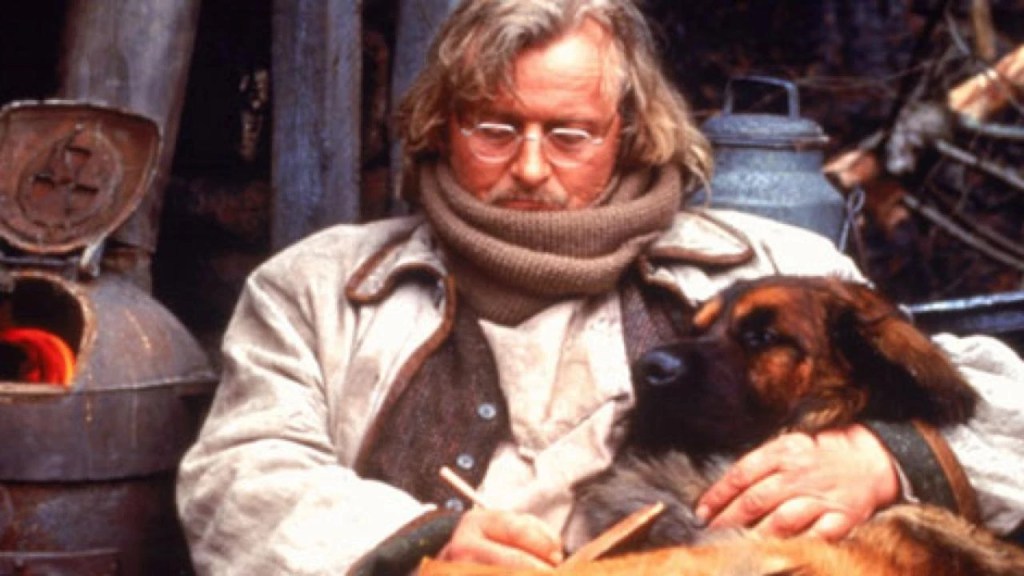
THE CALL OF THE WILD (1997) – Rutger Hauer stars in this version of the classic Jack London novel!


THE CALL OF THE WILD (1997) is based on Jack London’s classic story about Buck, a domesticated dog who lived the first four years of his life on the regal estate of Judge Miller. In 1897, he’s kidnapped and shipped up north to the frozen arctic regions where powerful dogs are in high demand. And Buck, a St. Bernard-Scotch Collie mix, is as powerful as it gets. 

On his journey, we see Buck fall into the hands of three different masters. First, he’s purchased by a dispatch courier for the Canadian government named Perrault (Luc Morissette) whose sled driver is Francois (Robert Pierre Cote). Perrault and Francois are kind to the dogs, but life is still harsh as they carry their dispatches across the snowy, frozen north. Buck sees a dog killed by other dogs for the first time. This is where he first learns that only the strong survive, and he soon has to prove it when he’s forced to fight and kill Spitz, the lead dog of the team. Unfortunately, circumstances require Perrault to sell Buck and his sled team to a group of greenhorns led by Hal (Charles Edwin Powell), his sister Mercedes (Bronwen Booth) and her husband Charles (Burke Lawrence). These morons have no business looking for gold in the Yukon. They have no clue as to what they’re doing and seem to be leading the group to certain death. Starving, tired, and sensing disaster, Buck is lucky that the group arrives at the camp of John Thornton (Rutger Hauer) just in the nick of time. Collapsing at the doorstep of Thornton’s tent, Buck refuses to get up and go any further. As Hal begins to beat Buck with a stick, even going so far as pulling his gun to shoot him, Thornton forcibly takes Buck from the morons. With Thornton, Buck has finally found his “human.” John Thornton nurses Buck back to health and the two become inseparable. Buck has found love for the first time with Thornton and will not let him out of his sight for fear he might lose him. Then something strange happens, he starts feeling a call from the forest, and the promise of a freedom he’s never known before. His love for Thornton is strong, but is it as strong as the call of the wild? 

Even though this 1997 version of THE CALL OF THE WILD is narrated by Richard Dreyfuss and includes the great actor Rutger Hauer in its cast, the true star of this film is Buck the dog. We really pull for Buck as we see him adapt to his new way of life after he’s stolen from his comfortable southern home. As hard as it is to see the animals kill the weakest among them, these are important lessons for Buck. His new world is no place for the weak, and he decides that he will never be weak again. Even though Buck has gotten tough, it’s still a relief when he ends up with John Thornton, the Hauer character. My favorite part of the film is when the two take off together in search of gold. Hauer is only in the film for about thirty minutes, but the relationship he shares with Buck is the highlight of the film as far as I’m concerned.

The last thing I want to mention about the film is that it’s directed by Peter Svatek. Svatek’s next film, BLEEDERS (aka HEMOGLOBIN) would also star Rutger Hauer, and he would follow that up with SILVER WOLF, starring Roy Scheider. For what it’s worth, the man definitely had something going for him since he was able to work with talents like Hauer and Scheider! 

I’ve never read Jack London’s novel, but I have read that this version of THE CALL OF THE WILD may be the most faithful adaptation of the book out there. If that’s truly the case or not, I still really enjoyed this adaptation, and it’s an easy recommendation from me. 

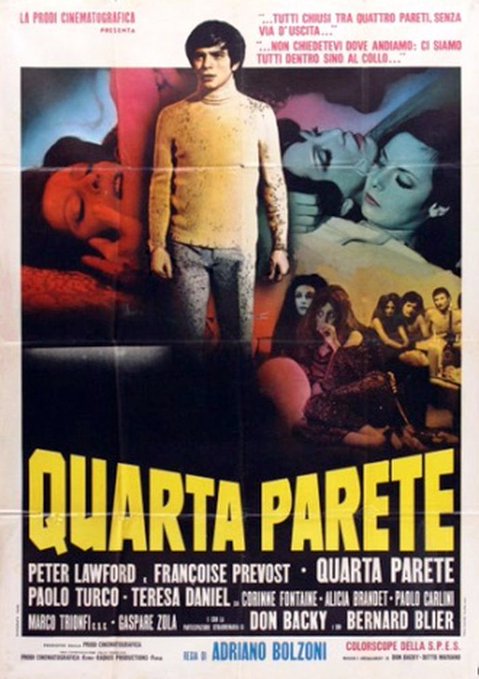
14 Days of Paranoia #1: The Fourth Wall (dir by Adriano Bolzoni)


First released in 1969, The Fourth Wall opens with a series of photographs.

The grainy photographs all appear to have been taken at a political protest in London.  The protestors are holding signs that say something about leaving Nigeria alone but the exact cause that is being supported is still left vague.  Eventually, after viewing several photographs of long-haired college students holding signs, we reach some photographs of the police violently breaking up the protest and carting several of the protestors off to jail.

Amongst the protestors is a young Italian named Marco Baroni (Paolo Turco).  Marco has spent the past four years in London, studying and apparently becoming politically active.  However, it is time for him to return to Italy.  When he reaches his home, we discover that, for all of his talk of protest and revolution, Marco comes from a wealthy, upper class family.  Papa Baroni (Peter Lawford) is a businessman who is willing to bankrupt even his best friends and who openly flaunts the affair that he’s having with his Swedish secretary.  Marco’s mother, Christiana (Francoise Prevost) spends her time in a haze of alcohol and ennui.  Marco’s younger sister, Marzia (Tery Hare), is a fashion model who has become infamous for a serious nude photographs that were taken by the enigmatic Lona (Corraine Fontaine).  Marzia’s room is full of picture of herself.  When Marco returns home, she greets him more as if he were long-distance boyfriend than her brother.  As the film progresses, it becomes clear that there is more to Marco and Marzia’s relationship than just sibling closeness.

It’s an odd and meandering film.  Marco, having had his consciousness raised in London, is disgusted by his family’s decadence and hates the fact that his father seems to represent everything that he was arrested for protesting in the UK.  At the same time, as much as Marco whines about the sins of his family, he finds himself repeatedly drawn to Marzia and her wild lifestyle.  At one point, Marco finds himself observing a group of student radicals who can’t even agree on what they want to protest.  At another point, he walks in on one of Marzia’s parties and watches as a rather tame orgy breaks out.  This is the type of film where Marco spends a lot of time complaining about Marzia being more interested in hedonism than politics but the camera itself lingers on the nonstop nudity and the sight of Lona and Marzia kissing.  For all of the film’s political pretensions, director Adriano Bolzoni obviously understood that sex sells better than speeches.

Bolzoni, himself, was not primarily a political filmmaker.  The majority of his films were a mix of giallo thriller and spaghetti westerns.  There are hints of the giallo genre in this film, with its vibrant colors and its shots of Marco slowly losing his mind as the full extent of his family’s decadence becomes clear to him.  (That said, it’s hard not to laugh at the scene in which Marco runs through the rain while screaming, “NO!” over and over again.)  The instrumental score is pure Spaghetti western, leading to some unintentionally funny moments.  When Marco spots his father with his mistress, the mix of a zoom lens and a musical sting that sounds like it was lifted from a Sergio Leone showdown is more likely to leave you laughing than gasping.  There are other scenes that are scored to songs that were apparently written to sound like Simon & Garfunkel’s contributions to The Graduate soundtrack.

As pretentious as the film is — and make no mistake, this is a very pretentious film — The Fourth Wall does do a good job of capturing Marco’s growing sense of unease as he returns home convinced that he’s figured out the world just to discover that no one else really cares about his politics, his ideals, or his outrage.  Marco goes from being stridently idealistic to drowning in his own paranoia and it’s hard not to regret that Paolo Turco was a bit of a dull actor because, with better casting, the character’s descent would have been truly heartbreaking.  Peter Lawford plays Papa Baroni with just the right amount of ruthless charm.  He might be the epitome of everything that Marco is against but just watching him, you know that Papa Baroni is always going to get exactly what he wants.  It doesn’t matter how much Marco whines or how many meetings Marco goes to or even how the film’s final burst of violence plays out.  Papa Baroni will always thrive and survive.

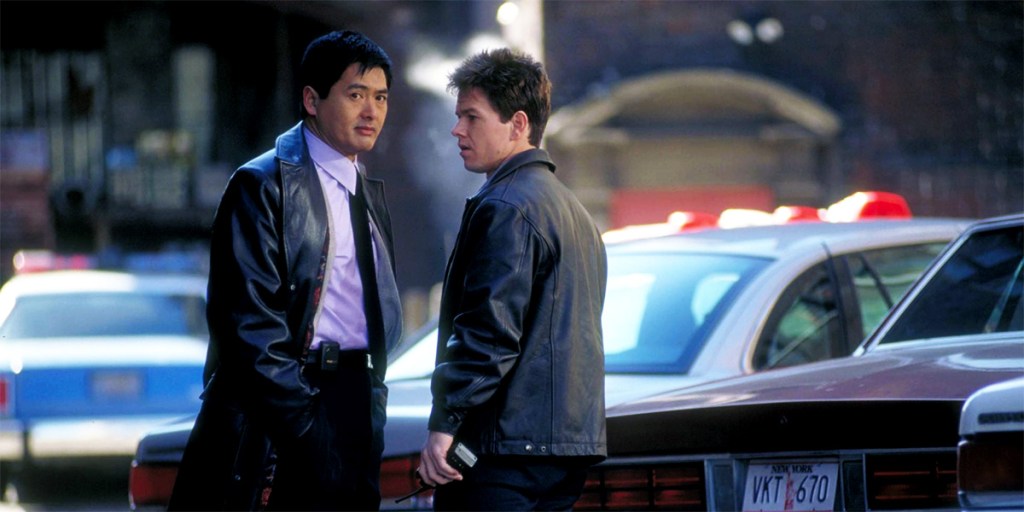
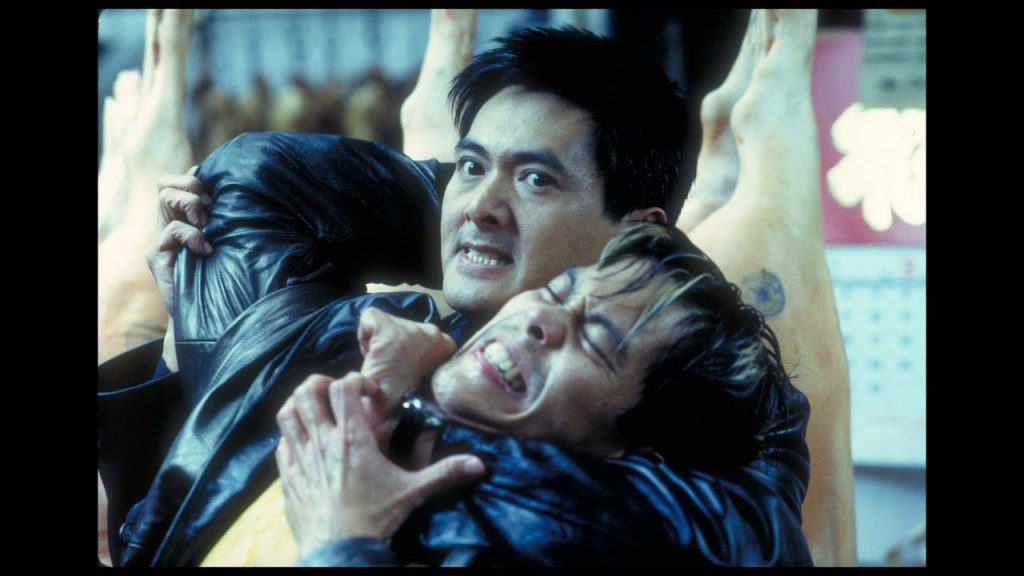
THE CORRUPTOR (1999) – Chow Yun-Fat and Mark Wahlberg fight corruption in Chinatown!


In the late 90’s, I was all in on actor Chow Yun-Fat. Having only discovered his excellent Hong Kong film work a couple of years earlier, I was so excited to see what kind of splash he would make in American films. I loved his first American film THE REPLACEMENT KILLERS (1998), but I will admit it was an exercise in style over substance, and it really didn’t show off his acting abilities. Chow was working hard to improve his English language skills during this time, but that limited his performance the first time around. As I settled into my seat on the film’s opening weekend at the box office in March of 1999, I was hoping to see the Chow Yun-Fat I loved from his Hong Kong movies. But more on that later…

THE CORRUPTOR opens with a bomb going off in Chinatown, followed by a sidewalk assassination in broad daylight. It seems there’s a turf war being fought between a street gang called the Fukienese Dragons, led by Bobby Vu (Byron Mann), and a Chinese criminal organization called the Tung Fung Benevolence Association, led by Uncle Benny Wong (Kim Chan) and Henry Lee (Ric Young). We then meet Nicholas Chen (Chow Yun-Fat), a heroic, highly decorated NYPD cop who runs the Asian Gang Unit. His unit is tasked with trying to keep the peace in Chinatown, but with all the recent violence, they’re clearly failing. Knowing he needs more help, Chen requests additional manpower and gets the young and eager Danny Wallace (Mark Wahlberg). The two men don’t hit it off immediately as Chen had wanted a more experienced, Asian cop. Over time, however, Chen begins to trust Wallace and begins to let him into the inner workings of the unit. 

We soon find out that things are much more complicated in Chinatown police work than they might have appeared at first. Chen is not quite as heroic as initially presented. He’s a morally conflicted man who wants to do good work for the people of Chinatown, but in the process, he’s compromised himself by taking sides and forming a delicate alliance with Uncle Benny and Henry Lee. And Danny isn’t quite the young, green cop he was presented as either. In fact, he’s been secretly tasked by Internal Affairs to monitor Chen and his unit. As Wallace sees what’s really going on in Chinatown, and after Chen saves his ass on multiple occasions, it becomes harder and harder for him to do his job and build a case against Chen. As the film reaches its conclusion in this world of grey, we will see if Chen and Wallace can work together and take down Henry Lee and Bobby Vu, who have formed an alliance to take over Chinatown’s criminal activities. And we will find out what Wallace will do with the information he has on Chen.

I’m a big fan of THE CORRUPTOR, and the primary reason is the excellent performance of Chow Yun-Fat. No other American made action film showed off the extraordinary charisma that made him a superstar in Asia in the 1980’s. In this film, Chow is able to play both sides of the law and still remain incredibly likable. He pulls this balancing act off in a way that appears effortless, and yet there are very few actors in the world who are capable of doing it. Mark Wahlberg had emerged as a major film star a couple of years earlier with the runaway success of BOOGIE NIGHTS (1997). I think he’s very good in this film as well, as his character must reconcile his ideals against the reality of fighting crime in such a dangerous environment. There’s a scene near the end where Chen has been informed that Wallace is internal affairs and confronts him about it. Wahlberg is incredible in the scene, setting the stage for the exciting resolution of the film.

THE CORRUPTOR has several excellent action set-pieces, beginning with a shootout at a lamp shop. This is when I knew this movie was going to present the Chow Yun-Fat I know and love. His personality is displayed in the scene, along with his two guns blazing in slow motion. There’s also an intense car chase through crowded streets and a final showdown on a cargo ship that really stood out to me. Director James Foley was probably hired based on his prior work that showed an ability to deal with moral ambiguity in films like AT CLOSE RANGE (1986) and GLENGARRY GLEN ROSS (1992). While he wouldn’t be my first directorial choice for an action film, he does a fine job in my opinion. 

Overall, I recommend THE CORRUPTOR to any person who likes Chow Yun-Fat, Mark Wahlberg, or an entertaining action film. It’s not in the league of Chow’s best Hong Kong films, but it is his best American action film, because it actually gives him a strong character to play. That went a long way with me. 

I’ve included the trailer for the film below:

Live Tweet Alert: Join #ScarySocial for Funeral Home!


As some of our regular readers undoubtedly know, I am involved in a few weekly live tweets on twitter.  I host #FridayNightFlix every Friday, I co-host #ScarySocial on Saturday, and I am one of the five hosts of #MondayActionMovie!  Every week, we get together.  We watch a movie.  We tweet our way through it.

Tonight, at 9 pm et, Tim Buntley will be hosting #ScarySocial!  The movie?  1980‘s Funeral Home!

If you want to join us this Friday, just hop onto twitter, start the movie at 9 pm et, and use the #ScarySocial hashtag!  I’ll be there tweeting and I imagine some other members of the TSL Crew will be there as well.  It’s a friendly group and welcoming of newcomers so don’t be shy.

Funeral Home is available on Prime and Tubi!

See you there!

The Eric Roberts Collection: Amazing Racer (dir by Frank E. Johnson)


2009’s Amazing Racer is the story of a teenage girl who meets her mother and learns how to ride a horse.

Shannon Greene (Julianne Michelle) is traumatized when her father dies and, having been told that her mother died giving birth to her, she now believes herself to be an orphan.  However, Dr. Rita Baker (Daryl Hannah) reveals that Shannon’s father was just a damn liar.  First, he told Shannon’s mother that her baby was stillborn.  Then, as Shannon was growing up, he told her that her mother was dead.  This is a lot to take in for both Shannon and the viewer.  Myself, I wondered not only how someone could do that but why they would do that.  Making the scene in which Shannon hears the truth even more surreal was the presence of Michael Madsen and Joanna Pacula, playing Shannon’s guardians.  Madsen played his good guy role in much the same way he played his bad guy in Reservoir Dogs.

Anyway, Shannon ends up living with her mother, Dr. Christine Pearson (Claire Forlani), and her mother’s boyfriend, Eric (Jason Gedrick).  Understandably, considering everything that she’s been through, Shannon is initially difficult and bratty but eventually, she comes to enjoy working on Eric’s horse ranch.  She even starts riding a horse and winning races!  This brings her to the attention of evil Mitchell Prescott (Eric Roberts), who wants her horse for himself and even has a spy working on the ranch….

There are a lot familiar faces in this movie.  Charles Durning makes his final film appearance as Floyd.  Steve Guttenberg has a bizarre cameo as a guy transporting a horse trailer.  Scott Eastwood and Kirsta Allen show up.  When it’s time for Shannon to finally start training for the big race, Lou Gossett Jr. pops up as the trainer.  The film itself a fairly predictable horse ranch movie and it’s enjoyable if you like that sort of thing.  (Myself, I like ranches and I like horses so I don’t mind movies like this.)  But really, most of the movie’s entertainment value comes from guessing who is going to show up next.  Some of the famous faces are bit distracting.  But sometimes, it really pays off.  I really wish Lou Gossett, Jr.’s role had been bigger because he does a great job with what little time he has.

As for Eric Roberts, he gets a bit more screentime than usual.  One gets the feeling that he may have actually spent more than two days shooting his scenes for this one.  Roberts is playing a villain here and he gives a enjoyably avuncular performance as the evil Mitchell.  Roberts has fun with the role and, as a result, he’s fun to watch in this movie.

I enjoyed Amazing Racer.  It had horses and it has Eric Roberts.  What more could you want?

Previous Eric Roberts Films That We Have Reviewed:

  1. Star 80 (1983)
  2. Blood Red (1989)
  3. The Ambulance (1990)
  4. The Lost Capone (1990)
  5. Love, Cheat, & Steal (1993)
  6. Voyage (1993)
  7. Love Is A Gun (1994)
  8. Sensation (1994)
  9. Dark Angel (1996)
  10. Doctor Who (1996)
  11. Most Wanted (1997)
  12. Mercy Streets (2000)
  13. Wolves of Wall Street (2002)
  14. Mr. Brightside (2004)
  15. Six: The Mark Unleased (2004)
  16. Hey You (2006)
  17. In The Blink of an Eye (2009)
  18. Enemies Among Us (2010)
  19. The Expendables (2010) 
  20. Sharktopus (2010)
  21. The Dead Want Women (2012)
  22. Deadline (2012)
  23. The Mark (2012)
  24. Miss Atomic Bomb (2012)
  25. Bonnie And Clyde: Justified (2013)
  26. Lovelace (2013)
  27. The Mark: Redemption (2013)
  28. Self-Storage (2013)
  29. This Is Our Time (2013)
  30. Inherent Vice (2014)
  31. Road to the Open (2014)
  32. Rumors of War (2014)
  33. Amityville Death House (2015)
  34. A Fatal Obsession (2015)
  35. Stalked By My Doctor (2015)
  36. Enemy Within (2016)
  37. Joker’s Poltergeist (2016)
  38. Prayer Never Fails (2016)
  39. Stalked By My Doctor: The Return (2016)
  40. The Wrong Roommate (2016)
  41. Dark Image (2017)
  42. Black Wake (2018)
  43. Frank and Ava (2018)
  44. Stalked By My Doctor: Patient’s Revenge (2018)
  45. Clinton Island (2019)
  46. Monster Island (2019)
  47. The Savant (2019)
  48. Seven Deadly Sins (2019)
  49. Stalked By My Doctor: A Sleepwalker’s Nightmare (2019)
  50. The Wrong Mommy (2019)
  51. Exodus of a Prodigal Son (2020)
  52. Free Lunch Express (2020)
  53. Her Deadly Groom (2020)
  54. Top Gunner (2020)
  55. Deadly Nightshade (2021)
  56. The Elevator (2021)
  57. Just What The Doctor Ordered (2021)
  58. Killer Advice (2021)
  59. The Poltergeist Diaries (2021)
  60. The Rebels of PT-218 (2021)
  61. A Town Called Parable (2021)
  62. Bleach (2022)
  63. My Dinner With Eric (2022)
  64. Aftermath (2024)
  65. The Wrong Life Coach (2024)

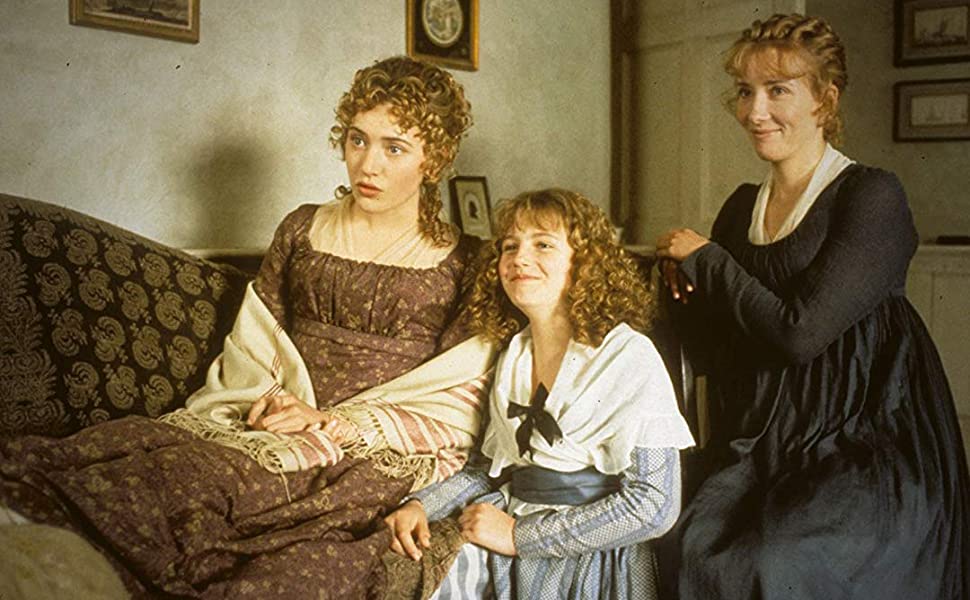
SENSE AND SENSIBILITY – 1995 was a banner year for Jane Austen and cinematic romance. This is one of my favorite scenes!


I may write mostly about the film exploits of actors like Charles Bronson, Rutger Hauer, James Woods, Clint Eastwood, and Chow Yun-Fat, but there’s no doubt that I’m a sucker for a good romance. And my very favorite romantic films are based on the works of Jane Austen. I’ve watched the 1995 TV mini-series version of PRIDE AND PREJUDICE starring Colin Firth and Jennifer Ehle at least ten times in my life. It’s just so good. My favorite Austen “book-turned-film” just may be the 1995 version of PERSUASION starring Amanda Root and Ciaran Hinds. I’ve probably watched it at least twenty times in my life. I love to watch these movies when I need a pick me up, or when I need to relax. They have hard won “happy endings” and they always leave me with a tear in my eye.

Well, it’s obvious that 1995 was an amazing year for Jane Austen adaptations, because the year also featured the release of Ang Lee’s SENSE AND SENSIBILITY starring an incredible cast that included Emma Thompson, Kate Winslet, Hugh Grant and Alan Rickman. Emma Thompson would even win an Oscar for the screenplay that she adapted for the screen. If it was up to me, she would have also won an Oscar for her performance in this scene alone, and I still get happy tears every time I watch it. *(SPOILER ALERT)* If you’ve never seen the film, and you don’t want to see how it ends, do not watch this clip. However, if you love the movie, and the scene, as much as I do, enjoy. Happy Valentine’s Day, my friends!

Love On The Shattered Lens: Charming Sinners (dir by Robert Milton and Dorothy Arzner)


Based on a play by Somerset Maugham, 1929’s Charming Sinners takes place amongst the very rich.

Kathryn Miles (Ruth Chatterton) is married to Robert Miles (Clive Brook).  Robert is wealthy and a respected businessman and, through her marriage, Kathryn is also wealthy and …. well, she’s not quite respected.  The fact of the matter is that everyone is gossiping about the fact that Robert is cheating on Kathryn.  Kathryn denies that Robert is being unfaithful but she knows that he is.  She also knows that Robert is cheating with her best friend, Anne-Marie Whitley (Mary Nolan).  Even when Anne-Marie’s husband, George (Montagu Love), comes to suspect that Anne-Marie is cheating with Robert, Kathryn tells George that it isn’t true and defends her cad of a husband.

Why is Kathryn doing this?  As Kathryn explains it, she doesn’t feel that marriage necessarily means that you have to love someone.  Kathryn married Robert for the money and the status and, as long as she has that, she’s willing to overlook Robert’s dalliances.  Admitting that Robert is cheating would obligate her to go through a divorce and potentially lose everything that she has.  If this film had been released just a few years later than it was, the Production Code would have insisted that Kathryn suffer for her less-than-reverent attitude towards the institution of marriage.  Since this is a pre-code film, Kathryn is portrayed as being strong and determined.  What the Production Code would have deemed a drama, the pre-code era considered to be a comedy.

Still, Kathryn does get revenge on her husband by openly flirting with a former lover, Karl Kraley (William Powell, handsome and suave as ever).  Kathryn also makes some money on her own, proving to her husband that she could be a success even if she hadn’t married him.  Kathryn informs Robert that she is going to be living her own life, even if they are married.  And if Kathryn wants to take a lover, that’s her decision.

And good for Kathryn!  Seriously, Robert is so smug and sure of himself that it’s deeply satisfying to watch as Kathryn reveals that Robert was never as clever as he thought it was.  Though the film does not end with the dramatic divorce that some might expect, it does end with Kathryn taking control of her own life and making her own decisions about how she’s going to live it.  That type of ending is rare enough today.  One can only imagine how audiences in 1929 reacted to it.

But is the film itself any good, you may be asking.  It’s an early sound picture and while the cast all proves their ability to handle dialogue, the largely stationary camera often makes the film feel like a filmed play (which is largely what it was).  Like many pre-code films, the emphasis here is on how the rich have better clothes and better homes than the majority of the people watching the movie.  That’s not a problem for me.  I like looking at nice clothes and wonderfully decorated houses.  Some others may dismiss this film as just being about the problems of the rich but my personal opinion is that everyone has problems.  Wouldn’t you rather have problems as a wealthy person than a poor one?  The most important thing is that the film features two of the best actors of Hollywood’s early Golden Age, Ruth Chatteron and William Powell, and they both give excellent and charming performances.

Charming Sinners is a bit of time capsule and probably not for everyone.  If you’re not interested in the film’s era, it probably won’t hold your attention.  But, to a fashionable history nerd like me, Charming Sinners definitely had its charms.

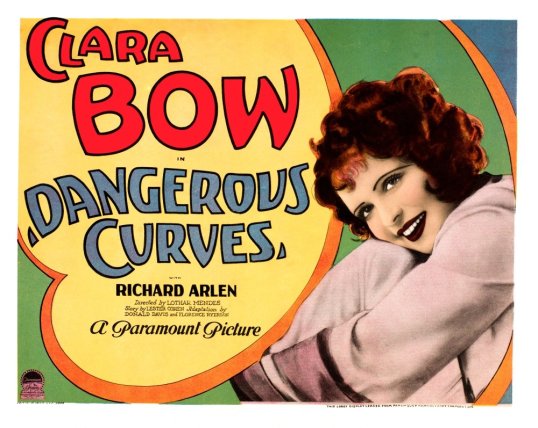
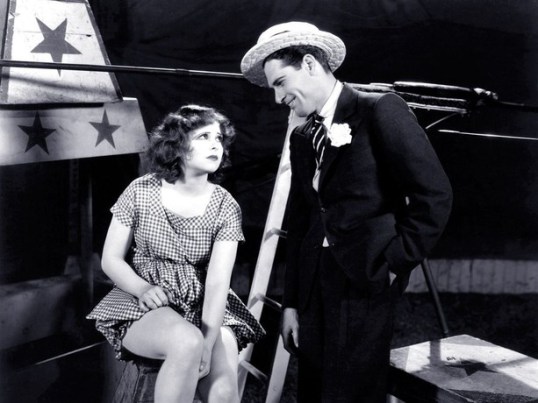
Love On The Shattered Lens: Dangerous Curves (dir by Lothar Mendes)


The 1929 film, Dangerous Curves, takes place at the circus.

Larry Lee (Richard Arlen) is a tightrope walker and, when we first meet him, he’s a bit of a cad.  He knows he’s the best and he knows that the crowds are specifically showing up to watch him risk his life on a nightly basis.  Every woman at the circus is crushing on him but Larry hardly notices because he’s used to being desired.  He’s in love with his tightrope-walking partner, Zara (Kay Francis).  Everyone can tell that Zara is manipulative and not even loyal to her relationship with Larry.  She wastes his money and Larry sometimes spends so much time thinking about her that it breaks his concentration on the tight rope.

Eventually, Larry discovers that Zara has been cheating on him!  When Larry finds out about Zara and Tony (David Newell), he cannot get the image of them kissing out of his head.  When he tries to walk across the tight rope, he loses his focus and, as the audience gasps, Larry falls to the ground below.  (In an impressively-edited sequence, we see Larry falling from about five different angles before we finally see him hitting the ground.)  Larry recovers but his confidence has been broken.  Instead of returning to the circus, he just wants to drink and obsess on Zara and Tony.

Can bareback rider Patricia Delaney (Clara Bow) convince him to return to the circus?  Can she give him the confidence to once again walk across the tightrope?  Will Larry then teach Pat how do the tightrope act herself?  Will Larry finally realize that Pat loves him and that he loves her?  And how will Pat react when, after all she’s done for Larry, he suddenly decides that he wants to bring Zara back into the act?

Dangerous Curves is a mix of melodrama and romance, all taking place at the circus.  It’s also a pre-code film, which means it’s a bit more honest about the relationships between the characters and Larry’s subsequent drinking problem than it would have been if the film had been made just a few years later.  As a result, this is a melodrama with an edge.  The members of the circus community are living on the fringes of polite society and they’ve built their own community, one that is based on their unique talents.  Larry’s sin isn’t so much that he’s arrogant and tempermental.  It’s that he doesn’t properly respect the community of which he’s a part.  He thinks he’s above the rest of the circus.  His fall from the high wire humbles him.  His relationship with Patricia eventually redeems him.

That said, the main appeal of this film is that it features Clara Bow in one of her early sound-era performances.  Bow became a star during the silent era but, unlike many of her contemporaries, she was able to make the transition to sound.  I absolutely love Clara Bow and this film features one of her best performances.  She’s determined and energetic and she plays the stereotypical “good” girl with just enough of a mischievous glint in her eye to make her compelling.  She may be willing to help Larry get back on the tightrope and then subsequently learn how to walk the tightrope herself but she also shows that she’s not going to put up with him taking her for granted.  As well, both Clara and Kay Francis get to wear a lot of cute outfits, which is always one of the pleasures of a pre-code film.

Dangerous Curves is worth watching for the chance to see Clara Bow at her best.


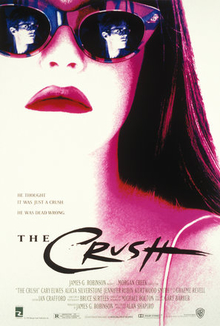
Live Tweet Alert: Join #FridayNightFlix For The Crush!


As some of our regular readers undoubtedly know, I am involved in a few weekly live tweets on Twitter and Mastodon.  I host #FridayNightFlix every Friday, I co-host #ScarySocial on Saturday, and I am one of the five hosts of #MondayActionMovie!  Every week, we get together.  We watch a movie.  We tweet our way through it.

Tonight, at 10 pm et, #FridayNightFlix presents 1993’s The Crush!

If you want to join us this Friday, just hop onto twitter, start the movie at 10 pm et, and use the #FridayNightFlix hashtag!  It’s a friendly group and welcoming of newcomers so don’t be shy.

The Crush is available on Prime and Tubi!  See you there!