The Fabulous Forties #19: Whistle Stop (dir by Leonide Moguy)


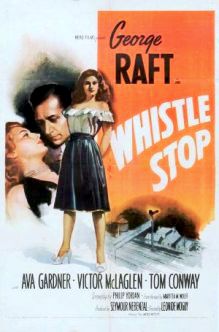
Whistle_stop_poster_small

The 19th film in Mill Creek’s Fabulous Forties box set was 1946’s Whistle Stop and I’m sad to say that I ran into some trouble when I tried to watch it.  As much as I love the Mill Creek box sets, the DVDs within are somewhat notorious for getting easily damaged.  That was the problem that I ran into when I tried to watch Whistle Stop.  From the minute I hit play, the film would randomly pause.  The picture would randomly pixelate.  The sound would randomly vanish.  As you may have picked up, it was all very random but it also made it impossible for me to watch Whistle Stop.

However, like almost every other film that’s ever shown up in Mill Creek box set, Whistle Stop is in the public domain and, therefore, it’s been uploaded to YouTube by dozens of different accounts.  Once I realized that the DVD wasn’t going to work, I switched over to YouTube and I finally got watch Whistle Stop.

Really, I probably shouldn’t have gone to all the trouble.  Of the 19 Fabulous Forties films that I’ve watched so far, Whistle Stop is perhaps the least interesting.  Half of the film is a film noir and the other half if a small town melodrama but, with its convoluted plot and uninspired direction, it really doesn’t work as either.

Mary (Ava Gardner) grew up in a small town but, eventually, she left and went to the big city, hoping to make a new life for herself.  Apparently, she didn’t succeed because, two years later, she returns to the small town.  (The town is so small and obscure that it’s mostly known for its train stop.  Hence, it’s a “whistle stop.”)  When she returns, she discovers that her ex-boyfriend, Kenny Veech (George Raft) has become a loser in her absence.  Kenny is still in love with her but he’s also bitter at her for leaving town.

Making things even worse, from Kenny’s point of view, is that Mary is now dating a sleazy nightclub owner named Lew Lentz (Tom Conway).  Kenny’s best friend, Gitlo (Victor McLaglen), comes up with a plan, in which he and Kenny will kill Lew and make it look like a robbery.  However, Lew has plans of his own and…

You know what?  I’m probably making Whistle Stop sound more interesting than it actually is.  This is one of those films were the plot manages to be absurdly complicated without actually adding up to much. On the plus side, Ava Gardner, one of my favorite of great femme fatales, is beautiful and sultry as Mary and reminded me of why, for several years, Film Noir Femme Fatale was my default Halloween costume.  Tom Conway makes Lew Lentz so amazingly sleazy that you can’t help but admire his commitment to the role.  On the other hand, George Raft is totally miscast and way too handsome and naturally rakish to play a total loser like Kenny Veech.  Watching the film, you can tell that he wasn’t particularly comfortable playing such an insecure and passive character.

Whistle Stop wasn’t particularly memorable but if you want to watch it, you can do so below.  It’s free!
http://www.youtube.com/watch?v=UE8gzD-J8FA

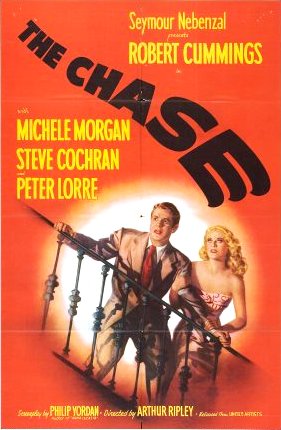
The Fabulous Forties #18: The Chase (dir by Arthur Ripley)


The_Chase_1946_posterThe 18th film in Mill Creek’s Fabulous Forties box set was 1946’s The Chase, which turned out to be a pretty nifty little film noir.  Did I actually just use the word nifty in a film review?  Yes, I did but then again, everyone should use the word “nifty” at least once in their lives.

The Chase tells the story of Chuck Scott (Robert Cummings), whose life is anything but nifty.  When we first meet him, he’s standing outside in the rain, staring into a restaurant, and enviously watching the people eating inside.  Chuck is a returning serviceman.  He helped to win World War II but he’s now returned to a society that has changed in his absence.  He has no money, he has no home, and he suffers from what we would today call PTSD.

Things change for Chuck when he finds the wallet of a man named Eddie Roman (Steve Cochran).  He returns the wallet, discovering that Eddie not only lives in a mansion but he also has a sinister henchman named Gino (Peter Lorre!).  Eddie is so impressed that Chuck returned the wallet and didn’t try to steal any of the money that he offers to put Chuck on the payroll.

Soon, he is working as Eddie’s driver.  Of course, Eddie has an accelerator installed in the backseat, so that he can control how fast the car is going.  Eddie enjoys freaking Chuck out by randomly speeding up the car.  Along with being a spectacularly bad passenger, Eddie also turns out to be a gangster.

When Chuck meets the mysterious Lorna (Michele Morgan), it’s love at first sight but there’s a big problem.  Lorna happens to be married … to Eddie!  Chuck and Lorna flee to Cuba, with Eddie and Gino in pursuit…

Or do they?

Chuck, it turns out, has been suffering from nightmares since he returned from the war.  Often times, he wakes up with amnesia.  Are Eddie, Gino, and Lorna real or are they just figments of Chuck’s dream state?  Is Chuck really living in a film noir or is he just dreaming that he is?

The Chase is an effectively dark little film noir, one that will keep you guessing.  Steve Cochran appears to be having a lot of fun as the cheerfully sociopathic Eddie (and it’s interesting to note that, in the same year as The Chase, Cochran had a supporting role in another film about the struggles of returning servicemen, the Oscar-winning Best Years Of Our Lives) and, of course, Peter Lorre is great as Gino.  Michele Morgan is both sympathetic and enigmatic as Lorna and Robert Cummings does a good job of playing a man who is never quite sure whether he’s awake or he’s asleep.

The Chase is a classic mix of film noir and psychological melodrama.  Watch it below!

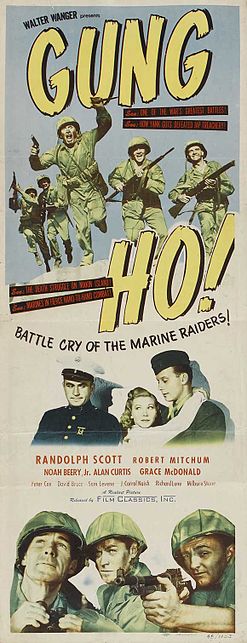
The Fabulous Forties #17: Gung Ho! (dir by Ray Enright)


Gunghopos

The 17th film in Mill Creek’s Fabulous Forties Box Set was the 1943 war film, Gung Ho!

Gung Ho!, which is filmed in a documentary style and features a narrator, opens with a series of job interviews.  A tough lieutenant (J. Carrol Naish) is recruiting Marines to serves in a special unit, one which will only take on the most hazardous of assignments.  The narrator reminds us that the interviews are taking place just a few weeks after the attack on Pearl Harbor and we listen as each interviewee is asked whether or not he is okay with killing members of the Japanese army.

Some of the interviewees hesitate and some don’t but ultimately, all of them are okay with killing.  One (Rod Cameron) explains that he’s already a murderer, having killed someone back in Kentucky.  Another says that he fought in the Spanish Civil War and that he sees his service as being a continuation of the fight against fascism.  Another Marine (Alvan Curtis) says that he’s an ordained minister but he’s willing to do what has to be done.  A Marine named Pig Iron shows up and, since he’s played by a young Robert Mitchum, we know that he’ll get things taken care of.

And then we get to the final interviewee.  He doesn’t have a big role in the film but his one line makes a big impression.  When asked why he doesn’t mind the idea of killing, he replies, “I just don’t like Japs.”

AGCK!

That’s a line that would definitely not make it into a modern version of Gung Ho!  Or, if it did, it would be followed by the interviewee being admonished and then kicked out of the office.  But Gung Ho! was made in 1943, at the height of World War II and in the shadow of Peal Harbor.  As uncomfortable as it may make us today, “I just don’t like Japs,” was probably Gung Ho‘s big applause line when it was originally released.

And really, that’s the main value of a film like Gung Ho!  It’s a well-made but predictable war film but ultimately, it’s most important as a time capsule.  If you want to know the truth about an era’s culture, as opposed to what you may want the truth to be, look at the art.  Read the books.  Watch the movies.  You may not always like what you find but you owe it to yourself to do so.

Anyway, as far the rest of Gung Ho!, it plays out exactly as you would expect.  Under the eye of Lt. Commander Thornwald (Randolph Scott), the men train for combat.  They visit Pearl Harbor and see the sunken remains of ships that are still smoking after being bombed.  And finally, the men fight the Japanese on an island.  Some survive.  Many more of them die.  And the fight continues.

Gung Ho! will probably be best appreciated by fans of war films, which admittedly I am not.  That said, it is an interesting time capsule of 1943 America.  Plus, it features Robert Mitchum!  Admittedly, it’s a small role but he does get two great scenes and … well, he’s Robert Mitchum!  How can you not enjoy watching Robert Mitchum?

And guess what?  You can watch Gung Ho! below!

http://www.youtube.com/watch?v=WwOFTAzW30E

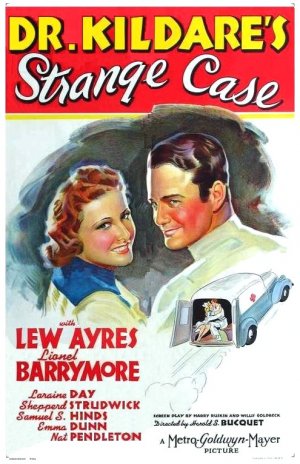
The Fabulous Forties #16: Dr. Kildare’s Strange Case (dir by Harold S. Bucquet)


Dr._Kildare's_Strange_Case_FilmPoster

The 16th film in Mill Creek’s Fabulous Forties box set was 1940’s Dr. Kildare’s Strange Case.  It’s about a doctor who investigates a medical case and wow, is it ever a strange case.

Apparently, there was a whole series of Dr. Kildare films that were released in the 30s and 40s.  I guess the films were the cinematic equivalent of a TV show like Grey’s Anatomy or ER or Children’s Hospital or… well, every medical show that’s ever shown up on TV since the beginning of time.  Dr. James Kildare (Lew Ayres) is a passionate young doctor who may break the rules but he gets results!  His mentor is Dr. Gillipsie.  Gillipsie is played by Lionel Barrymore and since the character is cranky and confined to a wheelchair, it was impossible for me to watch him without thinking about Mr. Potter from It’s A Wonderful Life.  Whenever Kildare went to him for advise, I kept expecting Gillipsie to glare at him and say, “You once called me a warped old man…”

Anyway, Dr. Kildare works in a hospital and, when he’s not silently judging everyone else that he works with, he’s busy silently judging the wealthy Dr. Lane (Sheppard Strudwick), a brain surgeon whose patients keep dying.  Kildare and Lane are also both in love with the same nurse, Mary Lamont (Laraine Day).  Mary wants to marry Kildare but Kildare would rather be poor and single than compromise his medical principles.  Lane, on the other hand, sends her a box full of silk stockings.  Plus, he’s rich!

Seriously, how is this even a competition?  Forget Kildare and marry Lane!

Except, as I mentioned earlier, all of Lane’s patients keep dying.  Is Lane incompetent or, as Kildare suggests, is it possible that brain surgery is just really, really hard?  I imagine it was even harder in 1940, when this movie was being made.  While Kildare and Lane are operating on brains, Dr. Gillipsie is still using leeches to suck sickness out of the poorer patients.

(You don’t actually see it happen in the movie but Gillipsie comes across as being a leech man.)

Anyway, eventually, Kildare has to cure a schizophrenic and it turns out that he can do this by putting the man into an insulin coma.  As is explained in great detail, forcibly putting a patient in a coma will cause that patient’s mind to go back to a reset point.  It’s kind of like how Windows sets up a restore point before doing a major update.

And that therapy sounds so crazy that you just know it had to be based in an actual practice.  I checked with Wikipedia and I was not shocked to discover that apparently Insulin Shock Therapy used to be a thing!

Anyway, Kildare’s gets into a lot of trouble for putting his patient into a coma and attempting to erase a huge part of his mind.  Will Kildare’s results vindicate his methods or will Gillipsie have to use leeches to suck the crazy out of the patient’s brain?

Watch the film to find out!  Or don’t.  Dr. Kildare’s Strange Case was directed by Harold S. Bucquet, who did a pretty good job with The Adventures of Tartu.  His direction here is flat and uninspired, which only serves to make this entire film feel like an old TV show.  I’m tempted to recommend the movie just because of the scene where it’s explained that insulin shock therapy causes patients to devolve so that they can re-evolve but otherwise, Dr. Kildare’s Strange Case is forgettable.

If you want to see it, you can watch it below!

http://www.youtube.com/watch?v=8UPFyrlNiGM

Or you can just watch this classic episode of Children’s Hospital!

http://www.youtube.com/watch?v=dpBjqgVaEbk

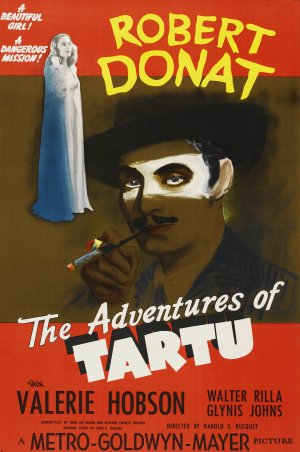
The Fabulous Forties #15: The Adventures of Tartu (dir by Harold S. Bucquet)


The_Adventures_of_Tartu_FilmPoster

The 15th film in Mill Creek’s Fabulous Forties box set was The Adventures of Tartu, a British film from 1943.

The Adventures of Tartu opens during the Blitz and follows Captain Terrence Stevenson (Robert Donat), a British explosives expert, as he defuses an unexploded German bomb in the ruins of London.  He does it without breaking a sweat or showing the least bit of hesitation.  With his clipped accent and his perfectly trimmed mustache, he’s a British hero through and through.  He’s so perfectly British that you expect him to start singing the entire score of H.M.S. Pinafore.  He’s the epitome of unflappable resilience.

And he’ll need all of that resilience to survive his next mission!  It turns out that, as British as he may seem, Captain Stevenson was originally born in Romania and is still fluent in both his native language and German.  Because of this, MI6 recruits him to parachute back into Romania, which is now under the control of the Nazis.  Stevenson will assume the identity of a recently assassinated Nazi chemist, Jan Tartu.  As Tartu, he will then make his way to Czechoslovakia where a member of the resistance will arrange for Stevenson to get a job at a secret Nazi chemical factory.  Stevenson will destroy the factory from within.

Unfortunately, Stevenson’s contact is arrested before he can arrange for job to be assigned to Stevenson.  When Stevenson (now pretending to be Tartu) arrives in Czechoslovakia, he is instead assigned to work in a munitions factory.  In order to eventually win assignment to the chemical factory, Stevenson now has to win the trust of the Nazis without losing the trust of the resistance.  That turns out to be more than a little difficult because, as Stevenson quickly discovers, he is now living in a world where no one can be trusted and everyone is paranoid.

(In one of the film’s best sequences, Stevenson is captured by a group of men and struggles to figure out whether he is now a prisoner of the resistance or a prisoner of the Gestapo.)

I’m not going to go into too many other details, beyond saying that The Adventures of Tartu is an effective and twist-filled work of wartime propaganda.  What’s interesting is that when the film starts, it almost feels a bit comedic.  Stevenson is so extremely British and the initial Nazis that he meets are so extremely buffoonish that it’s hard to take them seriously.  But, as the film progresses, it gets more and more serious.  In order to accomplish his mission, Stevenson is forced to make some difficult decisions and likable characters suffer as a result.  As Stevenson himself spends more time with the Nazis, both he and the viewer discover just how evil they truly are.  (Technically, the viewer should already know that the Nazis were evil but it must be remembered that The Adventures of Tartu was made during World War II, at a time when it was still difficult to get accurate information about what was happening in Nazi-occupied Europe.)  By the end of the movie, the Nazis are still buffoons but it’s impossible to laugh at them.

I imagine that wartime audiences left The Adventures of Tartu feeling even more committed to destroying the Nazi regime.  Meanwhile, modern audiences will watch The Adventures of Tartu and, once again, be reminded of how fortunate we are that the Allies won the war.

You can watch The Adventures of Tartu below!

http://www.youtube.com/watch?v=YhqNJCCTITs

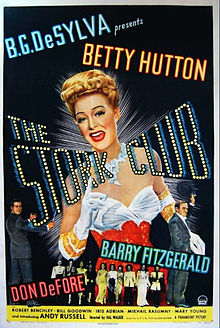
The Fabulous Forties #14: The Stork Club (dir by Hal Walker)


40s

For the past two weeks, I have been reviewing all fifty of the films to be found in Mill Creek’s Fabulous Forties DVD box set!  It’s been four days since I reviewed the 13th film in the set, Scared Stiffwhich is probably the longest bloggng break that I’ve ever taken in my life.  However, I am proud to say that I am back and ready to review the 37 remaining films!

Yay! Lisa’s back!

Now, I know what you’re asking.  Why, if I am about to review a film from the 1940s, am I sneaking a random Degrassi GIF into this review?  Well, unfortunately, the movie that I’m about to review isn’t that interesting and there’s not a whole lot to be said about it.  I’ve found some enjoyable and interesting films in the box set — The Black Book, Trapped, the original Jungle Book — but I’ve also found a few that are pretty forgettable.  So, why not liven things up with a shout-out to my favorite show?

Anyway, the 14th film from The Fabulous Forties Box Set was 1945’s The Stork Club.

220px-Stork_Club_poster

When I saw that this film was called The Stork Club, my first thought was that it would be a comedy about pregnancy.  But it turns out that I was totally wrong.  Apparently, The Stork Club was a very popular New York nightclub in the 1940s and this film was meant to take advantage of that popularity.  (That said, according to the imdb, The Stork Club was not filmed at the actual Stork Club but instead on a Hollywood soundstage.)

As for the film’s story — well, this isn’t going to make much sense but here’s what happens.  A millionaire named J.B. (charming, Irish-accented Barry Fitzgerald) falls into a pond and nearly drowns.  Fortunately, his life is saved by Judy (Betty Hutton).

J.B. wants to reward Judy but, for some reason, he doesn’t want her to know that he’s rich.  So, with the help of his lawyer (Robert Benchley), he anonymously arranges for Judy to get both a new apartment and an unlimited credit line at all of New York’s best stores!

But J.B. also wants to keep an eye on Judy and make sure that she’s happy.  But he still doesn’t want her to know that he’s a millionaire or that he’s her benefactor.  After he finds out that she’s a hatcheck girl at the Stork Club, he arranges to get hired on as a busboy.  However, he gets fired after just one night and, believing him to be poor and homeless, Judy invites him to stay at her new apartment.

J.B. agrees and, in the film’s best, non-musical moment, he watches as Judy recklessly spends his money on new clothes.  It turns out that Judy thinks that the apartment and the credit line are all gifts from the owner of the Stork Club and she’s offended because she thinks the owner is trying to steal her away from her boyfriend, Danny Wilson (Don DeFore).

Danny is a bandleader but he’s been serving in the U.S. Army.  When Danny finally returns home, Judy is excited about arranging for him to get an audition to play at the Stork Club.  However, Danny is more concerned about the fact that Judy has a mysterious benefactor and that she’s now living in a luxury apartment with a mysterious old man.

Could Judy be a kept woman!?  Both Judy and J.B. insist that she is not but Danny refuses to believe them because Danny is kind of a jerk.  Of course, Danny isn’t meant to be a jerk but, by today’s standards, he’s definitely a jerk.  Judy could do so much better!

Anyway, the plot’s not really that important.  It’s mostly just an excuse for Betty Hutton to sing a few songs and that’s when the movie is at its best.  Check out some of Betty’s performances below:

Anyway, The Stork Club was pleasant but not particularly memorable.  When it works, it’s largely due to the endless charm of Betty Hutton and Barry Fitzgerald.  It may not seem like much today but I’m sure that, for audiences dealing with the contemporary horrors of World War II, The Stork Club presented a nice diversion.

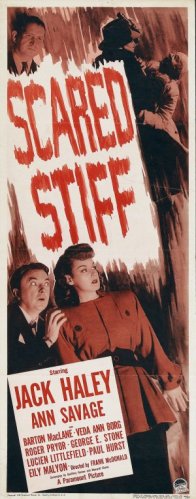
The Fabulous Forties #13: Scared Stiff (dir by Frank McDonald)


Poster_of_the_movie_Scared_Stiff

Last night, as a gentle rain fell outside, I watched the 13th film in Mill Creek’s Fabulous Forties box set, 1945’s Scared Stiff.  (The version in the box set appeared under the title Treasure of Fear, which was what the title was changed to when the film was later re-released.  However, the film was originally entitled Scared Stiff and that’s the title that I’m going to use.  Scared Stiff is just a better title and I happen to like the Scared Stiff film poster, featured above.  So, just remember that if you ever find yourself watching an old movie called Treasure of Fear, you’re actually watching Scared Stiff.)

As I attempted to watch Scared Stiff, I was reminded of some of the problems that occasionally come with watching a film that has slipped into the public domain.

On the one hand, the public domain is great because it makes it a lot easier to watch old movies.  And while it’s true that many public domain films aren’t exactly classics, there are a few gems to be found.  For instance, since I started watching the movies in the Fabulous Forties box set, I’ve discovered The Black Book, Trapped, and Jungle Book.

On the other hand, being in the public domain means that virtually anyone can duplicate and sell a copy of the film.  As a result, many of these films are available (and frequently viewed) in versions that are of an extremely poor quality and which have often been haphazardly edited.

That’s one reason why it’s going to be difficult for me to review Scared Stiff.  The version that I saw was, even for a public domain B-movie, rough.  The picture was slightly fuzzy and the sound quality was not the greatest.  I don’t think you can ever truly understand that importance of a clean soundtrack until you listen to a scratchy one.

As for Scared Stiff itself, it’s a comedic murder mystery and thankfully, it’s only 65 minutes long.  Jack Haley plays a reporter who covers chess tournaments for his uncle’s newspaper.  Unfortunately, Haley’s not a very good reporter so his frustrated uncle orders him to go to Grape City so that he can cover a beauty contest, apparently believing that there’s no way that Haley could possibly screw that up.

However, Haley manages to do just that.  He gets off the bus at Grape Center, instead of Grape City.  He finds himself stranded at an inn that’s run by two twins (both played by Lucien Littlefield).  The twins hate each other for reasons that aren’t clear.  However, they do possess a chess set that was once owned by Marco Polo!  One twin owns the white pieces while the other owns the black pieces!  Haley wants to buy all the pieces but things get complicated when it turns out that a gang of thieves are also in town and they want to steal the set for themselves.

But that’s not at all!  One of the passengers on the bus is found murdered and he has a chess piece in his hand.  Of course, everyone suspects Haley.  So, Haley has to get the chess pieces, clear his name, and hopefully get to Grape City before his uncle fires him.

Scared Stiff is way too frantic for its own good and I have a feeling that I would feel the same even if I had seen a version that didn’t sound scratchy or often look fuzzy.  That said, it is interesting to see Jack Haley, who is best known for being The Tin Man in The Wizard of Oz, play a human being.  Also of interest, to film noir fans, was that Haley’s girlfriend was played by Detour‘s Ann Savage.  Both Haley and Savage gave good performances but it was not enough to save this misbegotten little film.

The Fabulous Forties #12: D.O.A. (dir by Rudolph Mate)


DOA1950

The 12th film contained in Mill Creek’s Fabulous Forties box set is the classic film noir D.O.A.  Before I get into reviewing this film, there’s an oddity that I feel the need to point out.  According to the back of the Fabulous Forties box, D.O.A. was released in 1949.  However, according to Wikipedia, imdb, and almost every other source out there, D.O.A. was released in 1950.  In short, it’s debatable whether or not D.O.A. actually belongs in the Fabulous Forties box set but it really doesn’t matter.  D.O.A. is a classic and, along with Night of the Living Dead, it is undoubtedly one of the best B-movies to ever slip into the public domain.

D.O.A. opens with a lengthy tracking shot, following a man named Frank Bigelow (Edmond O’Brien) as he walks through the hallways of a San Francisco police station.  Frank walks with a slow, halting movement and it’s obvious that he is not a healthy man.  When he finally steps into a detective’s office, Frank announces that he’s come to the station to report a murder — his own.

Frank is a small-town accountant who came to San Francisco for a vacation.  After a long night of drinking, Frank woke up feeling ill.  When he went to a doctor, he was informed of two things.  Number one, he was in overall good health.  Number two, he only had a few days to live.  Sometime during the previous night, Frank was poisoned with a “luminous toxin.”  There was no antidote.

The rest of the film follows Frank as he attempts to figure out who poisoned him and why.  It’s an intriguing mystery and I’m not going to ruin it by going into too many details.  Over the course of his investigation, the increasingly desperate Frank comes across a gangster named Majak (Luther Adler).  This leads to a lengthy scene in which Majak’s psychotic henchman, Chester (Neville Brand), repeatedly punches Frank in the stomach.  It’s a scene that, even in our far more desensitized times, made me cringe.  I can only imagine how audiences in 1950 reacted.

(There’s also a shoot-out at a drug store that can stand alongside almost any modern-day action sequence.  Regardless of whether the film was made in 1949 or 1950, it still feels like a movie that could have just as easily been made in 2016.)

But really, the mystery is secondary.  Instead, D.O.A. is truly about Frank and how he deals with the knowledge that he is going to die.  Before being poisoned, Frank is the epitome of complacent, middle-class suburbia.  He’s engaged to Paula (Pamela Britton) but he’s in no hurry to marry her.  He’s got all the time in the world.  When Frank goes to San Francisco, he epitomizes the bourgeoisie on vacation.  He goes to the 1940s equivalent of a hipster nightclub, not because he’s actually interested in what the scene is all about but because he’s a tourist looking for a story to tell the folks back home.  When he checks into his hotel, he leers at every passing woman with a casual sexism that would not be out-of-place on an old episode of Mad Men.  Frank is floating through life, confident in his own complacency.

It’s only after he’s poisoned that Frank actually starts to live.  He goes from being passive to being aggressive.  Knowing that he’s going to die, he no longer has anything to lose.  Only with death approaching does Frank actually start to live.  Frank’s realization that he waited to long to live makes his final line all the more poignant.

D.O.A. is a classic!  Watch it below, you won’t be sorry!

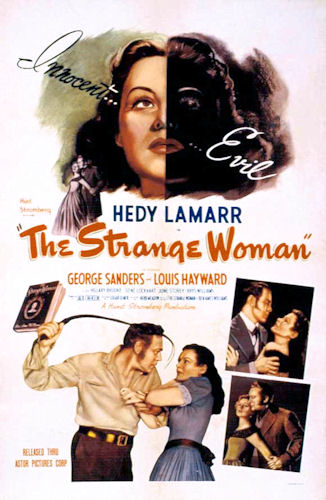
The Fabulous Forties #11: The Strange Woman (dir Edgar G. Ulmer)


The_Strange_Woman_1946_poster

The eleventh film in Mill Creek’s Fabulous Forties box set was 1946’s The Strange Woman.  The Strange Woman is one of those film noir/small town melodrama hybrids that seem to have been something of a cinematic mainstay in the mid to late 40s.

The Strange Woman of the title is Jenny Hager (Hedy Lamarr) and she’s not just strange because she’s got an Eastern European accent despite having grown up in Bangor, Maine.  The film opens in 1824 and we watch as tween Jenny pushes one her classmates into a river, despite the fact that he can’t swim.  At first, she seems content to let him drown.  However, once she realizes that an adult is watching, Jenny jumps into the river and saves his life.

Ten years later, Jenny has grown up to be the most beautiful woman in Maine.  However, her father is abusive and regularly whips her as punishment for being too flirtatious.  Jenny has plans, though.  She wants to marry the richest man in town, a store owner and civic leader named Isaiah Poster (Gene Lockahrt).  Isaiah also happens to be the father of Ephraim (Louis Hayward), the young man who Jenny tried to drown at the beginning of the film.

And eventually, Jenny’s dream does come true.  She marries Isaiah, even though she doesn’t love him.  She just wants his money and is frustrated when the sickly Isaiah keeps recovering from his frequent illnesses.  She starts to flirt with the weak-willed Ephraim, trying to manipulate him into killing his father.

Of course, even as she’s manipulating Ephraim, she’s also flirting with John Everd (George Sanders), despite the fact that John is already engaged to the daughter of the local judge.  Though Everd is a good and decent guy, he still finds himself tempted by Jenny.

What makes all of this interesting is that Jenny isn’t just a heartless femme fatale.  Throughout the film, there are several instances when she wants to do good but can’t overcome her essentially heartless nature.  She gives money to charity and, whenever she listens to one of the local fire-and-brimstone preachers, she finds herself tempted to give up her manipulative ways.

The Strange Woman was directed by Edgar G. Ulmer, who is probably best known for directing the ultimate indie film noir, Detour.  He was a childhood friend of Hedy Lamarr’s and she specifically asked that he direct her in The Strange Woman.  As a result, this film represents one of the few times that Ulmer was given a budget that was equal to his talents.  What makes The Strange Woman stand out from other 40s melodramas — like Guest In The House, for example — is that, even with the larger budget, Ulmer’s direction retains the same deep cynicism and dream-like intensity that distinguished his work in Detour.  The film remains sympathetic to Jenny, even as she often suffers the punishments that were demanded by the production code.

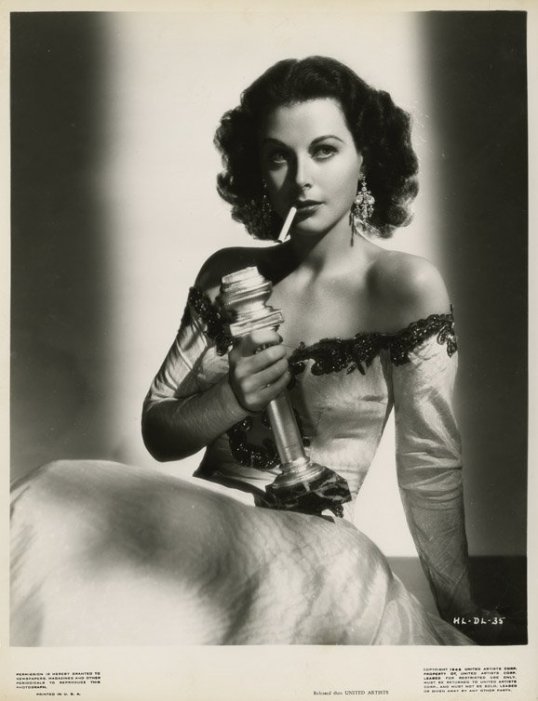
In the role of Jenny , Hedy Lamarr is a force of a nature.  She is so intense and determined that watching her as Jenny is a bit like seeing what Gone With The Wind would have been like if Scarlet O’Hara had been a total sociopath.  Even the fact that Lamarr’s accent is definitely not a Maine accent seems appropriate.  It sets Jenny apart from the boring people around her.

It reminds us that, even if she is “strange,” there is no one else like Jenny Hager.

6320831_3_l

The Fabulous Forties #9: Jungle Book (dir by Zoltan Korda)


Jungle_Book_FilmPoster

The 9th film in Mill Creek’s Fabulous Forties DVD box set was 1942’s Jungle Book.  Based on the novel by Rudyard Kipling (which was later made into an animated Disney film and of which a remake is scheduled to be released next week), Jungle Book was directed by Zoltan Korda and produced by Zoltan’s brother, Alexander.  Today, the Hungarian-born Korda Brothers are best remembered as being pioneers of the British film industry.  However, during World War II, they relocated their film making to the United States.  Jungle Book was one of the most critically and commercially successful of their American films.

Jungle Book opens in colonial India.  An elderly Indian storyteller is visited by a British woman (Faith Brook) who wants to hear a story from his youth.  The rest of the film plays out in flashback, a structure that allows Jungle Book to walk a thin line between reality and fantasy.  Is the storyteller telling the exact truth or is he exaggerating his tale?  That’s left up to the viewer to decide.  Personally, I chose to believe that he’s telling the exact truth.  It’s more magical that way.

The storyteller starts by telling the woman about the Indian jungle and the animals that live within it.  Some of the animals are kind and some of them are cruel but they all serve a purpose.  The most feared of the animals is a tiger named Shere Kahn.  When a baby disappears from a nearby village, the villagers assume that he, like his father, was killed by Shere Kahn.  What they do not know is that the baby actually wandered into the jungle and was raised by wolves.

The baby grows up to be Mowgli (Sabu), a feral young man who can talk to the animals.  When Mowgli is captured by the villagers, he is unknowing adopted by his real mother, Mesusa (Rosemary DeCamp).  At first, the wild Mowgli struggles to adapt to human ways and one of the villagers, Buldeo (Joseph Calleia), insists that Mowgli has “the evil eye.”

As Mowgli becomes a little more civilized (though he’s never exactly tamed), he starts to fall in love with a Mahala (Patricia O’Rourke).  Unfortunately, Mahala is the daughter of Buldeo and Buldeo is none to happy when Mowgli and Mahala start to spend all of their time exploring the jungle together.  However, that’s before Mowgli and Mahala come across a lost palace that is full of treasure.  When the greedy Buldeo finds out about the treasure, he demands that Mowgli tell him where the palace is.  Driven mad by Mowgli’s refusal to tell him, Buldeo goes to more and more extreme measures to find the treasure…

Jungle Book is a big epic film, one that proudly announces that it was shot in Technicolor.  The sets are big, the live animal footage (as opposed to the stock footage usually used in films like this) is impressive, and it’s just a fun movie to watch.  (Even though I was watching a typically cheap Mill Creek transfer, I was still impressed with the films visuals.)  Indian actor Sabu makes for a charismatic Sabu but the film’s best performance comes from Joseph Calleia, who brings unexpected depth to his villainous character.

(Movie lovers, like you and me, probably best know Joseph Calleia as Orson Welles’s tragic partner in Touch of Evil.)

You can watch the original Jungle Book below!

http://www.youtube.com/watch?v=MUHNtxQ82z8

(Jungle Book is in the public domain so, if the video above gets taken down — as often seems to happen with embedded YouTube videos — I would suggest just going to YouTube and doing a search for Jungle Book 1942.  You’ll find hundreds of other uploads.  I picked the one above because it did not appear to have any commercials.)