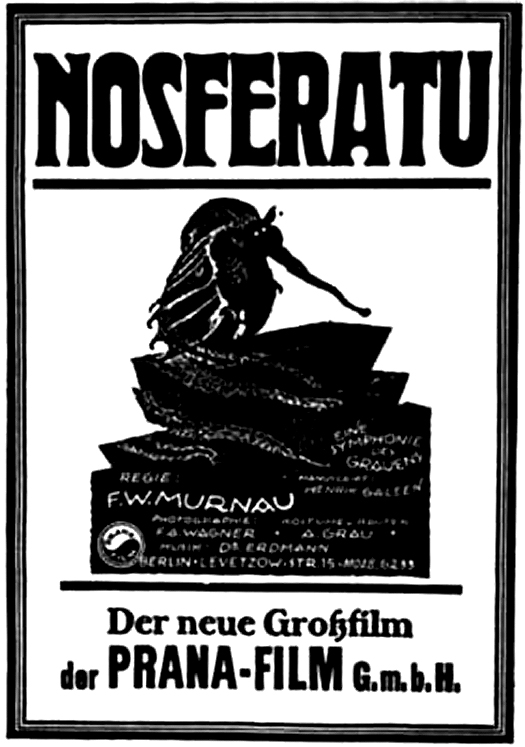
Today’s Horror on the Lens is a classic film that really needs no introduction! Released in 1922, the German silent film Nosferatu remains one of the greatest vampire films ever made. It’s a film that we share every October and I’m happy to do so again this year!
Today’s horror scene that I love comes from the absolutely terrifying 1922 silent film, Nosferatu.
Directed by F. W. Murnau and featuring Max Schreck as Count Orlock, Nosferatu is often cited as being the first vampire film. That’s actually not true. There were apparently film adaptations of Dracula that were produced years before Murnau gave the world his “unauthorized” adaptation.
However, I do think it can be argued that Nosferatu is the most influential vampire film ever made. Every vampire movie released over the past 95 years has been a direct descendant of Nosferatu and it remains a truly nightmarish work of horror art. One need only compare it to Universal’s first Draculafilm to see how well Nosferatu has aged.
Today’s Horror on the Lens is a classic film that really needs no introduction! Released in 1922, the German silent film Nosferatu remains one of the greatest vampire films ever made. It’s a film that we share every October and I’m happy to do so again this year!
(As well, since I’m going to be reviewing Dracula later today, it seems especially appropriate to start things off with Nosferatu.)
This October, I’m going to be doing something a little bit different with my contribution to 4 Shots From 4 Films. I’m going to be taking a little chronological tour of the history of horror cinema, moving from decade to decade.
Today, we take a look at the latter half of the 1920s.
4 Shots From 4 Films
The Phantom of the Opera (1925, dir by Rupert Julian)
Faust (1926, dir by F.W. Murnau)
London After Midnight (1927, dir by Tod Browning)
The Fall of the House of Usher (1928, dir by Jean Epstein)
This October, I’m going to be doing something a little bit different with my contribution to 4 Shots From 4 Films. I’m going to be taking a little chronological tour of the history of horror cinema, moving from decade to decade.
Today, we take a look at the first half of the 1920s.
4 Shots From 4 Films
The Cabinet of Dr. Caligari (1920, dir by Robert Wiene)
Today’s Horror on the Lens is a classic film that really needs no introduction! Released in 1922, the German silent film Nosferatu remains one of the greatest vampire films ever made. It’s a film that we share every October and I’m happy to do so again this year!
Last year, I published 60 film reviews under the heading of Embracing the Melodrama. Embracing the Melodrama was one of the first review series that I had ever done and I had so much fun doing it that I figured, “Why not try it again?”
In other words, welcome to Embracing the Melodrama, Part II!
Over the next three weeks, I will posting, in chronological order, 128 reviews of films that embrace the melodrama. As before, these reviews will be in chronological order and they will include everything from Oscar winners to grindhouse exploitation to made-for-television dramas. It should be fun!
And, considering that we’re talking about 128 reviews here, it should at least help me make a dent in my goal to see every single movie that has ever been made.
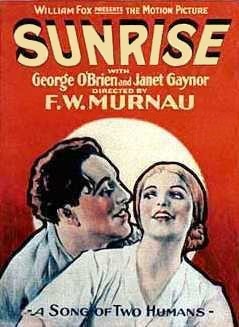
Let’s start things off by taking a quick look at the 1927 silent film, Sunrise. Directed by German expressionist F.W. Murnau, Sunrise is widely considered to be one of the greatest films ever made and for once, popular opinion is correct. The film tells a simple story. The Woman From The City (Margaret Livingston) takes a vacation out in the country. (We know she’s dangerous because she wears black lingerie.) She stands outside of a farmhouse and whistles. Soon, the Man (George O’Brien) steps out of the farmhouse and joins the Woman. Inside the farmhouse, the Wife (Janet Gaynor) can only dream of what life was like when she and the Man first fell in love.
The Man and the Woman meet at the edge of the lake and kiss as the moon shines down on them. They’re having an affair, though the film — in its dream-like way — leaves it ambiguous as to just how long the affair has been going on. (Indeed, the film almost seems to suggest that The Woman has sprung from the Man’s subconscious, a creation of his darkest desires.) The Woman wants the Man to murder his wife and come back to the city with her. At first, the Man refuses but, as the Woman talks to him, he starts to visualize the city. And, make no mistake about it — the city that the man visualizes is a scary place that resembles the dreamworld of The Cabinet of Dr. Caligari. But, at the same time, it’s also a lot more fun than the farm.
Now, you may be wondering why this familiar sounding tale is considered to be one of the best films of all time. The story itself is simple and deliberately allegorical. The film is less about the story and more about how Murnau tells it. Murnau fills the screen with hauntingly surreal images that are both beautiful and frightening at the same time. When the title cards appear on-screen, the lettering literally fades in and out and adds to the entire movie’s dream-like feel. Watch the scene below where the Woman first suggests killing the Wife and the Man visualizes the city:
Infatuated with the Woman, the Man plans to drown the Wife but, at the last minute, has a change of heart. The Wife, however, flees to the city herself. The Man follows her and attempts to win back her love. The city itself changes when the Man and the Wife are in it together. What seemed dark and threatening under the influence of the Woman is now revealed to be fun and vibrant. The film transforms from being an early example of film noir to being a screwball comedy.
How many other films can you think of that feature both a murderous femme fatale and a drunk pig?
And yet, as much joy as the Man and the Wife find in the city, both the farm and the Woman await their eventual return. And there’s a storm coming…
Interestingly enough, at the first Oscar ceremony, two awards were given for Best Picture of the year. The first award — for Outstanding Production — went to Wings, a big budget action spectacular about World War I. The other award — for Unique And Artistic Presentation — went to Sunrise. I’ve read a lot of speculation about which film the Academy meant to name the best of the year but, to me, it’s fairly obvious that the Academy meant for Outstanding Production to honor the year’s big blockbusters while Unique and Artistic Presentation would honor the “art” films.
And, to be honest, I think that, way back in 1928, the Academy had the right idea. Why should they only give out one award for best picture, as if all films can be judged by only one standard? Why not give out separate awards for the best comedy or the best thriller or the best film made for a certain amount of money? Why not bring back the Oscar for Unique and Artistic Presentation?
For whatever reason, the Academy discontinued the Unique and Artistic Presentation Award after the 1st ceremony and, in the future, only one film would be named best of the year. Since Outstanding Production eventually become known as Best Picture, Wings has been immortalized as the first film to win best picture.
And, nothing against Wings, but the Academy would have been smarter to have gone with Sunrise. Certainly, it would have won them the respect of future film students.
This isn’t the first time that we’ve shared the classic 1922 silent vampire film Nosferatu here on the Lens but who cares? It’s not only one of the most influential films ever made but it’s also something of a Halloween tradition around these parts! Directed by the great German expressionist F.W. Muranu and featuring an iconic performance from Max Schreck, Nosferatu is a film that everyone should see at least once.
Since I previously “presented” our readers with The Cabinet of Dr. Caligari, it’s only appropriate to now present another early horror film — F.W. Murnau’s classic silent vampire film, Nosferatu. Much like Dr. Caligari, Nosferatu requires a bit of patience from modern audiences that take intrusive sound and CGI as a given. And much like Dr. Caligari, Nosferatu rewards the patience. Everything from Murnau’s moody use of shadow to Max Schreck’s performance as Orlock adds up to create one of the most influential and iconic films of all time. And while the film itself might not feature the “jump out your seat scares” that modern audiences expect (and demand) from horror films, the image of Schreck’s creeping shadow remains effectively creepy and nightmarish. Like all great horror, this is a film full of images that stick with you after you view it.
I am also very aware of both Werner Herzog’s excellent 1980 remake and the Oscar-nominated Shadow of the Vampire. However, I’m kinda typing all this up at work so those two films will have to wait for a later date. For now, if you have 84 minutes to kill and seriously, who doesn’t?, please enjoy F.W. Murnau’s classic Nosferatu…


 Through the Shattered Lens