The TSL’s Horror Grindhouse: Satan’s Children (dir by Joe Wiezycki)


The 1974 film, Satan’s Children, tells the story of unfortunate Bobby Douglas (Stephen White).

Bobby is a teenager who lives in a hideous suburban house with his stepfather (Eldon Mecham) and his stepsister (Joyce Molloy), who looks old enough to be Bobby’s mother.  Bobby’s a rebellious kid who doesn’t understand why he should always have to cut the grass while his stepsister hangs out by the pool.  Bobby is sick of the whole scene, man.  When his stepfather yells at Bobby for having a small stash of marijuana in his room, Bobby decides to run away from home.  Seriously, that scene was totally melvin so I don’t blame Bobby.

Bobby goes to a bar, where an old man tries to talk to him until Jake (Bob Barcour) tells the old man to get lost.  Jake tells Bobby that he has to be careful because there are perverts all over the place.  Bobby nods and laughs because Bobby’s not a square.  He knows what’s up.  Jake invites Bobby to come hang out at his place and Bobby is like, “Cool, way too friendly stranger, I’ll get you in your rape van.”  Bobby goes home with Jake and is promptly raped.  With Bobby naked and bound, Jake calls all of his friends over and Bobby is then gang raped.  The scene where Jake and his friends drive the bound Bobby around is pure nightmare fuel and I can only imagine how audiences in 1974 reacted to it.

The next morning, a group of hippies found Bobby lying in a field and they take him back to their commune.  Of course, these folks aren’t just hippies.  They’re also Satanists!  Sherry (Kathleen Marie Archer) wants to let Bobby stay with them while she nurses him back to health.  Joshua (John Edwards), an older member of the group, says that Bobby isn’t welcome because Bobby is probably “queer.”  Simon (Robert C. Ray II), the turtleneck-wearing leader of the group, is also hesitant to allow Bobby to stay and again, it’s because Simon assumes Bobby must be gay.  Simon also makes it clear that he doesn’t want any lesbians in his Satanic cult either.  He just wants people who are prepared to carry out a blood sacrifice….

(I swear, that Satan.  Not only is he the ruler of Hell and the tormenter of souls and the fallen angel responsible for getting Adam and Eve kicked out of the Garden and bringing sin into the world, he’s also apparently a massive homophobe!)

While the Satanists torture Sherry for displeasing Simon, Bobby tries to figure out a way to escape.  Fair warning: the majority of the film’s finale involves Bobby running around in tighty-whities, which get progressively more and more mud-stained as the movie goes on.  Seriously, ew!  On the other hand, not one but two people manage to die as a result of accidentally wandering into quicksand.  If nothing else, it’s a reminder that Bobby isn’t the only incredibly stupid person in the movie.

This is a weird movie.  I imagine it was made to capitalize on the notoriety of the Manson Family but, with its extended opening scenes in the suburbs, it instead becomes an ennui-drenched look at how far people will go to escape conventional society.  Despite all the of the truly terrible things that happen to him, Bobby is not a sympathetic or likable character.  In fact, he comes across as being just the type of idiot who probably would get sucked into a cult.  That said, the film is truly a unique (if rather slow) experience and the brutal ending took me totally by surprise.  Like many grindhouse film, Satan’s Children is an oddity that you truly can’t look away from.

The TSL Horror Grindhouse: Boogeyman II (dir by Ulli Lommel)


Filmed in 1982 but not released until 1984, Boogeyman II is — as the name implies — the sequel to 1980’s The Boogeyman.

What’s that, you say?  You don’t remember anything about The Boogeyman and you don’t want to take the time to read my review of it?  Well, don’t worry.  It’s not necessary to have seen the original Boogeyman to follow the sequel, largely because the sequel is full of flashbacks to the first film.  Boogeyman II is only 79 minutes long and 30 minutes of that running time is taken up with footage from the first Boogeyman.  Indeed, if you want to see the good parts of Boogeyman without having to deal with any of the filler, I would recommend just watching the first 30 minutes of Boogeyman II.

There is a plot to Boogeyman II, kind of.  Having survived the massacre of her family at the farm, the now-divorced Lacey (played by Suzanna Love, the then-wife of director Ulli Lommel) goes out to California to visit her friends, actress Bonnie (Shannah Hall) and her husband, director Mickey (Lommel).  How is it that Lacey, who was portrayed as being a simple and not particularly worldly farm wife in the first film, happens to be friends with a wealthy actress and director?  It’s never really explained.

Bonnie and Mickey ask Lacey whether or not the people who killed her family were ever caught.  Lacey replies that they can’t be caught because they’re spirits.  Over dinner, Lacey tells Bonnie and Mickey the story of the shattered mirror and the killer whose spirit was trapped in the broken glass.  Bonnie and Mickey listen sympathetically, though they both think that Lacey’s crazy.  (Perhaps they noticed that Lacey’s flashbacks include scenes in which she wasn’t even present.  Or maybe they’re wondering why Lacey would take the time to apparently describe a lengthy, bondage-themed nightmare that she had during the first film.  Or maybe they’re just amazed by the presence of John Carradine in the flashbacks.)  Bonnie and Mickey also think that Lacey’s story would make a great movie!

For some reason, Lacey is still carrying around a piece of the haunted mirror.  This is the mirror that contains the spirit that possessed her during the first film and which killed the majority of her family.  I would throw that piece of the mirror away but I guess Lacey’s more sentimental than I am.  A creepy butler named Joseph (Sholto von Douglas, a rather stiff actor who still had a fascinatingly menacing screen presence) steals the piece of the mirror and soon, Hollywood phonies are dying.

Boogeyman II was directed by the late Ulli Lommel, a German director who got his start as an associate of Rainer Werner Fassbinder’s and who eventually came to America, where he hung out with Andy Warhol, directed some documentaries about the American punk scene, and married heiress Suzanna Love.  Love bankrolled Lommel’s early films, including The Boogeyman.  With Lommel, it was always a challenge to figure out how seriously he took any of his films.  In interviews, he would joke about being an exploitation filmmaker while, at the same time, claiming that his films were designed to expose the hypocrisy of American society.  Boogeyman II is full of phony Hollywood types and there’s a scene where Mickey comments that, in America, “exploitation is a genre.”  It’s probably not a coincidence that it’s the servant, Joseph, who uses the mirror to take out the film’s wealthy victims.  The opening credits of Boogeyman II appear to literally be written in magic marker.  Is Lommel mocking expensive Hollywood productions or could Lommel only afford a box of magic markers?  I suppose both could be true.

The best parts of Boogeyman II are the flashback to the first film, which was a genuinely atmospheric horror film with some serious pacing issues.  The rest of Boogeyman II is dull, though you do have to appreciate the sense of ennui that Lommel brings to the proceedings.  Was the ennui intentional?  That’s the mystery of Ulli Lommel.

As for Lommel, he and Love eventually divorced and Lommel ended his career making trashy true crime films that went direct-to-video.  As usual, Lommel claimed that his crime films were meant to be a serious critique of everything that was wrong with America.  Lommel’s true crime films have none of the atmosphere or occasional flashes of wit that distinguished Lommel’s earlier films.  Was Lommel an incompetent director or was he a subversive artist?  Again, both could be true.  Lommel died in 2017, bringing to close an enigmatic career.

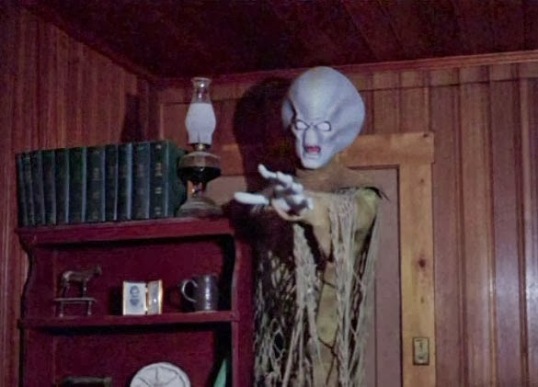
The TSL Horror Grindhouse: Spookies (dir by Brendan Faulkner, Thomas Doran, and Eugenie Joseph)


The 1986 film Spookies is not exactly the easiest film to describe.

A 13 year-old boy named Billy (Alec Nemser) runs away from home after his parents forget his birthday.  After a conversation with a random drifter, Billy ends up entering a spooky and apparently abandoned mansion.  The inside of the house is decorated for a birthday party.  “They didn’t forget!” Billy says, assuming the party is for him even though neither he nor his parents live at the house.  Needless to say, the party is not for Billy, who soon ends up getting buried alive by a werecat (Dan Scott).

The werecat is the pet of Kreon (Felix Ward), an elderly warlock who lives in the abandoned house and spends his time playing chess and trying to convince his wife, Isabelle (Maria Pechukas), to fall in love with him.  He’s been trying to convince Isabelle for 70 years.  Kreon is very old but Isabelle is still very young because Kreon has been sacrificing people to keep her young.  Isabelle is not particularly happy about that.

Meanwhile, a group of four couples and one friend come across the house on the same night of Billy.  Having gotten kicked out of a previous party, they decide to have a new party in the house.  The main thing that most viewers will notice about the nine friends is that none of them seem to have much in common.  Duke (Pat Wesley Bryan) and Linda (Joan Ellen Delaney) are apparently supposed to be rebellious teenagers, despite appearing to be in their 30s.  Adrienne (Charlotte Alexandra) appears to be wealthy and spoiled and is married to wimpy Dave (Anthony Valbrio).  Peter (Peter Dain) and Meegan (Kim Merril) both appear to be in their 40s and seem to be way too straight-laced and intelligent to be hanging out with Duke.  Rich (Peter Iasillo, Jr.) is the practical joker of the group and carries a puppet around with him.  Finally, Carol (Lisa Friede) and Lewis (Al Magliochetti) don’t get much character development as it only takes a few minutes for Carol to get possessed by a demon and for Lewis to die while trying to flee the mansion.

It turns out that the entire mansion is crawling with demons.  There’s zombies in both the wine cellar and the nearby cemetery.  There’s a spiderwoman who has spun quite an impressive web.  There are little green lizard things that chew off people’s faces.  There’s a hooded figure who can shoot out electrified tendrils.  While the monsters track down and kill the party-goers one-by-one, the Werecat watches from a distance and purrs.  Occasionally, he goes and visits with Kreon, who says that everything is going as he planned it.  Personally, I think Kreon is just saying that because it’s obvious that next to no planning went into any of this.

To say that Spookies is a bit disjointed would be an understatement.  The fact that there are three credited directors provides a clue as to how that came to be.  The footage with the partygoers and all the house monsters was filmed first and directed by Brendan Faulkner and Thomas Doran.  Creative differences between the film’s producers and financial backers led to the film being temporarily abandoned during the editing process.  A year later, Eugene Joseph was hired to shoot the scenes of Billy, Kreon, the Werecat, and Isabelle and those scenes were rather clumsily inserted into the original footage.  The end result was Spookies.

But, oddly enough, as confusing and disjointed and nonsensical as it all is, it kind of works.  The old mansion is creepy.  (Interestingly enough, the mansion is actually the Jay Estate, the home of founding father John Jay.)  Some of the monster makeup is effectively grotesque.  The story’s incoherence and even the all-around bad acting on the part of the actors playing the victims all come together to create a nightmarish atmosphere.  (And, in defense of the scenes that were shot by Eugenie Joseph, the performances of Felix Ward, Dan Scott, and Maria Pechukas are all actually quite good.)  The film’s frenzied ending actually works surprisingly well.

At its worst, Spookies is an Evil Dead rip-off that lacks the enthusiasm that Sam Raimi and Bruce Campbell brought to that film.  At its best, Spookies feels like a filmed nightmare.

The TSL’s Horror Grindhouse: Without Warning (dir by Greydon Clark)


1980’s Without Warning opens with a father (Cameron Mitchell) and his gay son (Darby Hinton) on a hunting trip.  The father taunts his son about not being what the father considers to be a real man.  He says that his son would have no chance of surviving in the wilderness.

“Why does it always have to be like this?” the son asks with a sincerity that will break your heart.

Suddenly, a bloodsucking starfish flies through the air, lands on the father, and starts to suck out his blood with a phallic stinger.  The father dies while his son watches.  The son picks up his rifle and prepares to fight back.  This will be the son’s chance to prove that his father was incorrect.  This is the son’s chance to prove that he can survive in the wilderness and….

Just kidding.  The son forgot to load the rifle and promptly gets a starfish to the eye.

That’s the type of film that Without Warning is.  Characters are introduced.  The majority of them are played by B-actor who have seen better days.  They get a few minutes of character development.  Then, they die and the viewer is left feeling a bit depressed because they all seemed like they deserved just a bit more screentime than they received.  Larry Storch shows up as a boy scout leader who gets a starfish to the back while trying to light a cigarette.  Neville Brand, Ralph Meeker, and Sue Anne Langdon hang out in a bar and refuse to believe that the Earth has been invaded by blood-sucking starfish.  Jack Palance plays a hunter and gas station owner who wants to capture an alien as a trophy.  Martin Landau plays Sarge, an unbalanced Vietnam Vet who has been telling people for years that there are aliens out there.  Everyone laughed at old Sarge but they won’t be laughing for long!  At the time this film was made, Palance was a two-time Oscar nominee.  He finally won his Oscar for City Slickers, a decade after Without Warning.  Martin Landau, for his part, won his Oscar 15 years after Without Warning.  Good for them.  If nothing else, this movie should remind everyone who has dismissed Eric Roberts’s chances that there’s still time!

That said, none of these familiar faces are the stars of the film.  Instead, the majority of the film follows four teenagers on a road trip, Sandy (Tarah Nutter), Greg (Christopher S. Nelson), Beth (Lynn Theel), and Tom (David Caruso).  David Caruso as a sex-crazed teenager sounds more amusing than it actually is.  If anything, the sight of him wearing shorts and t-shirt is almost blinding.  (As a fellow redhead, I sympathize.  We burn but we don’t tan.)  Tom and Beth die early on, leaving Greg and Sandy to try to escape from the alien (Kevin Peter Hall) who is tossing around the starfish.  Both characters are pretty generic but Christopher Nelson is at least likable.

Without Warning has a reputation for being the best film that Greydon Clark ever directed and I would agree that it’s one of his better ones, though I prefer The Forbidden Dance.  Then again, when you consider some of the other films that Clark directed, it’s easy to see that Without Warning didn’t exactly have a huge bar to clear.  Though the script borrows a bit too much from nearly every other horror film ever made, Without Warning is nicely paced and the killer starfish are genuinely frightening and their bloodsucking is almost Cronenbergian in its ick factor.  Just as he would for John Carpenter, cinematographer Dean Cundey gives us some nicely eerie shots of the alien.  Landau and Palance go all out, understanding that subtlety has no place in a film like this.  Without Warning is a dumb B-movie but it’s definitely entertaining.

Without Warning (1980, dir by Greydon Clark, DP: Dean Cundey)

6 Trailers In Memory of Roger Corman


Today, for the first day of Horrorthon, we pay tribute to the legacy of the legendary Roger Corman with a special edition of Lisa Marie’s Favorite Grindhouse and Exploitation Film Trailers.

1. The Day The World Ended (1955)

Though Corman worked in almost every type of film genre imaginable, he’s probably best remembered for his science fiction and horror films.  This was one of the first of them.

2. Bucket of Blood (1959)

In Bucket of Blood, Roger Corman gave Dick Miller a starring role and also mixed comedy and horror in a way that influence many future horror directors.

3. Little Shop of Horrors (1960)

Roger Corman famously shot Little Shop of Horrors in just two days.  The end result was a mix of comedy and horror that continues to be influential to this day.  The musical is very good but I still prefer the cheerful low-budget aesthetic of the Corman original.

4. The Terror (1963)

Corman was famous for his ability to spot new talent.  His 1963 film The Terror starred a then unknown actor named Jack Nicholson.

5. The Masque of the Red Death (1964)

In the 60s, Corman was also well-known for his Edgar Allan Poe adaptations, the majority of which starred Vincent Price.  With these colorful and flamboyant films, Corman showed himself to be a pop artist at heart.

6. Frankenstein Unbound (1990)

In the 1970s, Corman retired from directing and instead focused on producing and distributing movies.  In 1990, he briefly came out of retirement and gave us his final directorial effort, Frankenstein Unbound.

12 Roger Corman Trailers


Roger Corman in The Godfather Part II

Today we pay tribute to the legacy of Roger Corman with a special edition of Lisa Marie’s Favorite Grindhouse and Exploitation Film Trailers.

  1. Five Guns West (1955)

This western was the first film that Roger Corman was credited with directing.

2. The Day The World Ended (1955)

Though Corman worked in almost every type of film genre imaginable, he’s probably best remembered for his science fiction and horror films.  This was one of the first of them.

3. Not of this Earth (1957)

Not of this Earth was not only one of Corman’s better sci-fi films but this also the first film in which Corman really took full advantage of character actor Dick Miller.  (Miller, a longtime friend of Corman’s, largely improvised his role as a hip vacuum cleaner salesman.)

4. Machine Gun Kelly (1958)

Along with westerns and sci-fi films, Corman also directed several gangster classics.  Machine Gun Kelly is remembered as one of his best.

5. Bucket of Blood (1959)

In Bucket of Blood, Roger Corman gave Dick Miller a starring role and also mixed comedy and horror in a way that influence many future horror directors.

6. Little Shop of Horrors (1960)

Roger Corman famously shot Little Shop of Horrors in just two days.  The end result was a mix of comedy and horror that continues to be influential to this day.  The musical is very good but I still prefer the cheerful low-budget aesthetic of the Corman original.

7. The Intruder (1962)

Corman was an exploitation filmmaker with a conscience.  At a time when other films were avoiding social issues, Corman dove right in with challenging films like The Intruder.

8. The Terror (1963)

Corman was famous for his ability to spot new talent.  His 1963 film The Terror starred a then unknown actor named Jack Nicholson.

9. The Masque of the Red Death (1964)

In the 60s, Corman was also well-known for his Edgar Allan Poe adaptations, the majority of which starred Vincent Price.  With these colorful and flamboyant films, Corman showed himself to be a pop artist at heart.

10. The St. Valentine’s Day Massacre (1967)

The St. Valentine’s Day Massacre featured Corman directing a film for a big studio.  The film recreated the gang war between Al Capone and George Moran while also finding room for Corman regulars like Jack Nicholson, Dick Miller, and Jonathan Haze.

11. The Trip (1967)

Roger Corman was always sympathetic to the counter-culture, which led to the remarkably nonjudgmental nature of The Trip, a film in which Peter Fonda drops acid under the guidance of Bruce Dern and Dennis Hopper.  Jack Nicholson wrote the script.

12. Frankenstein Unbound (1990)

In the 1970s, Corman retired from directing and instead focused on producing and distributing movies.  In 1990, he briefly came out of retirement and directed his final film, Frankenstein Unbound.

The TSL Grindhouse: Locked Up (dir by Jared Cohn)


The 2017 film Locked Up tells the story of Mallory (Kelly McCart).

Mallory is not having a great life.  Her wealthy father has relocated to an unnamed county in Southern Asia.  (The film was shot in Thailand but the uniforms that we see various officials wearing seem more appropriate for North Korea.)  Mallory lives with her Uncle Tommy (Jared Cohen), who is Mallory’s legal guardian while her father is off doing whatever it is that he does.  Mallory goes to a school where she is the only American and certainly the only redhead.  She is bullied to such an extent that she finally snaps and punches another student.  Mallory is promptly arrested and sentenced to the country’s version of reform school.

When Tommy and Mallory first arrive at the facility, it seems to be clean and welcoming.  The Warden (Maythavee Burapasing) appears to be friendly and compassionate.  It seems like the type of place that all of us bleeding hearts are always insisting that we need here in America.  It’s only after Tommy leaves that the truth is revealed.  The reform school is actually a prison and the Warden is a sadistic tyrant.  Mallory is tossed into a filthy cell with several other girls and ordered to strip while everyone watches.  One of Mallory’s cellmates, Kat (Katrina Grey), orders Mallory not to cry because Kat doesn’t want the sound of her tears keeping her awake at night.

After manipulating Mallory into signing a document that says she doesn’t want her uncle to visit her in prison, The Warden reveals that she enjoys watching the prisoners fight.  She informs Mallory that she has two weeks to prepare for her first fight and that, if Mallory doesn’t fight, she will be gang raped twice a week for as long as she remains in the prison.  Mallory, having no experience with fighting (despite having hit that one student hard enough to get sentenced to confinement), begs Kat to train her.  At first reluctant, Kat eventually agrees.  But can even Kat’s training prepare Mallory for a fight against the fearsome Riza (Anastasia Maslova)?

If this all sounds rather exploitive, that’s because it is.  The film hit every sordid women-in-prison cliche with the efficiency of well-wound clock.  In fact, it’s so dedicated to hitting all of the expected beats that it actually becomes a bit comical at times.  Less than a minute after she enters her cell, Mallory has another inmate talking about how cute she is and sniffing her neck.  Mallory and Kat’s fight training inevitably leads to a shower room sex scene and Kat talking about how she’s in prison because her boyfriend convinced her to be a drug smuggler.  Meanwhile, because she is determined to turn Riza into a killing machine, The Warden personally injects steroids into Riza’s neck.  It’s all so shameless that you can’t help but appreciate the film’s audacity, even if there are several scenes (most of which involve the Warden’s threat to have the guards rape Mallory) that cross the line from being merely tasteless to being actually offensive.

Locked Up is an Asylum Production.  Like most Asylum films, it makes no excuses or apologies for being what it is.  (Regardless of how you feel about their films, it’s hard not to appreciate The Asylum’s honesty.)  In most ways, Locked Up is a pretty dumb movie but director Jared Cohen keeps the action moving quickly and The Warden is a properly hissable villain.  The Warden tells Mallory that her problem is that Americans have allowed themselves to become weak and, even if the film’s portrayal of Asia makes Midnight Express‘s portrayal of Turkey seem fair and balanced, it’s hard not to feel that the Warden has a point.  Get out there and fight, America!

6 Trailers For May 4th


Star Wars not only launched an entire expanded universe.  It also launched a few thousand rip-offs.  For this weeks edition of Lisa Marie’s Favorite Grindhouse and Exploitation Film Trailers, we’ve got six trailers that might seem just a little familiar….

  1. Battle Beyond The Stars (1980)

From Roger Corman comes this film, which is as much a rip-off of The Magnificent Seven as it is of Star WarsBattle Beyond The Stars was a surprise box office success when it was first released.

2. Space Raiders (1983)

Also from executive producer Roger Corman, Space Raiders tells the story of what happens when a quirky band of intergalactic outlaws pick up an annoying (and frankly, rather stupid) kid.

3. The Humanoid (1979)

From director Aldo Lado, The Humanoid features the great Richard Kiel as the title character.  There’s also a cute robot, an older mystic, and an evil Empire.

4. Message From Space (1978)

Do you remember another film that had a message from space?

5. Flash Gordon (1980)

Interestingly enough, Star Wars was as inspired by the original Flash Gordon as the Flash Gordon reboot was inspired by Star Wars.

6. Starcrash (1978)

And finally, we have Starcrash, the Star Wars rip-off that is actually better than Star Wars!

The TSL Grindhouse: The Spook Who Sat By The Door (dir by Ivan Dixon)


1973’s The Spook Who Sat By The Door opens with Senator Hennington (Joseph Mascolo) in a panic.

The Senator is running for reelection and is struggling to appeal to white voters and minority voters at the same time.  White voters are happy that the Senator recently gave a speech in favor of “law and order” but now, he’s polling weakly with black voters.  His wife (Elaine Aiken) suggests that the Senator win back black voters by demanding that the CIA hire more black agents.

The CIA responds to the political pressure by hiring Dan Freeman (Lawrence Cook) to be their first black agent.  Freeman is given the standard CIA training and taught how to start revolutions in other countries.  However, after he completes his training, Freeman is assigned no real responsibilities.  He is given a desk job and spends most of his day making copies.  Whenever a senator or a reporter visits CIA Headquarters, Freeman is trotted out so that the CIA can claim to be diverse.  Freeman understands that he’s a token.  He knows that his job is to basically sit by the door and be seen.  But Freeman actually has bigger plans.

After spending a few years at the CIA, Freeman resigns and heads back to Chicago to work as a social worker.  Using what he learned at the agency, he starts to recruit young black men as freedom fighters.  He and the Cobras (as they’re called) launch their own guerilla war against the establishment in Chicago.  Some of their tactics are violent and some of them are not.  Freeman understands the importance of winning both hearts and minds and he recruits Willy (David Lemieux) to serve as his lead propagandist.  Because Willy is light-skinned, he is also assigned to rob a bank because Freeman knows that both the witnesses and the police will mistake him for being white and will be less likely to fire on him.  (The other members of the Cobras wear whiteface during the robbery.)

Freeman hopes that he will be able to recruit his childhood friend, Dawson (J.A. Preston), to the cause.  Dawson, however, now works as a detective for the Chicago PD and has been assigned to beak up the Cobras.  Will Freeman be able to bring over Dawson and what will happen if Dawson resists?

Based on a novel by Sam Greenlee (who was one of the first black men to be recruited to work with the United States Information Agency and who based many of Freeman’s CIA experiences on his own), The Spook Who Sat By The Door has achieved legendary status as a film that the FBI reportedly tried to keep out of theaters.  Theater owners were pressured to either not book the film or to only book it for a week before replacing it with a less incendiary film.  As a result, The Spook Who Sat By The Door became a difficult film to see.  As often happens, the efforts to censor the film only added to its revolutionary mystique.

Of course, in 2024, one can go on YouTube and watch the film for oneself.  It’s definitely uneven film, one that has pacing issues (especially at the beginning) and also one that suffers due to its low budget.  Depicting the overthrow of the government on a budget will always be a challenge.  Some of the acting is a bit amateurish but Lawrence Cook broods convincingly as Freeman and he’s well-matched by J.A. Preston’s portrayal of the more down-to-Earth Dawson.  At its best, there’s a raw authenticity and anger to the film that immediately captures the viewer’s attention.  It’s the rare political film to actually feature conversations about actual politics and it’s a film that asks how far people would be willing to go to accomplish change.  The Spook Who Sat By The Door suggests that the true villains are the members of the establishment who cynically embraced the civil rights struggle in their words but not in their actions.  In the end, Dan Freeman becomes a bit of a fanatic but the film suggests that perhaps a fanatic was what the times demanded.

6 Trailers For October 31st, 2023


Happy Halloween!  For today’s special edition of Lisa Marie’s Favorite Grindhouse and Exploitation Film Trailers, we are paying tribute to the great George Romero!  Here are six trailers, all for films directed by the master of American horror!  How many of them have you watched this October?

  1. Night of The Living Dead (1968)

2. The Crazies (1973)

3. Martin (1977)

4. Creepshow (1982)

5. Monkey Shines (1988)

6. The Dark Half (1993)