Film Review: Free Fire (dir by Ben Wheatley)


Last night, I saw Free Fire, the latest film from the visionary British directing-and-screenwriting team of Ben Wheatley and Amy Jump.

Free Fire takes place in Boston in the 1970s.  We know it’s the 70s because of all the wide lapels, the flared jeans, and the impressive facial hair.  In short, everyone looks like an extra from Thank God, It’s Friday.  Note that I said Thank God, It’s Friday and not Saturday Night Fever.  None of the characters in Free Fire could pull off John Travolta’s white suit.  As much as they try to pretend otherwise, everyone in this film is low rent.  No one is as clever or street smart as they believe themselves to be.  Even more importantly, no one is as good a shot as they think.

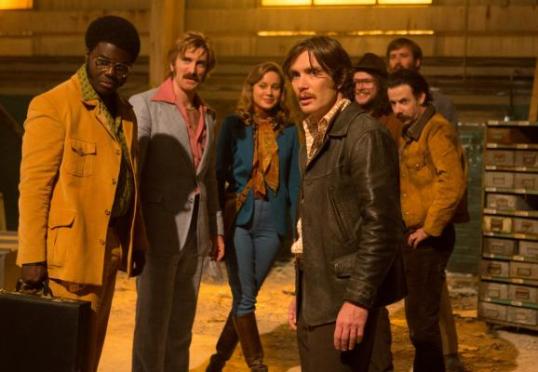
The film takes place in a decrepit warehouse, the type of place that is strewn with rats and hypodermic needles.  Chris (Cillian Murphy), Frank (Michael Smiley), Steve-O (Sam Riley), and Bernie (Enzo Cilenti) are members of the Irish Republican Army and they’ve come to the U.S. to purchases weapons.  Chris and Frank are no-nonsense professionals.  Bernie is a well-meaning moron.  Steve-O is a drug addict who, the previous night, got beaten up after he smashed a bottle across the face of a 17 year-old girl.

Working as intermediaries are Justine (Brie Larson) and Ord (Armie Hammer).  Justine specializes in keeping jumpy people calm.  She and Chris flirt as they wait for the guns to arrive.  As for Ord — well, let’s just say that Ord was my favorite character in the film.  He’s always calm.  He looks really good in a suit.  And, whenever things get intense, he’s always quick to light up a joint and make a sarcastic comment.  This is probably the best performance of Armie Hammer’s career so far.  (Or, at the very least, it’s the best performance of his that I’ve seen.  I hear that he gives an excellent performance in the upcoming Call Me By Your Name.)  Certainly, this is the first film that I’ve seen, since The Social Network, in which Hammer seemed to be truly worthy of the hype that has surrounded his career.

Finally, there’s the gun dealers themselves.  There’s Martin (Babou Ceesay), who seems to be fairly low-key professional.  There’s Gordon (Noah Taylor), who is a henchman who looks disconcertingly similar to Chris.  And then there’s Vernon, who is from South Africa and who is constantly talking and smiling.  Not surprisingly, Vernon is played by Sharlto Copley.  Finally, Harry (Jack Reynor) is a driver who desperately wants to impress Ord.  Harry loves John Denver and he also loves his cousin.  In fact, he loves his cousin so much that, when he recognizes Steve-O as the junkie who smashed a bottle across her face, Harry pulls a gun and starts firing.

The rest of the film deals with the resulting gun fight, which is complicated with two mysterious snipers (Patrick Bergin and Mark Monero) suddenly open fire on both of the groups.  Who hired them and why?  That’s a mystery that could be solved if everyone stops shooting and yelling at each other.  Of course, that’s not going to happen because 1) no one is a good enough shot to actually get the upper hand and 2) almost everyone in the warehouse is an idiot.

At it’s best, Free Fire mercilessly parodies the excessive violence of modern crime cinema.  When it comes to crime films, most people just remember the shoot outs so Free Fire takes things to their logical extreme by just being a 90-minute gun fight.  At its weakest, Free Fire occasionally becomes exactly what it’s parodying.  The film’s structure — one night in one location — proves to be limiting.  At times, you find yourself really wishing for a flashback or at least a little exposition to explain who everyone is outside of that warehouse.  The cast is full of good actors and they all give good performances but the characters are, at best, thinly drawn.  At times, it was difficult to keep track who was who.  I especially found myself mixing up Michel Smiley and Sharlto Copely.  It was all the facial hair.

About 30 minutes into Free Fire, I was already composing a bad review in my head but, by the final shot (and yes, the double meaning is totally intentional), Free Fire had won me over.  It’s an experiment that doesn’t really work but it’s so relentless and dedicated to seeing its story to its conclusion that I couldn’t help but appreciate the film’s efforts.  When the guns finally did stop firing and the end credits started, I was shocked to discover that, without even realizing it, I actually had gotten just a little caught up in the film’s story.

Ben Wheatley and Amy Jump previously gave us one of the most memorable films of the decade (so far), A Field in England.  Free Fire might not quite work but I’ll always make the time to see the latest from Wheatley and Jump.

 

Here’s The Red Band Trailer For Free Fire!


Hi, everyone!

When Jeff and I went to see Logan on Thursday night, one of the many trailers that played before the film was this red band one for Free Fire.  Free Fire is an action comedy, one that I think is meant to satirize the ultra violent heist films of the 90s and early aughts.  Seriously, there are parts of this trailer that should make Guy Ritchie cringe.

That said, this trailer is also about a minute too long.  At first, everyone in the theater thought it was kind of funny but then, around the two minute mark, the yawns started to kick in.  “Are they just going to shoot at each other for the entire trailer?” someone asked.

The answer is yes.  And you know what?  The trailer probably doesn’t do Free Fire justice because this movie was directed by Ben Wheatley and I’m still having dreams inspired by his oddly hypnotic A Field in England.  I’ll follow him anywhere!

Free Fire has a March 31st release date in the UK and an April 21st release date in the States.

Anyway, here’s the red band trailer for Free Fire!

Shattered Politics #85: In the Loop (dir by Armando Iannucci)


In_the_Loop_poster

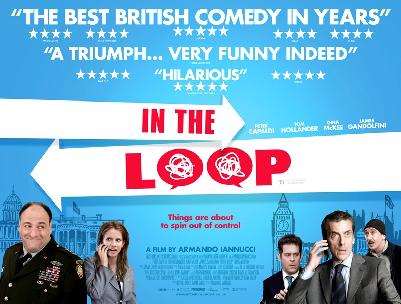
First released in 2009, In The Loop is one of the most brilliant political satires ever made.

The film opens in London, as a slightly ridiculous man named Toby (Chris Addison) starts his first day as the special assistant to the Secretary of State for International Development, Simon Foster (Tom Hollander).  And what a day to start!  Both the President of the United States and the British Prime Minister are eager to invade the Middle East and, during an interview the previous night, Simon accidentally announced that war was “unforseeable.”  This has led to people accidentally assuming that Simon is anti-war (Simon really doesn’t seem to have an opinion one way or the other) but it also means that the Prime Minister’s compulsively profane assistant, Malcolm Tucker (Peter Capaldi), is now running around the office and threatening people.

(I doubt that there’s any way that I can do justice to Capaldi’s performance here.  You simply have to see him.  He is a force of nature, a tornado of nonstop profanity and aggression.)

Not every government official in the U.S. is enthusiastic about going to war.  Both Assistant Secretary of State for Diplomacy Karen Clarke (Mimi Kennedy) and her former lover, Gen. George Miller (James Gandolfini) are opposed to the war.  Karen’s assistant, Liza (Anna Chlumsky), has even written a paper that explains why a war in the Middle East could not be won.  Karen hopes to use Simon as a spokesman to keep the British out of the war and, therefore, America as well.

(Toby, meanwhile, just wants to have sex with Liza.)

However, there are a few factors that complicate things.  First off, Malcolm is determined to make sure that the Prime Minister gets what he wants and if that means bullying and scaring everyone into supporting an unwinnable war, that’s exactly what he’s going to do.  Secondly, U.S. Assistant Secretary of State For Policy Linton Barwick (David Rasche) is eager enough to start a war that he’s actually started a secret committee to find a way to get into the war.  (The committee, of course, has been called the Committee For Future Planning.)  Third, and perhaps most importantly, Simon is an idiot.

Along with being both a satire of American-British relations (my favorite moment comes when a random American tourist tells Malcolm to stop cursing in public) and the lead-up to the Iraq War, In The Loop is also a devastating look at how government works.  In the Loop makes a good case that, for all the titles and the committee and the talk about doing what’s right, most government policy is the result of a combination of stupidity and needless aggression.  As played by Capaldi, Malcolm has no ideology or core beliefs.  He simply makes sure that the Prime Minister gets what he wants.

And if that means going to war, then Malcolm will do whatever it takes to push Britain into war.

Director Armando Iannucci is probably best known for creating two political comedies, the Thick of It and Veep.  And while I’ve never seen The Thick Of It, I absolutely love Veep.  From what I’ve read, all three projects share the same fictional universe.  (Capaldi’s Malcolm was the main character on The Thick Of It.)

Though, actually, I think it’s debatable just how fictional that universe is.  Ultimately, In The Loop is probably one of the most plausible satires that I’ve ever seen.

http://www.youtube.com/watch?v=_VDc7-YH1LA

Film Review: The Theory of Everything (dir by James Marsh)


theory-of-everything-felicity-redmayne

Earlier this year, when I was sitting in the audience for the unfortunate Nicholas Sparks film The Best Of Me, I found myself staring at the sight of an oil rig worker (played by James Marsden) relaxing by reading Stephen Hawking’s A Brief History of Time.  And, before I could stop myself, I laughed out loud and I may have even loudly said something along the lines of, “Oh come on!”

At the time, I got a lot of dirty looks but I stand by my reaction.  It’s such a cliché.  Any movie character who is meant to be intelligent and soulful will be seen casually reading a copy of Hawking’s book and scrunching up his brow as he considers whatever it is that Hawking has to say.  It makes sense, of course.  If the current cult surrounding Neil deGrasse Tyson proves anything, it’s that it is currently in to pretend to be fascinated by science.

I have to admit, though — science has never been my subject.  The cold logic of it all bores me to tears and there’s no bigger turn-off then listening to someone brag about being a “rational thinker.”  (Rational thought is incredibly overrated.)  As long as things work like they’re supposed to, the how and the why don’t really concern me.  Whenever I hear someone complain that there are “too many unanswered questions,” I think to myself, “Good.”  I like unanswered questions.  I like irrational feelings.  I like mysteries that can never be solved.  They fuel imagination.  They inspire great art.  They make life interesting and unpredictable.

(Please understand, I am not anti-science.  I’m anti-pretending-to-care-when-I-don’t.)

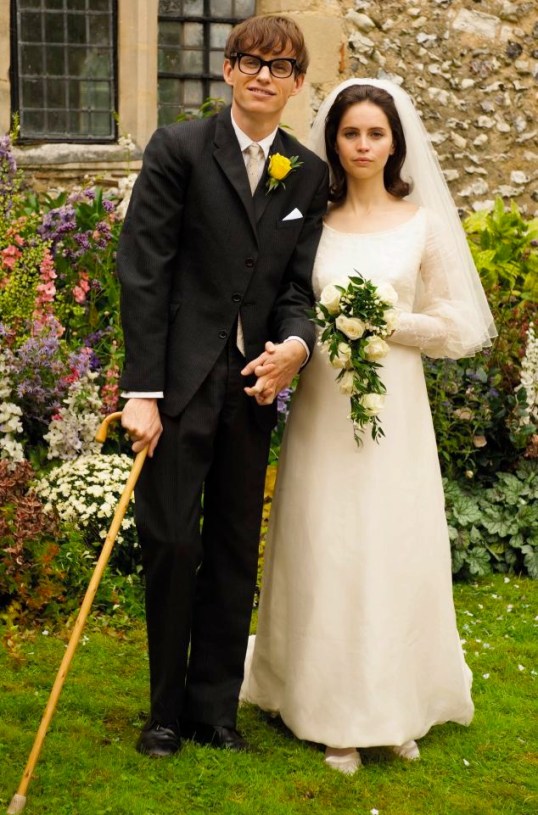
With all that in mind, you might think that I would be bored by The Theory of Everything, the recently released biopic about Stephen Hawking (Eddie Redmayne) and his marriage to Jane Hawking (Felicity Jones).  And, I’ll be honest.  If not for the fact that the film has been pegged as being a certain Oscar contender, I might not have ever wanted to see The Theory of Everything.  However, seeing as how The Theory of Everything is a certain Oscar contender, I did want to see it.

And, up until the final 30 minutes of the film, I was surprised with just how much I liked The Theory of Everything.  I have to admit that the film’s science still went over my head.  As far as that was concerned, the only thing I really learned is that there’s a difference between General Relativity and Quantum Field Theory but don’t ask me to explain that difference.  (And, for the love of all that is good, please don’t try to explain it to me…)  But, to be honest, the exact details of Hawking’s theories aren’t really that important to The Theory of Everything.  Instead, the film is content to have supporting characters assure us that Hawking’s work is brilliant and important and that’s really all that it has to do.  After all, everyone in the audience already knows that Stephen Hawking is a genius.  The appeal of The Theory of Everything is not the science but instead the human behind the science.

The Theory of Everything works for two very old-fashioned reasons — it’s well-directed by James Marsh and it’s well-acted by Eddie Redmayne and Felicity Jones.  For all the time that the film devotes to people talking about how Hawking challenged the conventional view of the universe, The Theory of Everything is, in many ways, a conventional biopic.  But that’s not necessarily a bad thing.  A familiar story well-told is still a well-told story.

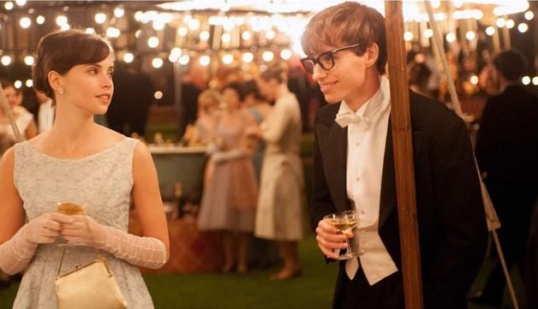
The film starts with Stephen as a student at Cambridge and we follow him as he awkwardly courts Jane and takes her on an amazingly well-filmed and soul-achingly romantic date.  Shortly after this, he’s diagnosed with motor neuron disease.  (As I discovered while doing some research for this review, Hawking was actually diagnosed before he even met Jane.)  Told he only has two years to live, Stephen’s first instinct is to isolate himself from the world but, largely as a result of Jane’s love and support, Stephen instead continues his work and becomes world famous.  The film suggests that it took a combination of Stephen’s logical (and skeptical) genius and Jane’s devout and unwavering faith (in both his genius and the God that Stephen doesn’t believe in) for him to eventually become the Stephen Hawking that we all recognize today.

And it’s all extremely well-done and touching, up until the final 30 minutes of the film.  Going into the film, I did not know much about Stephen Hawking but (thanks to Wikipedia), I did know that he eventually left Jane for another woman.  I have to admit that I did not expect the film to deal with this part of the story.  To the film’s credit, it does attempt to deal with the end of Stephen and Jane’s marriage but it does so in such an awkward way that it’s obvious that the filmmakers weren’t quite sure how they should handle the situation.

After all, the film had just spent 90 minutes presenting Jane as being an occasionally frustrated saint and Stephen as being idiosyncratic but likable.  And now, suddenly, Stephen is going to have to act like a jerk.  The film doesn’t know how to handle this and, as such, those final 30 minutes feel fake in a way that the rest of the film does not.  When Stephen tells Jane that he’s leaving her for another woman, it’s presented as being an almost mutual decision made by the two of them.  Tears are shed but there’s little visible anger, with the film going so far as to suggest that Stephen is leaving Jane because he wants her to be able to live the life that she put on hold to take care of him.  It’s even implied that Stephen was kind enough to pick out a new husband for her.

That new husband is played, quite well, by Charlie Cox.  When he first told Jane that he’s attracted to her, I assumed that the scene was included so that Jane could gently rebuff him and show us how devoted she is to Stephen.  However, thinking back on it now, it almost feels as if that scene was largely included so it could provide some cover for Stephen.  It’s as if the filmmakers are saying, “See?  Stephen wasn’t the only one tempted to end the marriage…”

And I have to admit that the way the film handled the end of Stephen and Jane’s marriage felt so false to me and the way Jane was treated and portrayed seemed so unfair that, as soon as I got home, I actually did the following google search: “Was The Theory Of Everything unfair to Jane Hawking?”

And the first result that came up was an article in The Guardian that essentially stated: “Yes, The Theory of Everything was unfair to Jane Hawking.”

Reading the article, I discovered that, according to Jane’s autobiography (upon which the film is ostensibly based), both her marriage to and divorce from Stephen Hawking was far more complex and intriguing than what was presented in the film.  For one thing, the marriage ended not with tears of acceptance but instead with a shouting match.  And trust me, if any actress could have done justice to Jane Hawking’s anger, it would be Felicity Jones.  By the time the film ends, both the character and the actress have earned the right to express their anger.  But neither one of them gets that opportunity, largely because that version of the Hawking marriage would also have been far less crowd pleasing.

And, if anything, The Theory of Everything is specifically designed to be a crowd pleaser.

And don’t get me wrong.  It’s a good film and it’s one that left me with tears in my eyes.  Do I recommend the film?  You bet I do.

I just wish that, during those final 30 minutes, the film could have been a little bit more honest with itself.  It’s a good film but it’s hard not to regret missing out on the film that it could have been.

theory-of-everything-new

Trailer: Kick-Ass 2 (Extended Red Band)


KickAss2

This past week saw the largest collection of nerd, geek and comic book fandom gathered in one magical place. The place in question is San Diego and the event is called San Diego Comic-Con or simply just uttered in awed whispers as Comic-Con. It is a place that many outsiders have shunned as a place that has no place in good, normal society yet they continue to arrive in larger numbers to ply their products to those they shun. Even this blog has it’s shamers and ignorant individuals who spew insults yet they too continue to visit because deep in their subconscious they know, like those who ridicule Comic-Con and those who attend them with a passion, that they’re the ones out of step with whats not accepted in society.

What does this mean when it comes to the latest trailer for Kick-Ass 2 that just came out of Comic-Con?

Absolutely nothing other than the trailer and the film itself is just another weird meeting of the two cultures. It’s a film that celebrates the ridiculousness and absurdity of the comic book culture, yet it’s one that’s funded by the very same people who insulted the scene just a decade ago.

The first film was a revelation and helped introduced the world to one Chloe Grace Moretz, but it also showed that comic books and films made from them didn’t have to be PG or even PG-13. There was a place for ultra-violence in our comic book films. It also helped bring the name of Matthew Vaughn into the forefront of comic book fandom. While he’s not directing this sequel (he elected to go with X-Men: First Class and we’re all the better for it), he did help in bringing it to life and hand-picked his successor in Jeff Wadlow.

While Kick-Ass 2 is not getting the same sort of buzz from Comic-Con the original film did it is still one film I’m quite interested in seeing just to find out what has happened to our young superheroes and vigilante crime fighters since the last film. Plus, it’s main villain likes to call himself “Motherfucker”.

Trailer: Kick-Ass 2 (Red Band)


KickAss2

2010’s Kick-Ass was one of those films that you either loved or hated. It was a film adapted from the Mark Millar and John Romita, Jr. comic book of the same name that also had a similar reputation of having extreme opposites in regards to how people perceived it.

I, for one, loved the film despite just being “meh” when it came to the comic. Where the film by Matthew Vaughn was a darkly comic deconstruction of the superhero story the comic book that gave birth to it was just an exercise in shocking the readers without working for it. Yet, despite that the film was a hit with both the fans of the comic book and those who didn’t even know it was a comic book. That popularity allowed the film to make enough profit that a sequel was greenlit even before a second volume of the comic book was even started by Millar and Romita, Jr.

Kick-Ass 2 sees the return of both Hit-Girl and Kick-Ass with Red Mist now calling himself The Motherfucker and the film’s main antagonist. The sequel sees Matthew Vaughn return as producer with Jeff Wadlow stepping in as director.

Kick-Ass 2 is set for an August 16, 2013 North American release date with the film premiering earlier on July 19, 2013 in the UK.