I’m a big fan of Gerard Butler, mainly because of his macho performances in action films and thrillers. I also appreciate his ability to sing. I remember being surprised and impressed with his performance in Joel Schumacher’s version of THE PHANTOM OF THE OPERA. I really enjoy the song “The Music of the Night,” and since I reviewed one of his thrillers today (SHATTERED), I thought I’d balance it out with a video of him belting out a tune. Enjoy!
Tag Archives: Emmy Rossum
Embracing The Melodrama: Poseidon (dir by Wolfgang Petersen)
The plot of 2006’s Poseidon may sound familiar.
There’s this cruise ship. It’s a luxury liner and it’s sailing across the ocean on New Year’s Eve. There’s a lot of passengers on the liner. Most of them are wealthy and the majority of them are played by familiar actors. Everyone is in the ballroom, celebrating the upcoming new year. They do the countdown. They cheer when they hit zero. Kisses are exchanges. Dances are danced. A blonde woman sings a song. Suddenly, a tidal wave smashes into the Poseidon, turning it over. Explosions rock the ship as it ends up floating upside down. The majority of the crew and the passengers are killed immediately. The survivors face a decision. Do they stay in the ballroom or do they attempt to climb upwards to safety?
Yep, Poseidon is a remake of The Poseidon Adventure. It tells basically the same story but with slightly better special effects and slightly less histrionic actors. The original Poseidon Adventure had Gene Hackman and Ernest Borgnine yelling at each other for over two hours while Shelley Winters swam until she died. “WHERE’S YOUR GOD NOW, PREACHER!?” Borgnine shouted while Hackman yelled, “ROGO!” over and over again. (Rogo was Borgnine’s character. Hackman shouted the name with a wonderful amount of loathing.) It was a very loud and every entertaining movie. The cast of Poseidon is a bit more low-key but Poseidon is also more interested in special effects than any sort of human (melo)drama.
For instance, Josh Lucas plays a Navy veteran-turned-professional gambler. He gives a good performance as the de facto leader of the survivors but he never gets to yell as much as Gene Hackman did in the original. Richard Dreyfuss plays an architect and you would think that Dreyfuss, of all people, would chew up the scenery in this disaster film with relish but Dreyfuss is oddly subdued. Jacinda Barrett is the mother who tries to protect her son (played by Jimmy Bennett). Fergie is the singer who embraces the ship’s captain (Andre Braugher) as the ballroom floods. Emmy Rossum is the rebellious teenager. Mike Vogel is her boyfriend. And Kurt Russell plays the former mayor of New York City. He also happens to be a former fireman.
It’s a good cast. Kurt Russell is especially good in his role, believable as both a fireman (a role that he’s played in a few films) and as a politician. It’s a talented group of actors but no one really goes overboard in the way that Gene Hackman, Ernest Borgnine, Shelley Winters, Stella Stevens, Roddy McDowall, and even Leslie Nielsen did in the first one. The premise of the film is so silly that it really does require the cast and the director to fully embrace the melodrama. As opposed to the original, this film only gives the melodrama a quick hug and instead concentrates on explosions, water, and flames. The special effects overshadow the humans and that’s unfortunate because there’s a lot of interesting people in this movie. A good performance can last a lifetime. There’s a reason why we still talk about Kurt Russell in films like Escape From New York and The Thing. Good special effects, on the other hand, still look incredibly dated after three years.
I’m not really sure that it was necessary to remake The Poseidon Adventure in the first place. I’m just glad they left Beyond The Poseidon Adventure alone.
Miniseries Review: Angelyne (dir by Matt Spicer and Lucy Tcherniak)
Who is the real Angelyne?
That’s question that is at the heart of Peacock’s new miniseries, Angelyne. The obvious answer is that Angelyne (played, quite well, by Emmy Rossum) is a Los Angeles icon who, in the 80s and 90s, was known for having her image plastered on billboards across the city. The billboards usually featured a provocative picture of Angelyne, her name, and a phone number that one could call. Billboards, of course, are used for advertising and Angelyne was advertising herself. What service did Angelyne provide? She provided the service of being a celebrity that people might actually run into while walking or driving around the city. She drove her pink Corvette across Los Angeles, waved at tourists, and sold merchandise to her fans. She even twice ran for governor. Before the Kardashians and the explosion of social media, Angelyne was famous for being famous. And when people asked who Angelyne was before she became Angelyne, she replied that she had always been Angelyne. Sometimes, she said she was someone who had come to Los Angeles from another state. Sometimes, she said that she was a literal angel, sent down to spread peace and help people believe in themselves. Other times, she suggested that she was an extra-terrestrial. Perhaps her most honest response was that she was whatever the person looking at her wanted to be. People saw Angelyne and they projected their own feelings onto her.
Filmed in a manner that combines faux documentary footage with flashbacks, each of Angelyne‘s five episodes focuses on someone from Angelyne’s past as they talk about their role in Angelyne’s enigmatic life. Often times, they seem to be struggling to come to terms with the fact that they’re obsessed with someone about whom they actually know very little. A smarmy reporter (Alex Karpovsky) and a twerpy filmmaker (Max Allen) both investigate Angelyne’s past and it’s hard not to resent their efforts to bring her down to Earth. (The reporter, at one point, actually says that Angelyne lost her right to privacy when she ran for governor, as if anyone seriously believed Angelyne was going to be the next governor of California. Seriously, most viewers will want to smack him.) Cory Hunt (Philip Ettinger), the lead singer of a band that Angelyne was briefly a member of, tries to take credit for creating her persona but he’s never credible and Angelyne even interupts their flashbacks to say that he’s lying. Wendy Wallace (played by Molly Ephraim) struggles to come to terms with the fact that her father, Harold (Martin Freeman), not only bankrolled Angelyne’s billboards but also neglected his family to “manage” Angelyne’s career. Angelyne’s assistant, Rick (Hamish Linklater), devotes his life to supporting and protecting Angelyne but sometimes, even he has to take a break.
All of them get their chance to tell their story and, as played by Rossum, Angelyne gets to tell her story. Not surprisingly, Angelyne’s story often differs from the stories being told about her. Frequently, a flashback will come to a halt as soon as Angelyne announces, “That’s not what happened.” When the twerpy filmmaker claims that he got Angelyne to admit the truth about who she was before she remade herself as Angelyne, Angelyne pops up to tell us that it never happened. Even after the “truth” of Angelyne’s past has been revealed, Angelyne shows up to assure that the story isn’t true and, if it is true, it’s only halfway true and it’s impossible not to respect Angelyne’s refusal to accept or admit to being anyone other than a Los Angeles icon named Angelyne. The miniseries suggests that Angelyne is someone who dealt with unimaginable pain and trauma by creating herself as almost a cartoon of what it means to be a celebrity. The miniseries also suggests that, at the very least, Los Angeles should be thankful that she did.
In many ways, Angelyne feels like a superior companion piece to Hulu’s Pam & Tommy. Both miniseries are about the curious nature of fame and the America’s bizarre celebrity culture. The main difference is that while Pam & Tommy was thuddingly literal and featured Seth Rogen wandering around with that stupid mullet, Angelyne is stylish and imaginative and there’s not a mullet in sight. Whereas Pam & Tommy struggled to justify its existence, Angelyne features a scene where the title character flies a UFO over Los Angeles. Whereas Pam & Tommy presented Hugh Hefner as being a benevolent father figure, Angelyne features a scene where Angelyne tells off a smug Hefner and informs him that there’s nothing his magazine can do for her that she can’t do for herself. For that scene alone, Angelyne deserves to be seen.

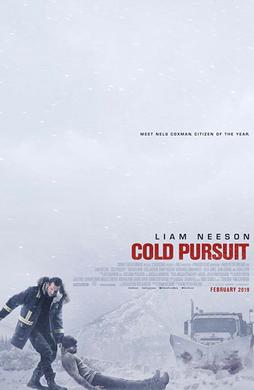
Film Review: Cold Pursuit (dir by Hans Petter Moland)
Released back in February (just in time for Valentine’s Day!), Cold Pursuit was this year’s Liam Neeson revenge flick.
This time, Neeson played Nels Coxman, a snow plow driver who speaks in a raspy tone of voice and tends to walk around with a thousand-yard stare on his face. After his son is killed by gangsters, Nels sets out for revenge. It turns out that Nels’s father was some sort of mob enforcer so both Nels and his brother (William Forsythe) have apparently inherited the “instinctively know how to kill” gene So, while Nels’s wife (Laura Dern) stays at home and has a nervous breakdown, Nels heads out and starts killing folks. Since the gangsters are led by an idiot named Viking (Tom Bateman), they all assume that they’re being targeted by a rival drug gang, one which is led by a Ute named White Bull (Tom Jackson). So, while the two drug gangs are killing each other off, Nels is busy killing any stragglers that he comes across. It all adds up to a lot of killing.
Cold Pursuit is different from other Liam Neeson revenge films by the fact that it’s an out-and-out parody of the genre. So, while Neeson walks through the film with his usual glum expression and commits all the usual mayhem that we’ve come to expect from a vengeance-driven Neeson, everyone else plays their role as broadly as possible. Tom Bateman leaves not a single piece of scenery unchewed in the role of Viking while Tom Jackson is stoic to the point of insanity in the role of White Bull. Whenever a gangster gets killed, a title card appears, listing his name, his nickname, and his religion. Meanwhile, two cops (Emmy Rossum and John Doman) prove to be comically ineffective.
And I will admit that I did laugh a few times while watching Cold Pursuit. The scene where Neeson asks his brother to explain why everyone has a nickname made me smile. Some of the murders are clever and the action scenes are frequently so over-the-top that you can’t help but be amused by them.
That said, Cold Pursuit didn’t really work for me. I think the problem is that the filmmakers spent so much time trying to parody Neeson’s films that they didn’t consider that the majority of those films are themselves already parodies. I mean, just watch The Commuter and tell me that film isn’t cheerfully winking at the audience. Since Neeson’s screen persona hasn’t really been a serious one for close to ten years now, parodying it isn’t quite the subversive act that Cold Pursuit seems to think it is. The difference between Neeson’s other films and Cold Pursuit is the difference between merely winking at an audience or pulling a gun on an audience while demanding, “LAUGH, DAMN YOU!” Sometimes, the funniest jokes are the ones that you pretend you’re not making.
On the plus side, the film looks gorgeous. It takes place in the Colorado mountains and makes great use of the frozen landscape. And George Fenton’s score is nicely evocative and well-used in the film. Finally, Liam Neeson is always fun to watch, even when it’s in a somewhat flawed film like this one.
Scenes I Love: The Phantom of the Opera (Part 3)

It’s time to finish off my triptych of Scenes I Love from 2004’s film adaptation of The Phantom of the Opera. The first two parts were my favorite solo and chorus scenes from film and now we finish it off with what has to be the top scene (IMO) from the film.
The characters of The Phantom and Christine have always been the focal point of the film. Even with the arrival of the wholesome and (as Lisa Marie would call him) vanilla Raoul, Vicomte de Chagny, the film continues to truly sizzle when it’s all about The Phantom and Christine moving their relationship from ingenue and mentor to unrequited lovers.
It’s the latter which this scene looks to portray through a duet written by The Phantom himself and where he swaps himself into the role of Don Juan. This duet has always been a fan favorite for those who love the musical and many different versions of it have played throughout the years. Yet, they all have one thing in common and that is the heated chemistry between the two characters once the duet begins.
The scene itself begins and comes off pretty much like foreplay between the two characters without having literal sex on the stage. The whole scene is so sexually charged that even those watching the duet who set the trap looked so transfixed that they fail to act. Even Raoul, Christine’s own fiance, finishes the scene with such a look of cuckold expression once he realizes that he could never have such a deep and personal connection that Christine has with The Phantom.
For me, this duet pretty much sums up what the whole is all about.
Scenes I Love: The Phantom of the Opera (Part 2)
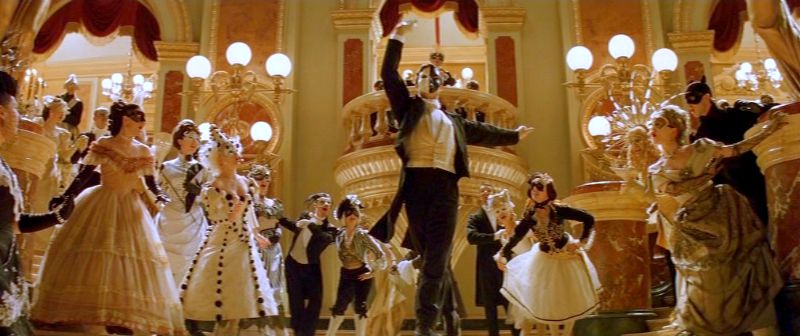
Here we have the second of three scenes I love from the 2004 film adaptation of The Phantom of the Opera.
The first scenes was my favorite solo from the film with Emmy Rossum as Christine Daaé performing the solo “Think of Me”. It’s a powerful scene that more than holds it’s own against the other solos in the film. The second favorite scene from this film comes in the beginning of Act II.
“Masquerade” is really the one and only true full cast and chorus production in the film and in the stage musical. While both would have songs and scenes involving multiple characters and a large of background chorus, this one pretty much cements the film’s grandiose and epic visuals.
Director Joel Schumacher may have his detractors and critics, but he definitely nails the grand masquerade ball in the opera house to begin the second half of the film.
Scenes I Love: The Phantom of the Opera (Part 1)

Stage productions, especially musicals, have always drawn me. I think it goes back to my time in my final two years in high school when, on a lark, I decided to join the Drama production as part of my after-school activities. For a teenager whose never really had any experience watching musicals prior to joining one I was surprised as any to have fallen in love with the art when exposed to it.
Musicals range from classic Sondheim-style productions to the Andrew Lloyd Webber rock opera epics right up to the Matt Stone and Trey Parker comedy musicals. I love them all. One musical production that I was literally obsessed with during those late high school years was Andrew Lloyd Webber’s rock opera production of The Phantom of the Opera.
I knew the songs by heart and, even now, I still remember those final years of high school fondly because of this particular musical. So, finding out that they were going to make a film adaptation of the musical had me feeling both excited and hesitant.
How could a stage musical translate to film if they cast more for acting and less for singing?
My trepidation ended up being unfounded once I finally saw the film and was satisfied that all involved were more than up to the task of performing the iconic roles in the musical.
This first of three of my favorite scenes from The Phantom of the Opera comes early in the film as Emmy Rossum’s understudy, Christine Daaé, gets a chance to show just how much she has learned from her mysterious tutor. “Think of Me” is the one of the signature solos in the musical (the other being the Phantom’s own) and Emmy Rossum nails the scene and song. The expression on the skeptical managers in the beginning quickly turns to surprise as does the rest of the cast and crew who never realized they had a genuine ingenue in their midst.
While I will admit that the song and the scene has been pulled off better on stage, Emmy Rossum’s own experience singing as a member of the Metropolitan Opera as a child leading up to being chosen for the role of Christine Daaé more than makes her hold her own against those who came before her.
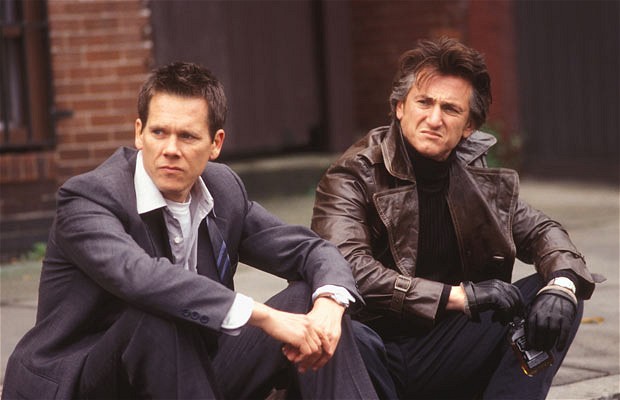
Embracing the Melodrama #51: Mystic River (dir by Clint Eastwood)
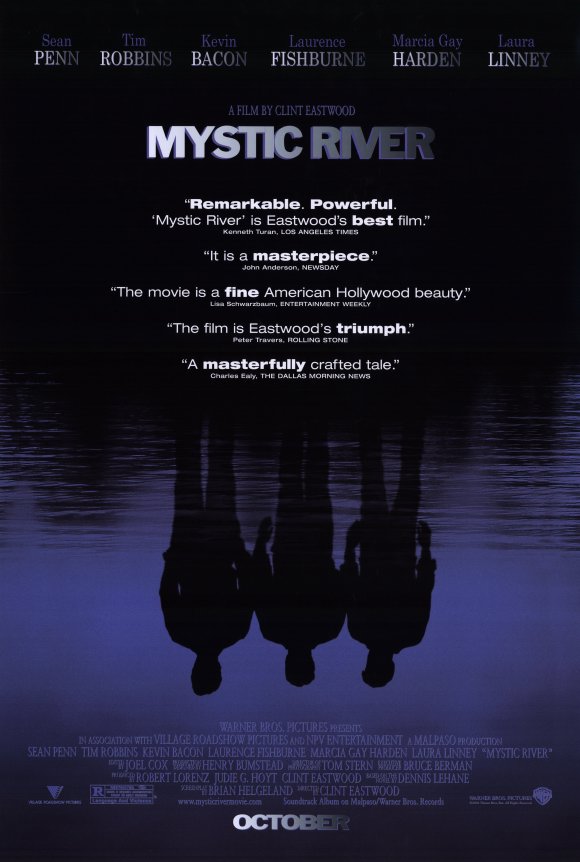
Much like In The Bedroom, 2003’s Mystic River is a film that deals with guilt, murder, and vengeance in New England. Whereas In The Bedroom deals with the guilt of just four people, Mystic River deals with the guilt of an entire neighborhood.
Mystic River opens in Boston in 1975. Three young boys are writing their names in wet cement when a car pulls up beside them. An angry-looking man (played by the always intimidating John Doman) gets out of the car and announces that he’s a police officer and that the three boys are under arrest. He orders them to get in the car. Of the three boys, Jimmy and Sean refuse but meek Dave gets into the car, where he’s greeted by a leering old man. Jimmy and Sean watch as the car drives away with their friend trapped in the back seat. Dave is held prisoner and abused by the two men for four days until he finally manages to escape.
Twenty-five years later, the three boys have grown up but are still haunted by what happened. Sean is now a detective with the Massachusetts State Police. Jimmy is an ex-con who now owns a local store and who, despite being married to Annabeth (Laura Linney), the daughter of a local gangster, is trying to lead a law-abiding life. As for Dave (Tim Robbins), he is married to Celeste (Marcia Gay Harden) and manages to hold down a job but he’s also the neighborhood pariah.

When Jimmy’s daughter Katie (Emmy Rossum) is brutally murdered, Sean and his partner Whitey Powers (Laurence Fishburne) are assigned to the case. The distraught Jimmy, however, starts to investigate the murder himself and, after talking to Celeste, he discovers that, on the night Katie died, Dave came home with blood on his clothes and claiming that he had a fight with a mugger. That’s all the evidence that Jimmy and his friends need to believe that Dave is the murderer…
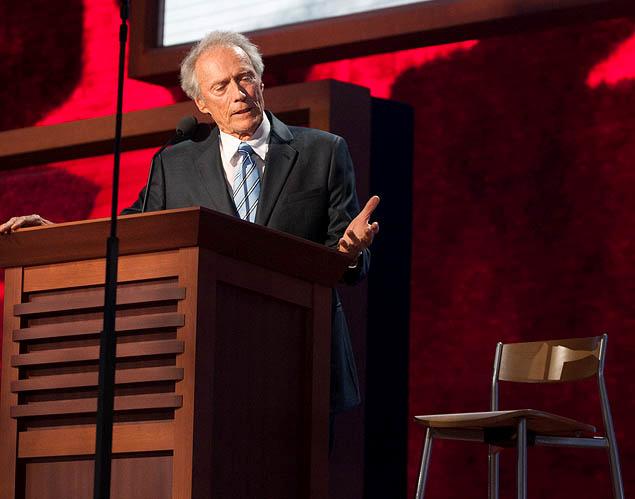
I have a lot of friends who will probably never forgive Clint Eastwood for not only endorsing Mitt Romney in 2012 but for also giving the “empty chair” speech at the Republican Convention. From the way that a lot of them reacted, you would think that Eastwood had filmed himself drowning puppies as opposed to simply expressing his own cantankerous opinions about current events. (Honestly, do you know any 82 year-olds who weren’t disgruntled in 2012?) Myself, I thought the empty chair speech was an act of brilliant performance art, one that not only highlighted the fact that most politicians really are just empty chairs but also exposed just how humorless most political activists truly are. (Admit it — if John Fugelsang had done that same routine at the 2004 Democratic convention and referred to the empty chair as being President Bush, most of the people who went on and on about how terrible it was that Eastwood was being disrespectful to the President would still be using it to create Facebook memes.)
Unfortunately, I sometimes find myself wondering why Clint Eastwood the director sometimes seem to struggle to be as interesting, innovative, and thought-provoking as the empty chair speech. It sometimes seems that for every Eastwood film that works, there’s a handful films like Hereafter, Changeling, and Jersey Boys. These aren’t bad films as much as they’re just uninspired films. (Well, Hereafter is pretty bad…) Ultimately, Eastwood is more of a storyteller than a Martin Scorsese-style innovator. If Eastwood has a good story to tell, the film will work. If he has a weak story — well, then the film will be weak.
Fortunately, with Mystic River, Eastwood has a good story and the end result is one of the best films of his uneven directorial career. Eastwood uses a fairly standard murder mystery to explore themes of guilt, redemption, and paranoia. Jimmy may be looking for revenge and Sean may be doing his job but ultimately, both of them are trying to absolve themselves from the consequences of their childhood decisions. If Dave is guilty, then Jimmy will justified in having let him get in that car. If Dave is innocent, Sean can finally step up and save him.
And complicating all of this is the Neighborhood, which is as much a character in this film as Jimmy, Dave, and Sean. The Neighborhood will never allow anyone to forget or live down the past. When, towards the end of the film, Jimmy is declared to be the “king of the neighborhood” by Annabeth, there’s little doubt that she’s right. The question is whether Jimmy’s kingdom is one worth ruling.
 Through the Shattered Lens