Embracing the Melodrama Part III #1: No Down Payment (dir by Martin Ritt)


Back in 2014 and 2015, I did a series of reviews that I called Embracing the Melodrama, in which I reviewed some of the best (and worst) melodramas ever made.  All together, I reviewed 186 films as a part of Embracing the Melodrama, everything from Sunrise to Reefer Madness to The Towering Inferno to Cocaine: One Man’s Seduction.  I had so much fun doing it that I’ve decided to do it again.

No, don’t worry.  I’m not going to attempt to review 186 films this time.  Instead, for Embracing The Melodrama Part III, I am going to limit myself to reviewing 8 films.  I’ll be posting one Embracing the Melodrama review a day, from now until next Sunday.

Let’s kick things off with 1957’s No Down Payment, a film about life in … THE SUBURBS!

(cue dramatic music)

The suburbs!

Is there any place in America that’s more dramatic?  Is it any wonder that, since the early 50s, films have regularly been using the suburbs as an example of everything that’s apparently wrong with America?  Every year sees at least one major film about how terrible life is in the suburbs.  Last year, for instance, George Clooney directed a film called Suburbicon, which was regularly cited as a possible Oscar contender before it was released and everyone was reminded of the fact that George Clooney is a terrible director.  That said, I can understand why filmmakers continue to be drawn to the suburbs.  Secret affairs.  Dangerous drugs.  Duplicitous children.  Fractured families.  Barbecuing alcoholics.  Undercover occultists.  You can find them all in the suburbs!

No Down Payment opens with David (Jeffrey Hunter) and Jean Martin (Patricia Owens) driving down a California highway and looking at the billboards that dot the landscape.  Every billboard advertises a new community, inviting people to make a new and better life away from the crowded city.  David and Jean smile, amused by how blatant all of the ads are.  That’s when they see the billboard that’s advertising their new home:

Sunrise Hill Estates

A Better Place For Better Living

Soon, David and Jean are moving into their new home and meeting their new neighbors.  It turns out that most of the houses in Sunrise Hill Estates are available for “no down payment” and the majority of the residents are struggling financially.  Though David may look at all of his neighbors and say, “Looks like everybody here is living a wonderful life,” the truth is something far different.

(If David’s line sound a bit too on the nose and obvious, that’s because almost all of the dialogue in No Down Payment was too on the nose and obvious.  As a side note, “on the nose” is an extremely strange expression.)

David’s neighbors include:

Herm Kreitzer (Pat Hingle) and his wife, Betty (Barbara Rush).  Herm owns an appliance store and sits on the town council.  Herm is gruff but likable.  He’s the leader of his neighborhood and he welcomes the Martins with a backyard party.  Herm’s employee, Iko (Aki Aleong), wants to move to Sunrise Hill but no one is willing to give him a reference because he’s not white.

Troy Boone (Cameron Mitchell) and his wife, Leola (Joanne Woodward).  We know that Troy is going to be trouble because he’s played by Cameron Mitchell.  We know that we’re going to like Leola because she’s played by Joanne Woodward.  Troy’s an auto mechanic and a veteran.  He wants to be appointed the chief of police but the town is reluctant to hire him because he doesn’t have a college education.  Leola wants to have a child but Troy says that they can’t even think about that until he has a good job.

And then there’s Jerry Flagg (Tony Randall) and his wife, Isabelle (Sheree North).  Jerry is a used car salesman and he’s also a drunk.  Jerry spends most of the movie hitting on other women and embarrassing Isabelle.  Jerry has no impulse control and, as a result, he’s heavily in debt.  His only hope is that he can convince a family to buy an expensive car that they really don’t need.  When last I checked, that’s what a used car salesman is supposed to do.

The film deals with a lot of issues — prejudice, sexism, economic insecurity — that are still relevant today.  Unfortunately, the film itself is a bit slow and what was shocking in the 50s seems rather jejune today.  Watching the film, you get the feeling that, as with many films of the 50s, all of the interesting stuff is happening off-screen.  That said, the film has an interesting cast.  Jeffrey Hunter and Patricia Owens are a bit dull as the Martins but then you’ve got their neighbors!  Any film that features Cameron Mitchell glowering can’t be all bad but the best performance comes from Tony Randall, who is memorably sleazy and desperate as Jerry Flagg.  For a fun experiment, watch this film right before watching Will Success Spoil Rock Hunter?

Tomorrow, we’ll continue to embrace the melodrama with 1961’s Common Law Wife!
Embracing the Melodrama Part II #126: Veronika Decides To Die (dir by Emily Young)


VeronikaDecidesToDie_USPosterWell, here we are!

It’s been 9 weeks since we originally embarked on this journey that I called Embracing The Melodrama Part II.  At that time, my plan was to do 126 reviews in just three weeks.  It didn’t quite work out that way, did it?  But still, I had fun doing this series of reviews and I hope that you’ve had at least a little fun reading them.  If I’ve inspired you take a chance on any of the films that I’ve reviewed — whether it be Sunrise or An American Hippie In Israel or Cocaine: One Man’s Seduction or Calvary — then this has all been worth it!

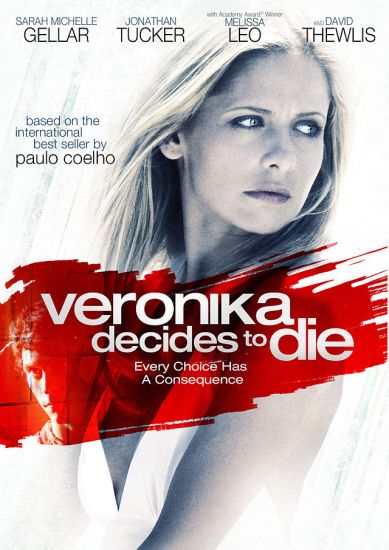
So, for my final review in this series, I want to take a quick look at one of the most melodramatic films to be released this year so far, Veronika Decides To Die.

Veronika Decides To Die finally got an American release in 2015, six years after it initially premiered on the festival circuit.  Years before it was available here in the States, Veronika played in Europe.  Not surprisingly, the American release felt much like an afterthought, one final attempt to make a little money off the film before moving on.  It’s spent about a week in theaters and two months later, it is now showing up on cable and Netflix.  And while Veronika didn’t get many reviews, the few that it did get were rather dismissive.

But you know what?

I like Veronika Decides To Die.

Don’t get me wrong.  It’s not a great film.  In many ways, it’s a very silly film.  The entire plot hinges on a character doing something that makes no sense.  Frustrated with her life as an anonymous and lonely office worker, Veronika (Sarah Michelle Gellar) attempts to commit suicide.  She survives the suicide attempt and, upon waking in a mental hospital, she’s told by a mysterious psychologist (David Thewlis) that, as a result of her attempt, she now has a heart condition that will kill her in a matter of weeks.  And what does Veronika decide to do after learning that she’s going to die?  She voluntarily remains in the mental hospital and goes to sessions of group therapy!

And you never really believe that Veronika would do that.  But, if you can bring yourself to accept that one implausibility — well, you’ll soon be confronted by a lot of other implausibilities.  You’ll meet Veronika’s glassy-eyed roommate (Erika Christensen) and a mysterious older patient (Melissa Leo).  You’ll also meet Edward (Jonathan Tuker), who is mute but has such a sexy stare that he really doesn’t need to speak.  And as Veronika gets to know her fellow patients, she starts to come to terms with her own issues of anger and regret and she realize that importance of embracing life and doing what you love.

Of course, that’s a little hard to do when you’re in a mental hospital.  Luckily, there’s a piano that Veronika can play while Edward silently watches her.  If you’re guessing that this eventually leads to Veronika sitting naked at the piano and masturbating in front of Edward, well, you’re right…

Listen, Veronika Decides To Die is one of those films that takes itself way too seriously and it ends with a plot twist that you’ll see coming from a thousand miles away.  I can understand why the film’s release was delayed because the film’s tone is all over the place.

But, dammit, I liked Veronika Decides To Die!

When taken on its own defiantly melodramatic terms, it works.  That’s largely because Sarah Michelle Gellar really commits herself to the role.  You forget that you’re watching Buffy.  Instead, Gellar truly becomes Veronika, this tragically sad and lonely young woman who finds inner peace by masturbating at a piano.  Veronika Decides To Die is a movie that really shouldn’t work but Sarah Michelle Gellar saves it.  When the film starts, she beautifully captures Veronika’s lonely desperation, her feelings of isolation and worthlessness.  (I don’t care who you are, we’ve all felt like Veronika at some point in our life.)   As the film progresses, she portrays both Veronika’s anger and her growing appreciation of life.  She has a nice chemistry with Jonathan Tucker and, in the end, Sarah Michelle Gellar probably gives a better performance than the material really deserves.

Of course, another reason that Veronika Decides To Die works is because it is so silly and melodramatic.  This is one of those films that goes so far over-the-top that it creates an almost heightened sense of reality.  It becomes, almost despite itself, compulsively watchable.

It’s also the perfect film with which to complete Embracing the Melodrama Part II.  I hope y’all have enjoyed reading these 126 reviews because I’ve certainly enjoyed writing them!  To everyone who has read these reviews and clicked on the “like” button and occasionally left a comment or two, thank you so much!  Love you!   However much effort or work it may take, all of you make it worth it.

And now I’m going to go pass out for a little while…

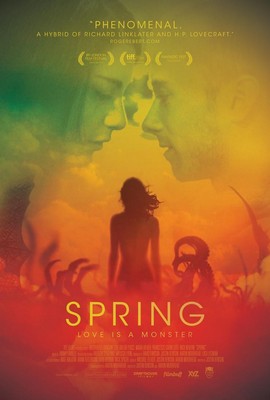
Embracing the Melodrama Part II #125: Spring (dir by Justin Benson and Aaron Moorehead)


Spring_(2014_film)_POSTERWhen was the last time that a film truly took your be surprise?

Well, regardless of what you may think of the film overall, Spring will take you by surprise.  The film takes two different genres — talky romance and body horror — and mashes them together.  It’s the sort of thing that shouldn’t work and, yet, it somehow does.  If Richard Linklater and David Cronenberg spliced their DNA, the result would be Spring.

Spring opens in Los Angeles, with Evan (Lou Taylor Pucci) sitting at the bedside of his cancer-stricken mother and watching her die.  After the funeral, Evan is drinking at a bar when a drunk and obnoxious toadsucker picks a fight with him.  Though Evan, at first, tries to avoid the confrontation, he eventually ends up punching the man.  (Evan spends the majority of the film trying to avoid confrontation.  He’s actually a genuinely likable character and when was the last time you saw that in a film?)  With the man now looking to kill him and the police possibly interested in pressing assault charges, the distraught Evan impulsively decides to take a trip to Italy.

He spends a while wandering around Italy.  He hangs out with obnoxious and continually drunk tourists, the type who will be familiar to anyone who has ever spent the summer after high school graduation in Europe.  And, eventually, he ends up in a beautiful Italian village, where he meets the mysterious Louise (Nadia Hilker).

Louise is a researcher and, at first, it would seem like she and Evan have little in common.  (She’s an intellectual.  Evan, cute as he is, most definitely is not.)  But, over the course of a week, they get to know each other and Evan starts to fall in love with Louise.  These scenes are full of nonstop conversation, covering topics of culture, history, and philosophy.  It’s an obvious homage to Richard Linklater’s films with Ethan Hawke and Julie Delpy and it works perfectly.  Both Pucci and Hilker are likable performers and they have a lot of chemistry.

However, there’s another story unfolding.  At night, a strange creature roams the city, eating stray animals and eventually killing one of the most obnoxious American tourists to ever appear in a film.  How do these two stories connect?

Well, I’m not going to tell you.  You need to see the movie for yourself.

To be honest, when I started this review, I thought I was going to be a lot more critical of Spring.  As often happens with ambitious but low-budget indie films, there are a few scenes where the pacing is off and, once the solution to the film’s big mystery has been revealed, the explanation goes on for a bit too long.  I appreciate the filmmakers attempt to make everything plausible but, sometimes, it’s better to just gloss over the exact details.

But you know what?

As I sit here writing this review, I realize that those criticisms may be valid but, in the big picture, they don’t really matter.  So what if the film has flaws?  All films have flaws!  Spring tells a unique and interesting story and it will take you by surprise.  Plus, it captures the romance of Italy!  So, instead of getting all nitpicky, I’m just going to recommend that you see the film.

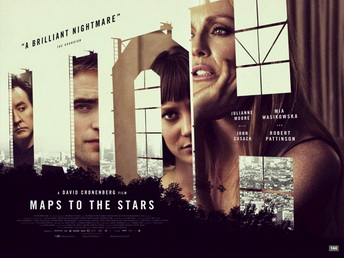
Embracing the Melodrama #124: Maps to the Stars (dir by David Cronenberg)


Maps_to_the_Stars_posterI have to admit that, for the most petty of reasons, I was dreading the 2014 release of David Cronenberg’s Maps to the Stars.  

This was despite the fact that I happen to be a big fan of just about everyone in the cast and David Cronenberg as a director.  (I still say that Cosmopolis is one of the best films of the decade and I don’t care who disagrees.)

My initial issue with Maps to the Stars — and again, I admit this is really petty — was that Sasha Stone, over the Awards Daily web site, was so damn fanatical about singing the film’s praises.  I have a theory that Sasha tends to overpraise certain films specifically so she can have an excuse to get angry and go off on a rant when they don’t receive any Oscar nominations.  Ever since Sasha went batshit crazy over The King’s Speech beating The Social Network, Awards Daily has pretty much gone from being a site about the Oscars to being a site about Sasha screaming in the wilderness like a biblical prophet (and not one of the interesting biblical prophets, like Elijah.  We’re talking about Haggai here.)  From what I had read about Maps To The Stars and judging from the response that it got at Cannes (where, despite mixed reviews, it did win an award when Julianne Moore was named best actress), this film seemed like the epitome of another deliberate lost cause.

Fortunately, the release date of Maps To The Stars was moved to 2015 and civilization was spared from having to deal with a thousand “If Cronenberg doesn’t get an Oscar, society is doomed!” rants.  Instead, we had to deal with a thousand “If Hillary Swank doesn’t win for The Homesman, society is doomed!” rants.

“Okay,” you’re saying, “that’s great Lisa.  Thank you for whatever all that was.  But what about the movie itself!?  Is it any good?”

Eh … I guess.

I mean, Maps to The Stars isn’t a bad movie.  It’s not bad at all.  It’s just maddeningly uneven.

One of my favorite up-and-coming stars, Mia Wasikowska, has a great role in it.  She plays a schizophrenic, named Agatha, who comes to Hollywood.  Agatha’s arms and the back of her neck are covered with burn scars and she is always taking pills.  She is also obsessed with a vile teen star named Benjie Weiss (Evan Bird).  There’s more to her obsession than you might originally think.

Benjie, meanwhile, has just gotten out of rehab and he is literally one of the worst characters ever.  The film does try to build up some sympathy for him by revealing just how fucked up his home life is.  His fragile mother (Olivia Williams) always seems to be on the verge of collapse.  His father (John Cusack) is a glib and shallow psychologist.  Benjie serves as a stand-in for every child star who has been destroyed by Hollywood.  Unfortunately, the film devotes so much time to Benjie being a monster that it never really allows us to see why Benjie’s a star in the first place.  Evan Bird gives such a boring, uninteresting, and flat performance that you never really buy the idea of Benjie could be a success.  (Say what you will about Justin Bieber, he does at least have a cute smile.  Evan Bird can’t even claim that.)

Agatha meets a lot of people in Hollywood, including a limo driver (Robert Pattinson) who is an aspiring screenwriter.  She eventually gets a job working for actress Havana Segrand (Julianne Moore).  Havana, herself the daughter of a legendary and self-destructive actress, is a monster but — unlike, Benjie — she’s a sympathetic monster.  She’s a talented actress who grew up in Hollywood and now, because she’s no longer in her 20s, is being discarded by Hollywood.  Havana is as much a victim as a victimizer.

Anyway, the film kinda wanders about.  Along with all the other stuff going on, the characters are regularly visited by ghosts.  Secrets are revealed.  Hearts are broken.  Lives are lost.  And yes, relevant points about Hollywood are made but … well, so what?   There’s nothing in Maps to the Stars that you couldn’t learn from rewatching Sunset Boulevard and Sunset Boulevard is a lot less pretentious.  Plus, William Holden was a much better actor than Evan Bird.

As for Cronenberg’s direction — well, Maps to the Stars is definitely David Cronenberg on autopilot.  It’s filled with identifiable Cronenberg touches.  The emphasis placed on Agatha’s scars, for instance, is trademark Cronenberg.  But still, Cronenberg’s direction often just seems to be going through the motions.  Unlike his work in the far more interesting and challenging Cosmopolis (not to mention Eastern Promises), Cronenberg doesn’t really seem to care that much about the story that he’s telling.

Maps to the Stars is worth watching for the performances of Julianne Moore and Mia Wasikowska.  Otherwise, it’s just another well-made but only occasionally interesting Hollywood melodrama.

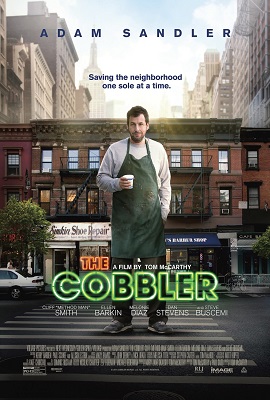
Embracing the Melodrama Part II #123: The Cobbler (dir by Thomas McCarthy)


The_Cobler_poster

Oh, Cobbler, Cobbler — what a frustrating film you are!

There was a time when everyone was excited about seeing The Cobbler.  It was originally scheduled to come out in 2014 and, along with Men, Women, & Children, it was supposed to be part of the dramatic recreation of Adam Sandler.

After all, one of the main reason why critics like me hate to see Adam Sandler devoting his time to stuff like That’s My Boy is because, in the past, Sandler has actually proven himself to be a surprisingly good and likable dramatic actor.  Unfortunately, dramatic Sandler films never seem to make much money and, as a result, Sandler goes back to making films where he, David Spade, and Chris Rock play former high school classmates.  If only one Sandler dramedy could be a success, we tell ourselves, then he’d never feel the need to make another movie like Jack and Jill

(And yes, I realize that’s probably wishful thinking on our part.  Even if Adam Sandler somehow won an Oscar, I get the feeling he’d follow the win by starting work on Grown Ups 3….)

The Cobbler promised that not only would Sandler be playing a more low-key role than usual but he would also be directed by Thomas McCarthy, who previously directed the excellent The Visitor and Win Win.  Based on his previous films, McCarthy seemed to be the perfect filmmaker to give Adam Sandler some credibility.

And, let’s not forget, that not only would Sandler be working with Thomas McCarthy but Men, Women, & Children was being directed by Jason Reitman!  At one point, it truly appeared that 2014 was going to be the year that we saw the rebirth of Adam Sandler.

And then Men, Women, & Children came out and was a disaster, despite the fact that Sandler got fairly good reviews.  Meanwhile, rumors started to swirl that just maybe The Cobbler wasn’t as good as McCarthy’s previous film.  When The Cobbler‘s release date was pushed back to 2015 … well, we all knew what that meant.

Anyway, The Cobbler was released in a few theaters earlier this year and on VOD.  It’s now available on Netflix.  I watched it last week and it’s really not as bad as I expected it to be.  Of course, that’s not to say that it’s particularly good either.  It’s not terrible but it is disappointing.  Considering the director and the supporting cast (Dustin Hoffman, Steve Buscemi, Dan Stevens, and Melonie Diaz, who was way too good in Fruitvale Station for you not to regret how this film totally wastes her), The Cobbler should at least be interesting.  Instead, it’s just kind of bland.

However, Adam Sandler does give a pretty good performance.  In this film, he plays Max, a shy and emotionally withdrawn cobbler.  He comes from a long line of cobblers and he inherited his store from his father (Dustin Hoffman).  Years before the film begins, Max’s father mysteriously vanished.  Now, Max spends his time going to and from work and taking care of his dementia-stricken mother.  His only friend is Jimmy (Steve Buscemi), the paternal barber who works next door.

In the basement of Max’s shop, there’s an old stitching machine.  About 30 minutes into the film, Max discovers that if be puts on a pair of shoes that have been repaired using the machine, he can physically transform into whoever owns the shoes.  After experimenting with being different people, Max eventually puts on his father’s shoes.  Transforming into his father, he has dinner with his mother.

The next morning, his mother dies.  Max cannot even afford to buy her a good headstone.  However, a local criminal (played by Method Man) has dropped off his shoes to be repaired.  Perhaps, by wearing the criminal’s shoes, Max can come up with the money…

I’m probably making The Cobbler sound a lot more interesting than it actually is.  And seriously, it sounds like it should a really good and thought-provoking movie.  Unfortunately, McCarthy awkwardly tries to combine the broadly comedic elements (i.e., Sandler transforming into a variety of eccentric characters) with the dramatic (which includes not only Max’s anger at his father but a few murders as well).  The film never finds a consistent tone and, as such, it remains an interesting idea in search of a stronger narrative.  Watching the film as it wanders from scene to scene, it’s impossible not to mourn all of the missed opportunities.

But, as I said, Adam Sandler does well.  Hiding his face behind a beard and only occasionally offering up a sad smile, Sandler gives a low-key performance that is full of very genuine melancholy.  In this film, he proves that he can act when he wants to.  You just wish that the rest of The Cobbler lived up to his performance.

Unfortunately, as far as the box office is concerned, The Cobbler is the least financially successful film that Sandler has ever appeared in.  This means that plans for Grown-Ups 3 are probably already underway…

(For those keeping track of the progress of Embracing The Melodrama Part II, we are now 123 reviews down with 3 to go.)

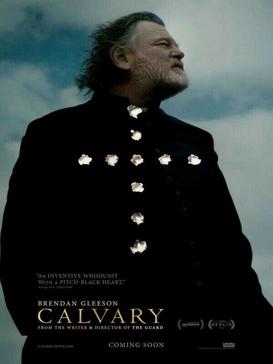
Embracing the Melodrama Part II #122: Calvary (dir by John Michael McDonagh)


Calvary_movieposterCalvary was probably the best movie of 2014 that you did not see in a theater.  I missed seeing it during its brief theatrical run in the States.  If I had seen it when it was originally released, my list of the best films of 2014 would have been far different.  Calvary is an amazing film that takes a serious and intelligent look at issues of faith, morality, guilt, and absolution.  It is one of the best films about Catholicism that I’ve ever seen.

The film, which was written and directed by John Michael McDonagh (who previously gave us The Guard), tells the story of an Irish priest, Father James (Brendan Gleeson).  During confession, an unseen parishoner tells James about the horrific sexual abuse that he suffered as a child.  The parishoner explains that the priest who abused him has since died so the parishoner plans to get his revenge on the Catholic Church by killing James.  He tells James to meet him on the beach next Sunday.  He also informs James that his death will mean more because James is a “good man.”

The rest of the film follows James over the course of what could be the last week of his life and we watch as James struggles to fulfill his priestly duties in a world that seems to be moving further and further away from the Church.  While everyone seems to come to him with their problems and their questions, few people seem to share James’s faith and James is often left to wonder whether he’s doing any good at all.

For instance, when he confronts the local butcher (Chris O’Dowd) for beating his wife, the butcher refuses to admit that he did anything wrong.  When he goes to prison and talks to a serial killer (Freddie Joyce) who wants forgiveness, James replies that he can’t be forgiven because he feels no guilt.  The local millionaire (Dylan Moran) offers to donate money to the church but also confesses that he made his money through illegal means.  A local doctor, a hedonistic, cocaine-snorting atheist played by Aiden Gillen, takes perverse pleasure in taunting James for caring about death.  When James attempts to talk to a local girl, the girl’s father accuses him of being a pedophile.  When the local church catches on fire, nobody in the village seems to care.  And finally, one night, James returns home to discover that someone has murdered his beloved dog.

And yet, there are good moments as well.  James prays with a woman (Marie-Josee Croze) who has just lost her husband.  James gets chance to bond with his emotionally unstable daughter, Fiona (Kelly Reilly).  James successfully counsels a troubled young man (Killian Scott) and befriends an American writer (M. Emmett Walsh).

And, as Sunday approaches, James is forced to decide whether to leave his parish or to go to the beach.

Calvary is a great film, one that consistently takes you by surprise and forces you to think.  In many ways, James serves as a stand-in for the entire Catholic Church.  He’s made mistakes, he’s been battered, and he struggles with doubt.  And yet, at the same time, he is still capable of doing so much good.  Calvary is one of the best Catholic films ever made.

And it also features Brendan Gleeson’s best performance to date.  That is truly saying something because Brendan Gleeson is one of our greatest actors.  Gleeson is onscreen for every minute of Calvary and his emotional and, at times, warmly humorous performance is an amazing thing to behold.  When we first see James, he’s a weary and burned-out man.  Over the course of the week (and the film), he goes from being frightened to angry to sad to eventually achieving a state of grace.

It’s a great performance in a great film.

You may have missed Calvary in 2014.

Don’t miss it again.

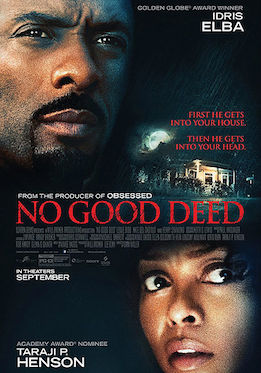
Embracing The Melodrama Part II #121: No Good Deed (dir by Sam Miller)


No_Good_Deed_2014_movie_posterSo, this weekend, my BFF Evelyn and I were watching the critically reviled 2014 film No Good Deed.  As we watched Idris Elba (playing the role of Colin) viciously and violently choke to death a character played by Kate del Castillo, Evelyn said, “He can strangle me any time that he wants.”  My first instinct was to reprimand my friend and remind her that it’s not empowering to allow a man to murder you, regardless of how unbelievably sexy that man may be.  But then, by the time that Idris was murdering Leslie Bibb, I found myself agreeing.  Seriously, Idris Elba can do anything he wants to me….

Idris is pretty much the only reason to see No Good Deed.  No Good Deed is one of those crappy suspense films where every plot point hinges on someone acting like a total idiot.  Colin escapes from prison.  Colin murders his ex-fiancee after he discovers that she’s been cheating on him.  Later, Colin crashes his truck outside of the house of Terri Granger (Taraji P. Henson).  Terri’s husband is out-of-town and when Colin shows up at her doorstop and asks to use the phone to call for a tow truck, Terri invites him inside.  Terri’s friend Meg (Leslie Bibb) shows up.  Mayhem follows.  Of course, there’s a big twist at the end.

This is where I’d usually say something like, “DON’T REVEAL THE SURPRISE ENDING OF NO GOOD DEED!” but, honestly, you’ll figure it out within the first few minutes of the film.  It’s pretty obvious and it’s pretty stupid.  I won’t reveal it but if you see the film, feel free to tell all your friends about the big twist.  Some films were meant to be spoiled.

As I watched No Good Deed and found myself hissing at the terrible dialogue and the total stupidity of all of the characters and wondering if any of the filmmakers had ever actually met any real human beings, I found myself wondering how this film could be so incredibly bad.  I hopped onto the imdb and discovered that the film was written by Aimee Lagos.

If you don’t recognize that name, Lagos also wrote and directed the absolutely terrible movie, 96 Minutes.  And I will say this: No Good Deed is slightly better than 96 Minutes.

That’s the power of Idris Elba.

(Incidentally, it bothers me that nobody in this film is actually named Deed.  If Colin’s full name had been Colin Deed … well, that would have been pretty stupid but it would have at least been kinda fun and entertaining.)

(Also, for those keeping track, that’s 121 reviews down and 5 to go.)

Embracing the Melodrama Part II #120: We Need To Talk About Kevin (dir by Lynne Ramsay)


We Need To Talk About KevinThis is a historic occasion!

Two months and one week ago, I started on this journey that we call Embracing the Melodrama, Part II.  At the time, I announced that I would be reviewing 126 film melodramas and that I would get it all done in 3 weeks.  Well, I was 6 weeks off as far as the timing was concerned but I am going to reach the 126 mark.

(And then I’m going to pass out and sleep for a year…)

We started this series by taking a look at the 1927 silent classic Sunrise and now, 119 reviews later, we have reached the disturbing 2011 film, We Need To Talk About Kevin.

We Need To Talk About Kevin tells the story of Eva (Tilda Swinton).  Eva was once a very successful travel writer, who explored the world and lived a life of total independence and sophistication.  Now, however, she has a demeaning job at a travel agency.  She lives in a dilapidated house that is the frequent target of vandals.  Everyone in town views her as a pariah, either deliberately avoiding her or greeting her with open hostility.

You see, Eva is the mother of a teenager named Kevin (Ezra Miller) who is currently in prison.  One day, Kevin locked all of his high school classmates in the gym and, using a bow and arrow set that was given to him by his father, Franklin (John C. Reilly), Kevin proceeded to kill or maim them all, one-by-one.  When Kevin finally surrendered to police, he looked over at his mother and he smirked.

We Need To Talk About Kevin unfolds in flashback as Eva looks back on her former life and tries to understand how her son could do something so evil.  From the time that Kevin was a baby, Eva suspected that there was something wrong with her son and found it impossible to bond with him.  While Franklin spoiled him and refused to accept that there was ever anything wrong, Eva went the opposite direction.  When Eva became more and more convinced that Kevin was evil, Franklin refused to listen to her.

And, make no mistake about it, Kevin is evil.  For the majority of the film, he is one of the most evil characters that you’ve ever seen.  (It’s even suggested — though thankfully never shown — that he may have deliberately blinded his little sister.)  We, like Eva, wonder if Kevin was born evil or if he became evil as the result of the way he was raised but there’s no doubt that he’s evil.

And then, one day, Eva goes to visit her son in prison and we see a different Kevin.  Kevin is about to turn 18, which means that he’ll be transferred to an adult prison.  Kevin admits that he’s scared.  In this scene, the cocky and hateful Kevin is one.  This new Kevin has shaved off his previously unruly mop of hair.  His face is bruised and he has a cut above his eye, suggesting that, within the walls of the justice system, he’s no longer the attacker but instead the one being attacked.  He no longer smirks or glares at his mother.  Instead, he looks lost and vulnerable.

And, at first, I actually felt sorry for Kevin when I saw that scene.  I guess it was maybe my own maternal instinct coming out or maybe my own tendency to feel compassion for those who have no freedom.  But, at that moment, I felt as if maybe Kevin finally understood that what he did was wrong.  Just like Tilda Swinton’s Eve, I suddenly felt compassion for this hateful creature…

Until, of course, it occurred to me that the only time that Kevin showed any fear or regret was when it came to his own situation.  As scared as Kevin is, Kevin never expresses any regret over what he did.  Instead, he’s scared for himself and upset that he no longer has control of his situation.  Though the film never states it, that’s classic sociopath behavior.  (One is reminded of the BTK Killer, who unemotionally talked about those he killed but then cried when talked about having to spend the rest of his life in prison.)

At that point, I realized that Kevin hadn’t changed at all.  Much like Eve, I wanted to believe that Kevin had changed because that, at least, would give the story some sort of closure.  But, unfortunately, the Kevins of the world can never change.  We may not know how someone like Kevin is created, whether he’s born evil or becomes evil due to circumstances.  But we do know that evil can never change.  That’s the burden that both Eve and the audience must carry.

We Need To Talk About Kevin is a lot like Million Dollar Baby.  It’s well-directed and fiercely well-acted but, at the same time, it’s so sad and disturbing that I don’t know that I’ll ever be able to watch it again.  There are a few moments of very dark humor, mostly connected to just how oblivious everyone, with the exception of Eve, is to Kevin’s evil.  But make no mistake, this is a seriously dark film.

http://www.youtube.com/watch?v=TGjjK5SMbJA

(For those keeping track, that’s 120 reviews down and 6 to go.)

Embracing the Melodrama Part II #119: Shutter Island (dir by Martin Scorsese)


Shutter IslandThe 2010 film Shutter Island finds the great director Martin Scorsese at his most playful.

Taking place in 1954, Shutter Island tells the story of two detectives, Teddy Daniels (Leonardo DiCaprio, giving an excellent performance that, in many ways, feels like a test run for his role in Inception) and Chuck Aule (Mark Ruffalo, also excellent), who take a boat out to the Ashecliffe Hospital for The Criminal Insane, which is located on Shutter Island in Boston Harbor.  They are investigating the disappearance of inmate Rachel Solando, who has been incarcerated for drowning her three children.

Ashecliffe is one of those permanently gray locations, the type of place where the lights always seem to be burned out and the inmates move about like ghostly visions of sins brought to life.  It’s the type of place that, had this movie been made in the 50s or 60s, would have been run by either Vincent Price or Peter Cushing.  In this case, the Cushing role of the cold and imperious lead psychiatrist is taken by Ben Kingsley.  Max Von Sydow, meanwhile, plays a more flamboyantly sinister doctor, the role that would have been played by Vincent Price.

When a storm strands Teddy and Chuck on the island, they quickly discover that neither the staff nor the patients are willing to be of any help when it comes to tracking down Rachel.  As Teddy continues to investigate, he finds himself stricken by migraines and haunted by disturbing images.  He continually sees a mysterious little girl.  He has visions of his dead wife (Michelle Williams).  A horribly scarred patient in solitary confinement (Jackie Earle Haley) tells him that patients are regularly taken to a lighthouse where they are lobotomized.  When Teddy explores more of the island, he comes across a mysterious woman living in a cave and she tells him of even more sinister activity at Ashecliffe.  Meanwhile, Chuck alternates between pragmatic skepticism and flights of paranoia.

And I’m not going to share anymore of the plot because it would be a crime to spoil Shutter Island.  This is a film that you must see and experience for yourself.

This is one of Martin Scorsese’s most entertaining films, an unapologetic celebration of B-movie history. He knows that he’s telling a faintly ludicrous story here and, wisely, he embraces the melodrama.  Too many directors would try to bring some sort of credibility to Shutter Island by downplaying the film’s more melodramatic moments.  Scorsese, however, shows no fear of going over the top.  He understands that this is not the time to be subtle.  This is the time to go a little crazy and that’s what he does.

Good for him.

Embracing the Melodrama Part II #118: The Kids Are All Right (dir by Lisa Cholodenko)


Kids_are_all_right_poster

Dare I admit to thinking that the 2010 best picture nominee The Kids Are All Right is overrated?

The Kids Are All Right tells the story of Nic (Annette Bening) and Jules (Julianne Moore), married lesbians in Los Angeles.  The pragmatic Nic is an obstetrician while the more flighty Jules has a landscaping business.  They also have two children, Laser (Josh Hutcherson) and Joni (Mia Wasikowska).  When Laser and Joni decide to track down their anonymous sperm donor father, the trail leads to Paul (Mark Ruffalo), who owns an organic restaurant.  (Of course, he does…)  After Paul meets Nic and Jules, he eventually ends up having an affair with Jules, which threatens the family’s stability.

It’s been five years since the film first came out and, as a result, I think it’s easy to forgot what a big deal The Kids Are All Right was back in 2010.  It got a lot of attention for being both a film about a lesbian couple and a box office success.  To a certain extent, every LGBT-themed film to come out since owes a debt of gratitude to The Kids Are All Right for proving that audiences are willing to see films with LGBT characters.  As well, the film’s box office success was an early sign of the growing support for the legalization of gay marriage.  The Kids Are All Right can make a very valid claim to being a landmark film.

But, once you look past the film’s historic importance, it doesn’t hold up as well as you might hope.  The performers are all good, especially Annette Bening.  The film’s script also has a lot of good lines.  However, it also has a lot of lines that feel just a little bit too glib and obvious.  It’s not surprising that HBO considered turning The Kids Are All Right into a TV series because the entire movie really does feel like an above average episode of an hourly drama.  Lisa Cholodenko’s visually flat direction also feels more appropriate for television than for the big screen.

As much as I hate to admit it, I’d probably be more into The Kids Are All Right if the characters were a little less wealthy.  If you can look past the fact that this is a movie about a happy lesbian marriage being threatened by a clueless straight guy, you discover that The Kids Are All Right is essentially just another movie about rich white people with problems.

I guess my problem with The Kids Are All Right can be summed up by the scene where Jules fires her Mexican gardener because she suspects that he’s seen her with Paul.  The scene is largely played for laughs and, after the gardener has lost his job, he’s never seen again.  At one point, Jules does say that she feels guilty for firing him but again, the scene is played for laughs.  The film asks us to laugh with the rich white characters and to laugh at the one non-rich non-white.

The Kids Are All Right is a historically important film but that’s not necessarily the same thing as being a great film.