The TSL Grindhouse: Record City (dir by Dennis Steinmetz)


1977’s Record City opens with a montage of rear-focused close-ups of women wearing short shorts and that pretty much tells you all that you really need to know about the film.  It’s crass, shameless, and very much a product of its time.

The film takes place over the course of one day at a California vinyl record shop.  It’s tempting to compare the film to something like Empire Records but, unlike Empire Records, Record City suggests that working in a record store is perhaps the worst thing that could ever happen to anyone.  The store is dirty and grimy.  The customers are rude and played by vaguely familiar comedy actors, all of whom seem to have been bitten by the overacting bug before stepping in front of the camera.  The employees all seem to hate each other.  Marty (Tim Thomerson) keeps getting slapped and kicked by Vivian (Deborah White).  Vivian keeps getting groped by almost every customer and employee who walks by her.  The only thing that Vivian hates more than men is other women.  The store’s owner (Jack Carter) is in trouble with the mob.  The store’s manager (Michael Callan) is lech who wears gold chains, keeps his shirt unbuttoned, and who expects the new cashier, Lorraine (Wendy Schaal), to sleep with him because, after all, he did hire her.  Danny (Dennis Bowen) is the shy guy with a crush on Lorraine.  Rupert (Stuart Goetz) is the nerdy virgin who goes from wearing a bowtie to dressing like a swinger but he still can’t get laid.  Both the customers and the employees are paranoid about “fairies” coming into Record City.  Pokey (Ed Begley, Jr.) wants to hold the place up and who can blame him?  Really, the only likable employee is a black man known only as The Wiz and that’s just because he’s played by Ted Lange.  (Yes, Isaac the Bartender from The Love Boat.)  Lange gets to perform a song at the end of the film.

When the film isn’t focused on the antics inside Record City, it’s all about the talent show that’s taking place in a nearby parking lot.  The talent show is hosted by radio DJ Gordon Kong (Rick Dees) and it gives the film an excuse to trot out a bunch of cameos, some of whom are more recognizable than others.  For instance, Gallagher — the comedian with the sledgehammer — shows up.  Kinky Friedman also shows up, playing himself and looking for records at Record City.  When he spots a woman with a blonde bowl cut and glasses, he accuses her of being John Denver and then grabs her breasts.  And to think — less  than 30 years later, Kinky Friedman would run for governor of my homestate.

Anyway, this is a terrible and rather boring movie but I did find it interesting for one reason.  It’s the reason why I find so many grindhouse films to be interesting.  Shot on location and for no other reason than to make money, Record City is a true product of its time.  There’s no attempt to try to make the 70s look nicer than they were.  There’s no attempt to try to make the record store look like anything more than a tacky establishment.  There’s an honesty to how low-rent the whole thing is.  Watching the movie is like stepping into a time machine and getting a chance to experience the past firsthand.  I was born long after the 70s but, after watching this film, I now feel like I’ve been there.

Late Night Retro Television Review: CHiPs 4.10 “Forty Tons Of Trouble”


Welcome to Late Night Retro Television Reviews, a feature where we review some of our favorite and least favorite shows of the past!  On Mondays, I will be reviewing CHiPs, which ran on NBC from 1977 to 1983.  The entire show is currently streaming on Prime!
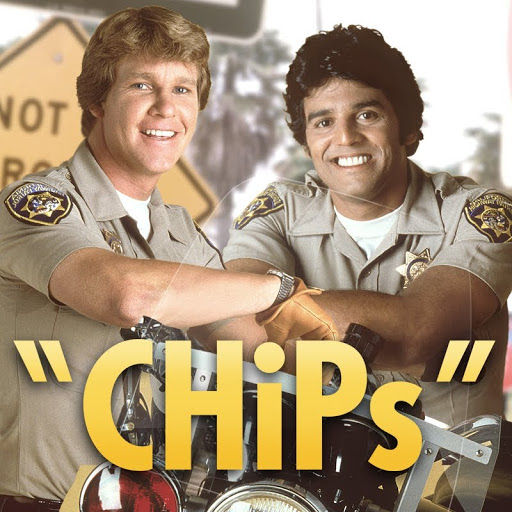
This week, two sets of thieves cause trouble!

Episode 4.10 “Forty Tons Of Trouble”

(Dir by Gordon Hessler, originally aired on January 11th, 1981)

A group of criminals is stealing equipment from construction sites and selling it on the black market.  An attempt to steal a loader leads to it rolling down a Los Angeles street until Baker is able to jump onto it and crash it into a (hopefully) abandoned building.  Getraer points out that Baker just destroyed a building.  Baker shrugs and says he’s always wanted to do that.

A different group of criminals is stealing parts for their drag racer.  The CHiPs have their own car entered into the drag races.  Of course, it’s driven by Ponch.

After two accidents on the highway and several chases, Baker and Ponch (but mostly Ponch) capture the bad guys.  Paula Kohl (Mary Louise Weller), the owner of Kohl Construction, appreciates the efforts of Baker and Ponch (but mostly Ponch).

In other words, this was a typical episode of CHiPs.  Still, it’s memorable because of the supporting cast.  Amongst the construction site thieves is Robert Englund.  Englund thinks that Sarge (Taylor Lacher) is taking to many risks when it comes to trying to steal loaders and bulldozers but Sarge is like, “I got it under control.”  Meanwhile, amongst the drag race thieves, is Chris Mulkey.  Mulkey doesn’t get to do much but he does get two scenes where he smirks at Ponch.  Sadly, both characters end up getting arrested during this episode but have no fear.  Robert Englund went on to play Freddy Krueger.  Chris Mulkey went on to play the sleazy but strangely likable Hank Jennings on Twin Peaks.

As for the rest of the episode — hey, I don’t ask for much from CHiPs.  As long as there’s a good crash scene and a lot of cool cars, I’m happy.  This episode delivered.  One could ask why Ponch is always the one who gets to do the cool things, like driving in the race and taking Paula out on a fancy date.  Earlier seasons usually tried to portray Ponch and Baker as being equals.  This season, though, has clearly been The Ponch Show.  It’s a legitimate criticism but …. eh.  Sometimes, you just want to watch a chase or two.


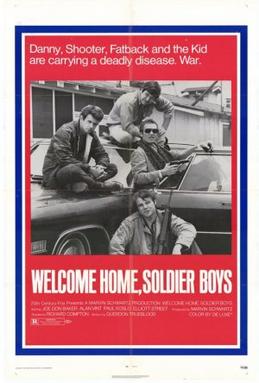
Welcome Home, Soldier Boys (1971, directed by Richard Compton)


Talk about embarrassing!  When Lisa told me that today was Joe Don Baker’s birthday, I decided that I would review Speedtrap, as 1977 car theft movie that Lisa and I watched last week.  But, when I took a look at the imdb to double check the name of the character that Baker played in Speedtrap, I discovered that I had already reviewed it!

Instead of talking about Speedtrap a second time, I’m going to recommend one of Joe Don Baker’s early films.  In Welcome Home, Soldier Boys, Baker stars as Danny, the leader of a group of Green Berets who have just returned from Vietnam and can no longer find a place in society.  Danny, Kid (Alan Vint), Shooter (Paul Koslo), and Fatback (Elliott Street) go on a cross-country road trip.  After they kill a prostitute (Jennifer Billingsley) who demanded more money than they were willing to pay, they visit many sites from their youth.  They go to a high school basketball team.  They spend some time in a sleazy motel.  (Geoffrey Lewis plays the desk clerk.)  They get into a fight with a mechanic (Timothy Scott) over the price of some auto repairs.  After being cheated by one too many people and realizing that no one cares about the sacrifices that they made for their country, they put on their uniforms and violently take over a small town, leading the National Guard to show up to take them all out.

Welcome Home, Soldier Boys is a pretty ham-fisted anti-war allegory and the plot sometimes meanders too much for its own good.  With its road trip violence, its a dry run for director Richard Compton’s far more cohesive Macon County Line.  The movie still packs a punch, due to the efforts of the cast and the violent ending.  The movie is full of familiar characters actors, who are all convincing in their roles but it really is dominated by Joe Don Baker’s hulking intensity.  Danny is the dark side of the amiable country boys that Joe Don Baker would play in so many other movies.  Danny is angry but, as a stranger in a strange land, he’s sometimes sympathetic.  Ultimately, Danny wants the respect that was given to the returning soldiers of the previous generation.  Instead, he comes back to country that doesn’t want much to do with him or his friends.  Returning from serving overseas and still trying to deal with the things that he saw in overseas, Danny feels lost in and rejected by his home country.  It’s one of Baker’s best performances.