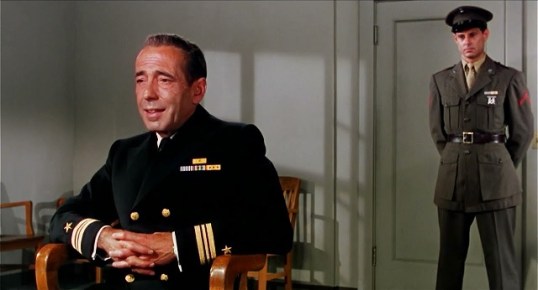
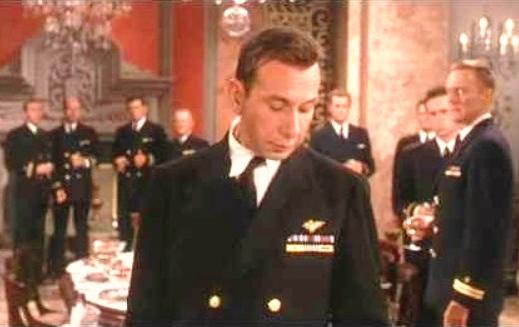
In this scene, Captain Queeg (Humphrey Bogart) is cross-examined by Barney Greenwald (Jose Ferrer). The court martial concerns whether or not an officer under Queeg’s command was justified in taking over the ship from Queeg. Greenwald, tasked with defending the head mutineer, knows that the only way to win the case is to expose Queeg himself as a paranoid and unstable officer. Greenwald does his job but he’s not happy about it.
This scene, directed by Edward Dmytryk, features both Bogart and Ferrer at their absolute best.
4 Or More Shots From 4 Or More Films is just what it says it is, 4 shots from 4 of our favorite films. As opposed to the reviews and recaps that we usually post, 4 Shots From 4 Films lets the visuals do the talking!
117 years ago, on this date in Columbia, Canada, director Edward Dmytryk was born. Today, we honor this underrated filmmaker with….
4 Shots From 4 Edward Dmytryk Films
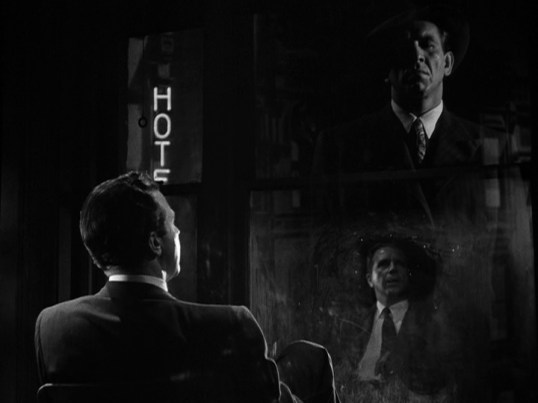
Murder, My Sweet (1944, dir by Edward Dmytryk, DP: Harry J. Wild)
Crossfire (1947, dir by Edward Dmytryk, DP: J. Roy Hunt)
The Caine Mutiny (1954, dir by Edward Dmytryk, DP: Franz Planer)
The Carpetbaggers (1964, dir by Edward Dmytryk, DP: Joseph MacDonald)
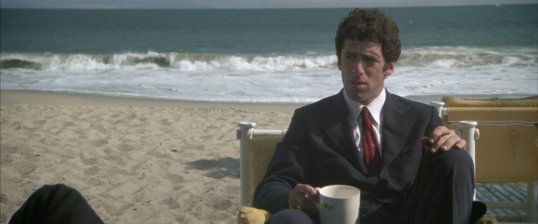
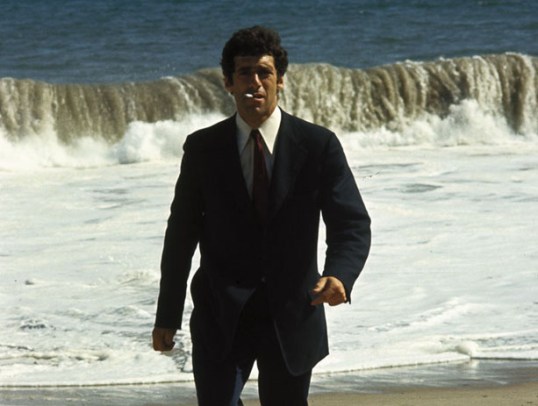
The Long Goodbye (1973, dir by Robert Altman, DP: Vilmos Zsigmond)
4 Shots From 4 Films is just what it says it is, 4 shots from 4 of our favorite films. As opposed to the reviews and recaps that we usually post, 4 Shots From 4 Films is all about letting the visuals do the talking.
Today is the anniversary of the birth of Raymond Chandler. That means that it’s time for….
4 Shots From 4 Philip Marlowe Films
Murder, My Sweet (1944, dir by Edward Dmytryk, DP: Harry J. Wild)
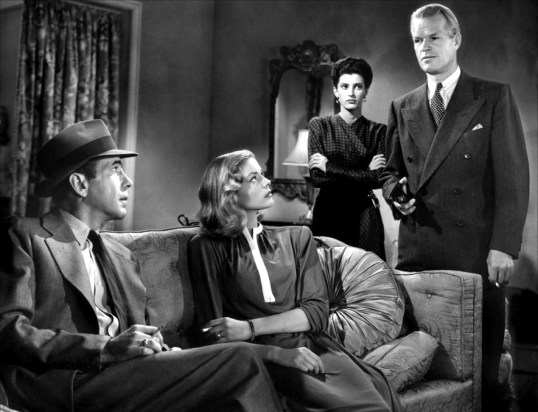
The Big Sleep (1946, dir by Howard Hawks, DP: Sidney Hickox)
The Long Goodbye (1973, dir by Robert Altman, DP: Vilmos Zsgimond)
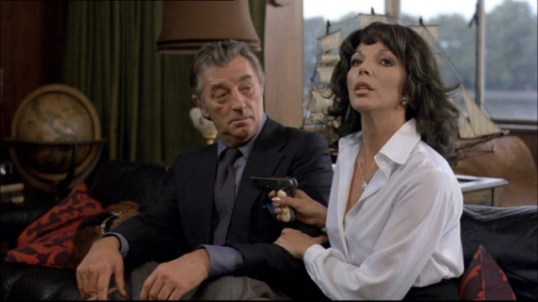
The Big Sleep (1978, dir by Michael Winner, DP: Robert Payner)
4 Or More Shots From 4 Or More Films is just what it says it is, 4 shots from 4 of our favorite films. As opposed to the reviews and recaps that we usually post, 4 Shots From 4 Films lets the visuals do the talking!
Today, we pay tribute to the year 1944 with….
4 Shots From 4 1944 Films
Murder, My Sweet (1944, dir by Edward Dmytryk, DP: Harry J. Wild)
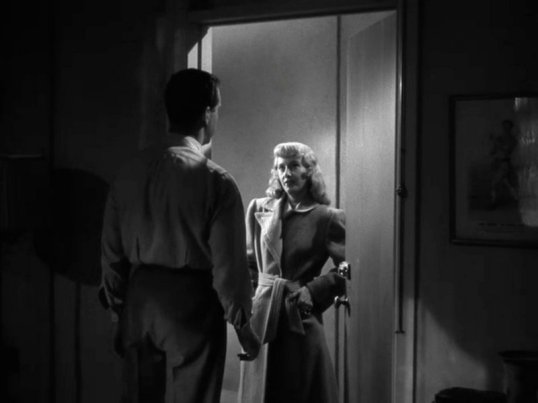
Double Indemnity (1944, dir by Billy Wilder, DP: John Seitz)
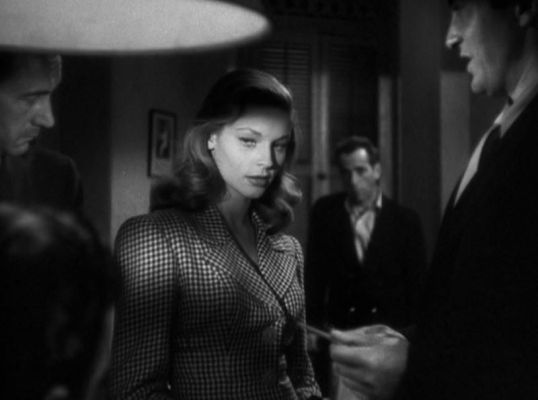
To Have and Have Not (1944, dir by Howard Hawks, DP: Sidney Hickox)
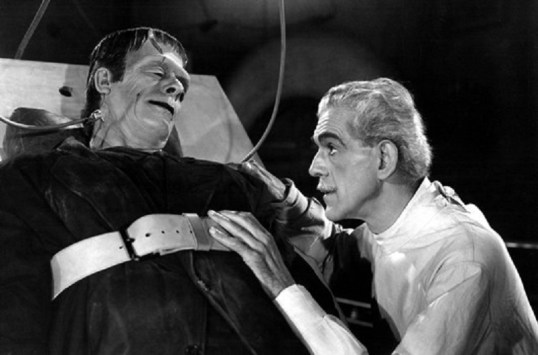
House of Frankenstein (1944, dir by Erle C. Kenton, DP: George Robinson)
In this scene, directed by Edward Dmytryk, the Caine mutineers celebrate their acquittal when they’re confronted by their own defense attorney. Having previously exposed Captain Queeg’s paranoia on the stand, Barney Greenwald (Jose Ferrer) has dealt with his guilty conscience by having a bit too much to drink. He interrupts the celebration and calls out the man who he claims is the real “author of the Caine Mutiny,” the arrogant Keefer (Fred MacMurray).
This scene features Ferrer at his most vitriolic and MacMurray at his sleaziest. Fred MacMurray was typically cast as a nice, All-American guy so it’s always interesting to see him cast as a bad guy in films like this one, The Apartment, and Double Indemnity. MacMurray always tended to underplay his villains, playing them as self-centered cads who hid their true motives behind a façade of bland affability. The Caine Mutiny features one of MacMurray’s best performances.
4 Or More Shots From 4 Or More Films is just what it says it is, 4 shots from 4 of our favorite films. As opposed to the reviews and recaps that we usually post, 4 Shots From 4 Films lets the visuals do the talking!
115 years ago, on this date in Columbia, Canada, director Edward Dmytryk was born. Today, we honor this underrated filmmaker with….
4 Shots From 4 Edward Dmytryk Films
Murder, My Sweet (1944, dir by Edward Dmytryk, DP: Harry J. Wild)
Crossfire (1947, dir by Edward Dmytryk, DP: J. Roy Hunt)
The Caine Mutiny (1954, dir by Edward Dmytryk, DP: Franz Planer)
The Carpetbaggers (1964, dir by Edward Dmytryk, DP: Joseph MacDonald)
Halfway through the chilling 1952 film, The Sniper, there’s a scene in which a woman is seen standing on the rooftop of a San Francisco apartment building. She’s nonchalantly hanging laundry. When she steps to the side, we suddenly see that there’s a man standing on the next rooftop over. And he’s holding a rifle.
Fortunately, in this case, the man is a policeman. He’s one of several cops who have been ordered to stand on rooftops with their weapons drawn and to keep an eye on the city below. There’s a killer on the loose and the city is demanding that the police capture him. And yet, even with a city that’s caught in the grip of fear and even with heavily armed men watching everything going on in the streets, life goes on. People go to bars. People go to work. Couples stroll in the park. And one woman hangs her laundry to dry on the rooftop of an apartment building.
Suddenly, the policeman spots someone on another rooftop, a man who isn’t supposed to be there. He’s a young guy, carrying what looks like a rifle. The police quickly rush to the rooftop where they arrest the young man. Have they caught the sniper who has been terrorizing San Francisco?
The police think that they have their man but we know that they don’t. We know that the sniper is a guy named Eddie Miller (Arthur Franz). Eddie is a delivery man. He’s handsome but, from the minute we first see him, we can tell that there’s something off about him. He stumbles through life, keeping his head down and rarely speaking to anyone. The few times he does attempt to smile, it’s painfully awkward. He’s someone who is struggling to convince the people of San Francisco that he’s one of them but the more he tries, the more of an outsider he seems to be. In fact, the only time that we see Eddie truly happy is when he goes to a carnival and comes across a dunk tank. Over and over again, he throws a baseball and cause the woman inside to be submerged in cold water.
At first, Eddie tries to deal with his bad thoughts by deliberately burning his hand on an electric stove. When he goes to the emergency room, he asks the attending doctor why he would do something like that but the doctor is soon distracted by another patient. With his hand bandaged, Eddie goes on a shooting spree, targeting brunette women.
This dark film is fairly evenly divided, between Eddie, the cops that are trying to catch him, and the psychiatrist who tries to explain him. Not surprisingly, the cops, led by the appropriately named Lt. Kafka (Adolphe Menjou), aren’t particularly interested in what makes the sniper tick. They just want to get him off the street. However, Dr. James Kent (Richard Kiley) is convinced that the only way to stop not only this killer but others is to understand what’s going on inside of his mind. The differences between Kafka and Kent’s approaches are most obvious in a scene in which every registered sex offender in San Francisco is paraded into a squad room full of jeering cops. While the detectives taunt the offenders that they know, the offender that they don’t know prepares to kill yet again.
The Sniper was directed by Edward Dmytryk, who previously directed the Oscar-nominated (and superficially similar) Crossfire. This was Dmytryk’s first film after his career was temporarily derailed by his refusal to testify before the House Unamerican Activities Committee. (He later changed his mind and named names while testifying about his time as a member of the Community Party.) Interestingly enough, top-billed Adolphe Menjou was one of the leaders of the anti-communist Motion Picture Alliance for the Preservation of American Ideals, a prominent supporter of the blacklist that Dmytryk had narrowly escaped.
Filmed in a black-and-white, documentary style, The Sniper is a chilling and disturbing film. When Eddie stalks through the city at night, the dark shadows that he casts against the walls of empty alleyways and closed storefronts serve to remind us that men like Eddie could be lurking anywhere, unseen and unknown. During the day scenes, the harshly bright lighting reminds us of just how vulnerable we are. If the night provides too many places to hide, the day provides too few. Arthur Franz gives a disturbingly credible performance as Eddie. While he plays Eddie as being obviously troubled, he also suggests how someone like Eddie has managed to survive without getting exposed. Menjou is properly cynical as the world weary Kafka while Richard Kiley brings some needed passion and anger to the film’s most talky scenes. The film ends on a note of melancholy ambiguity, leaving it to us to make up our own mind about how to deal with the Eddie Millers of the world.
Universal decided the time was ripe for a new monster, and 1943’s CAPTIVE WILD WOMAN introduced the world to Paula Dupree, aka The Ape Woman! What’s that you say? You’ve never HEARD of her? Don’t worry, you’re not alone – The Ape Woman is the most obscure of the Universal Monsters despite the fact she was featured in three films, with various degrees of quality. The first is the best of the bunch, a fun little ‘B’ lifted by the presence of John Carradine in the first of his patented mad scientist roles.
Animal trainer Fred Mason returns from Africa with a shipload of lions, tigers, and a powerful female gorilla named Cheela. He’s greeted at the docks by his sweetie Beth Colman, who tells Fred that her sister Dorothy has “some kind of glandular problem” and is being treated at Crestview Sanitarium by endocrinology expert Dr. Sigmund Walters. Walters…
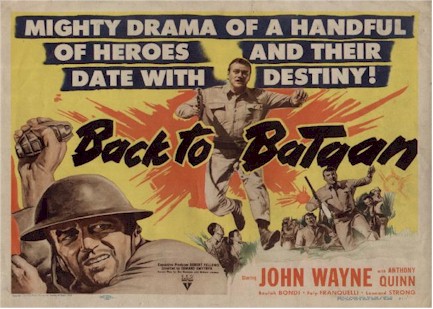
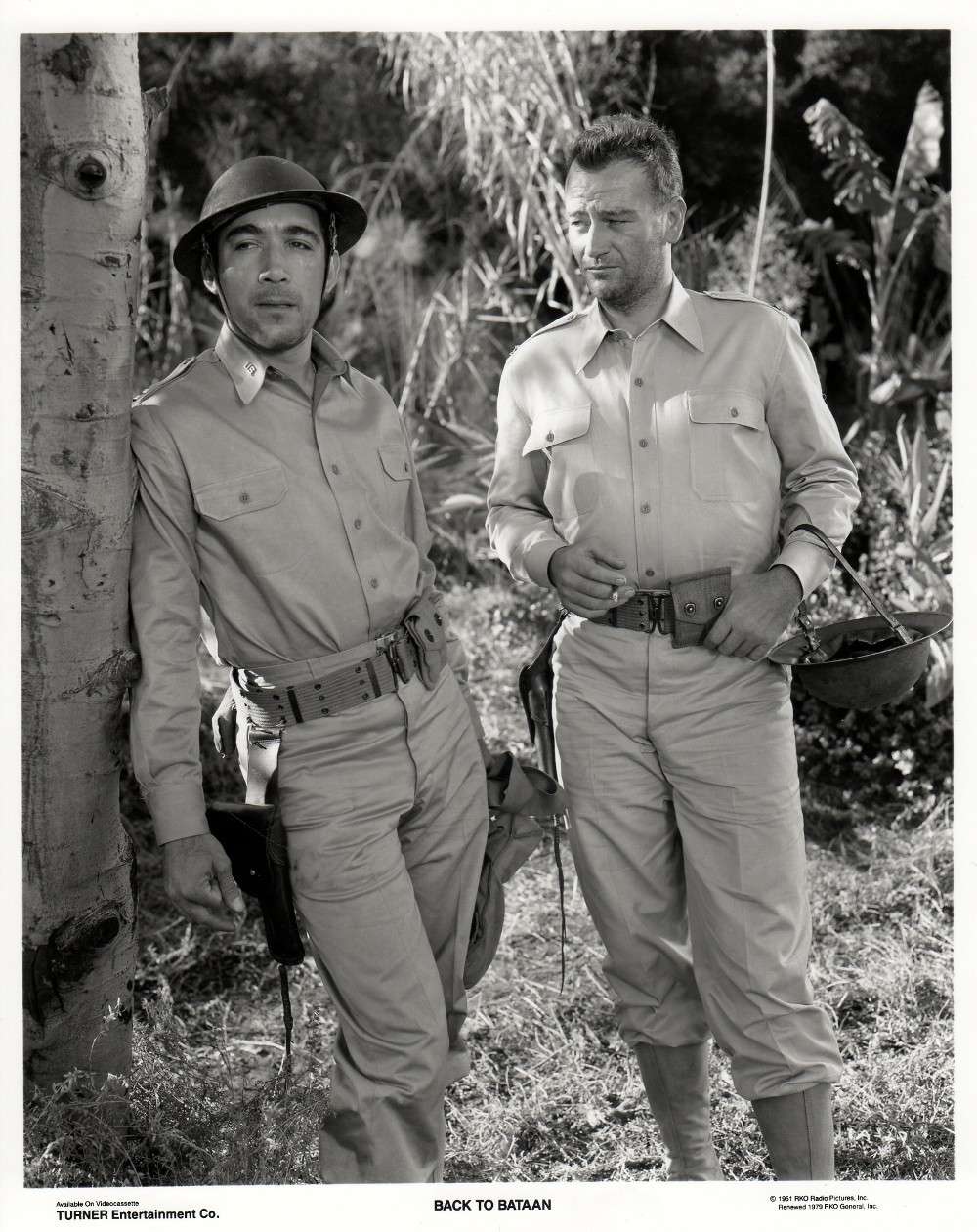
John Wayne and Anthony Quinn fight World War II on the backlots of RKO (subbing for the jungles of the Philippines) in BACK TO BATAAN, a stirring exercise in propaganda ripped from headlines of the era. The film was made to stoke audience’s patriotic fires, and succeeds in it’s objective. It’s well directed and shot, has plenty of action, and superb performances by all, including a standout from 14-year-old Ducky Louie.
Wayne plays Col. Madden, assigned to train Filipino freedom fighters (try saying that three times fast!) to battle the invading Japanese. Quinn is Capt. Bonifacio, grandson of Filipino revolutionary hero Andres Bonifacio. He’s having issues with his girlfriend Dalisay, who’s the island version of Tokyo Rose (what he doesn’t realize is she’s secretly sending coded messages to the Allies through her broadcasts). Madden and his ragtag crew are out to destroy a Japanese gas depot, but first they encounter schoolteacher…
It’s the 1940s and World War II is raging. The U.S. Navy is model of military discipline and efficiency. Well, except for the U.S.S. Caine, that is. The Caine is something of a disorganized mess, where no one takes his job seriously and sailors have names like Meatball (Lee Marvin) and Horrible (Claude Akins). The men love Lt. Commander DeVriess (Tom Tully), largely because he has given up on trying to enforce any sort of discipline. However, DeVriess has recently been relieved of his command. As he leaves, Meatball gives him a new watch, a gift from all the men. DeVriess admonishes them, snapping that the gift is violation of Naval regulations. He then puts the watch on his wrist and leaves the ship.
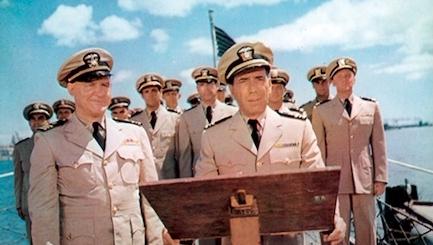
DeVriess’s replacement is Captain Francis Queeg and, at first, we have reason to be hopeful because Captain Queeg is being played by Humphrey Bogart. Surely, if anyone can get this ship into shape, it’ll be Humphrey Bogart! From the moment he arrives, Queeg announces that he’s going to enforce discipline on the Caine and if that means spending hours yelling at a man for not having his shirt tucked in, that’s exactly what Queeg is prepared to do. However, it also quickly becomes apparent that the awkward Queeg has no idea how to talk to people. He is also overly sensitive and quick to take offense. Whenever Queeg makes a mistake (and he does make a few), he’s quick to blame everyone else.
Realizing that the men are turning against him, Queeg even begs his officers for their help. He asks them if they have any suggestions. They all sit silently, their heads bowed as Queeg somewhat poignantly rambles on about how his wife and his dog both like him but the crew of the Caine does not.
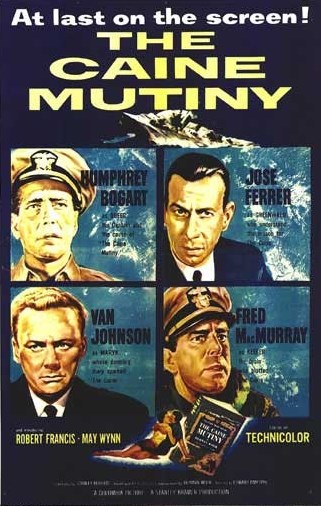
Queeg’s officers are a diverse bunch, none of whom are quite sure what to make of Queeg or the state of the Caine. Ensign Willie Keith (Robert Francis) is a wealthy graduate of Princeton University who, at first, likes Queeg but quickly comes to doubt his abilities. On the other hand, Lt. Steve Marsyk (Van Johnson) has doubts about Queeg from the start but, as a career Navy man, his natural instinct is to respect the chain of command above all else.
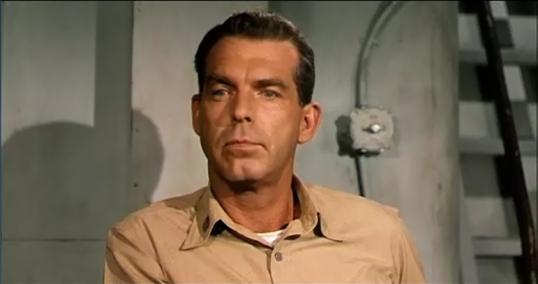
And then there’s Lt. Tom Keefer (Fred MacMurray). Keefer is a self-styled intellectual, a novelist who is always quick with a snarky comment and a cynical observation. (If The Caine Mutiny were remade as a B-horror film, Lt. Keefer’s name would probably be Lt. Sardonicus.) From the minute the viewers meet Lt. Keefer, our inclination is to like him. After all, he seems to be the only person in the film who has a sense of humor. If we had to pick someone to have dinner with, most of us would definitely pick the erudite Tom Keefer over the humorless and socially awkward Francis Queeg. As such, when Keefer starts to suggest that Queeg might be mentally unstable, our natural impulse is to agree with him.
It’s Tom Keefer who first suggests that it may be necessary to take the command away from Queeg. And yet, when it comes time to take action, it’s Keith and Marsyk who do so while Keefer stands to the side and quietly watches. And, once the Caine arrives back in the U.S., it Keith and Marsyk who are court martialed. Will they be found guilty of treason or will their lawyer, Lt. Barney Greenwald (Jose Ferrer), prove that Queeg was unfit for command?
Made in 1954 and based on a novel by Herman Wouk, The Caine Mutiny is one of those big and glossy 1950s productions that holds up a lot better than you might expect. The film has its flaws. In the role of Keith, Robert Francis is a bit on the dull side and a subplot in which he courts May Wynn feels unneccessary and only serves to distract from the main story. But, for the most part, it’s an intelligent and well-directed film. Humphrey Bogart turns Queeg into a pathetic and lonely figure and you can’t help but feel sorry for him when he talks about how his dog loves him. Van Johnson also does well as Marsyk, effectively portraying a well-meaning character who is in over his head. Jose Ferrer gets a great drunk scene at the end of the film and, of course, you can’t go wrong with Lee Marvin as a smirking sailor, even if Marvin only appears for a handful of minutes.
But for me, my favorite character (and performance) was Fred MacMurray’s Tom Keefer. Technically, Keefer is not meant to be a likable character. He’s totally passive aggressive. He’s pretentious. He’s smug. At times, he’s rather cowardly. And yet, Tom Keefer remains the most memorable and interesting character in the entire film. He gets all of the good one-lines and MacMurray delivers them with just the right amount of barely concealed venom. (“If only the strawberries were poisoned…” he says as he considers dinner aboard the Caine.) It’s a great role and Fred MacMurray gives a great performance. And you know what? I don’t care how bad a character he may have been. I still want to read Tom Keefer’s book!
The Caine Mutiny was nominated for best picture of 1954. However, it lost to On The Waterfront.




 Through the Shattered Lens