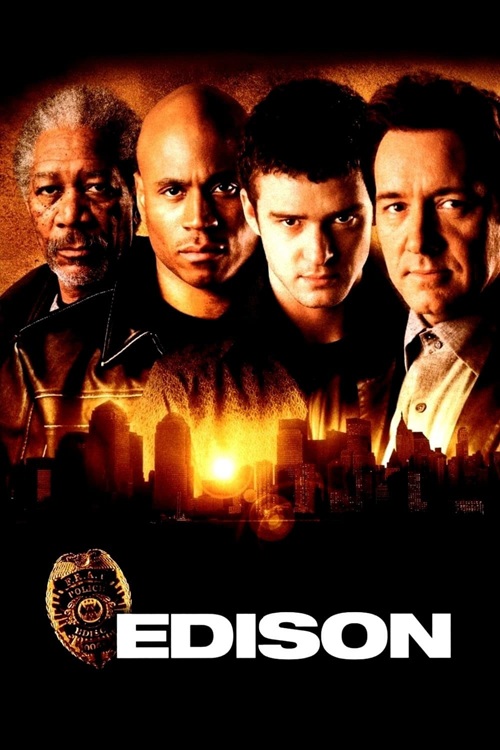
In the town of Edison, a reporter named Pollack (Justin Timberlake) is convinced that he’s uncovered evidence of massive police corruption. His editor, Moses Ashford (Morgan Freeman), responds by firing Pollack but then rehires him on the condition that he actually do the work and interview everyone involved. Pollack is confused until he sees that Ashford has a Pulitzer Prize in his Edison bachelor pad.
FRAT stands for First Response Assault and Tactical. Led by Captian Tilman (John Heard) and protected by duplicitous politician Jack Reigert (Cary Elwes), FRAT has made Edison safe but at what cost? The constitution is regularly trampled. Drug dealers are summarily executed. Sgt. Lazaerov (Dylan McDermott) confiscates and uses the drugs himself while the newest recruit, Detective Deeds (LL Cool J), worries that he’ll be executed when he declines to lie in court. Deeds has reason to be worried because he witnesses the attempted assassination of both Pollack and his girlfriend (Piper Perabo).
Teaming up with Detective Leon Wallace (Kevin Spacey), Pollack and Ashford try to get Deeds to turn on FRAT and expose the trouble in Edison.
First released in 2005, Edison was produced by Randall Emmett, who is today best-known for producing (and occasionally directing) Bruce Willis’s final films. Emmett specializes in getting name actors to play small roles in what are otherwise B-movies. In an Emmett film, De Niro, Stallone, Travolta, or Nicolas Cage might get top billing but usually, they only have a few minutes of screentime. Edison is unique in that Morgan Freeman and Kevin Spacey (who was still considered to be a big name back in 2005) both actually have fairly large roles. Though LL Cool J and Justin Timberlake are the stars of the film, it still appears that it probably took Freeman and Spacey longer than a day to shoot their scenes and that truly does set this film apart from other Emmett productions. I should also note that Spacey wears an incredibly tacky hairpiece while Freeman gets an extended dance scene set to Time Has Come Today by The Chambers Brothers.
Is the film itself any good? Eh, not really. It’s a bit disjointed. John Heard was a good actor but this movie was made when he was at the height of his “9-11 was an inside job” nuttiness and he gives a cartoonish performance as the main bad guy. Cary Elwes is entertaining as the crooked politician but it’s hard not to feel that the film would have been more interesting if he and Kevin Spacey had switched roles. LL Cool J is not particularly convincing as a cop so naive that he’s shocked to discover that there’s corruption on the force. As for Justin Timberlake, this was actually his debut as an actor. Timberlake is always at his best playing morally shady characters, like in Alpha Dog or The Social Network. In this film, he has to play earnest and outraged and he’s never particularly convincing. If anything, he comes across as being a little whiny.
That said, the idea behind Edison is at least interesting. FRAT — like countless other special police units in the country — has become untouchable by actually doing its job. The streets are safer, as long as you don’t get on FRAT’s bad side. Who watches the watchmen? Edison asked this now common question in 2005, when America was still embracing the survelliance state. Flaws and all, Edison was ahead of its time.


 Through the Shattered Lens