4 Shots From 4 Tod Browning Films: West of Zanzibar, Dracula, Freaks, Mark of the Vampire


4 Shots From 4 Films is just what it says it is, 4 shots from 4 of our favorite films. As opposed to the reviews and recaps that we usually post, 4 Shots From 4 Films lets the visuals do the talking!

This October, we’ve been using 4 Shots From 4 Films to pay tribute to some of our favorite horror directors!  Today, we honor the legacy of the great Tod Browning!

4 Shots From 4 Films

West of Zanzibar (1928, dir by Tod Browning)

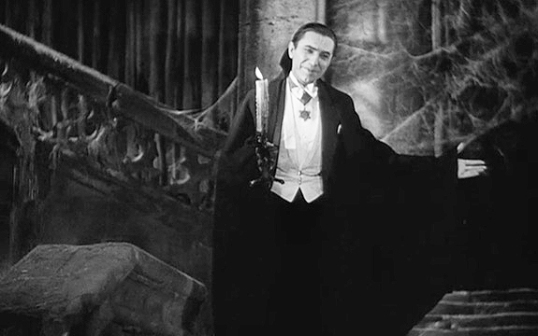
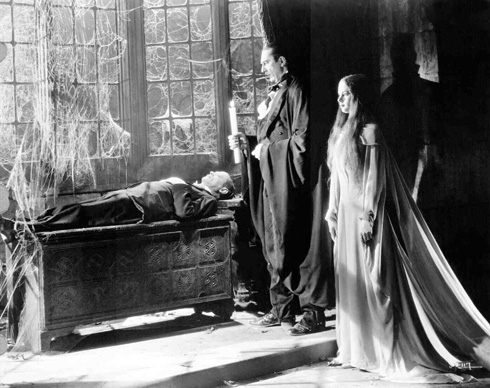
Dracula (1931, directed by Tod Browning)

Freaks (1932, dir by Tod Browning)

Mark of the Vampire (1935; dir by Tod Browning)


Scenes That I Love: Vampire Lucy Makes Her Presence Known In Horror of Dracula


Today is the 116th anniversary of the birth of the British director, Terence Fisher.

Though Fisher had a long career as both an editor and a director and he worked in almost every genre, he achieved immortality with the horror films that he directed for Hammer Films.  Fisher’s horror films took the monsters that had previously been made famous by Universal Studios and resurrected them with a pop art spin.  Regardless of whether the subject matter was Frankenstein, the Mummy, Dracula, or some other fearsome creature, Fisher brought a vibrant splash of color to their stories.  (Often that color was blood red.)  At a time when American horror films were still hobbled by the production code and tended to hide their themes under several heavy layers of subtext, Terence Fisher brought Hammer’s stories to life with explicit violence and unapologetic sexuality.  When Christopher Lee’s Dracula stared at a victim with lustful eyes, there was little doubt about what was actually happening.  Once Fisher started working for Hammer, he never left the horror genre.  Personally, I would have liked to have seen what he could have done with a Bond film.

Today’s scene that I love comes from one of the first of the Fisher-directed Hammer horror films, 1958’s Horror of Dracula.  (In the UK, it was simply know as Dracula.)  Christopher Lee may not appear in this scene but it’s still one of the creepiest moments in the film.  In this scene, Lucy (Carol Marsh) returns from the dead and, sporting a new set of fangs, attempts to get her former maid’s daughter, Tania, to come for a walk with her.  Thanks to both Fisher’s direction and Marsh’s unforgettable performance, this is a scene that sticks with you even after the film ends.   Whenever I see Lucy peeking out from behind that tree and calling out to little Tania, my mind flashes back to when I was in the 1st grade and a police officer stopped by the classroom to ask if we all knew what to do if an adult who we didn’t know tried to get us to go off with them.  This scene definitely gives off stranger danger vibes and it’s all the more creepy as a result.


6 Horror Performances That Deserved An Oscar Nomination


Despite making some inroads as of late, horror films still never quite get the respect that they deserve when it comes Oscar time.  That’s especially true of the performers who regularly appear in horror films.  If it’s rare for a horror movie to receive a best picture nomination, it’s even rarer for someone to get nominated for appearing in one of them.

And yet, it takes as much skill to make a monster compelling as it does a historical figure or a literary character.  In fact, it may take even more skill.  After all, everyone knows that Queen Elizabeth I actually ruled over England and that Atticus Finch was an attorney in the South.  However, everyone also knows that there’s no such things as vampires and that the dead cannot be reanimated or raised as a zombie.  It takes a lot of skill to make a monster seem human.

With that in mind, here are 6 horror performances that deserved, at the very least, an Oscar nomination:

1. Boris Karloff as The Monster in Frankenstein (1931) and The Bride of Frankenstein(1935)

The great Boris Karloff is perhaps the most egregious example of a deserving actor who was consistently ignored by the Academy because of the type of films in which he appeared.  In the role of Monster, Karloff was never less than brilliant and he set the standard by which all future monsters are judged.

Dracula (1931, directed by Tod Browning)

2. Bela Lugosi in Dracula (1931)

When viewed today, it’s perhaps a little bit too easy to be dismissive of Lugosi’s grandly theatrical interpretation of Dracula.  But, if you can ignore all of the bad imitations that you’ve seen and heard over the years, you’ll discover that Lugosi’s performance is perfect for the film in which he’s appearing.  Indeed, Lugosi’s best moments are the silent ones, when he goes from being a courtly (if vaguely sinister) nobleman to a hungry animal.  In those moments, you see why Lugosi’s performance endures.

3. Anthony Perkins as Norman Bates in Psycho (1960)

Ah, poor Anthony Perkins.  Before he played Norman Bates, he was considered to be something an up-and-coming star and even something of a neurotic romantic lead.  As with Lugosi’s Dracula, we’ve seen so many bad imitations of Perkins’s performance that it’s easy to overlook just how good he is in the role.  He was so perfect as Norman that spent the rest of his career typecast.  And, sadly enough, he didn’t even get a much-deserved Oscar nomination out of it.
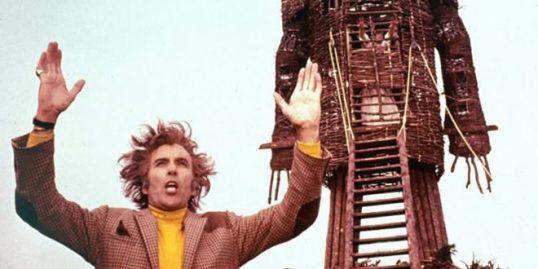
4. Christopher Lee as Lord Summerisle in The Wicker Man (1973)

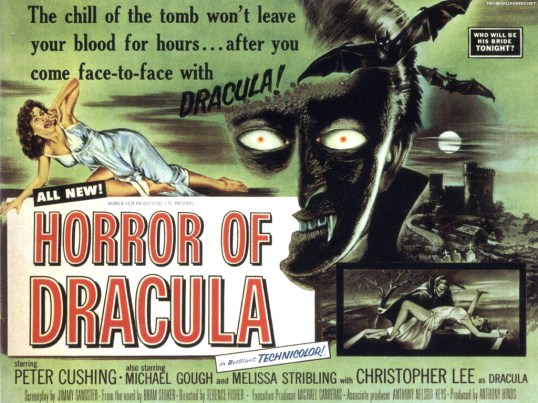
Christopher Lee was one of the great actors and, though he may be best remembered for his horror work, he actually appeared in almost every genre of film imaginable.  Lee was often dismissive of the Dracula films that he made for Hammer so, as much as I’d love to argue that he deserved a nomination for The Horror of Dracula, I’m instead going to suggest that Lee deserved one for the role that he often cited as his favorite, the pagan Lord Summerisle in The Wicker Man.  Lee brings the perfect mix of wit and menace to the role and, in the process, shows that not all monsters have to be undead.

5. Donald Pleasence as Dr. Sam Loomis in Halloween (1978) and Halloween II (1981)

Much as with Lugosi and Anthony Perkins, it’s important (and perhaps a little bit difficult) to separate Pleasence’s performances in these two slasher films with all of the imitations that have followed.  In both films, Pleasence does a great job of playing a man who has been driven to the verge of madness as a result of having spent too much time in the presence of evil.  As potentially dangerous as Sam Loomis sometimes appears to be, there’s no way not to sympathize with him as he continually tries to get people to understand that he wasn’t the one who left Michael escape.  If nothing else, Pleasence deserved a nomination just for his delivery of the line, “As a matter of fact, it was.”

6. Betsy Palmer as Pamela Voorhees in Friday the 13th (1980)

“I’m an old friend of the Christys.”  AGCK!  RUN!

Horror Scenes That I Love: Bela Lugosi Introduces Himself In Dracula


I swear, nothing annoys me more than when wannabe hipsters go out of their way to trash old movies.

You see that a lot on twitter.  People who, for the most part, haven’t even studied film or cultural history will try to post something snarky about a film that was made decades before they were born.  They either make fun of the acting or the dialogue or they attempt to call out the film for not being properly woke.  It’s an easy way to get likes and retweets but it’s also about as intellectually lazy as you can get.

For instance, there’s a tendency to dismiss the 1931 version of Dracula and Bela Lugosi’s performance in the lead role.  Personally, I do think that Dracula is a bit too stagey (it was, after all, based on a stage play that was based on Bram Stoker’s novel) and I wouldn’t put it up there with director Tod Browning’s best work.  The Spanish-language version of Dracula, which was filmed at the same time, is technically a better film.  But, that being said, I will accept no criticism of Lugosi’s performance.  Lugosi is the perfect Dracula.  If he seems overly theatrical …. well, Dracula’s a pretty theatrical character.  It has to be remembered that Lugosi is playing a character who is supposed to be several hundred years old.  If he acts like a man out-of-time, that’s because that is exactly what he is.

Ultimately, it comes down to this — a lot of actors have played Dracula.  Some of them have been very good in the role.  Some of them have been very bad.  But, if not for Lugosi, none of them would have had the opportunity.

So, in honor of that legacy, today’s horror scene that I love comes from the original Dracula and features Bela Lugosi at his creepiest:


Dracula Through The Ages


Count Dracula has been scaring people for centuries.  Many different artists who have taken their turn portraying the world’s most famous vampire.  Below is a small selection of portraits of Dracula through the ages:

1560

1897

1931

1931

1931

1943

1957

1968

1970

1970

1979

1979

1987

1992

1992

2005

2014

Music Video of the Day: Dracula by MOANA (2018, dir by Luna Laure)


For today’s music video of the day, we have yet another song called Dracula.  However, as you can tell by looking at the lyrics, this song actually has some connection to everyone’s favorite vampire (or, at the very least, the legend of everyone’s favorite vampire):

Her
She was a dancer
Feel
As the girl she twirls off the edge of her paper-thin world

The “I”
Give to the Master
Mirror, mirror
Can you tell one from the other?
Strange
I offer my veins
Feel
As the girl she twirls off the edge of her paper-thin world

Oh in the night
When Dracula comes to fill your soul
To atone, confess
My one true weakness
My Dracula, Count Dracula

Her
She was a dancer
(First I must appease my thirst)
Feels
Good you know as the girl she twirls off the edge of her world

Oh in the night
When Dracula comes to fill your soul
To atone, confess
My one true weakness
My Dracula, Count Dracula

Oh in the night
When Dracula comes to fill your soul
To atone, confess
My one true weakness
My Dracula, Count Dracula

According to singer Moana Mayatrix, “I’d say it’s not directly about vampires but more so an exploration of vampire mythology and the allure of the dark side, much like being seduced by a Bram Stoker character.”

Enjoy!

Music Video of the Day: Dracula by Vondelpark (2012, dir by ????)


It’s debatable whether or not this song from Vondelpark is actually about the Lord of the Vampires but I imagine he’d appreciate it.  Myself, I love the atmospheric, dream-like feel of both the song and the video.  Just listening to this puts me into another world.

Sadly, Vondelpark is no more.  They broke up in 2016.  But Dracula lives forever.

Enjoy!

4 Shots From 4 Films: Special Tod Browning Edition


4 Shots From 4 Films is just what it says it is, 4 shots from 4 of our favorite films. As opposed to the reviews and recaps that we usually post, 4 Shots From 4 Films is all about letting the visuals do the talking.

This October, I am going to be using our 4 Shots From 4 Films feature to pay tribute to some of my favorite horror directors, in alphabetical order!  That’s right, we’re going from Argento to Zombie in one month!

Today’s director is Tod Browning, who started his career during the silent era, ended it in the sound era, and was responsible for some of the most important horror and suspense films of both!

4 Shots From 4 Films

West of Zanzibar (1928, dir by Tod Browning)

Dracula (1931, dir by Tod Browning)

Freaks (1932, dir by Tod Browning)

Mark of the Vampire (1935, dir by Tod Browning)


Horror Film Review: Dracula (dir by John Badham)


I have to admit that, when I first sat down to watch the 1979 version of Dracula, I wasn’t expecting much.  I hadn’t even heard of the film until I came across it on Encore and, when I considered that it was made in 1979, I immediately assumed it would be a disco Dracula film.

And, let’s be honest — a disco Dracula film sounds kinda fun.  But still, it’s Halloween.  Dracula is an icon of horror.  And somehow, the idea of watching disco Dracula just was not appealing.  It would be appealing in November or September.  BUT THIS IS OCTOBER!

Well, despite my misgivings, I watched the film and I quickly discovered that it wasn’t a disco Dracula at all.  This Dracula takes place in 1913 and there’s actually very little about it that would lead you to suspect that it had been made in the 1970s.  Instead, it feels more like a tribute to the colorful and lushly erotic Dracula films that Hammer produced in the 60s.  Except, oddly, the Hammer films were far more bloody than the 1979 version.  Oh, don’t get me wrong.  There’s a few gory scenes in 1979’s Dracula.  Towards the end of the film, there’s a rather bloody impaling.  Dracula graphically breaks another character’s neck as we watch.  But, even with those scenes in mind, the 1979 Dracula feels oddly restrained at times.

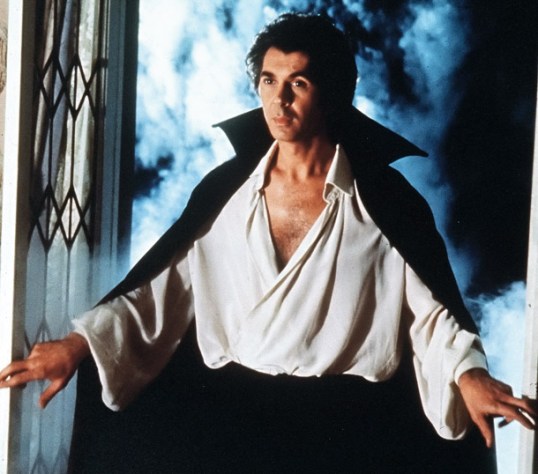
In this version of Dracula, the title character is played by a youngish Frank Langella.  I have to admit that it was a bit odd to see Langella playing someone other than a corrupt authority figure.  Dare I say it, Langella is almost sexy in this film and his somewhat feral features are perfect for a character who considers wolves to be “the children of the night.”  Langella’s performance falls between the haughty charm of Bela Lugosi and the animalistic fury of Christopher Lee.  And while Langella’s performance never quite reaches the heights of those two actors, he’s still effectively cast.

As for the film itself, it starts with a shipwreck near a local asylum.  One of the passengers on that ship is the charming but mysterious Count Dracula.  Dracula introduces himself to the head of the asylum, Dr. Jack Seward (Donald Pleasence, stealing almost every scene in which he appears).  There’s an immediate attraction between Dracula and Seward’s daughter, Lucy (Kate Nelligan).  That does not amuse Lucy’s fiancee, Jonathan Harker (Trevor Eve, who is perhaps the whiniest Harker in film history).

Meanwhile, Lucy’s best friend, Mina (Jan Francis), has been taken ill and it might have something to do with the two puncture marks on her neck.  After Mina dies, her father (played by Laurence Olivier) comes to investigate.  Her father’s name?  Abraham Van Helsing.

As I said, I was not expecting much from this version of Dracula so I was actually pleasantly surprised during the first hour of the film.  This version gets off to a nice start, with director John Badham giving us a mix of lush romanticism and gothic moodiness.  I’ve already talked about Langella’s performance but  Donald Pleasence and Laurence Olivier also distinguish themselves.  It’s obvious that these veteran performers enjoyed playing opposite each other and there’s a lot of pleasure to be found from watching Pleasence and Olivier compete to see who can steal the most scenes.

Unfortunately, after that strong first hour, Dracula slows down.  Once Seward and Van Helsing know that Dracula is a vampire, the whole movie becomes about finding excuses for them to not do anything about it.  The final 40 minutes feel almost like filler and, at one point, you’re required to believe that an elderly man, who has been seriously wounded, could still find the strength to swing a hook into a much stronger person’s back.

In the end, the 1979 Dracula is more of an intriguing oddity than a definitive version.