Horror Scenes That I Love: Bela Lugosi in Dracula


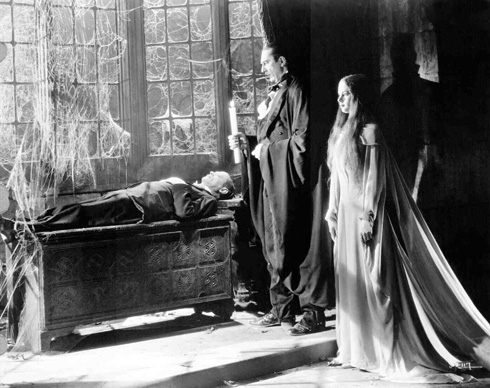
Dracula (1931, starring Bela Lugosi as the Count, Dir by Tod Browning, DP: Karl Freund)

Bela Lugosi was born in what is now Romania.  Lugosi began his career in his native country, appearing on stage.  After serving as an infantryman in World War I, Lugosi moved into the movie industry and appeared in silent Hungarian films.  The young Lugosi was an activist, involved in labor issues and trying to unionize the Hungarian film industry.  When a new government came to power in Hungary in 1920, the politically-active Lugosi moved first to Germany and then eventually ended up in the United States.  After a period of working as a merchant seaman, Lugosi returned to acting.

He first played Dracula on stage in New York City.  In 1928, while touring in the role of Dracula, he moved out to California and quickly became a part of the Hollywood community.  When Universal produced a film adaptation of Dracula in 1931, Lugosi was the obvious choice for the lead role.  The film made Lugosi a star and it also typecast him.  Lugosi never stopped acting, though the films varied widely in quality.  By the end of his career, Lugosi was a member of the Ed Wood stock company.  Even appearing in something like Bride of the Monster, Lugosi still made an impression.

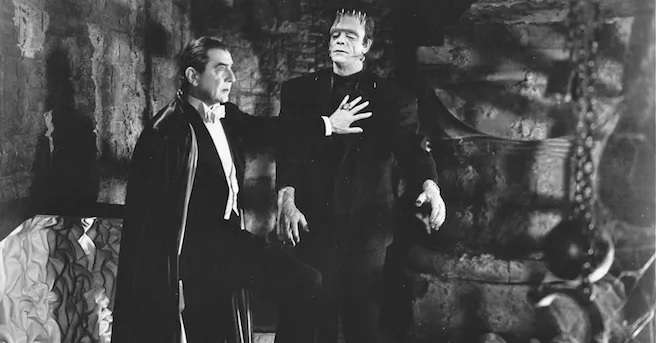
In the scene below, from 1931’s Dracula, Lugosi suggests that Edward van Sloan’s Van Helsing should perhaps leave the country.

4 Shots From 4 Films: Special Tod Browning Edition


4 Shots From 4 Films is just what it says it is, 4 shots from 4 of our favorite films. As opposed to the reviews and recaps that we usually post, 4 Shots From 4 Films is all about letting the visuals do the talking.

This October, I am going to be using our 4 Shots From 4 Films feature to pay tribute to some of my favorite horror directors, in alphabetical order!  That’s right, we’re going from Argento to Zombie in one month!

Today’s director is Tod Browning, who started his career during the silent era, ended it in the sound era, and was responsible for some of the most important horror and suspense films of both eras!

4 Shots From 4 Tod Browning Films

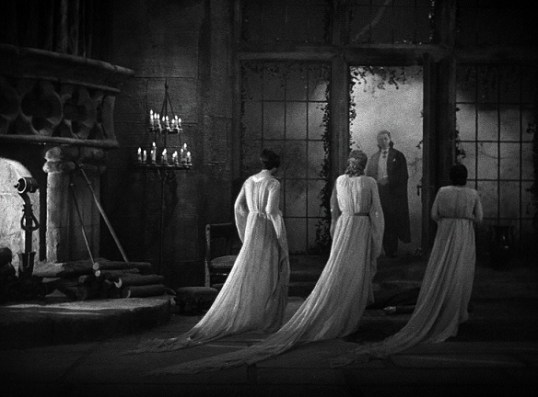
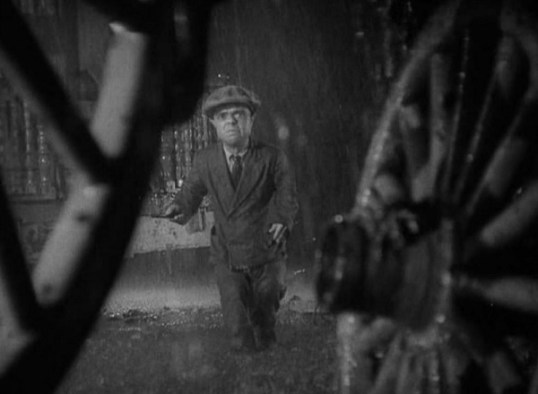
West of Zanzibar (1928, dir by Tod Browning, DP: Percy Hilburn)

Dracula (1931, dir by Tod Browning. DP: Karl Freund)

Freaks (1932, dir by Tod Browning, DP: Merritt Gerstad)

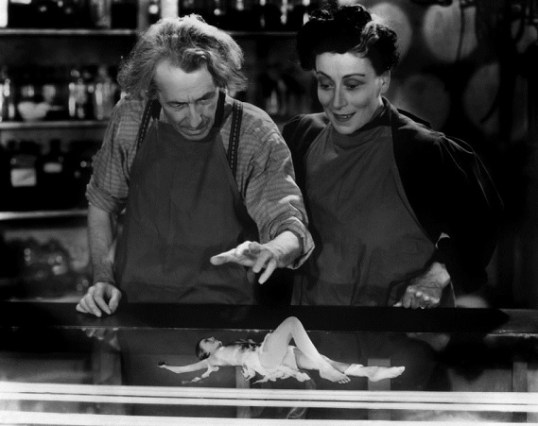
The Devil-Doll (1936, dir by Tod Browning, DP: Leonard Smith)

Scenes That I Love: Dracula Meets Van Helsing


143 years ago, on this date in Kentucky, director Tod Browning was born.  Though Browning was a director who was comfortable working in any genre, he is today best remembered for the horror films that he directed for Universal studios.  Today’s scene that I love comes from Tod Browning’s 1931 adaptation of Dracula.

In this scene, Count Dracula (Bela Lugosi) is introduced to Prof. Van Helsing (Edward Van Sloan).  Van Helsing notes something interesting about Dracula’s reflection, namely that he doesn’t have one.  Needless to say, the Count is not amused.

10 Oscar Snubs From The 1930s


Ah, the 1930s. America was mired in the Great Depression. FDR was plotting to pack the courts.  The American public, sick of playing by the rules and getting little in return, began to admire gangsters and outlaws.  The horror genre became the new way to vent about societal insecurity. In Europe, leaders were trying to ignore what was happening in Italy, Spain, and Germany. As for the Academy, it was still growing and developing and finding itself. With people flocking to the movies and the promise of an escape from reality, the Academy Awards went from being an afterthought to a major cultural event.

And, of course, the snubs continued.

1930 — 1931: Crime Doesn’t Pay For Little Caesar and The Public Enemy 

When people think about the 1930s, gangsters are probably one of the first things that come to mind.  In the 30s, audiences flocked to movies about tough and streetwise criminals who did what they had to do in order to survive during the Depression.  Unfortunately, the Academy was not always as quick to embrace the gangster genre.  Though The Public Enemy did pick up a nomination for its screenplay, both it and Little Caesar were largely ignored by the Academy.  Not only did the films fail to score nominations for Best Picture but neither James Cagney nor Edward G. Robinson would be nominated for bringing their title characters to life.  It’s a crime, I tells ya.
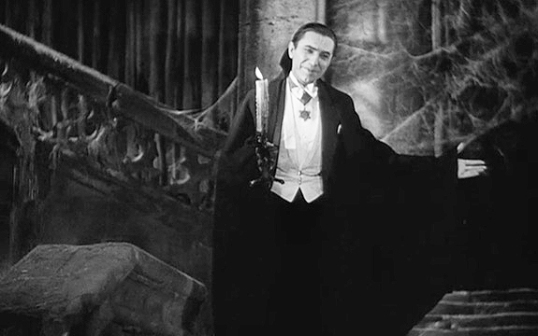
1930 — 1931: Bela Lugosi Is Not Nominated For Best Actor For Dracula

Admittedly, the 1931 version of Dracula is a bit of a creaky affair, one that feels quite stagey to modern audiences.  But Bela Lugosi’s performance in the title role holds up well, despite the number of times that it has been parodied.  Unfortunately, from the start, the Academy was hesitant about honoring the horror genre.

Frankenstein (1931, dir by James Whale)

1931 — 1932: Boris Karloff Is Not Nominated For Best Actor For Frankenstein

Again, the Academy snubbed an iconic horror star.  Not only was Boris Karloff not nominated for Frankenstein but the film itself was not nominated for Best Picture, despite being infinitely better than at least one of the 8 films that were nominated.  (That film, by the way, was Bad Girl.  When is the last time that anyone watched that one?)  In fairness to the Academy, they did honor one horror film at that year’s awards.  Fredric March won Best Actor for Dr. Jekyll and Mr. Hyde.  Of course, he also tied with Wallace Beery, who was nominated for The Champ.  Obviously, the Academy still had to work out its feelings towards the horror genre, a process that continues to this very day.

1932 — 1933: King Kong Is Not Nominated For Best Picture

Oh, poor King Kong.  Film audiences loved him but the Academy totally ignored both him and his film.  Unfortunately, back in 1933, the Academy had yet to introduce a category for special effects.

1932 — 1933: Duck Soup Is Ignored By The Academy

King Kong was not the only worthy film to be ignored at the 1932-1933 Oscars.  The Marx Brothers’s greatest film also went unnominated.

1934: The Scarlet Empress Is Not Nominated For Best Picture

Josef von Sternberg’s surreal historical epic was totally ignored by the Academy.  Not only did it miss out on being nominated for Best Picture but the sterling work of Marlene Dietrich and Sam Jaffe was ignored as well.  How was the opulent set design ignored?  How did it not even pick up a nomination for costume design?  My guess is that Paramount chose to promote Cleopatra at expense of The Scarlet Empress.  Either the way, the Best Picture Oscar was won by one of my favorite films, It Happened One Night.

1935: Fred Astaire and Ginger Rogers Are Not Nominated For Top Hat

Top Hat scored a best picture nomination but the film’s two stars went unnominated.

1936: My Man Godfrey Is Nominated For Everything But Best Picture

My Man Godfrey, a classic screwball comedy, was nominated for Best Actor, Best Actress, Best Supporting Actor, Best Supporting Actress, Best Director, and Best Screenplay but somehow, it was not nominated for Best Picture.  It’s a shame because My Man Godfrey, along being a very funny movie, is also a film that epitomizes an era.  Certainly, it’s far more entertaining today than the film that won Best Picture that year, The Great Ziegfeld.  (Interestingly enough, William Powell played the title role in both Godfrey and Ziegfeld.)

1937: Humphrey Bogart Is Not Nominated For Best Supporting Actor in Dead End

Dead End featured one of Bogart’s best gangster roles.  As a gangster who returns to his old neighborhood and is rejected by his own mother, Bogart was both menacing and, at times, sympathetic.  Like Cagney and Robinson, Bogart definitely deserved a nomination for his portrayal of what it was like to live a life of crime.  Unfortunately, Bogart was an actor who was taken for granted for much of his career.  It wasn’t until he played Rick Blaine in Casablanca that the Academy would finally nominate him.

The Adventures of Robin Hood (1938, dir by Michael Curtiz)

1938: Errol Flynn Is Not Nominated For Best Actor In The Adventures of Robin Hood

This is truly one of the more shocking snubs in Academy history.  Errol Flynn’s performance as Robin Hood pretty much set the standard for every actor who followed him.  Russell Crowe is undoubtedly a better actor than Flynn was but Crowe’s dour interpretation of Robin could in no way compete with the joie de vivre that Flynn brought to the role.

Agree?  Disagree?  Do you have an Oscar snub that you think is even worse than the 10 listed here?  Let us know in the comments!

Up next: 1940s, in which Hollywood joins the war effort and the snubs continue!

Dead End (1937, dir by William Wyler)

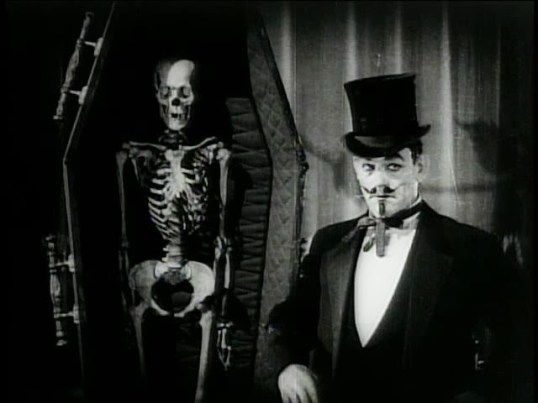
Dracula vs. LBJ: Who Would Win?


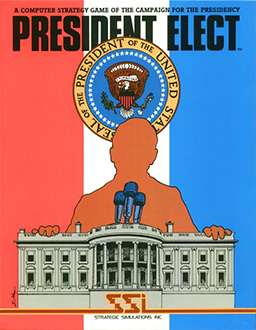
For my final President Elect simulation of this year’s horrorthon, I decided to see what would happen if, in 1964, Dracula had been the Republican nominee against LBJ.  I had already discovered that Dracula would have easily defeated both Frankenstein’s Monster and Jimmy Carter in a presidential election.  Would he be able to do the same with LBJ?

In the real world, LBJ easily defeated the Republican nominee, Barry Goldwater.  LBJ benefitted from public sympathy for the Kennedy family and also from a brutally negative campaign that portrayed Goldwater as being a war monger.  Johnson won 61% of the popular vote and he carried 44 states (and DC).  Goldwater won only 38% of the popular vote and carried only 6 states (5 in the Deep South and his home state of Arizona).  At the time, Goldwater’s defeat was portrayed as being the end of the Republican Party.  Instead, Goldwater’s losing campaign set the foundations that would later lead to election of Ronald Reagan in the 80s.

How would Dracula have done against LBJ?  Would Dracula, with his superb speaking skills and his hypnotic magnetism, have been able to defeat LBJ despite the incumbent’s strengths?

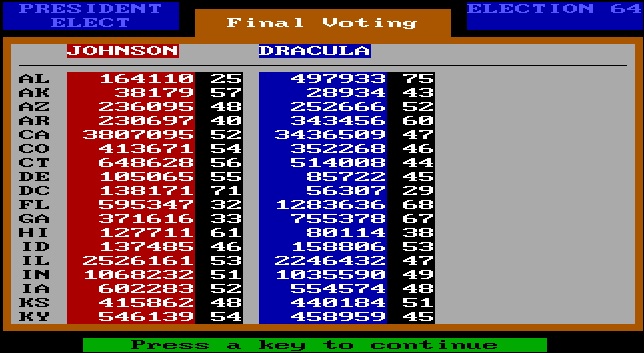
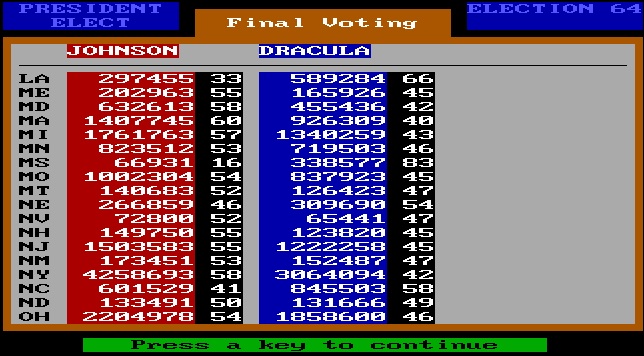
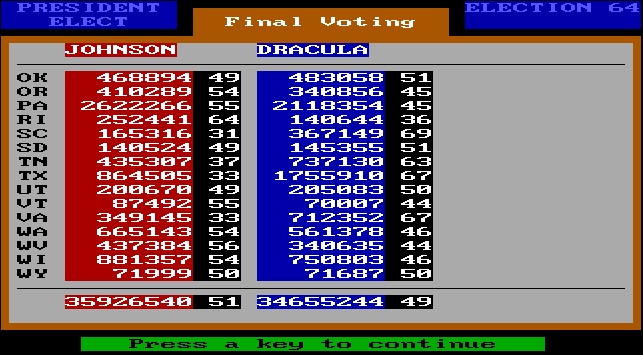
According to President Elect, LBJ would have still won if Dracula had been the nominee but the election would have been much closer, as far as the popular vote was concerned.  During the simulation, Dracula was such a strong candidate that LBJ even debated him twice.  Dracula won both times but LBJ was still able to hold his own.  If LBJ had made a serious gaffe during the debate, the election would have turned out differently.  It was a risk but it was a risk that paid off for Johnson.

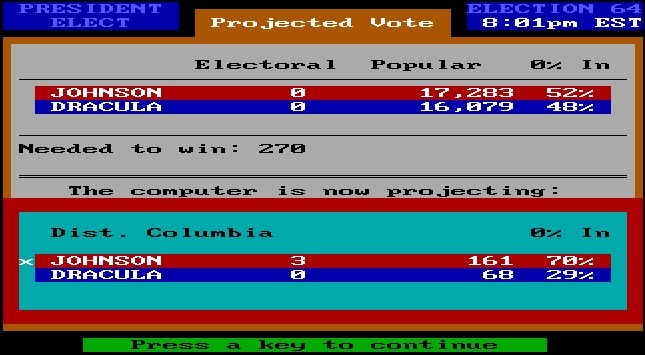
The first results of election night tells the story:

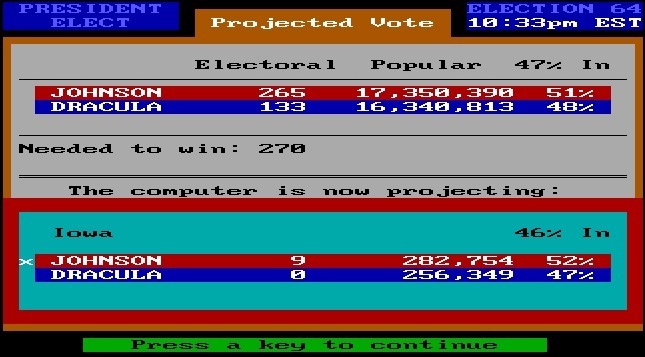
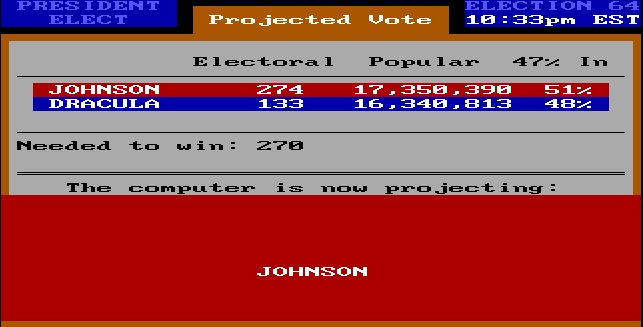
Though Johnson easily won the District of Columbia, the rest of the states were much closer.  Dracula did well in the South and in the west.  Johnson did well in the North and the Industrial Midwest.  It was Iowa that put him over the top.

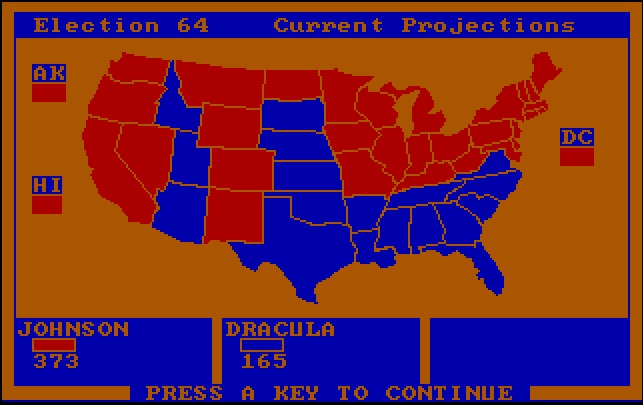
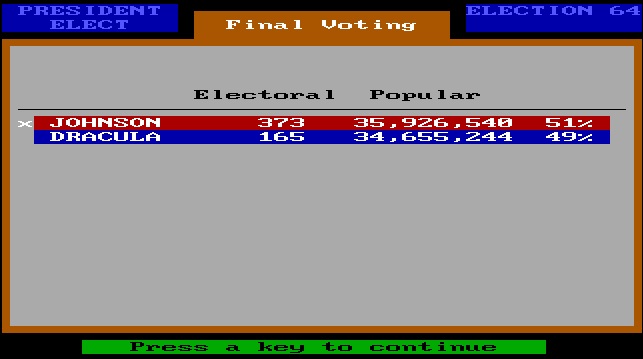
In the end, Dracula carried 18 states while Johnson won the other 32 (and D.C.).

(In President Elect, the Republican states are colored blue while the Democratic states are red. It took me a while to get used to it too.)

Against Dracula, Johnson still scored an electoral landslide but the popular vote was much closer.

So, if you’re ever wondering which President could have defeated Dracula, the answer is Lyndon B. Johnson.

And Ronald Reagan.  But you already knew that.

Dracula vs. Jimmy Carter: Who Would Win?


Earlier this week, I used the President Elect simulator to discover who would win if Dracula, Frankenstein’s Monster, and The Mummy ran against each other in the 2024 presidential election.  Dracula won easily.  The Monster carried D.C. and that’s it.

Then, I decided to see what would have happened in Frankenstein’s Monster had run against Richard Nixon in 1960.  Nixon won easily.  Even though the Monster received more votes against Nixon than he did against Dracula, he was still only able to carry two states in the Deep South, Georgia and Mississippi.

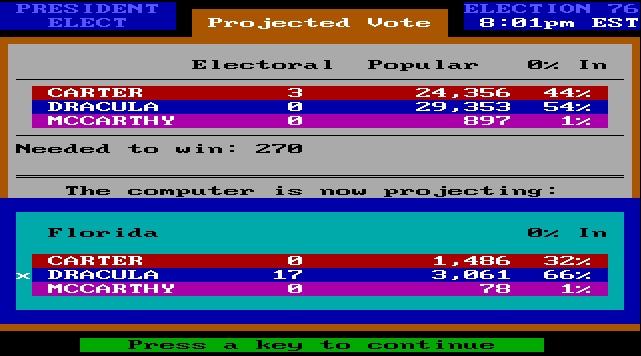
Today, I decided to see how Dracula would have done against Jimmy Carter in 1976.  I set up the simulation with the same economic and world conditions that Carter, Gerald Ford, and third party candidate Eugene McCarthy were debating in 1976.  The only difference is that I substituted Dracula for Gerald Ford.  No longer would Ford carry the stain of pardoning Nixon.  Now, it would be Dracula.  Again, I gave Dracula high score for his speaking ability, his personal magnetism, and his ability to stay cool under pressure.  I also made sure that Dracula’s campaign platform represented his authoritarian politics.

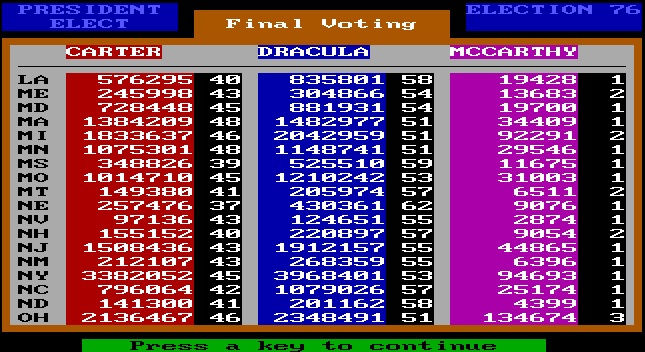
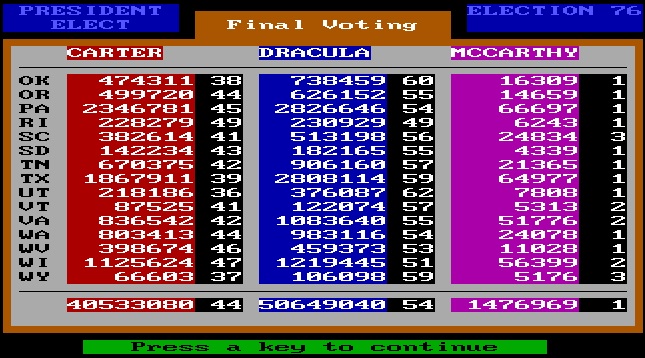
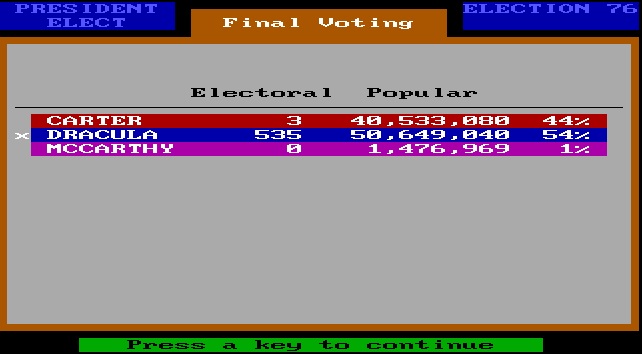
In the end, Dracula’s platform didn’t matter.  Watergate didn’t matter.  The economy didn’t matter.  Dracula wiped the floor with both Carter and McCarthy.  Carter challenged Dracula to one debate.  Dracula blew him out of the water.  In real life, Carter narrowly defeated Ford after Ford lost their debates.  In the simulation, Dracula dominated the election.

On election night, Carter got one piece of good news when he won the District of Columbia.

However, that would be all that Carter would win.  Dracula won the next state and never looked back.

Carter was strangely competitive in Rhode Island, only losing the state by a few thousand votes.  As for the rest of the states:

Sorry, Jimmy.  The people have spoken.

Frankenstein vs. Dracula vs. The Mummy: Who Would Win?


If the next presidential election were held today and the major candidates were Frankenstein, Dracula, and The Mummy, who would win?

I know that’s a question that has been on everyone’s mind and, in order to find out, I went to the Internet Archive and ran the scenario through a game called President Elect.  President Elect was developed as an election simulator in the 80s and it is still considered to be one of the best and most accurate games of its type.  Over the years, President Elect has correctly predicted the results of almost every election since 1988.

After setting the game to duplicate both the fragile state of the American economy and the uncertain outlook of our current place in the world, I then selected my three nominees.  Frankenstein’s Monster ran as the Democratic candidate.  He had no platform, beyond more funds for fire prevention.  As a public speaker, I had to give him a low rating and I also had to admit that he wasn’t good at maintaining his cool under pressure.  However, I did give him high marks on the “personal magnetism” scale because people have been fascinated by the monster for over two hundred years.  Frankenstein’s Monster may seemed like the underdog but perhaps voters would be moved by his personal story and his refusal to take definite positions on the issues.

Running for the Republicans was Dracula.  As for as public speaking, personal magnetism, and staying calm under pressure, Dracula got the highest rating available.  But his platform was undeniably extreme, with absolutely no concern for human rights.  Dracula was the only candidate to be opposed to the agendas of the Religious Right, the National Organization for Women, and the NRA.  (The last thing that a vampire would want would be for everyone to have access to silver bullets.)  Would he be too extreme for the voters?

Finally, running as an independent was the Mummy.  The Mummy had roughly the same platform as Dracula but little of the personal magnetism.  In fact, the Mummy could not even speak.  But he was determined to get what he wanted and again, he scored high on the personal magnetism because he’s been in so many movies despite spending all of his time under wraps.

I allowed the game to simulate the 9 weeks between Labor Day and the election.  Not surprisingly, Frankenstein’s Monster refused to debate Dracula.  As a third party candidate, the Mummy struggled to keep up financially.  I was expecting a close election with a lot of fireworks but instead, it was clear from week one who was going to win.  Dracula led in the polls from the start and, within the first hour of election night, he had the 270 electoral votes necessary to claim the presidency.  He went on to win a lot more than just 270 though.

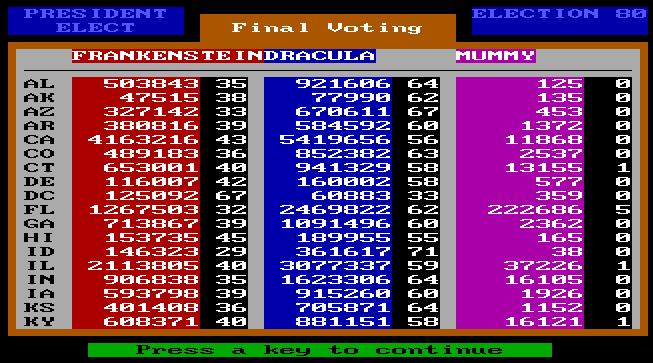
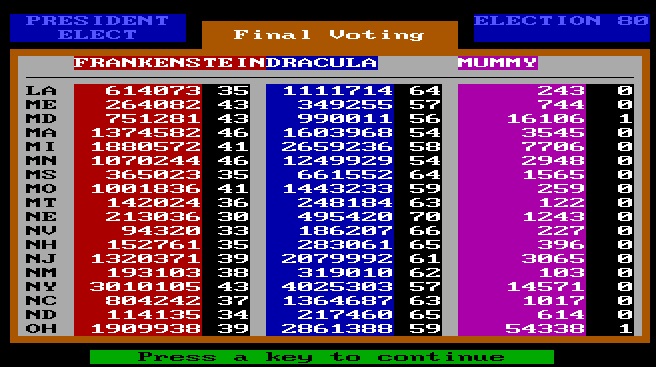
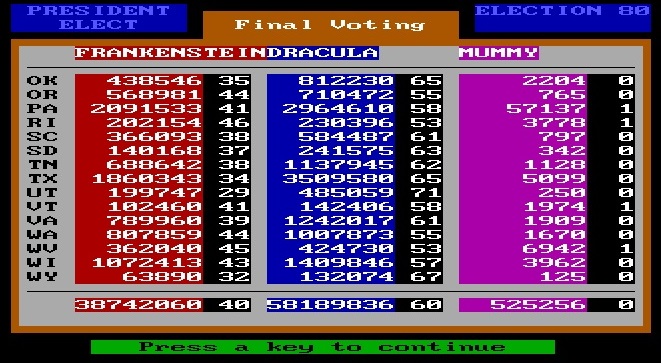
Here are the votes by state:

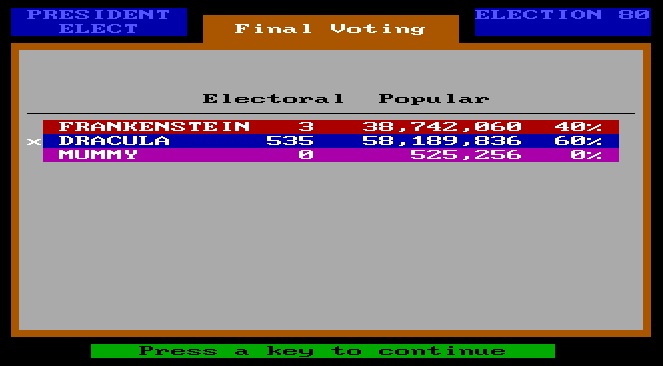
America went full Dracula, not only giving him 60% of the popular vote but also 535 electoral votes.  Frankenstein’s Monster won only the District of Columbia and, even then, he only received 67% of the vote in this Democratic stronghold.  After D.C., Frankenstein’s best states were Minnesota and Rhode Island, in which he took 47% of the vote.  The Mummy turned out not to be a factor at all, despite winning 5% of the vote in Florida.  Frankenstein’s Monster may have had the most compassionate platform but Dracula had the charisma.  His best states were Idaho and Utah, both of which he won with 71% of the vote.

See you at the inauguration!

6 Trailers For October 2nd, 2022


With Horrorthon underway, it’s time for a special October edition of Lisa Marie’s Favorite Grindhouse Trailers!  Today, I bring you 6 spine-tingling trailers from the 30s and the 40s!  Say hello to old school horror at its best!

  1. Dracula (1931)

First off, here is the original trailer for the 1931 version of Dracula!  Yes, it’s a bit grainy and it’s a bit creaky and …. well, it’s old.  But listen, if I had been around in 1931 and I saw this trailer, I definitely would have been at the theater on opening day.  “Do vampires exist?” the trailer asks.  No, they do not but who knows?  Maybe the trailer would have made me question my beliefs for at least a day or two.

Apparently, the odd scene with Edward Van Sloan and the mirror was taken from an outtake.  The scene itself is not in the film and presumably, that mirror was not supposed to fall off the wall.  Also, it’s interesting to note that Dracula was not a Halloween film but instead, it was released just in time for Valentine’s Day!

2. Frankenstein (1931)

Of course, Universal followed Dracula from Frankenstein.  Again, this is one of the original trailers for the film and not a trailer that was put together and released in later years.  The trailer does, at one point, say, “It’s coming back!,” so I’m assuming that this version was sent to theaters where the film had played previously.  The trailer features a few scenes that were cut from the film and also a few alternate takes,

3. Bride of Frankenstein (1935)

If you have a weak heart …. you better leave now!  The early Universal horror films are not necessarily thought of as being grindhouse films but this trailer is pure grindhouse.

4. The Wolf Man (1941)

In the 40s, Dracula and Frankenstein’s Monster were joined by a werewolf named Larry.  Here is the original trailer for The Wolf Man.

5. Cat People (1943)

In 1943, horror took a new, psychological turn with the original Cat People!

6. House of Frankenstein (1944)

Finally, in 1944, all of the great monster came together.  Before The Avengers, before the Justice League, before the Snyder cut, there was the House of Frankenstein! 

Next week …. more horror trailers!

8 Shots From 8 Horror Films: The 1930s


4 Or More Shots From 4 Or More Films is just what it says it is, 4 shots from 4 of our favorite films. As opposed to the reviews and recaps that we usually post, 4 Shots From 4 Films lets the visuals do the talking!

This October, I’m going to be doing something a little bit different with my contribution to 4 (or more) Shots From 4 (or more) Films.  I’m going to be taking a little chronological tour of the history of horror cinema, moving from decade to decade.

Today, we take a look at the 1930s.

8 Shots From 8 Horror Films

Dracula (1931, starring Bela Lugosi as the Count, Dir by Tod Browning, DP: Karl Freund)

Frankenstein (1931, dir by James Whale, DP: Arthur Edeson)

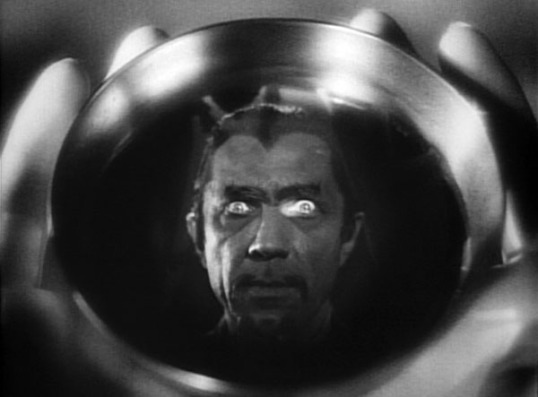
White Zombie (1932, directed by Vincent Halperin, DP: Arthur Martinelli)

The Mummy (1932, directed by Karl Freund, DP: Charles Stumar)
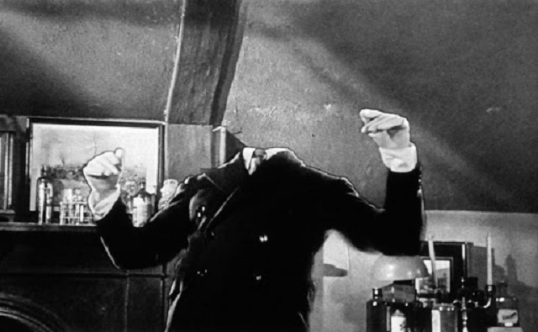
The Invisible Man (1933, dir by James Whale, DP: Arthur Edeson)
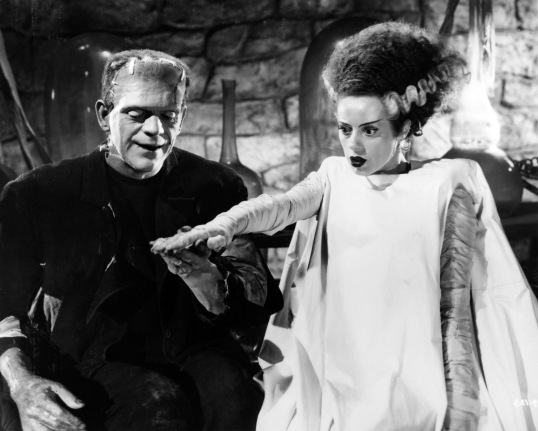
Bride of Frankenstein (1935, dir James Whale, DP: John J. Mescall)

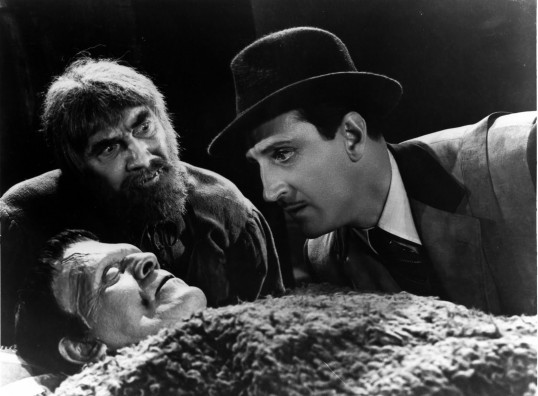
Mark of the Vampire (1935, dir by Tod Browning, DP: James Wong Howe)

Son of Frankenstein (1939, directed by Rowland V. Lee, DP: George Robinson)

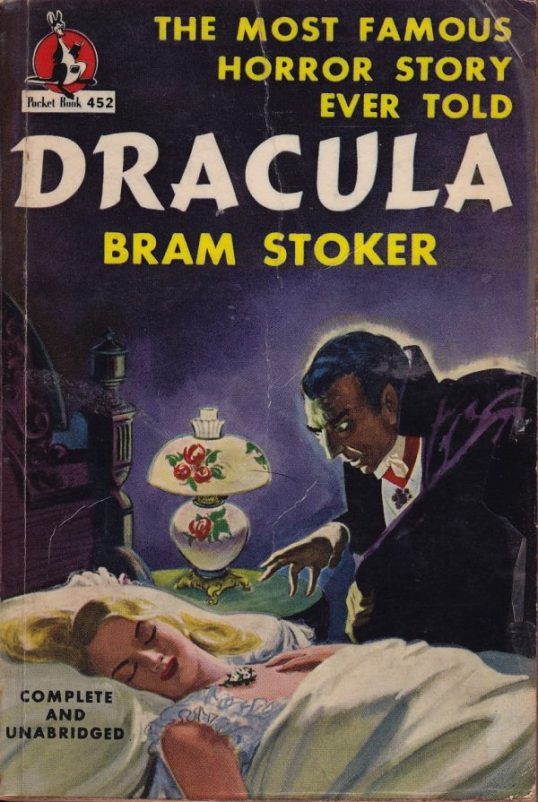
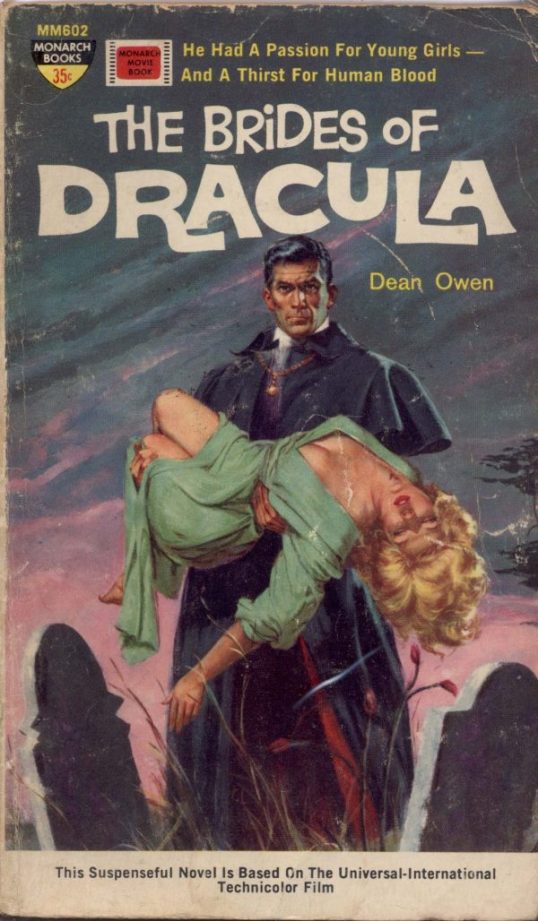
Happy Dracula Day!


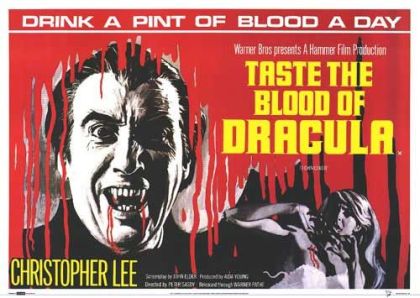
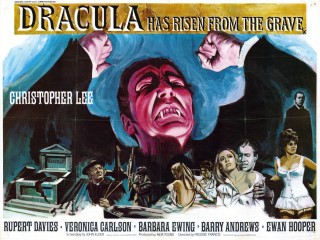
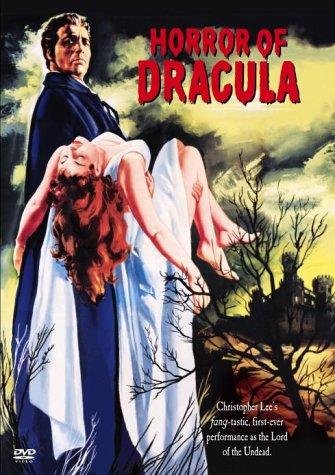
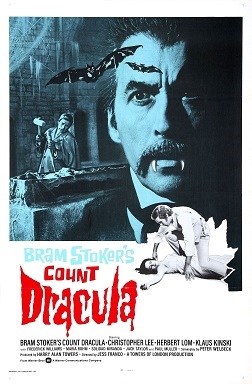
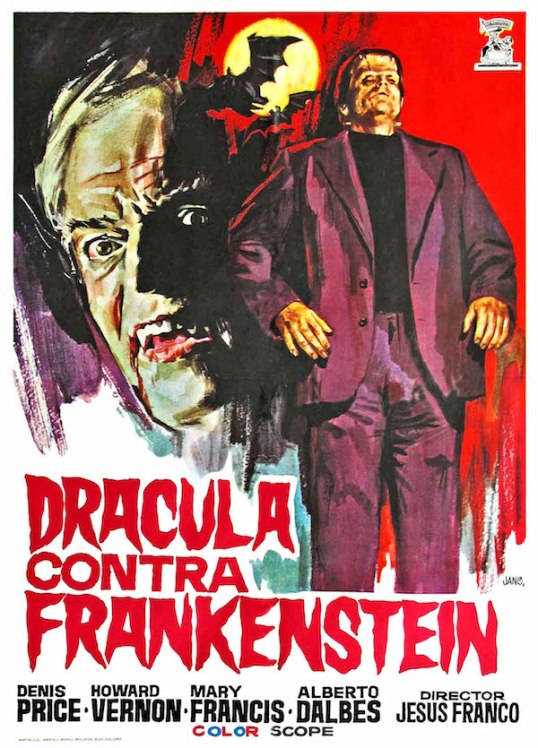
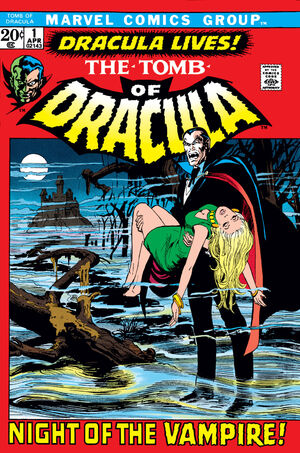
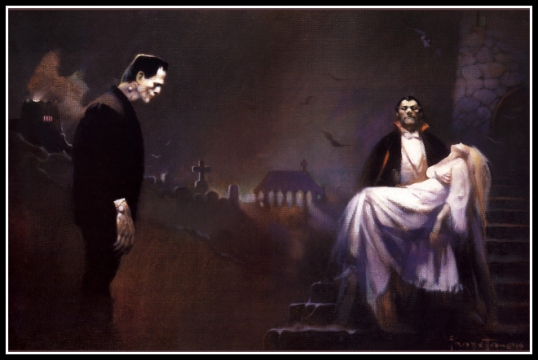
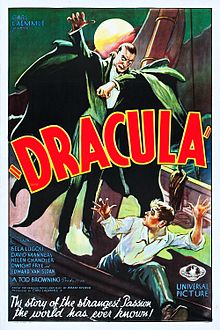
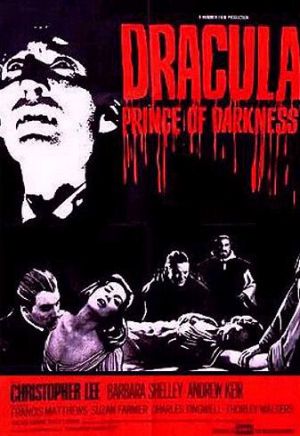
Today is the 125th anniversary of the publication of Bram Stoker’s Dracula!  Since 1897, Dracula has ruled supreme as the king of the Vampires.  In honor of this day, here are some of the way that Dracula has been imagined over the years.