Rancher Bob “Utah” Neyes (Russell Hayden) heads into Canada to meet up with his business partner. Unfortunately, his partner has been murdered by outlaw Nails Nelson (Douglas Fowley). Mountie Jack Craig (Lyle Talbot) almost arrests Utah for the crime but he becomes convinced that Utah is innocent and Nails is guilty. Along with fur trader Ivy Jenkins (I. Stanford Jolley), Craig and Utah try to break up Nails’s fur-smuggling operation.
While I was watching it, I thought this movie seemed even more familiar than the usual Poverty Row western. I realized that’s because I had actually seen Russell Hayden and most of the rest of the cast in another movie that had a similar plot, right down taking place on the other side of the border. That other movie was called ‘Neath Canadian Skies. Both it and North of the Border are among the four Canadian western films that Robert Lippert produced in 1946, all of which starred Russell Hayden and were directed by B. Reeves Easton. Supposedly, it took 20 days to shoot all of them.
As for North of the Border, it’s only 42 minutes long and none of those minutes are wasted. There’s all of the usual horse chases and gunfights that fans want from these films. For me, the most interesting thing about the film was getting to see Lyle Talbot play something other than a boring authority figure. Also, this film features Inez Cooper, a pretty redhead who had a short career but whose beauty and personality as well-remembered by fans of Poverty Row westerns. She plays the love interest in this one and there’s no doubt that most men would give up living in Utah for her.
As a person who sees his love of movies through a lens of “Bronson connections,” I have a special fondness for Kurt Russell. In 1963 and 1964, Charles Bronson worked on a television series with Kurt Russell called THE TRAVELS OF JAIMIE MCPHEETERS. The series itself is the story of twelve year old Jaimie McPheeters (Kurt Russell) who, along with his ne’er-do-well doctor dad (Dan O’Herlihy) and a ragtag group of pioneers, travel westward from Paducah, Kentucky to the California gold fields in 1849. Charles Bronson first appeared on episode 10 of the series, and would stay with the series until it ended after 26 episodes. Russell was the star, with Charles Bronson riding along in the important role of Linc Murdock, the guide who gets them through all sorts of dangerous situations. 1964’s GUNS OF DIABLO is an interesting concoction, using the final episode of the series, “The Day of Reckoning” and adding some new scenes shot specifically for a movie release.
GUNS OF DIABLO opens with Linc Murdock (Charles Bronson) leading the wagon train across a raging river. The group constructs a wooden barge, and most of the group makes it across safely. Unfortunately for one of the groups, a tree floating down the river smashes into the barge, causing it to sink along with the wagon and the man on top of it. Murdock jumps into the river and is able to save the man who unfortunately suffers a broken leg. Needing to rest for a few days, Murdock decides to go into the local town, Devil’s Gap, to get supplies. Jaimie (Kurt Russell), a boy with the wagon train, asks his dad if he can go with him. Dad says yes under one condition, Jaimie gets a real bath while he’s in town. So Linc and Jaimie head off together. When they get to town, Linc immediately goes to the saloon to get a beer, where he sees the beautiful Maria (Susan Oliver), a woman with whom he has a dangerous past. Via flashback, we learn the story of Linc and Maria falling in love while he was working as a hand on the Macklin ranch five years earlier. But it was a doomed love affair as Maria had been promised to the eldest son of the family, Rance Macklin (Jan Merlin). When Linc and Maria plan to elope and get married, Rance and his brothers get the drop on them. A big gunfight ensues, with Rance taking a shot in the arm, and Maria being shot in the crossfire. Believing her to be dead, Linc barely escapes with his own life.
Back in the present time we meet a Maria who is stuck in a loveless marriage to a one-armed Rance. Rance and his brothers have lost the ranch and are always trying to stay one step ahead of the law. That’s why Maria’s been reduced to working as a waitress at the saloon. She also believes that Linc ran out on her five years ago, so she’s mad at him. But soon those old feelings start stirring up deep within her when Linc talks sweet to her. When the duplicitous bartender Ives (John Fiedler) sees Linc go into Maria’s room, he sends word to Rance. Soon the Macklin Brothers are on their way back to town to settle their old score with Linc. What they didn’t count on was the 12 year old Jaimie McPheeters, with all of his youthful exuberance and ingenuity, being there to swing the odds in Linc’s favor! I made up that last line, but Jaimie does help Linc a couple of times.
I mentioned earlier that GUNS OF DIABLO was assembled together using the final episode of THE TRAVELS OF JAIMIE MCPHEETERS, along with some new footage added specifically for the movie. I’ve never seen the final episode of the series that this movie was based on, but I have seen some of the earlier episodes and I did notice one key difference. The TV series revolves mostly around the trials and tribulations of Jaimie and his dad, Dr. Sardis McPheeters. Dan O’Herlihy played Dr. McPheeters in the series, but actor Russ Conway plays him in this movie. He’s not a big part of the movie, just appearing at the beginning and the end, but it was odd seeing a different actor portraying Jaimie’s dad. It sure would be great if the series were to become more widely available at some point in time. I’d love to compare the TV version to this movie version.
Charles Bronson was not a big movie star when GUNS OF DIABLO was released, but he was a well respected character actor. He had already headlined his own TV series, MAN WITH A CAMERA (1958-1960), and he had prominent roles in the massive box office hits THE MAGNIFICENT SEVEN (1960) and THE GREAT ESCAPE (1963). This movie heavily focuses on his character, and Jaimie McPheeters takes a back seat. Bronson, already 43 years old, was more than up to the challenge. He comes across as a decent, hardworking man, who’s capable of taking care of himself. In other words, he shows the strength and charisma that would make him the most popular actor in the world just a few years later. Susan Oliver is quite beautiful as Maria. Although primarily known as a blonde, blue eyed beauty, her hair is dark here. She’s so beautiful that I can understand why a man with such limited options would be willing to fight to the death for her. And what can you really say about Kurt Russell?! He’s such a good child actor. While Jaimie McPheeters may not be the focus of the movie, he’s still so good in the role, showing kindness, loyalty and bravery in equal measure. In a world where so many child actors can’t adjust to life as an adult, Russell has made it look easy for the last six decades. In my opinion, he’s one of the all time greats.
Overall, GUNS OF DIABLO will never be confused with HIGH NOON (1952) or RIO BRAVO (1959), but for a movie assembled from a 60’s TV western and a few newly shot scenes, it’s actually quite enjoyable. And the storyline may not be the most original, but the time tested tale of true love and honor winning out over greed and evil will always make for compelling viewing. I got my first VHS of this film in the 80’s and I still own it to this day. I even watched it multiple times while I was writing up this review. As far as I’m concerned, GUNS OF DIABLO is well worth watching for fans of westerns or fans of the stars.
Rather than sharing a trailer for the film I thought I’d share this heartwarming story of the time Kurt Russell bought Charles Bronson a birthday gift while they were working together on this series. It’s a classic. Enjoy, my friends!
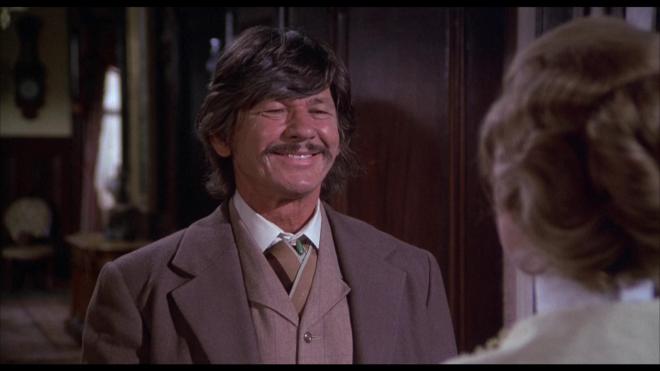
During the height of his popularity in 1976, Charles Bronson tried something quite different with this romantic comedy costarring his wife Jill Ireland. And to be honest, he’s darn funny in the role. This movie has grown on me over the years.
Bronson plays Graham Dorsey, a bank robber who spends an afternoon with the lonely widow Amanda Starbuck (Ireland) while his gang is robbing a bank in town. After his gang is all killed during the robbery, Dorsey must take off and go into hiding, eventually being arrested for impersonating a quack dentist. While he’s in jail, and through a variety of circumstances, a book is written about their afternoon together and it becomes an international sensation. As soon as Dorsey gets out of jail, he goes back to Starbuck’s home to rekindle their affair. Unfortunately for Dorsey, the book has created such a legend of him and their affair that Ms. Starbuck doesn’t even recognize the man he really is. His method of convincing her that he’s the “real” Graham Dorsey is the funniest moment in Bronson’s entire filmography.
Charles Bronson & Jill Ireland are clearly having a wonderful time making this movie together, which is one of the main reasons I enjoy the film. He may not have done it often, but Bronson could play comedy and he’s excellent in this film cast completely against his normal type. Jill Ireland is also very good as the widow Starbuck and her rendition of the song “Hello and Goodbye” was even nominated for a Golden Globe for Best Song. We had the privilege of interviewing Jill Ireland’s niece, Lindsay Ireland, and she told us of singing this song with her aunt Jill and her cousin when she would spend summers with them in Vermont in the 70’s. It’s so fun for me to hear firsthand about those times when the Bronson’s were one of the biggest celebrity couples of the world! The best part, Bronson valued his time with his family over anything else. They were everything to him.
**BONUS CONTENT** – I’ve included a link to the “This Week in Charles Bronson” podcast episode where Lindsay Ireland describes her time with her aunt Jill Ireland, and how they would sing “Hello & Goodbye,” the song that was in FROM NOON TILL THREE, while they were driving down the roads in Vermont. It’s a really nice insight into Jill Ireland.
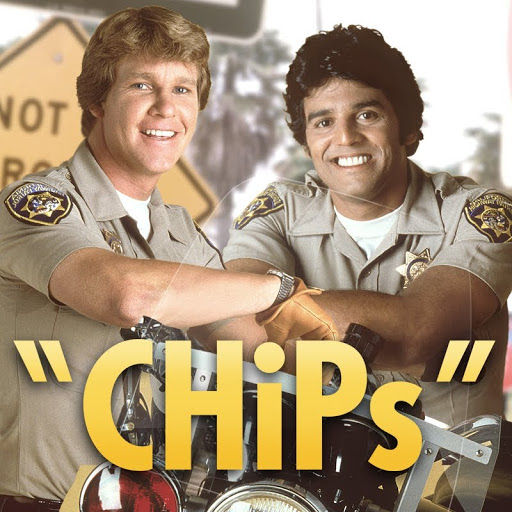
Welcome to Late Night Retro Television Reviews, a feature where we review some of our favorite and least favorite shows of the past! On Mondays, I will be reviewing CHiPs, which ran on NBC from 1977 to 1983. The entire show is currently streaming on Freevee!
This week’s episode is a change-of-pace as Ponch and Baker get off their motorcycles and go undercover!
Episode 2.16 “Pressure Point”
(Dir by Phil Bondelli, originally aired on January 20th, 1979)
The limousine of wealthy industrialist Arthur Forbinger (Rudy Vallee) is ambushed by three cars and a motorcycle. The motorcyclist shatters both the back and the front driver’s side window and tosses an envelope into the backseat. Forbinger orders his driver to chase the motorcycle.
Ponch and Baker, enjoying a leisurely patrol through Beverly Hills, spot the limo speeding down the street and they decide to pursue it. When Forbinger finally tells his driver to pull over, Ponch and Baker demands to know why Forbinger was putting lives at risk. Forbinger lies and says that he was late to a meeting. In reality, Forbinger has just opened the envelope and discovered pictures of his granddaughter, Chris (Mary Crosby). The implication is that whoever broke his window can also get to Chris.
Despite Forbinger’s attempts at deflection, Ponch, Baker, and Cahill soon figure out what actually happened. Thinking that Forbinger is perhaps being targeted by a private security firm that scares rich people into hiring its guards, Getraer tells Ponch and Baker to get off their motorcycles because they’re going undercover. Ponch will pretend to be a diplomat from Argentina and Baker will be his driver.
Ponch is overjoyed to at the chance to pretend to be rich. He’s even happier when he meets Chris. Oh, that Ponch!
This episode was weird. It just doesn’t feel right for Ponch and Baker to not be on their motorcycles and the episode spent so much time with Forbinger and Chris that I found myself wondering if it was meant to be some sort of backdoor pilot for a primetime soap opera about the Forbinger family. Despite featuring quite a few chase scenes and a few dramatic crashes, this didn’t feel like an episode of CHiPs at all. Is there really a point to the show without the motorcycles?
The other problem with this episode was that the performance of Rudy Vallee …. well, it wasn’t good. I know that Rudy was a show business veteran when he did this episode and that he had been around for a while but he still gives a rather flat and lifeless performance. He delivers his lines as if reading them off of a cue card. (For all I know, he was reading them off of a cue card.) As for the rest of the guest cast, Mary Crosby is stuck with a nothing role while Guy Stockwell and Tom Troupe are a bit too obviously sinister as the duplicitous security men.
This episode went for a change of pace but it just didn’t work. Sorry, Highway Patrol.
Yeah, yeah, I know. That sounds kinda silly, doesn’t it? However, November is traditionally the month that classic film bloggers tend to concentrate on writing about film noir. It provides a bit of grit and cynicism in between the horror fun of October and the holiday schmaltz of December.
I have to admit that I’m a little bit torn when it comes to taking part in Noirvember. On the one hand, I love a good film noir and there’s quite a few obscure and underrated ones available on YouTube right now. On the other hand, as a natural-born contrarian, I don’t like the idea of hopping on any bandwagons.
In the end, my love of film noir won out. So, welcome to my first entry in 30 More Days of Noir.
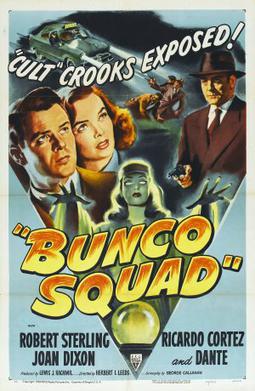
The 1950 film, Bunco Squad, tells the story of Tony Weldon (Ricardo Cortez), a con man who specializes in using a phony psychic routine to swindle rich people out of their money. He runs a fake enlightenment center and he claims that he can speak to the dead. His latest target is the wealthy Jessica Royce (Elisabeth Risdon). After he finds out that her son was killed during the invasion of Normandy, he and his associates go out of their way to trick her into believing that Tony can contact her son and that her son wants her to leave all of her money to Tony’s organization. It’s actually kind of interesting watching as Tony and his gang manage to track down information about Jessica and her son, asking the most mundane of questions to find out things that Jessica believes only her son would know. Watching Tony operate, I was reminded of those documentaries and news reports that you see about phony faith healers and other people who claim they can speak to the dead but who actually just go on very vague fishing expeditions. (“I’m sensing something about the letter L. Does that mean anything to you?”)
Tony is not just a con artist. He’s also a murderer, one who specializes in cutting brake lines on cars. If you try to expose Tony, you’re probably going to end up driving off of a cliff. I guess you can get away with that when you’re a con artist in California. Myself, I live in North Texas where the land is totally flat. Someone could cut my brake lines and I would probably just keep going forward until I eventually ran out of gas. Once that happened, someone would probably pull over and offer to give me a lift to the nearest gas station. That’s one reason why someone like Tony Weldon could never pull off any of his crimes in my home state.
Fortunately, the detective of the LAPD’s Bunco Squad know what Tony’s doing. The only problem is that they have to get some proof that Tony is swindling Ms. Royce and they have to manage to do it before Tony gets a chance to tamper with all of their brakes. Leading the Bunco Squad is Steve Johnson (Robert Sterling) and you better believe that there’s no way someone named Steve Johnson is going to be anything other than honest and upright. Working with a real-life magician named Dante, Johnson attempts to expose all of Tony’s tricks.
It’s probably open for debate whether or not Bunco Squad is a true noir. On the one hand, Tony and his schemes are very noirish. On the other hand, Steve and the members of the Bunco Squad are so upright that there’s none of the ambiguous morality that you find in the best film noirs. I guess I would call this a half-noir.
The best thing about Bunco Squad is that it’s only 67 minutes long, which is all the time that it needs to tell a compact and occasionally interesting story. There’s no excessive padding to try to force the story out to an unwieldy 90 minutes. Instead, Bunco Squad jumps right into its story and it doesn’t let up until things come to an end. The other good thing about Bunco Squad is that you’ve got Ricardo Cortez, giving a charmingly evil performance as Tony Weldon. The film’s heroes are a pretty dull bunch but Cortez brings a nice charge of danger to the proceedings.
Bunco Squad is an obscure film but it moves quickly and the story is interesting enough to hold your attention for an hour. It can be found on YouTube.
As the 1947 film, Roses Are Red, begins, Robert A. Thorne (Don Castle) has just been elected to the office of district attorney.
Now, being the horror fan that I am, the thing that I immediately noticed was that the new district attorney had the exact same name as the character played by Gregory Peck in The Omen. However, Roses Are Red has nothing to do with the son of Satan or the end of the world. Instead, it’s just a briskly paced tale of swapped identity.
Robert A. Thorne is not just a brilliant lawyer. He’s also an example of that rare breed, an honest politician. He ran on a platform of reform and that’s what he’s intending to pursue now that he’s been elected. As he tells his girlfriend, journalist Martha McCormick (Peggy Knudsen), cleaning up this country isn’t going to be easy but he’s determined to do it. And the first step is going to be taking down the local mob boss, Jim Locke (Edward Keane).
The wheelchair-bound Jim Locke is a man who prefers to stay in the safety of his penthouse, where he can feed his fish and give orders to his subordinates, all of whom have names like Duke (Charles McGraw), Knuckle (Jeff Chandler), Buster (Paul Guilfoyle), and Ace (Douglas Fowley). However, his man on the police force, Lt. Rocky Wall (Joe Sawyer), has warned him that this new district attorney might not respond to usual combination of bribes and intimidation. That’s not good news because there are men who might be willing to testify against Locke in return for a shorter prison sentence.
However, things start to look up when none other than Robert A. Thorne shows up at Locke’s penthouse and says that the honesty bit was all a sham and that he wants to be on Locke’s payroll. However, Locke soon figures out that he’s not talking to Thorne. Instead, he’s talking to Don Carney (also played by Don Castle), a career criminal who has recently been released from prison and who just happens to look exactly like Robert Thorne!
Locke and Don come up with a plan that seems foolproof. What if Knuckle kidnaps Thorne and holds him hostage for a few days? During that time, Don can study Thorne and learn how to perfectly imitate all of his movements and expressions. Once the two men are absolutely indistinguishable, Knuckle will murder Thorne and then Don will take his place.
Knuckle manages to kidnap Thorne with absolutely no trouble. The police, under the prodding of Lt. Wall, announce that Thorne has obviously run off to avoid dealing with the local gangsters. Don starts the process of studying Thorne but it turns out that the district attorney has a few tricks of his own….
With a running time of only 67 minutes, Roses are Red doesn’t waste any time jumping into its somewhat implausible plot. Fortunately, the film is so short and quickly paced that most viewers won’t really have time to worry about whether or not the film’s plot actually makes any sense. This is an entertaining, low-budget film noir, featuring a host of memorable performances and all of the hard-boiled dialogue that you could hope for. Don Castle does a good job playing both the sleazy Don Carney and the upright Robert A. Thorne. History nerds like me will immediately notice that, with his mustache and his slicked back hair, Castle bears a distinct resemblance to former Manhattan D.A. and two-time presidential candidate, Thomas E. Dewey.
All in all, Roses are Red is an enjoyable film for fans of old school gangster noir. Check it out below:
The 1944 film, Lady in the Death House, tells the tragic and faintly ridiculous story of Mary Kirk Logan (Jean Parker).
The daughter of a small-time criminal, Mary has spent most of her life trying to escape from her family’s legacy of crime. She’s even got a job, working at the same bank that her father once tried to rip off. Of course, at work, everyone knows her as Mary Kirk and they have no idea that her father was the infamous Tom Logan. If that information got out, Mary would lose her job and no longer be able to take care of herself or her younger sister, Suzy (Marcia Mae Jones).
One night, Mary is out on a date with a clumsy man who takes her out to a nightclub and manages to accidentally set Mary’s dress on fire. Luckily, Dr. Brad Braford (Douglas Fowley) is there, having a drink with his friend, the famous criminologist, Charles Finch (Lionel Atwill). Brad jumps into action, extinguishing the fire and saving Mary’s dress. It’s love at first sight.
There’s just one problem. Dr. Bradford is studying ways to bring the dead back to life and, in order to raise money for his research, he’s been working as the state’s executioner. When someone goes to the electric chair, Brad is the one who pulls the lever. Mary says that she can only marry Brad if he gives up his electrifying night job.
However, before Brad can turn in his letter of resignation, Mary is arrested for the murder of Willis Millen (Dick Curtis), a crook who once knew her father. Mary swears that she’s innocent but there are two eye witnesses who testify that they not only heard Mary and Willis fighting but that they also saw the shadow of someone hitting Willis over the head with a lamp. It doesn’t take long for the jury to reach a verdict:
I have to admit that, when this newspaper appeared on-screen, I was actually more curious about the “youth” who was arrested for stealing glitter off of campaign signs. However, for whatever reason, the film declines to follow up on that story. Instead, we watch as Mary goes to death row, with the knowledge that she is to die “at the hand of the man I love.”
However, there may still be hope! Charles thinks that Mary is innocent. Though there’s only 24 hours left before Brad is scheduled to execute Mary, Charles launches an investigation of his own. But even if Charles is able to find the evidence that exonerates Mary, will he be able to contact the governor in time? Or will Mary go to the chair?
Well, regardless of what happens, rest assured that this World War II-era film will end with an appeal for all movie goers to do the right thing and buy war bonds.
Lady in the Death House is an entertaining but fairly ludicrous little movie. I mean, realistically, having the executioner execute his own fiancée is a huge conflict of interest. It seems like they could have gotten a substitute executioner, if just for one night. But, if they did that, we wouldn’t get the melodramatic highlight of Mary announcing that she’s scheduled to be killed “by the hand of the man I love.”
Lady in the Death House provides a rare chance to see Lionel Atwill in a heroic role. The British actor played a countless number of mad scientists, killers, and Nazis before his premature death in 1946. (Atwill’s promising career was derailed in 1943, when he accused of hosting orgies at home and was subsequently convicted of perjury. That’s one reason why Atwill turned up in a “poverty row” feature like this one.) Atwill is convincing as Charles Finch. The same superior attitude that made him a good villain also makes him believable as the only person capable of figuring out who murdered Willis Millen.
Taking on its own terms, Lady in the Death House is a fun movie. If nothing else, it provides a lesson on how to get a message to the governor, even if no one’s quite sure where he is for the evening. That’s an important lesson to learn!
After witnessing the murder of an informant, Kolchak finds himself being targeted by the mob!
Of course, after some of what Kolchak has been through, a simple Earth-bound threat like the Mafia would be a nice change of pace. However, Kolchak soon discovers that he’s also got a witch after him! With the help of a model (Lara Parker), Kolchak sets out uncover the witch at the heat of Chicago’s fashion industry!
This episode originally aired on January 24th, 1975.
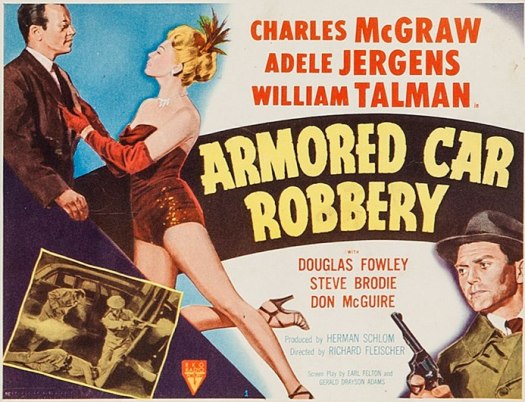
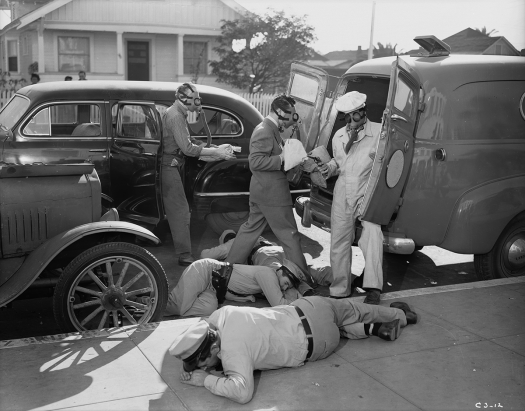
Looking for a tough, no-frills ‘B’ crime drama? Look no further than ARMORED CAR ROBBERY, which is just what it says it is, the planning, execution, and aftermath of said dirty deed, with a cast of rugged mugs and hard-hearted dames directed by Richard Fleischer during his salad days at RKO. The movie echoes Robert Siodmak’s CRISS CROSS in its heist scene, and I’m sure Stanley Kubrick watched and remembered it when he made his film noir masterpiece THE KILLING .
Make no mistake, ARMORED CAR ROBBERY isn’t on a par with those two films. It is, however, an enjoyable little 67 minutes of cops vs crooks. Criminal mastermind Dave Purvis assembles a gang of low-lives to pull the caper off, killing a cop in the process. The cop’s partner, Lt. Jim Cordell, is now determined to hunt the crooks down and avenge him. One of the participants, Benny McBride…
The simple answer to that is that Barabbas was the prisoner who, according to the Gospels, Pontius Pilate released during Passover. As the story goes, Pilate gave the people the choice. He could either release Barabbas or Jesus. For what crime was Barabbas being held? The Gospel of Matthew merely says that Barabbas was a “notorious prisoner.” Mark and Luke both write that he was involved in a recent riot and that he was a murderer. The Gospel of John refers to him as being a bandit, which may have been another term for revolutionary. Regardless of what crime he had committed, the people overwhelmingly called for Barabbas to be released and for Jesus to be crucified. What happened to Barabbas after he was set free is not recorded but has been the subject of a good deal of speculation over the centuries.
(Of course, there are some scholars who believe that the Barabbas story was simply an invention of later writers, designed to shift the responsibility for the crucifixion away from the Romans. There’s also some who say that Jesus and Barabbas were actually the same person and that the inclusion of the Barabbas story was meant to indicate that Jesus was actually a revolutionary who was working to free Judea from Roman role. I imagine Dan Brown will eventually base a novel on this theory, so look forward to hearing your grandma debating the historicity of Barabbas at some point in the future.)
Back to the original question, who was Barabbas?
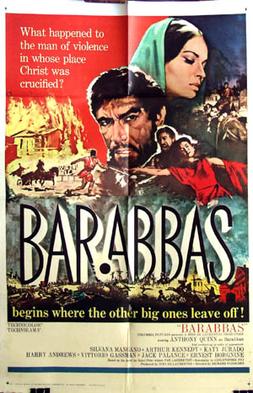
According to the 1961 film of the same name, Barabbas was Anthony Quinn.
Based on a novel by the Nobel Prize-winning Swedish author, Pär Lagerkvist, Barabbas opens with Pilate (Anthony Kennedy) making his infamous offer. Barabbas or Jesus? Perhaps the only person more shocked than Pilate by the people’s decision is Barabbas himself. A brutish and violent man, Barabbas is looking forward to returning to his old life but, as he leaves the prison, he finds himself fascinated by the sight of Jesus stoically carrying the cross, heading to the fate that Barabbas was spared. Later, Barabbas witnesses the Crucifixion and is shaken when, upon Jesus’s death, the sky turns black.
(Director Richard Fleischer shot the Crucifixion during an actual solar eclipse, so that the sky actually did turn black during filming. It’s a stunning scene.)
For the rest of his life, Barabbas is haunted by both his narrow escape from death and his subsequent notoriety. When Barabbas tries to reunite with his former lover, Rachel (Silvana Mangano), he discovers that not only does she now want nothing to do with him but that she has also become a follower of Jesus. (Later, in a surprisingly graphic scene, Rachel is stoned to death.) Barabbas becomes convinced that he cannot die and he becomes increasingly reckless in his behavior. Over the next few decades, he finds himself sold into slavery and forced to spend 20 years working in the harsh sulfur mines of Sicily. He befriends a Christian named Sahak (Vittorio Gassman) and, with him, is trained to be a gladiator by the sadistic Torvald (Jack Palance). Eventually, Barabbas finds himself rejected by both the Romans and the Christians while Rome burns all around him.
Barabbas is a film that really took me by surprise. I’ve seen a lot of Biblical and Roman films from the 50s and 60s and I was expecting that Barabbas would be another sumptuously produced but slow-paced epic, one that would inevitably feature stiff dialogue and overly reverential performances. I mean, don’t me wrong. I happen to love spectacle and therefore, I enjoy watching most of those old historical and religious epics. But still, for modern audiences, these films can often seem rather … well, hokey.
But Barabbas was totally different from what I was expecting. As wonderfully played by Anthony Quinn, Barabbas wanders through most of the film in a state of haunted confusion. Even at the end of the film, after he’s met St. Peter (Harry Andrews), Barabbas doesn’t seem to fully understand what he believes or how he’s become one of the most notorious men in Rome. Quinn plays Barabbas almost like a wild animal, one that has been cornered and trapped by his own infamy. The more Barabbas struggles against his fate, the more trapped he becomes. Barabbas may be a brute but, the film suggests, even a brute can find some sort of redemption. Quinn gets good support from the entire supporting cast. Jack Palance is perfectly evil as Torvald while Vittorio Gassman, Silvana Mangano, and Ernest Borgnine bring some needed nuance to characters who, in lesser hands, could have just been cardboard believers.
Barabbas is a surprisingly dark film. When Rachel is stoned, the camera doesn’t flinch from showing just how cruel an execution that was. Nor does the camera flinch from the violent brutality of the gladiatorial games. When Barabbas is sold into slavery, the sulfur mines of Sicily are depicted in Hellish detail and practically the only thing that saves Barabbas from spending the rest of his life being smothered under a cloud of sulfur is a giggly Roman woman who decides to buy Barabbas so that he can serve as a good luck charm. The scenes of Barabbas’s skill of a gladiator are contrasted with the bloodthirsty crowd demanding and cheering death. Even when Barabbas joins the Christians in the Roman catacombs, he discovers that they want nothing to do with him, suggesting that they believe in forgiveness for everyone but him. The spectacle of Rome is displayed but so is the terror of what lies underneath the city’s ornate surface. If Barabbas is occasionally a ruthless or unsentimental character, one need only look at the world he lives in to understand why.
With the exception of a few slow scenes at the start of the film, director Richard Fleischer does a good job of keeping the action moving. It’s a long film but it never becomes a boring one. In the end, thanks to Quinn’s performance and the film’s unflinching portrayal of life in ancient Rome, Barabbas is a biblical epic for people who usually don’t like biblical epics.
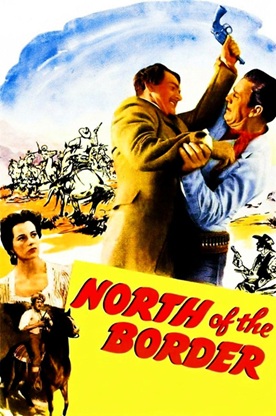 Rancher Bob “Utah” Neyes (Russell Hayden) heads into Canada to meet up with his business partner. Unfortunately, his partner has been murdered by outlaw Nails Nelson (Douglas Fowley). Mountie Jack Craig (Lyle Talbot) almost arrests Utah for the crime but he becomes convinced that Utah is innocent and Nails is guilty. Along with fur trader Ivy Jenkins (I. Stanford Jolley), Craig and Utah try to break up Nails’s fur-smuggling operation.




 Through the Shattered Lens