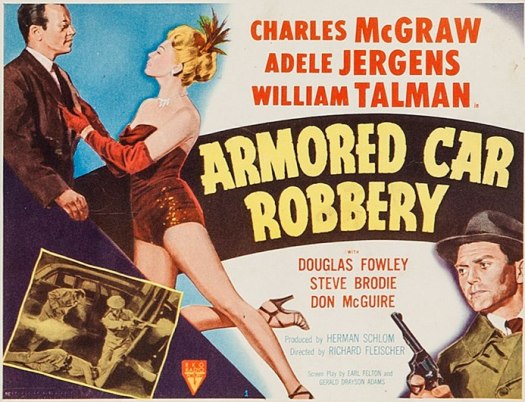
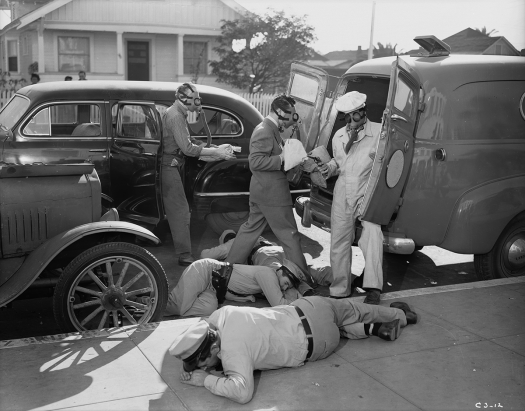
Looking for a tough, no-frills ‘B’ crime drama? Look no further than ARMORED CAR ROBBERY, which is just what it says it is, the planning, execution, and aftermath of said dirty deed, with a cast of rugged mugs and hard-hearted dames directed by Richard Fleischer during his salad days at RKO. The movie echoes Robert Siodmak’s CRISS CROSS in its heist scene, and I’m sure Stanley Kubrick watched and remembered it when he made his film noir masterpiece THE KILLING .
Make no mistake, ARMORED CAR ROBBERY isn’t on a par with those two films. It is, however, an enjoyable little 67 minutes of cops vs crooks. Criminal mastermind Dave Purvis assembles a gang of low-lives to pull the caper off, killing a cop in the process. The cop’s partner, Lt. Jim Cordell, is now determined to hunt the crooks down and avenge him. One of the participants, Benny McBride…
The simple answer to that is that Barabbas was the prisoner who, according to the Gospels, Pontius Pilate released during Passover. As the story goes, Pilate gave the people the choice. He could either release Barabbas or Jesus. For what crime was Barabbas being held? The Gospel of Matthew merely says that Barabbas was a “notorious prisoner.” Mark and Luke both write that he was involved in a recent riot and that he was a murderer. The Gospel of John refers to him as being a bandit, which may have been another term for revolutionary. Regardless of what crime he had committed, the people overwhelmingly called for Barabbas to be released and for Jesus to be crucified. What happened to Barabbas after he was set free is not recorded but has been the subject of a good deal of speculation over the centuries.
(Of course, there are some scholars who believe that the Barabbas story was simply an invention of later writers, designed to shift the responsibility for the crucifixion away from the Romans. There’s also some who say that Jesus and Barabbas were actually the same person and that the inclusion of the Barabbas story was meant to indicate that Jesus was actually a revolutionary who was working to free Judea from Roman role. I imagine Dan Brown will eventually base a novel on this theory, so look forward to hearing your grandma debating the historicity of Barabbas at some point in the future.)
Back to the original question, who was Barabbas?
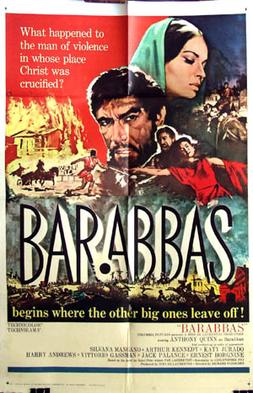
According to the 1961 film of the same name, Barabbas was Anthony Quinn.
Based on a novel by the Nobel Prize-winning Swedish author, Pär Lagerkvist, Barabbas opens with Pilate (Anthony Kennedy) making his infamous offer. Barabbas or Jesus? Perhaps the only person more shocked than Pilate by the people’s decision is Barabbas himself. A brutish and violent man, Barabbas is looking forward to returning to his old life but, as he leaves the prison, he finds himself fascinated by the sight of Jesus stoically carrying the cross, heading to the fate that Barabbas was spared. Later, Barabbas witnesses the Crucifixion and is shaken when, upon Jesus’s death, the sky turns black.
(Director Richard Fleischer shot the Crucifixion during an actual solar eclipse, so that the sky actually did turn black during filming. It’s a stunning scene.)
For the rest of his life, Barabbas is haunted by both his narrow escape from death and his subsequent notoriety. When Barabbas tries to reunite with his former lover, Rachel (Silvana Mangano), he discovers that not only does she now want nothing to do with him but that she has also become a follower of Jesus. (Later, in a surprisingly graphic scene, Rachel is stoned to death.) Barabbas becomes convinced that he cannot die and he becomes increasingly reckless in his behavior. Over the next few decades, he finds himself sold into slavery and forced to spend 20 years working in the harsh sulfur mines of Sicily. He befriends a Christian named Sahak (Vittorio Gassman) and, with him, is trained to be a gladiator by the sadistic Torvald (Jack Palance). Eventually, Barabbas finds himself rejected by both the Romans and the Christians while Rome burns all around him.
Barabbas is a film that really took me by surprise. I’ve seen a lot of Biblical and Roman films from the 50s and 60s and I was expecting that Barabbas would be another sumptuously produced but slow-paced epic, one that would inevitably feature stiff dialogue and overly reverential performances. I mean, don’t me wrong. I happen to love spectacle and therefore, I enjoy watching most of those old historical and religious epics. But still, for modern audiences, these films can often seem rather … well, hokey.
But Barabbas was totally different from what I was expecting. As wonderfully played by Anthony Quinn, Barabbas wanders through most of the film in a state of haunted confusion. Even at the end of the film, after he’s met St. Peter (Harry Andrews), Barabbas doesn’t seem to fully understand what he believes or how he’s become one of the most notorious men in Rome. Quinn plays Barabbas almost like a wild animal, one that has been cornered and trapped by his own infamy. The more Barabbas struggles against his fate, the more trapped he becomes. Barabbas may be a brute but, the film suggests, even a brute can find some sort of redemption. Quinn gets good support from the entire supporting cast. Jack Palance is perfectly evil as Torvald while Vittorio Gassman, Silvana Mangano, and Ernest Borgnine bring some needed nuance to characters who, in lesser hands, could have just been cardboard believers.
Barabbas is a surprisingly dark film. When Rachel is stoned, the camera doesn’t flinch from showing just how cruel an execution that was. Nor does the camera flinch from the violent brutality of the gladiatorial games. When Barabbas is sold into slavery, the sulfur mines of Sicily are depicted in Hellish detail and practically the only thing that saves Barabbas from spending the rest of his life being smothered under a cloud of sulfur is a giggly Roman woman who decides to buy Barabbas so that he can serve as a good luck charm. The scenes of Barabbas’s skill of a gladiator are contrasted with the bloodthirsty crowd demanding and cheering death. Even when Barabbas joins the Christians in the Roman catacombs, he discovers that they want nothing to do with him, suggesting that they believe in forgiveness for everyone but him. The spectacle of Rome is displayed but so is the terror of what lies underneath the city’s ornate surface. If Barabbas is occasionally a ruthless or unsentimental character, one need only look at the world he lives in to understand why.
With the exception of a few slow scenes at the start of the film, director Richard Fleischer does a good job of keeping the action moving. It’s a long film but it never becomes a boring one. In the end, thanks to Quinn’s performance and the film’s unflinching portrayal of life in ancient Rome, Barabbas is a biblical epic for people who usually don’t like biblical epics.
With Arleigh away in Boston, I originally thought that this weekend would present the perfect opportunity to turn Through The Shattered Lens into the web’s premier site for Twilight fan fiction and soulful Edward Cullen gifs. I was even planning on writing a post about how, by simply using time travel as a plot device, one could do a massive Twilight-Divergent-Hunger Games crossover. (Essentially, Katniss and Tris would work together to raise Bella’s self-esteem but there was a lot more to it than just that….)
It was going to be glorious but then I got distracted by a 1953 film called Cat-Women of The Moon.
Cat-Women of the Moon attempts to imagine what will happen when mankind finally attempts to launch an expedition to the moon. According to this film, it will involve four men and one woman sitting around on a rocket and trading sexist quips.
Among our crew:
Laird Grainger (Sonny Tufts) is the philosophical but tough captain who talks about the eternal mysteries of the stars.
Helen Salinger (Marie Windsor) is the ship’s navigator. She also happens to be — GASP! — a female. When asked why she should be allowed to step foot on the moon with the men, she replies, “Somebody needs to cook your meals!” Because, you know, it’s 1953…
Then there’s Walter Walters (Douglas Fowley) who is secretly New Mexico’s biggest supplier of meth. Oh wait — sorry, wrong Walter. Walter Walters is just some guy with a mustache who won’t stop talking about how he’s going to use the moon to get rich.
And then there’s Kip (Victor Jory) and Doug (Bill Phipps), two all-American boys who deal with their problems by first considering their options and then shooting anyone who happens to be standing in their way.
Anyway, once the rocket finally does reach the moon, our intrepid crew discovers that not only does the moon have an atmosphere but it’s inhabited by both a giant spider (which looks a bit like an ill-conceived piñata whenever it dangles over the heads of our astronauts) and the Cat-Women of the Moon (played, the opening credits tell us, by “THE HOLLYWOOD COVER GIRLS”).
Now, if you’re like me, you probably saw the film’s title and then assumed that the film would be about women who were half feline. You would be wrong. Despite the film’s title, the Cat-Women don’t have much to do with actual cats. Instead, they’re the last 8 members of an ancient race. They all wear black leotards and, when Doug asks where their “menfolk” are, they reply that they have no need of men.
Oh, and get this — they spend all of their spare time dancing!
Seriously,whether they’re actually descended from cats or not, the Cat-Women rock! If I ever manage to trick Richard Branson into sending me to the moon, I’m joining up with the Cat Women! Sorry, Earth men, y’all were fun and all but I’m a cat woman at heart…
Except, according to this film, the Cat Women might not be on the moon anymore. Apparently, the moon’s atmosphere was evaporating and the Cat Women needed to steal the rocket so they could go to Earth and, as their leader puts it, convince all the women on Earth to rise up and destroy all the men.
Seriously, I was totally on her side. Solidarity, sisters!
So, what do you think happened? Did the Cat Women’s plot succeed or did our brave crew somehow manage to save the patriarchy?
You’ll have to watch to find out. The film is only an hour and 8 minutes long and, if you’re like me and you enjoy watching movies that are so bad that they’re good, you’ll find a lot to enjoy in Cat-Women Of The Moon!
Most of us are a little bit scared of the elderly.
Oh, we try to deny it. We talk about how they’re “real characters” or we attempts to convince ourselves that their eccentricities are actually signs of an incurable zest of life. We tell ourselves that old people remind us of the value of carpe diem but, ultimately, they creep most of us out because, when we look at them, we see our own future. Regardless of what we do today or tomorrow, we’re all going to eventually become old. Perhaps that’s why there’s a whole industry devoted to keeping old people out of sight and out of mind.
Today’s entry in the Daily Grindhouse, the obscure 1974 film Homebodies, is effective precisely because it understands that unpleasant truth.
Directed by Larry Yust, Homebodies tells the story of Mattie (Paula Trueman). Mattie is one of seven elderly retirees who are the sole residents of a condemned apartment building. All around them, buildings are being torn down and replaced with new apartments. When an uncaring social worker (Linda Marsh) shows up and informs them that they’re going to be forcefully relocated to an assisted living facility, Mattie take matters into her own hands. She realizes that every time there’s an accident on a construction site, work stops for a few days. Hence, if there are enough accidents, work will be stopped indefinitely. Mattie and her fellow residents (some reluctantly and some not) are soon murdering anyone they view as a threat. While this is effective initially, things get complicated once Mattie starts to view some of her fellow residents with the same contempt that she previously reserved for construction workers.
Homebodies is one of those odd and dark films that could have only been made in the 70s. When the film begins, one would be excused for expecting to see a heart-warming comedy about a bunch of plucky seniors outsmarting the forces of progress and real estate. After all, the elderly residents of the condemned building are all appropriately quirky and, as played by Paula Trueman, Mattie doesn’t seem like she’d be out-of-place as one of the prankers on Betty White’s Off Their Rockers. Linda Marsh’s social worker and Kenneth Tobey’s construction foreman both seem like the type of authority figures who one would expect to see humiliated in a mawkish 1970s comedy film.
Instead, Homebodies turns out to be an effectively creepy and dark little film. When the elderly residents of the apartment building fight back, they do so with a surprising brutality that’s all the more effective because of the harmless exteriors of Mattie and her fellow residents. Paula Trueman makes Mattie into a truly fascinating and frightening monster. When a few of her fellow residents start to question Mattie’s methods, you truly do fear for them because Mattie has truly proven herself to be capable of just about anything. While Trueman dominates the film, the entire cast is excellent. As a classic film lover, I was happy to see that one of the residents was played by Ian Wolfe, a character actor who will be recognizable to anyone who has ever watched TCM.
(Remember the old man who gave the lecture at the observatory in Rebel Without A Cause? Him.)
I first saw Homebodies on YouTube and I was going to share it below but, apparently, the video has been pulled from the site. That’s a shame because it’s a film that definitely deserves to be seen, if for no other reason than to appreciate the performances from a cast of underrated character actors who, sadly, are no longer with us. Unfortunately, the best I can offer is this Spanish-language trailer for the film.