October Hacks: He Knows You’re Alone (dir by Armand Mastroianni)


198o’s He Knows You’re Alone opens with a young couple making out in a car.  (The guy, who is named Don, is played by Russell Todd, the devastatingly handsome actor who played the first victim in Friday the 13th Part II.)  A report comes over the radio.  There’s a killer on the loose.  The girl is concerned.  The guy is cocky.  It’s hard not to notice that both of them look a little bit too old to be playing high school students.  Suddenly the killer attacks and….

We sitting in a movie theater, watching as two friends, Ruthie (Robin Lamont) and Marie (Robin Tilgham), watch the film.  Marie covers her eyes while Ruthie announces, excitedly, that the couple is going to die.  Marie, uncomfortable with the onscreen violence, goes to the washroom.  She splashes water on her face.  She catches her breath.  When she returns to the theater, Ruthie is excited because the girl on screen is about get slashed by her stalker.  Marie hides her eyes.  Just as the girl onscreen screams, the man sitting behind Marie drives a knife into the back of her neck, killing her.

It’s a brilliantly edited sequence, one that comments on how audiences love depictions of violence while fearing it in real life.  It’s also a genuinely scary sequence, especially if you’re someone who frequently goes to the movies.  (Would the sequence have the same impact on someone who has grown up almost exclusively in the streaming age?  Probably not.)  It’s a sequence that shows a hint of a self-awareness that was lacking in many 80s slasher films.  It’s also so good that the rest of the film struggles to live up to it.

The killer in He Knows You’re Alone is Ray Carlton (played with wild-eyed intensity by Tom Rolfing), a serial killer who preys on women who are engage to be married.  While Detective Len Gamble (Lewis Arlt) tries to track down Ray and get revenge for the murder of his fiancée, Ray stalks Amy Jenson (Caitlin O’Heaney) and her bridesmaids, Nancy (Elizabeth Kemp) and Joyce (Patsy Pease).  (Why Ray focuses on the bridesmaids before going after Amy is never really explained.)

We also meet a few red herrings, all of whom would probably be suspects if the film hadn’t already shown us that Ray is the murderer.  Joyce is having an affair with a married professor named Carl (James Rebhorn).  While we don’t really get to know Amy’s fiancé, we do spend a good deal of time with her ex-boyfriend, hyperactive morgue attendant Marvin (Don Scardino).  We also meet Nancy’s date for the weekend, a psych major named Elliott (Tom Hanks).  This was Hanks’s film debut and, even though he doesn’t get much screentime, he’s  so instantly likable that it’s easy to understand why he became a star.

As I mentioned earlier, the rest of He Knows You’re Alone struggles to live up to its opening moments.  That doesn’t meant that He Knows You’re Alone is a bad movie.  Though there are a few scenes that comes across as being filler, it’s still an effective slasher film.  The fact that the killer is just some anonymous loser as opposed to a Freddy Krueger-style quip machine makes him all the more frightening.  Ray Carlton is a killer who you can actually imagine siting behind you, preparing to strike.  The film also makes good use of its chilly Long Island locations.  There’s a grittiness to the film that leaves the viewer feeling as if the world itself is decaying along with Ray’s victims.

And then there’s Tom Hanks, a ray of cheerfulness amidst the drabness of the Mid-Atlantic hellhole that is New York.  At one point, his psych student talks about how scary stories and movies can help people deal with the horrors of the real world, another hint that this film was more self-aware than the usual slasher flick.  Originally, Hanks’s character was meant to be one of Ray’s victims but director Amand Mastroianni (who later went on to direct several episodes of Friday the 13th: The Series) said that Hanks proved to be so likable in the role that no one could stand the thought of killing him off.

He Knows You’re Alone is an effective little slasher flick.  Watch it with the lights on.  You never know who might be behind you.
 

Retro Television Review: Homicide: Life On The Street 4.1 “Fire: Part One”


Welcome to Retro Television Reviews, a feature where we review some of our favorite and least favorite shows of the past!  On Sundays, Lisa will be reviewing Homicide: Life On The Street, which aired from 1993 to 1999, on NBC!  It  can be viewed on Peacock.

Episode 4.1 “Fire: Part One”

(Directed by Don Scardino, originally aired on October 20th, 1995)

Hey, guest reviewer here!  It’s my pleasure to review the fourth season premiere of Homicide.  As someone who lived in Baltimore while the show was airing, I watched every episode of Homicide (and later, The Wire).  It was always interesting to see Frank Pembleton and Tim Bayliss and John Munch and Kay Howard walking down streets that I recognized.  It didn’t matter that the show presented Baltimore as being a hotbed of murder and corruption, mostly because anyone who has lived in Baltimore knows that our city is often just that.  There are wonderful places and people in Baltimore.  There’s also a a lot of problems.

Enough editorializing from me!  Let’s talk about the fourth season premiere.  It opens with Kay and Munch talking about how Detectives Beau Felton and Stanley Bolander have been suspended without pay for 22 weeks because of some drunken shenanigans at a cop convention.  That was the way that the show wrote out former series regulars Daniel Baldwin and Ned Beatty.  (Baldwin was dropped due to his drug addiction.  Beatty wanted to get back to movies.)  Felton?  Sure, I could imagine him doing something stupid at a convention.  But the idea that conservative, straight-laced Bolander would join him in that behavior?  That’s never sat well with me.  That was out of character for Stanley Bolander.

Gee’s unit is now down by three detectives.  He needs replacements but Megan Russert — Tim’s cousin, we’re told! — says that they can’t afford to hire any new detectives.  Maybe Gee should reach out to another division and see if anyone wants to transfer.  Gee looks at the Board, which is covered in red ink.  His remaining detectives are struggling to close cases and nobody wants to partner up with Lewis.

Pembleton and Bayliss, the best Homicide team out there, are investigating a warehouse fire.  An unidentified body has been found in the warehouse, burned to a crisp.  They meet Detective Mike Kellerman (Reed Diamond), the cocky and youngish arson investigator who is convinced that the fire was set by a bigshot businessman named Matthew Rowland.  Kellerman gets on Pembleton’s nerves but he bonds with Bayliss.  Even though it hasn’t happened by the end of this episode, it’s obvious that Kellerman  is going to end up at Homicide.  And because everyone in this episode keeps talking about how they refuse to partner up with Lewis, you can guess who Kellerman is going to end up working with.

Mike Kellerman went on to become one of the best characters on the show.  Everyone remembers the Luther Mahoney story arc.  Reed Diamond eventually became a key member of the ensemble.  But I can remember the controversy that initially greeted his character.  A lot of viewers and critics resented that he was replacing the popular Ned Beatty.  (No one really cared about Daniel Baldwin.)  Reed Diamond was seen as a pretty boy actor who was intruding on a gritty crime drama.  As an introduction, this episode doesn’t do Kellerman many favors.  He comes on very strong and, within minutes, he’s antagonizing and double guessing Pembleton.  A scene where Megan confronts him about going after Matthew Rowland makes it seem like the show is trying too hard to be a typical cop drama.  It reminded me of when Itchy & Scratchy added Poochie and Poochie was just too in your face with his coolness.  Luckily, Reed Diamond was a better actor than Homer Simpson and Mike Kellerman did not die on the way back to his home planet.  Instead, after this shaky introduction, he became a key member of one of the best casts in the history of television.

This episode ends on a cliffhanger, with another fire being set at another warehouse.  Kellerman’s going to be around for a while, whether Frank Pembleton likes it or not.

Retro Television Review: Veronica’s Video 1.1 “Pilot”


Welcome to Retro Television Reviews, a feature where we review some of our favorite and least favorite shows of the past!  On Thursdays, I will be reviewing Veronica’s Video, which was produced by UPN in 1998.  The entire show is currently streaming on YouTube!

I sacrificed my eyesight to review this show.

Episode 1.1 “Pilot”

(Dir by Don Scardino, originally aired on …. well, we’ll get to that.)

Aspiring filmmaker Gary Gluckin (Matt Champagne) needs a day job so he walks into a trashy, nearly deserted video store and tells the owner, Nick (Cobin Bernsen), that he wants to work for him.  Nick is an angry man who chain smokes and rolls around in a wheelchair because his wife ran him over while she was leaving him.  Nick is also Gary’s father.

Nick is only willing to hire on a Gary probationary basis and he explains that Gary will be competing for a full time job with Chandra (Shishir Kurup), a Sikh who is an expert on Indian films.  Gary and Nick make fun of Chandra’s ethnicity, religion, and name.  Chandra, meanwhile, enforces a strict policy of only allowing 21 year-olds into the porn section of the video store.  He kicks out a 51 year-old.  That’s the type of show this was.

Occasionally dropping by the video store is Mary Sue Henderson (Julie Benz) who works for her grandmother and who wears an Alice In Wonderland costume that Gary is constantly looking down.  Mary Sue is always bright and cheerful.  When she talks to Gary, Gary goes all mush-mouthed because Gary is a loser.  Gary also thinks that he may have seen Mary Sue’s picture on the cover of one of the porn videos that is in the store.

Nick eventually tortures Gary by forcing him to stand outside in 116-degree heat.  At one point, Greg gets beaten up by someone who is played by Greg Grunberg.  Frustrated, Gary announces that he doesn’t need the job and he’ll just move in with his mother.  Nick replies that Gary’s mother wants nothing to do with him.  Wow, what a fun comedy.

This is, without a doubt, one of the worst shows that I’ve ever watched.  This show was so bad that the pilot didn’t even get a pity showing.  UPN, which was famous for being the home for terrible and misguided shows, didn’t even want to mess with this thing.  Why is this show so bad?  The humor is not particularly funny, the laugh track in intrusive, and the video store itself is so dirty and ugly that it’s hard to believe that it has ever had a customer.  Corbin Bernsen, being a veteran actor, at least manages to suggest that there’s a heart underneath Nick’s rough exterior.  The rest of the cast is just bland.

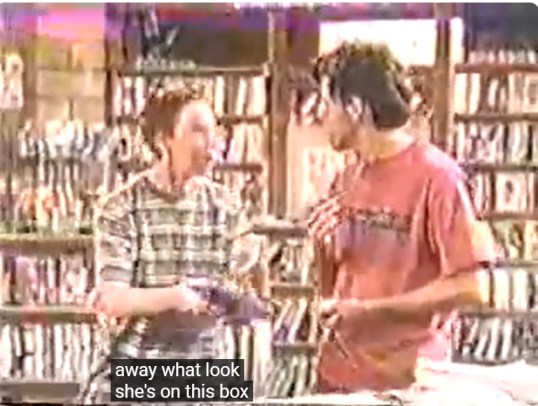
I should also admit that I watched this on YouTube and the upload was one of the worst that I’ve ever seen.  I’m surprised I still have my eyesight after being confronted with this:

And this:

I had 20/60 eyesight when I started this show.  I’m worried about what it is now.

Anyway, needless to say, only one episode of Veronica’s Video was produced.  And that episode probably should have been left in a landfill somewhere, rather than uploaded to YouTube.

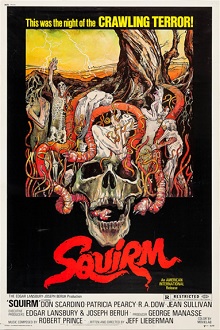
Horror Film Review: Squirm (dir by Jeff Lieberman)


Worms are creepy and you don’t want to get them in your hair.

I think that, more than anything, explains the continuing appeal of this lightly satirical Southern shocker from 1976.  The film’s plot is a simple one, as the plots of the best horror films often are.  There’s a storm.  The power lines over Fly Creek, Georgia get knocked down.  The power line lands in the mud and soon, you’ve got thousands of electrified worms crawling all over the place.  These worms are angry and noisy and they like to eat people’s faces and take control of their bodies.  Of course, since the power lines are all down, you’re can/t exactly call for help and even worse, you’re thrown into darkness once the sun goes down.  Squirm gets at some very basic fears.

Squirm has a welcome sense of humor, as any film about killer worms should.  It’s obvious that Lieberman knew that the audience would be demanding that the worms get revenge on at least a few fisherman and those scenes are tossed in there.  The film’s nominal hero is Mick (Don Scardino), a visitor from New York City, and he’s so out-of-place in rural Georgia that it becomes funny watching him try to do simple things like order food or have a simple conversation.  Even when he tries to warn people about the worms, you can tell they’re thinking, “He might be right but do I want to listen to a yankee?”  As we say down here in Texas, you can always spot the yankee because they’re the ones sweating profusely and talking about killer worms.  The scenes of Mick trying to order something at the local diner reminded me of the great “We don’t got no goddamn trout” scene from Hell or High Water.

Mick is in Georgia to visit his girlfriend, Geri (Patricia Pearcy).  Almost everyone who Mick meets seems like they could have come out of an overheated first draft of a Tennessee Williams play.  Once the worm attack starts in earnest, Geri’s mother sinks into a state of denial that would have impressed Blanche DuBois.  Meanwhile, Squirm has its own wannaba Stanley Kowalski in the form of Roger (R.A. Dow), who obviously can’t understand why Geri would want a boyfriend from New York when she could have him.  Roger is a creep but he’s a familiar creep.  Anyone who has ever lived in the country will immediately recognize Roger and know everything that they need to know about him.

That said, the worms are the real stars of Squirm and they certainly do manage to get everywhere.  On the one hand, it’s funny to see the worms emerging from a shower head but, on the other hand, it’s actually really terrifying because, when you’re standing naked in a shower, the last thing you want is to get about a thousand worms dumped on your head.  Seriously, that would freak me out even more than threat of getting killed by Norman Bates’s mother.  The film is also full of close-ups of the worms and, to be honest, worms are really freaky to look at.  The opening and closing of that little mouth is like pure nightmare fuel.

Squirm is a classic of Southern horror.  You’ll never look at a worm the same way again.


Horror on the Lens: He Knows You’re Alone (dir by Armand Mastroianni)


For today’s Horror on The Lens, we present 1980’s He Knows You’re Alone!

He Knows You’re Alone is an old school slasher film, which means that it’s basically about one stalking killer and a bunch of people who have absolutely no common sense.  The gimmick here is that the slasher is stalks young brides-to-be.  Admittedly, this is all pretty standard stuff, though the film does have a clever opening and features some good cinematography and —

OH MY GOD, IS THAT TOM HANKS!?

Yes, He Knows You’re Alone is the debut film of Tom Hanks and he’s so young in this film that he still has a chin.  He plays a college student named Eliot.  Nowadays, He Knows You’re Alone is usually described as “starring Tom Hanks” but actually, Tom’s role is pretty small.  But he’s still probably the most likable person in the film.

Anyway, He Knows You’re Alone is an above average slasher flick and it’s definitely not safe for work so stop watching movies while on the clock!  Wait until you get home to enjoy He Knows You’re Alone!

http://www.youtube.com/watch?v=W0Nbt19ukdg


Embracing the Melodrama #25: The People Next Door (dir by David Greene)


people_next_door

For the past week, I’ve been reviewing — in chronological order — fifty of the most, for reasons good and bad, memorable  film melodramas of all time.  I started with a film from 1916 called Where Are My Children? and now, as we reach the halfway mark, we also reach the 70s.  There were several reasons why I wanted to start the 70s with the 1970 drugs-in-the-suburbs melodrama, The People Next Door.  First off, not many people seem to have heard of it and I always enjoy discovering and sharing previously obscure films.  But, even more importantly, The People Next Door stars Eli Wallach, the great character actor who recently passed away at the age of 98.  Needless to say, Wallach is great in The People Next Door but then again, when wasn’t Wallach great?

At first glance, the Masons appears to be your typical suburban family.  Patriarch Arthur (Eli Wallach) may be a bit strict but he works hard to provide his family with a good life.  Wife Gerrie (Julie Harris) may seem to be a bit nervous at times but she still works hard to maintain a perfect home.  Son Artie (Stephen McHattie) may have long hippie hair and he does devote a lot of time to his band but otherwise, he seems to be a good kid.  And then there’s 16 year-old Maxie (Deborah Winters), who is blonde and pretty and overall the ideal American girl.  Even better the Masons live next door to the friendly Hoffmans, perfect David Hoffman (Hal Holbrook), his perfect wife Tina (Cloris Leachman), and their perfect teenage son, Sandy (Don Scardino).

But guess what?

Nobody’s perfect!

Arthur is actually a smug and overbearing bully whose constant bragging hides his own dissatisfaction with how his life has turned out.  He is jealous of his son’s future and his over protectiveness of his daughter takes on a distinctly disturbing tone as the film progresses.  Arthur is also having an affair with his secretary (Rue McClanahan).

Gerrie knows about Arthur’s affair but chooses to look the other way.  She goes through her day in a haze of smoke provided by the cigarettes that she is constantly smoking.  Like Arthur, she cannot understand her children.  Unlike Arthur, she does realize that she doesn’t have all the answers.

Artie may be a good kid but he feels totally and thoroughly alienated from the rest of the family and, because of his long hair, he is the constant subject of Arthur’s abuse.

And then there’s Maxie, who everyone believes to be perfect and wholesome until one night when she’s discovered tripping on LSD.  Arthur immediately assumes that Artie must have given his sister the drugs and kicks Artie out of the house.  However, what Arthur doesn’t realize, is that Maxie is actually getting the drugs from clean-cut Sandy.  Sandy doesn’t use himself but he has no problem with dealing.

To Arthur and Gerrie’s shock, Maxie tells them that she’s been using drugs for a while and she’s sexually active as well!  When Arthur subsequently discovers Maxie snorting cocaine and living with a naked biker, it’s naturally time for everyone to get into family therapy.  Unfortunately, the therapy doesn’t really help that much and soon, Maxie is again dropping acid and dancing naked on the front lawn…

As you can probably guess from the description above, The People Next Door is one of those families-in-crisis melodramas where everything that possibly can be wrong with a family is wrong with this family.  It’s always easy to dismiss well-intentioned films like this and The People Next Door has its share over-the-top moments.  But, at the same time, the film actually works better than most of the Suburban Hell melodramas of the early 70s.

That’s largely due to the performances, with Eli Wallach in particular giving an explosive performance as an all too plausible monster and Hal Holbrook and Cloris Leachman very believably bringing to life another family which turns out to be not quite as ideal as they first appear to be.  And then there’s Deborah Winters, who starts out as being so mannered that you think she’s going to give a bad performance but then, as the film progresses, you realize that Maxie is the one giving the performance because that’s the only way she can survive her “perfect” family.

I first came across The People Next Door on YouTube and, considering how much I love exposing people to obscure films, I was really looking forward to sharing it with you on this site.  But guess what?  In the three weeks between me watching this film and me staring this post, The People Next Door was taken down from the site.  I guess somebody is really dedicating to protecting the copyright on a film that hardly anybody in the world has actually heard of.

So, unfortunately, I can only share the trailer.

Watch it below!

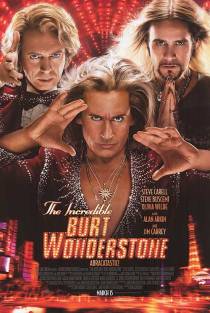
Quick Review: The Incredible Burt Wonderstone (dir. by Don Scardino)


url-2I don’t have a whole lot to say about The Incredible Burt Wonderstone. It’s such a compact, little film, there’s not much I can say without telling everyone the entire story. The trailer is the movie, let’s put it that way.

When I was little, I owned this deck of magic playing cards. On the back of every card was a circular pattern that told the reader what card they were holding, the next card in the deck and the card at the bottom of the set (if they were shuffled correctly). It only lasted a few days, but the effect of doing the trick – that look of amazement when the trick actually worked – was pretty cool. Once that time passed, the trick was stale and predictable.

The Incredible Burt Wonderstone is kind of like that. It’s a film that probably won’t be very memorable in the long run, especially when you have other films about magic like Neil Burger’s The Illusionist and Christopher Nolan’s The Prestige. At the start, it seems awesome, but once the story arcs develop, you may start wondering if you need to stick around for the rest. Truth be told, it’s not a film you have to rush out to see, though there are some scenes to laugh at. On the other hand, if you’re going to the movies just to be entertained, to just laugh for a while, this may be what you’re looking for.

After receiving a magic trick set as kid and watching a training video by the great Rance Holloway (Alan Arkin), young Burt Wonderstone decides he’s going to be a magician. He and his new best friend decide to train together over the years, enjoying the tricks until they become The Incredible Burt Wonderstone and Anton Marvelton. They end up doing so well that they become the headliners for a major Casino for the next 10 years, and this strains their friendship. Anton enjoys the magic for the entertainment it is, and Burt considers himself royalty, feeling a sense of entitlement for all the perks he receives. When Steve Gray (Jim Carrey) appears on the scene with his new tricks, Burt and Anton find themselves facing some serious competition. Can the duo come up with something as amazing as Grey serves up? Can Wonderstone deflate his incredibly huge ego?

The story, written by Johnathan Goldstein (Horrible Bosses) and John Francis Daley (Freaks and Geeks) is not bad for what it’s offering. Of the last 3 films I’ve seen (Hansel & Gretel: Witch Hunters, Identity Thief, Jack & the Giant Slayer), it easily has the best pacing, but you can almost close your eyes and dictate what the next scene is going to be. There’s not a whole lot in the way of surprise, story wise…which I guess is what all the magic is for.  Not saying I could ever come up with anything better, though. For the director, Don Scardino, if this is first movie coming off of the 30 Rock episodes he’s done, he does a good job of keeping the story moving. The cast does well, but there’s nothing amazing with anyone here save for Carrey and Arkin. Carrell is basically himself in this film, which works well enough, and I felt that Buscemi was almost reenacting his role from The Big Lebowski. As a group, it seemed to make sense that Buscemi was the straight man to Carrell’s role.

Carrey’s Steve Grey is a lot like a David Blaine or Criss Angel, performing a mixture of illusion and stunt effects.  I have to admit that while I’m not a huge fan of Carrey’s recent efforts, I really don’t think this film would be as fun as it is without him in it. That the movie offers him up in small doses actually helps things. Olivia Wilde was nice as Wonderstone’s new assistant, but I would have liked her to do just a little more, or even better, she could have played a great rival. The same can be said of Alan Arkin, who had me smiling for most of the time he was in the film (though his appearance does kind of leave something of a plot hole in the story, but that’s just me).

The magic itself is more or less hit or miss. Depending on who you’re watching, the “tricks” were either worthy of a chuckle, made you simultaneously laugh and wince (Just about all of Grey’s were that way) or they showed one or two that made the audience at my showing gasp. For those moments, the movie was worth it, and the comedy is definitely there. Overall, I’d see this again if it were on cable or someone showed it to me, but it’s not a film I’d run right back to.

If only I could get that damn Abracadra song out of my head.