Trading Places (1983, directed by John Landis)


It all starts with a bet.

As Christmas approaches, Mortimer (Don Ameche) and Randolph Duke (Ralph Bellamy) make a bet to determine whether it’s nature or nurture that shapes someone’s future.  The fabulously wealthy owners of Duke & Duke Commodity Brokers, the brothers casually frame their director, Louis Winthrope III (Dan Aykroyd), for everything from dealing drugs to sealing money to cheating on his girlfriend (Kirstin Holby).  After Louis is kicked out of both his job and his mansion, the Dukes hire a street hustler named Billy Ray Valentine (Eddie Murphy) to take his place.  Earlier Winthrope tried to get Valentine arrested for approaching him in the street.  Now, Valentine is living in Winthrope’s mansion, with Winthrope’s butler and Winthrope’s job.

While Winthrope tries to survive on the streets with the help of a outwardly cynical but secretly kind-hearted prostitute named Ophelia (Jamie Lee Curtis, in her first non-horror starring role), Billy Ray surprises everyone by using his street smarts to become a successful, suit-wearing businessman.  The Dukes, of course, have no intention of keep Billy Ray Valentine on as their director.  Not only are the Dukes snobs but they’re racists as well.  Once their one dollar bet has been settled, they start planning to put Billy Ray back out on the streets with Winthrope.

Trading Places was Eddie Murphy’s follow-up to 48 Hrs and he again showed himself to be a natural star while playing the type of role that could have been played by Dan Ayrkroyd’s partner, John Belushi, if not for Belushi’s early death.  (Jim Belushi has a cameo as a party guest.)  Murphy gets to show off a talent for physical comedy and Trading Places is one of the few films to really take advantage of Dan Aykryod’s talents as both a comedian and actor.  Winthrope goes from being a coddled executive to being as streetwise as Valentine.  This is probably Aykroyd’s best performance and he and Eddie Murphy make for a good team.

But the real stars of the film are four actors who weren’t really thought of as being comedic actors, Denholm Elliott, Don Ameche, Ralph Bellamy, and especially Jamie Lee Curtis.  Ophelia is a much edgier character than the “final girls” that Curtis was playing in horror films and Curtis steals almost every scene that she’s in.  Ameche and Bellamy are great villains and it’s fun to watch them get their comeuppance.  What screwball comedy would be complete without a sarcastic butler?  Denholm Elliot fills the role of Coleman perfectly.

Trading Places was a box office success when it was released and it’s now seen as being one of the new Christmas classics, a film for the adults to enjoy while the kids watch Rudolph and Frosty.  I think the movie ends up going overboard towards the end with the gorilla and Dan Aykroyd wearing blackface but, for the most part part, it’s still a very funny and clever movie.
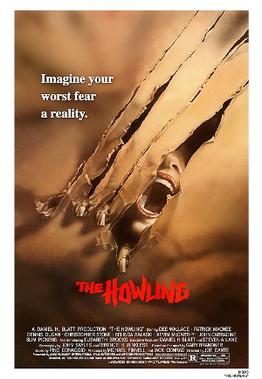
Horror Film Review: The Howling (dir by Joe Dante)


The 1981 film, The Howling, takes place at The Colony.

The Colony is a lovely place, a nice resort out in the middle of the countryside.  It’s a place that celebrity therapist George Waggener (Patrick Macnee) sends his clients so that they can recover from trauma.  It’s a bit of a grown-up version of the ranch to which Dr. Phil used to send juvenile delinquents.  Of course, the Colony is full of adults and they’re an eccentric bunch.  I mean, one of them — named Erle Kenton — is actually played by John Carradine!  That’s just how eccentric the place is.  Sheriff Sam Newfield (Slim Pickens) keeps an eye on the place but everyone knows that there’s nothing to worry about when it comes to The Colony.  Dr. Waggner does good work.

Karen White (Dee Wallace) is a Los Angeles news anchor who was held hostage by a serial killer named Eddie Quist (Robert Picardo).  While she was with Eddie, she was forced to not only watch videos of Eddie’s crimes but she also saw something happen with Eddie that terrified her to such an extent that she has blocked it from her mind.  Karen was rescued by the police but she is haunted by nightmares.  Dr. Waggner arranges for Karen and her husband, Bill Neill (Christopher Stone, who was married to Dee Wallace when they co-starred in this film), to spend some time at the Colony.

Bill loves the Colony, especially after he attracts the eye of Marsha (Elisabeth Brooks), the resort’s resident seductress.  Karen, however, is less enamored of the place.  The Colony feels off to her and she’s not happy about the howling in the distance or the fact that Bill has suddenly started to grow distant from her.  Could it be that The Colony is actually crawling with werewolves and that Bill has become one of them?  (It’s totally possible and, to The Howling‘s credit, it doesn’t waste any time letting us know that.)  Karen’s friend, Terry Fisher (Belinda Balanski), and her boyfriend, Chris Halloran (Dennis Dugan), do some research of their own into Eddie Quist, The Colony, and whether or not werewolves exists and they meet a helpful bookstore owner named Walter Paisley (Dick Miller).

To understand the approach that director Joe Dante and screenwriter John Sayles take to The Howling, one needs to only consider the names of some of the characters.  George Waggner.  Bill Neill. Terry (which can be short for Terence) Fisher.  Fred (or is that Freddie) Francis.  Erle Kenton.  Sam Newfield.  Jerry Warren.  All of these characters are named after horror film directors.  This is the type of werewolf film where Chris Halloran has a copy of The Three Little Pigs sitting on his desk.  Veteran actors like Kevin McCarthy, John Carradine, Slim Pickens, and Kenneth Tobey show up in small roles.  Roger Corman mainstay Dick Miller plays yet another character named Walter Paisley and he kicks Forrest J. Ackerman out of his bookstore.  Roger Corman himself plays a man making a phone call.  After a werewolf is shot on live TV, the program immediately cuts to a dog food commercial and we see a blank-faced child telling his unconcerned parents that someone just turned into a wolf.  The Howling was made by people who obviously love B-horror and that love is present in every frame of the film.

Like Dante’s Piranha, The Howling is a film with a sense of humor but it’s not a comedy.  The werewolves are still impressive, even forty-two years after the film was first released.  The character of Eddie Quist (“I’m going to give you a piece of my mind”) is a terrifying monster and the sight of his signature smiley face will fill you with dread, especially when it shows up in a place where it really shouldn’t be.  The film cynically ends on a note of noble sacrifice that will apparently not make much difference, with the suggestion being that human beings are either too distracted or too jaded to realize that there are monsters among them.  The Howling is a fast-paced and well-directed homage to B-horror and it’s still terrifically entertaining.

Lifetime Movie Review: Doomsday Mom: The Lori Vallow Story (dir by Bradley Walsh)


Doomsday Mom is a Lifetime true crime film, based on the disappearance of 16 year-old Tylee Ryan and 7 year-old J.J. Vallow and the subsequent arrest of their mother, Lori Vallow, and her new husband, Chad Daybell. Both Lori and Chad were heavily involved in the Doomsday movement, the belief that the end times were quickly approaching and that only the righteous would be saved. (Hence the title, Doomsday Mom.) Apparently, before the children disappeared, Lori and Chad had said that they had become demonically-possessed zombies. While the police were investigating the disappearances of Tylee and J.J., they also uncovered evidence that suggested that Lori and Chad may have been involved in several more deaths and attempted murders, including those of Lori’s ex-husband and her brother and Chad’s first wife.

It’s a disturbing story but it’s also one that hasn’t been resolved yet. Both Lori and Chad are currently in prison, awaiting trial. While the state of Idaho has ruled the Lori is not mentally competent enough to stand trial for murdering her children, the state of Arizona has still indicted her for attempting to kill one of her ex-husbands. Meanwhile, Chad will be facing the death penalty when his trial finally begins. Because neither has been convicted of any crime, they are still considered to be innocent until proven guilty in a court of law. If they are found guilty, there’s still the question of how many of the mysterious deaths that occurred within their orbit were the result of foul playe and how many were just coincidences. (Lori’s brother, for instance, died at a rather convenient time for Lori but everyone still seems to agree that he had been in poor health long before Lori even met Chad.) There’s also the question of whether or not Lori is actually legally insane or if she’s just faking it to get out of being sent to death row.

That proves to be a bit of a problem for Doomsday Mom, which is a film that suggests a lot of things but can’t actually come out and take a definite stand on anything, beyond the fact that Lori and Chad were a creepy couple who believed in some strange things. Though the film clearly believes that both Lori and Chad are guilty, it still has to try to maintain some sort of ambiguity. Hence, we learn that people have died but we never learn much about the circumstances of their death. We learn that Tylee was rebelling against her mother’s strict rules but we don’t learn much details about those rules, beyond Lori insisting that Tylee stay home to babysit so that Lori could go to church whenever she felt like it. We don’t see much of Chad’s first wife, nor do we learn much about his family.

Perhaps most importantly, we don’t really learn much about Lori and Chad’s doomsday beliefs, beyond the fact that they were convinced the world was ending and that the people around them were being possessed by demons. The film suggests that both of them were motivated by their own ego. Lori and Chad enjoyed being mini-celebs in the Doomsday movement. But, by not exploring how they came to have such beliefs in the first place, it’s hard not to feel that the film is refusing to give us some very important clues to understanding how all of these murders could have occurred in the first place. Presumably because the question of Lori’s mental competence is still in the air, the film cannot take a clear stand on whether Lori really believes all of the things that she says or if she’s just using all of the doomsday talk as a cover for her own selfishness. As often when happens when a film about a true crime case is rushed into production, Doomsday Mom often leaves the viewer with a number of unanswered questions.

On a positive note, both Lauren Lee Smith and Marc Blucas are chilling in the roles of Lori and Chad. Smith, in particular, is frightening as she switches from being a normal, overprotective mother to a wild-eyed religious fanatic, seemingly at random. Playing the role of the concerned grandparents of the missing children, Patrick Duffy and Linda Purl do a great job of capturing their desperation as they start to realize that, despite all of their hopes and efforts, they will probably never see their grandchildren again. The scene were they learn the fate of Tylee and J.J. is poignantly portrayed by both Duffy and Purl.

I always have a slightly problem with films like Doomsday Mom. I’m not a fan of rushing films into production to take advantage of a tragedy still being in the news. But Doomsday Mom is a well-acted and well-directed film, even if it can’t provide us with the answers that we may be looking for.