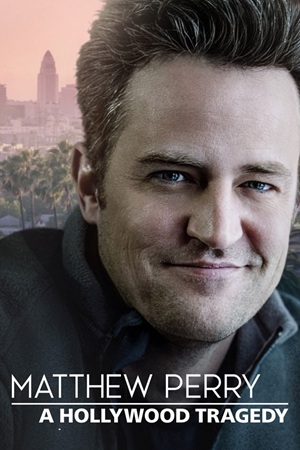
Documentary Review: Matthew Perry: A Hollywood Tragedy (dir by Robert Palumbo)


It’s rare that I ever feel like I should apologize for having watched a documentary but that was the feeling I had after watching Matthew Perry: A Hollywood Tragedy.

This documentary examined the career and death of actor Matthew Perry, with most of the emphasis being put on Perry’s struggle with addiction.  Excerpts were read from his book.  Lots of clips were shared from Friends.  People in the industry talked about what a charming actor Perry was and they also talked about how hard it is to free oneself from addiction.  This is especially true when you’re rich enough to have a bunch of people around you who will literally respond to your every whim and not take a second to ask, “Are you sure?”  One of the worst things about celebrity culture is that we tend to root for the worst until it actually happens.  When an actor is publicly struggling with addiction or their mental health, it’s treated as entertainment  It’s only after that actor dies that we talk about how tragic it was and people hop on social media to talk about how addiction is a disease and no one should be shamed for their struggle.

And that brings me to documentaries like this one.  There’s something really hypocritical about these documentaries that take a real life tragedy and turn it into entertainment while pretending to be a tribute or a serious examination of the addiction crisis in America.  For instance, this documentary tells you absolutely nothing that you didn’t already know about Matthew Perry and his tragic death and it really doesn’t do a good job of paying tribute to him as an actor either.  Those clips from Friends are the same clips that you’ve seen on every other special about the life of Matthew Perry.  There’s really no reason for this documentary to exist, other than to appeal to the desire of viewers to learn something sordid about a well-known figure.  It’s a documentary that exploits Perry’s death while claiming to mourn it.

And I’m not saying anything that you haven’t already heard or which hasn’t been said by hundred other people.  Nearly every review that I’ve read of this documentary says basically the same thing that I just said.  It’s exploitive and doesn’t have much to add to our overall understanding of how someone with so much talent and so many fans could also be so self-destructive.  And yet, while we all criticize documentaries like this, many of us still watch them.  I still watch them.  I watched this one.  I learned absolutely nothing new and I felt fairly guilty afterwards.  Matthew Perry’s death was a tragedy and a cautionary tale and, at the same time, it should take nothing away from the happiness that he brought his fans.  He deserved better than this.  For that matter, he deserved better than all of the speculative stories that came out after his appearance on the Friends Reunion Special.

But I can’t get self-righteous or too quick to condemn.  Because I did watch this.  I was bored, I saw that it was streaming, and I watched it.  And I’ll probably watch the next trashy celebrity documentary that come out.  I won’t feel good about it but I’ll probably do it.  I doubt I’ll be alone.

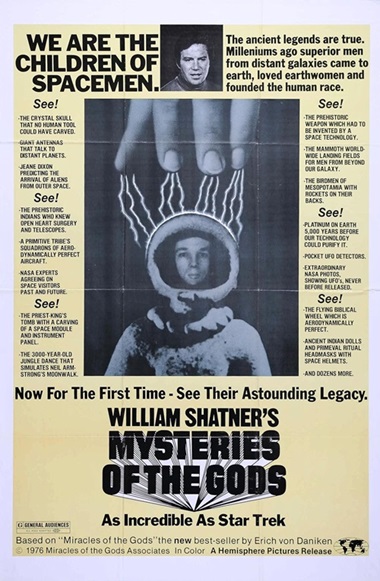
Documentary Review: William Shatner’s Mysteries of the Gods (dir by Harald Reinl and Charlie Romine)


First released in 1976, the German documentary Mysteries of the Gods raises the same questions that were asked by Chariots of the Gods and it offers up the same answers.  How did ancient man build the pyramids?  Aliens!  How were the giant statues of Easter Island moved to their final resting place?  Aliens!  Who created Stonehenge?  Aliens!  Who drew the South American ley lines?  Aliens!  Who took Elijah, Gilgamesh, and Enoch up into the sky?  Aliens!  Who is responsible for religion?  Aliens!

Mysteries of the Gods was made by the same people who did Chariots of the Gods but it’s less a continuation and more of a remake.  The only new thing that Mysteries of the Gods brought to the table was the suggestion that the governments of the world knew about the aliens and that they were, in some cases, working with the aliens.  I’ve already made my feelings about those theories clear.  I’m a skeptic and I’m proud of it.  Still, it’s interesting to wonder what type of advice the aliens would have given the world leaders.  I mean, considering everything that has happened over the past 66 years, it doesn’t appear to be very good advice!

Seriously, tell those dumbass aliens to go home and mess around with their own planet.

When Mysteries of the Gods came over to the United States, it was decided that the film needed a bit more of an American feel to it.  The original’s German narrator would have to go.  But who could replace him?  Who had the gravitas necessary to seriously discuss the theory of ancient astronauts?  Who would draw in the science fiction crowd while possibly still appealing to people who didn’t know much about the history of UFO sightings?  Who would have the proper enthusiasm for the project?  Who was reasonably famous but still enough in need of a paycheck that they would agree to be associated with something as shoddy as Mysteries of the Gods?

We all know the answer to that question.

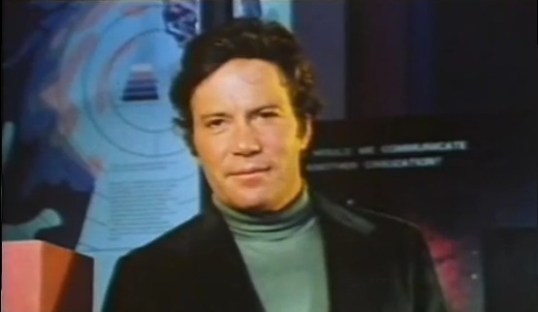
And if the American distributors were going to pay William Shatner to re-record the film’s narration, why not take full advantage of his presence and film some scenes of him interviewing various psychics and scientists?  Why not have him wax rhapsodic about a crystal skull while actually holding the artifact?  Why not have him actually visiting the locations described in the documentary?  Why not put him in a green turtleneck and a black jacket and present him as being the hip face of pseudo-science?  And why not change the title of the film to William Shatner’s Mysteries of the Gods, implying that Shatner himself had something substantial to do with the making of the film?

And let’s give credit where credit is due.  Mysteries of the Gods is a ludicrous documentary that provides even less evidence for its fantastical claim than Chariot of the Gods did.  But the American version of the film is worth watching, just to see William Shatner trying to repress his natural smirk while reciting the film’s overwrought narration.  Shatner appears to be amused by the whole thing and he definitely comes across as being a good sport as he gamely interview a series of crackpots who are all convinced they’ve cracked some sort of alien code.  The film ends on a triumphant note, with psychic Jeanne Dixon telling an excited Shatner that aliens will visit Earth in April of 1977.

Now, you may say that Dixon was incorrect.  There’s no record of aliens coming to Earth in 1977.  Maybe that’s just what they want you to believe!  To quote the Amazing Criswell, can you prove it didn’t happen?

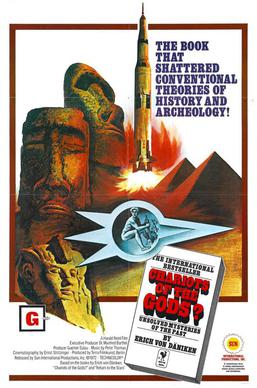
Documentary Review: Chariots of the Gods (dir by Harald Reinl)


First released in 1970, the German documentary Chariots of the Gods tests the proposition that you can prove anything with stock footage and a narrator.

Chariots of the Gods takes viewers on a tour through some of the most visually impressive locations ever seen by human eyes.  Look at the ruins of the Aztec and Inca civilizations!  Behold a Mayan observatory!  Marvel at Egypt’s pyramids!  Trace the amazing Nazca Lines of South America!  View the amazing “heads” of Easter Island!  Be amazed that an ancient civilization was able to create a primitive battery!  Feast your eyes upon colorful cave drawings of mythic beasts and powerful wizards!  Examine this skull of a 200,000 year-old bison and think about just how long living things have inhabited this amazing planet!

And then read the ancient texts and consider how every civilization wrote of certain shared events, suggesting that the legendary cataclysms of mythology were based on things that actually happened.  Read the words of men and women who lived centuries ago and consider that humans have always been trying to figure out how things work.  Humans have always been curious and imaginative creatures and the fact that, from the beginning of time, they were inspired to record their stories indicates that we have an instinctual understanding of the importance of history.

It takes your breath away but, according to this documentary, it shouldn’t.

All of those things that you think humans did?  According to Chariots of the Gods, it was the aliens.  The aliens built the pyramids.  The aliens inspired the cave drawings.  All of those ancient texts are actually about spaceships landing on Earth and the aliens saying, “Hi.”  The great flood that appears in both the Bible and the epic of Gilgamesh?  Aliens!  Enoch’s journey into Heaven?  Aliens!  Elijah’s ascension?  Aliens!  The Nazca lines?  An alien airport!  The statues of Easter Island?  Alien robots!  Chariots of the Gods opens by suggesting that the human race is basically just a big cargo cult, worshipping stuff left behind by the aliens.

Seriously, what a depressing way to look at the world!  Instead of marveling at the determination of ancient man, this documentary says that the whole thing was done by aliens and the humans were apparently just standing off to the side.  Forget about celebrating ingenuity and imagination.  The aliens did it all and all of the ancient stories and all of the cave drawings should be taken very literally because it’s not like the ancient artists could have just been really talented or creative.  Instead, when the authors of the Epic of Gilgamesh wrote about Gilgamesh floating over the Earth, it was because it really happened!  Imagination had nothing to do with it.

In the tradition of most pseudoscience documents, Chariots of the Gods is one of those documentaries that makes its point by basically refusing to accept that any other viable theories exist.  Repeatedly, we’re flatly told that “scientists agree….,” as if every scientist has signed off on the idea of ancient aliens.  The documentary’s narrator often informs us that there’s no way ancient people could have constructed and moved giant statues or monuments but he fails to mention that numerous studies that have argued and demonstrated that actually ancient people could very well have done all of that.  Essentially, Chariots of the Gods is a travelogue in which we are shown stock footage of some really cool sights while the narrator says, “I bet an alien did that!”

Silly as it was, Chariots of the Gods was still a box office hit and it was nominated for Best Documentary Feature.  It’s pseudoscientific legacy lives on today.

The Films of 2024: Gary (dir by Robin Dashwood)


Wow, what a depressing documentary!

I’m taking about Gary, which is currently streaming on Peacock.  Gary tells the story of former child actor-turned-security guard Gary Coleman, who went from being one of the top stars in television to eventually struggling to pay the bills.  The documentary tells the story of Coleman’s life, from his start as a cute kid with a mischievous smile to his stardom, his health struggles, and the controversy over why all the money that he made as a child eventually disappeared.  Gary blamed his parents.  His parents blamed Gary’s managers.  The woman who eventually married Gary blamed everyone.  Gary, himself, ended up as tabloid fodder, in which he was treated as not only being the poster child for the problems that young stars encounter but in which he was also regularly ridiculed for having those exact same problems.  Watching the documentary, one gets the feeling that the world took an odd joy in Gary Coleman’s downfall.  Coleman himself died under mysterious circumstances and the documentary, though even-handed, leaves one feeling that there’s definitely a lot about his death that could stand to be examined.

Gary Coleman’s stardom was a bit before my time, though I have seen a few episodes of Diff’rent Strokes online.  The show, to be honest, always seems a bit cringey to me but, still, it’s obvious that Coleman was a capable actor even when he was having to repeat the catch phrases that he came to hate.  Unfortunately, his kidney problem stunted his growth and, as he got older, the acting opportunities dried up.  He was reduced to parodying his former stardom, appearing on talk shows and sitcoms and repeating, “What you talkin’ about” to anyone who asked.  The documentary was painfully sad to watch.  Gary Coleman definitely comes across as being a bit of an eccentric but it’s hard not to feel that he never allowed to grow up and that the people who should have been looking out for him, like his parents and his manager and his wife, were only looking out for themselves.

The film features interviews with the people who failed Coleman.  None of them really take any sort of responsibility for their actions.  At first, his wife comes across like she really cared about him but, as the documentary progresses, we hear too many stories about her abusing and manipulating him to take anything she says at face value.  When she sells a picture of Coleman on his death bed to a tabloid, that’s pretty much last straw as far as any sympathy for her is concerned.  Coleman’s business manager also initially comes across as being genuine and sincere but, again, there are just too many stories of misusing Coleman’s money.  If he doesn’t seem to be as ruthlessly mercenary as Coleman’s wife, it’s still obvious that he shouldn’t have been managing Coleman’s career.  As for Coleman’s parents, the less said about them the better.  Everyone that is interviewed is very good at blaming someone else for what happened after Coleman’s stardom ended.

Again, this was depressing documentary.  Watching this, I really felt bad about Gary Coleman.  It’s hard to know what to do about child stars.  On the one hand, there are child stars who grow up to lead what appear to be perfectly normal and stable lives.  But, there’s also a lot like Gary Coleman, whose lives are pretty much destroyed by their early success.  No kid should be supporting their family.  And no family should be paying their bills exclusively with their kid’s salary.  To me, it all comes down to the parents.  You can’t depend on an industry to raise your child for you.  In the end, though, Coleman was let down by a lot of people.  There’s more than enough blame to go around.

“Documentary” Review: Paul McCartney Really Is Dead: The Last Testament of George Harrison? (dir by Joel Gilbert)


There’s a reason why I put the word Documentary is scare quotes when I titled this review.

Yes, 2010’s Paul McCartney Really Is Dead is listed as a documentary on Tubi, Prime, and probably every other streaming site in which it has appeared.

Yes, the film is full of archival footage of the Beatles and it opens with a lengthy discussion about the time that John Lennon said that group was bigger than Jesus.

And yes, the film does present itself as being a documentary.

That said, I don’t believe any of the claims made in this film and I doubt the filmmakers do either.  Much like that time travel documentary that I reviewed a few years ago, this film is obviously a mockumentary, a hoax that a few people online have taken seriously.  Fortunately, it doesn’t appear that as many people have taken this film seriously as they did with that Man From 3036 film.  I guess that counts as progress.

(I should note that, after writing the paragraph above, I looked up Joel Gilbert’s YouTube profile and saw that he has specifically stated that the film is a mockumentary.  So, good for Gilbert!)

As for Paul McCartney Is Really Dead, it opens with director Joel Gilbert explaining that his production company received several mysterious cassette tapes.  They were mailed from the UK.  The man on the tapes claims to be George Harrison and says that he’s recording the tapes on his death bed.  He explains that, in 1966, Paul McCartney was killed in a car crash.  A fake Paul (nicknamed Faul) was brought into the group and, for the next four years, the Beatles recorded with this imposter.  John Lennon, fearing that the fans would turn on the band if they ever learned of the deception, inserted clues throughout the Beatles’s album covers and in their songs.  A lot of those clues were only evident to those who played the song backwards.  Turn me on, dead man!

The conspiracy theory that Paul McCartney was decapitated in a car accident and was replaced by a man named William Campbell has been around for a while.  It’s generally agreed that the rumor first started to circulate way back in 1966 and it’s been theorized that the Beatles themselves were aware of the rumor and they occasionally made references to it as a private joke.  Of course, it’s just as possible that the Beatles knew nothing of the rumor and all of the “clues’ were actually just coincidences that were overanalyzed by conspiracy theorists with too much free time on their hands.  For instance, one widely cited clue was a picture of Paul McCartney wearing a patch that apparently said “OPD.”  The theorists decided that OPD stood for “Officially Pronounced Dead,” whereas the patch was actually one worn by members of the Ontario Provincial Police and it actually read “OPP.”

Paul McCartney Is Really Dead features someone pretending to be George Harrison going over all of the clues on the album covers and in the songs.  He hits all the major points, including the famous Abbey Road cover.  However, the faux Harrison goes on to claim that the Beatles were forced to pretend that Paul was alive by a sinister MI5 agent named Maxwell.  Maxwell explained that word of Paul’s death would lead to a suicide epidemic amongst young British woman and it would also leave the UK vulnerable to the communists.  Yes, you read that correctly.  Of course, as unbelievable as that sounds, it’s really not that much different from a lot of “real” conspiracy theories that can currently find circulating online.  A spoof works best when its credible.  While the theory that Paul is dead may not be credible, the fact that people will believe the dumbest things is.

It’s easy to laugh at first, largely because the guy doing George Harrison’s voice doesn’t even seem to have a British accent.  While the Beatles looked at the dead Paul, Maxwell commented that the injuries Paul had sustained in the car crash had left him looking like a walrus.  “I AM THE WALRUS!” John supposedly shouted at Maxwell.  If you can’t smile at that, what can you smile at?  But then, towards the end of the documentary, it’s suggested that John’s assassination and the near fatal attack that George Harrison suffered in 1999 were actually due to John and George threatening to reveal the truth about Faul.  At that point, the whole thing gets rather offensive.  This could have been an enjoyably daft hoax if the filmmakers hadn’t tried to pass the tapes off as being from George Harrison.  (Personally, I would have used either Maxwell or Rita, the girl in blue who was supposedly with Paul at the time of the accident, as the narrator.)

As for myself, I love conspiracy theories but I don’t believe 99% of them.

Musical Film Review: Let It Be (dir by Michael Lindsay-Hogg)


Hey, it’s the Beatles!

The 1970 documentary Let It Be, which is now streaming on Disney+ after being impossible to see for decades, follows the Beatles as they record music, occasionally argue, occasionally laugh, collaborate on songs, and ultimately play the famous rooftop concert that was eventually ended by the London police.  Paul McCartney smiles and laughs and jokes but he also obsesses over every little musical detail and often seems to be talking in order to keep anyone else from getting a cross word in.  John Lennon dances with Yoko Ono and occasionally smiles but often seems like his mind is elsewhere.  George Harrison smiles whenever he know that the camera is on him but, when glimpsed in the background, he doesn’t seem happy at all.  Ringo patiently waits for his chance to perform, sometimes bored and sometimes amused but always the most likable of the bunch.  He and George work on Octopus Garden and it’s a charming moment, if just because it’s obvious that both men would rather be there than in the studio.

Even if you haven’t seen Peter Jackson’s The Beatles: Get Back (which was constructed out of material that was shot for but not used in this documentary), Let It Be is often time one of the most depressing behind-the-scenes documentaries ever made.  The more the individual members of the Beatles smile and perform for the camera, the more one can see the cracks that have formed in their relationships.  With Lennon spending most of his time with Yoko, it’s Paul who dominates the documentary.  Paul comes across as being charming and talented but his habit of nonstop talking gives the impression of someone who is desperately trying to hold together a sinking ship.  At one point, George snaps that he’ll play the guitar however Paul tells him to and it’s obvious that, for George and probably the others as well, being the world’s most popular band has gone from being a thrill to just being another job.  When Paul and John talk about how much fun they had when they first started playing live in  Hamburg, it’s obvious that the conversation is at least partially staged to set up the rooftop concert but there’s a genuine sadness to their voices.  Even as they write and record new songs, they’re realizing that all things must pass.

But then the Beatles give a rooftop concert and they bring London to a halt and, for a few minutes, it seems like everything is going to be alright.  Standing on the roof and performing a wonderful version of Get Back, the Beatles are suddenly a band just having fun and it’s delightful to see.  Later, John Lennon gets a devilish gleam in his eyes as he sings the raunchy (for 1969) lyrics for I’ve Got A Feeling.  Even George looks happy for a few moments.  People gather in the street below to watch and the camera is quick to show us that both young and old love the Beatles.  Of course, eventually, the police show up and shut down the show.  (Of course, being British police, they’re very polite about it.  One has to breathe a sigh of relief that the Beatles didn’t try to do their rooftop show in New York or Los Angeles.)  It’s a reminder that nothing lasts forever.  Eventually, every concert comes to an end.

It’s interesting to compare Let It Be to another 70s documentary about a famous British rock band.  In Gimme Shelter, the Altamont Free Concert ends with a murder as Mick Jagger pleads with the crowd to stop fighting and just sit down.  In Let It Be, things end with a random joke from John Lennon, who would himself be murdered in just ten years.  Both Gimme Shelter and Let It Be are about the end of an era and both are full of regret and a longing for a simpler and more idealistic era.  For those of us who want to understand history, they’re essential.


Documentary Review: Brats (dir by Andrew McCarthy)


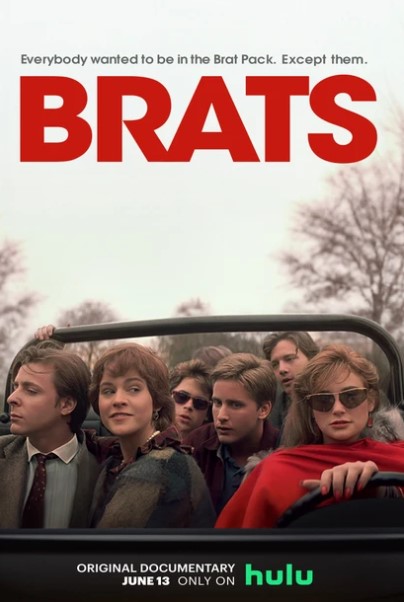
The documentary Brats opens with actor and travel writer Andrew McCarthy in New York City.

He’s obsessing over his film career, which featured him starring in several classic 80s films, like Pretty In Pink, Class, and Less Than Zero.  If you love those films as much as I do, you’ll be happy to know that, physically, McCarthy has aged well.  If he was adorably cute during his teen idol days, Andrew McCarthy now looks like a distinguished and handsome creative writing teacher.  McCarthy talks about how he was briefly a star and now, he has a busy career as a writer.  To be honest, it seems like everything should be going pretty well for Andrew McCarthy.

The only problem is that Andrew McCarthy has spent the last 30 years obsessed with an article that he feels led to him being labeled as one of the “Brat Pack,” along with Emilio Estevez, Rob Lowe, Judd Nelson, Molly Ringwald, Demi Moore, and Ally Sheedy.  Interestingly enough, McCarthy is only mentioned once in the article, when Nelson dismissively describes him as playing every role “with the same intensity.”  Still, McCarthy feels that the article led to him being unfairly labeled “a brat,” and it also led to his film career fizzling.

Over the course of the documentary, McCarthy travels to California and tracks down some of his co-stars (with both Ringwald and Nelson being notable for their absence) and he also talks to the author of the article.  He talks about what it means to be identified with the Brat Pack and how the label still haunts him.

Seriously, this is one of the most depressing documentaries I’ve ever seen.

It’s not just that McCarthy, who really does seem like he should be enjoying his second act as a successful and respected travel writer, is still obsessed with an article that came out 30 years ago.  It’s also the fact that, judging from the scenes in which he drops in on Estevez, Lowe, Moore, and Sheedy, it doesn’t appear that anyone has wanted to talk to McCarthy since they all did St. Elmo’s Fire.  Emilio Estevez, especially, seems to be uncomfortable with having McCarthy in his kitchen.  As for the others, Ally Sheedy is polite, Demi Moore comes across as if she’s visiting from another planet, and Rob Lowe is once again the most likable and laid back person in the room.  Everyone that McCarthy interviews has dealt with the Brat Pack legacy in their own different way.  The thing they all have in common is that they’ve all dealt with it better than McCarthy.

The saddest part of the film is that Molly Ringwald never returns Andrew McCarthy’s call.  Seriously, the main reason I watched this documentary was because I wanted to see Andie and Blane reunited.  Instead, I had to settle for Blane and Duckie having an awkward conversation.  It’s nice to see that McCarthy and Jon Cryer are apparently now on friendly terms (which apparently they weren’t during the filming of Pretty in Pink), but seriously, Molly is the one that most viewers will probably want to see reunited with Andrew.  That it doesn’t happen is kind of heart-breaking.

I hope someone gives Andrew McCarthy a good hug and tells him that we’re all Team Blane.  He deserves it.

Documentary Review: Lock-Up: The Prisoners of Rikers Island (dir by Jon Alpert and Nina Rosenblum)


Rikers Island is one of those places that we all know about, even those of us who have never been there.

Rikers Island is an island that sits in the East River in the Bronx.  It is also home to New York City’s largest and most notorious jail.  It’s a jail that has a reputation for violence and corruption.  Over 100,000 people are admitted into Rikers per year and, on most days, the complex has a population of 10,000 prisoners.  (For comparison, my mom was born in a town that currently has a population of 1,200.)  Rikers Island is notorious for the number of prisoners who have died while in the jail.  It is estimated that 85% of the inmates are pre-trial defendants, people who have yet to be convicted of anything but who either didn’t get or couldn’t afford bail.  The other 15% are serving short sentences.  Rikers Island is a county jail that has a reputation for being as bad as any state prison.  You don’t have to be from New York City to know about Rikers Island.  The jail has become so notorious that Rikers Island has developed an international reputation and is often held up as a symbol of everything that’s wrong with the way that incarceration is handled.

Lock-Up: The Prisoners of Rikers Island was filmed for and aired on HBO in 1994.  The documentary is now 30 years old and the population of the jail has grown considerably since it first aired.  That’s a frightening thought because the jail that is seen in the documentary was already overcrowded, dirty, and dangerous.  The documentary features interviews with both guard and prisoners.  We follow the guards as they search cells and confiscate weapons and drugs.  We meet a prisoner who has AIDS and who is hoping to be transferred to a drug rehab.  (He explains that he was born addicted and he’ll probably die addicted if he’s left in Rikers.)  We meet several of the pregnant women who are incarcerated in the jail and listen as they wonder what would happen if they went into labor when there’s not a guard around.  We watch as the guards uneasily deal with the prisoners who have asked to be incarcerated in the jail’s “gay wing.”  We meet several inmates who are obviously dealing with untreated mental illness.  A lawyer tries to talk to his client and gets in a shouting match with another prisoner.  We meet a notorious criminal named Eddie White, who explains that a life sentence means that he no longer has to follow the rules.  We meet a lot of people in this documentary and what they all agree on is that being locked up is Hell.

It’s hardly a balanced documentary.  The filmmakers are clearly on the side of the inmates but that’s okay.  Considering that the inmates have essentially no control over their own lives while they’re in Rikers, it can be argued that they deserve to have someone on their side.  Most of the inmates talk about their regrets but, as the documentary ruefully observes, most of them will eventually end up returning to Rikers even after they’re released.  One woman cries when she learns her baby might be ill but, when we see her during her second stint at Rikers, she blithely comments that her baby was taken away by “the city.”  As with so many inmates, she explains that she was set free with no training as to how to remain free.  As an addict, she has discovered the system is more interesting in punishing her addiction than treating it.

The biggest problem with the criminal justice system is that it rarely rehabilitates but instead creates a situation where no one can get or take advantage of a second chance.  30 years after it was released, Lock-Up reminds us that this is hardly a new problem.

Documentary Review: Sly (dir by Thom Zimmy)


Now streaming on Netflix, Sly is a documentary about the life and career of Sylvester Stallone.

The documentary opens with Stallone watching as all of his belongings in his Hollywood mansion are packed in boxes so they can be shipped to his new home in New York.  As I listened to Stallone talk about how you sometimes have to return to your roots to discover who you truly are, it occurred to me that Stallone is one of those people who is never not playing a role.  Even when he’s not Rocky Balboa or John Rambo or any of the other characters that he’s played in the movies (or, less frequently on television), he’s still playing Sylvester Stallone, the bigger-than-life movie star who has been an inescapable part of the American pop cultural landscape for longer than I’ve been alive.  Watching Stallone talk about what it’s like to go, overnight, from being an unknown to being a celebrity, I never doubted his sincerity but I was always aware of how carefully chosen his words seemed to be.  Sylvester Stallone lets the audience in but he’s still careful about how much he reveals about himself.

The same can be said of the documentary, which largely focuses on Rocky, Rambo, and The Expendables, with a little Lords of Flatbush, F.I.S.T., Paradise Alley, and Cop Land trivia tossed in as well.  Stallone admits that he’s not proud of all of the films that he’s made, citing Stop!  Or My Mom Will Shoot! as his biggest regret.  (Arnold Schwarzenegger pops up to brag about how he was smart enough to turn down the script when it was originally sent to him.)  That said, there’s not much attention given to Stallone’s films with Roger Corman or for the films that he did for Cannon.  Sorry, there’s no Over The Top trivia.  There are a few clips from Cobra and Rhinestone but not much more.  If you’re looking for a documentary about the B-movies of Sylvester Stallone, this is not it.  (Interestingly enough, even films like Demolition Man — which was one of Stallone’s better non-Rocky and non-Rambo films — are also glossed over.)  Beyond talking his troubled relationship with his father, mentioning his love for daughters, and a moment where he gets noticeably emotional while talking about his late son, there’s not much information here about Stallone’s private life.  And again, it’s not that Stallone owes anyone any of that information.  At one point, Stallone says that he hasn’t had a moment of privacy since the release of Rocky and he’s probably right.  He’s earned the right to keep some things private.

Also interviewed in the documentary are Frank Stallone, Quentin Tarantino, film critic Wesley Morris, director John Herzfeld, and Talia Shire.  Frank comes across as a lot more genuine here than he did in his own documentary while Talia does the best job of understanding the appeal of Rocky.

This is a documentary that will probably best be appreciated by people who are already fans of Stallone.  Stallone doesn’t attempt to win over his doubters but, having been a star for nearly 50 years, Stallone can definitely argue that his doesn’t owe his doubters any effort.  Watching the documentary, it became clear to me that Stallone is one of those pop cultural figures who it is impossible not to love.  Everything about him, from the rough Hell’s Kitchen childhood to his decision to write a movie for himself to his decision to move into the director’s chair, is pure Americana.  There’s a reason why Rocky Balboa often appears with an American flag.

(That said, I still think that Stallone’s best performance was in First Blood and, in this documentary, Stallone gets genuinely emotional as he discusses when he discusses why he felt it was important for Rambo to survive the end of the film.)

He’s a survivor and he’s confident enough to admit that he got a bit arrogant after the success of Rocky.  Stallone still has that confidence that borders on arrogance but he’s aging well and it’s hard not to feel that he’s earned the right to brag on himself.  (It helps, of course, that he’s become a better actor as he’s aged.)  Stallone may not totally open up but he still has his movie star charisma.  When he talks, you listen.  When he moves, you watch.  We’ll miss him when he’s gone.


Documentary Review: Back to the Drive-In (dir by April Wright)


When I was 11 years old, I spent about a month and a half living in a motel with my mom and my sisters.

We were between homes and, since my mom didn’t really have the money to pay for our rooms, she and my two oldest sisters would work as maids during the day while my sister Erin and I stayed in our own room and watched stuff on the television that we probably shouldn’t have been watching.  (“What are you watching!?” mom would say as either Erin or I grabbed the remote and tried to get the TV off of HBO as quickly as possible.)  In retrospect, I know that all probably sound very dramatic and traumatic but I have to admit that, at the time, it just felt like an adventure.  I was jealous of my mom and my sisters getting to wear uniforms every day and basically go anywhere they wanted to go in the motel.  I would ask my mom and sisters about what they found in the rooms that they had to clean and I would beg for a chance to go with them because I figured it had to be fun to see how other people lived.  They always refused and years later, my sister Megan would tell me that they usually just found discarded underwear, used condoms, and half-eaten fast food.  Sometimes, I would sit in the front lobby, bothering whoever was working behind the desk and trying to overhear conversations.  I would love watching the various people who checked in and out of the motel and I would imagine amazing identities and life stories for them.  At night, I would listen for sounds coming from other rooms.  One time, the police were called because the people below us were fighting and I remember watching the reflection of the red lights flashing across the walls of my room.

That said, I think my main memory of living at that motel was that there was a creek right next to the hotel (though I always envision it as being a raging river whenever I think back to those days) and, on the other side of that creek, there was a drive-in movie theater.  Every night, I would go out on the balcony and look into the distance, at the silent images flickering across the giant screens.  The fact that I couldn’t actually hear what Stallone and Schwarzenegger were saying only made the experience more enjoyable.  I could make up my own stories to go along with the images.  Watching those movies became a bit of a ritual for me.  I had to watch every night and at the same time and if anyone tried to keep me from doing so, I would throw a fit.  Though I didn’t fully realize it at the time, for me, that drive-in came to represent stability.

I found myself thinking about that drive-in as I watched the documentary Back To The Drive-In.  Shot in 2021 and 2022, Back To The Drive-In cut backs and forth to tell the stories of drive-ins around the country and how they dealt with the pandemic.  Every owner has their own reason for owning and loving their drive-in.  Some of them are friendly eccentrics.  Some of them are full of nostalgia and recreating the past.  Some of them are hard-nosed businessmen who make sure to enforce the rules.  My favorite was the guy who decided to that his backyard was the perfect location for a drive-in.  (He calls it The Field of Dreams.)  However, they all have the same basic story.  Business was suddenly good during the Pandemic because their competition was closed down.  However, in the post-Pandemic world, they’re facing an uncertain future.

The documentary, of course, was made before box office successes of Top Gun: Maverick, Oppenheimer, and Barbie proved that people are willing to return to theaters but the fate of America’s drive-ins are still up in the air.  And that’s a shame because, as this funny and wonderfully humanistic documentary shows, the drive-in is more than just a theater.  It’s an experience and once they go away, our culture is going to be just a little bit more dull.  As I watched the documentary, I made note of which drive-ins are within driving distance of my home.  I’ll do my part to support these temples of Americana and I hope everyone else will as well.

Save the Drive-In!