After a blow-up at work, air traffic controller John Chester (John Candy) is given five weeks of paid leave. He takes his family to Florida, where they rent a beach house and discover that their summer town is controlled by snobbish sailing champion Al Pellett (Richard Crenna). It’s the snobs vs slobs as Pellett tries to kick John and his family out of their summer rental and John tries to prove himself to his son and daughter (Joey Lawrence and Kerri Green) by winning the local sailing championship. Luckily, John has Sully (Rip Torn), a modern-day pirate captain, on his side.
John Candy was a remarkable talent. It’s just a shame that he didn’t appear in more good films. He will always be remembered for films like Splash, Uncle Buck, Planes, Train, and Automobiles, and Only The Lonely but unfortunately, most of his starring roles were in lightweight, forgettable far like Summer Rental. Candy is likable as John Chester and sympathetic even when he’s losing his temper over every minor inconvenience. But the film itself never really does much to distinguish itself from all of the other 80s comedies about middle class outsiders taking on the richest man in town. Candy is stuck playing a role that really could have been played by any comedic actor in 1985. It’s just as easy to imagine Dan Aykroyd or even Henry Winkler in the role. It feels like a waste of Candy.
The best thing about the film is Rip Torn’s performance as Sully. Torn’s performance here feels like a dry run for his award-winning work as Artie on The Larry Sanders Show. I would have watched an entire movie about Sully. As it is, Summer Rental is inoffensive and forgettable.
In 1971’s The Anderson Tapes, Sean Connery stars as Duke Anderson.
Duke is a career criminal, a safecracker who has just spent ten years in prison. He’s released, alongside Pops (Stan Gottlieb), who spent so much time behind bars that he missed two wars and the Great Depression, and the quirky Kid (Christopher Walken, making his film debut). Duke immediately hooks up with his former girlfriend, Ingrid (Dyan Cannon), and decides to rob the luxury apartment building where Ingrid is now living.
Of course, Duke will have to put together a crew. It’s not a heist film without a quirky crew, is it? Duke recruits the Kid and Pops. (The Kid is happy to be in the game but he’s not a fan of violence. Pops, meanwhile, has none of the skills necessary for living in the “modern” world and would much rather return to prison.) Duke also brings in the flamboyant Tommy Haskins (an overacting Martin Balsam) and driver Edward Spencer (Dick Anthony Williams). Duke goes to the mob for backing and Pat Angelo (Alan King) gives it to him on the condition that he take along a sociopathic racist named Socks (Val Avery) and that Duke kills Socks at some point. Duke reluctantly agrees.
So far, this probably sounds like a conventional heist film. Director Sidney Lumet mixes comedy and drama with uneven results but, overall, he does a good job of ratcheting up the tension and TheAndersonTapes is a good example of one of my favorite mini-genres, the “New Yorkers will be rude to anyone” genre. At first glance, Sean Connery seems to be playing yet another super smooth operator, a confident criminal with a plan that cannot fail. Duke seems like a criminal version of James Bond, However, as the film progresses, we start to suspect that things might be getting away from Duke. When Duke has to go the Mafia for support and is told that killing Socks is now a part of the job, we see that Duke isn’t as in-control of the situation as we originally assumed. This is the rare Sean Connery film where he has someone pushing him around.
(Apparently, Connery took this role as a part of his effort to escape being typecast as Bond. Perhaps that explains why Duke seems like almost a deconstruction of the James Bond archetype.)
Of course, what really lets us know that Duke isn’t as in-charge as he assumes is the fact that four different law enforcement agencies are following his every move. From the minute he gets out of prison, Duke is being watched. The apartment is bugged. Security cameras records his every move. Once the heist begins, we’re treated to flash forwards of breathless news reports. TheAndersonTapes is less a heist film and more a portrait of the early days of the modern Surveillance State. Of course, none of the agencies make any moves to stop Duke because doing so would reveal their own existence. The film really does become a portrait of a government that has gotten so big and intrusive that it’s also lost the ability to actually do anything.
The Anderson Tapes is entertaining, even if it’s not really one of Lumet’s best. Connery is, as always, a fascinating screen presence and it’s always entertaining to see a young Christopher Walken, showing early sings of the quirkiness that would become his signature style. TheAndersonTapes is a portrait of a world where you never know who might be listening.
May 1st is a day of many holidays, including Law Day.
President Dwight D. Eisenhower first proclaimed May 1st to be Law Day in 1958 and apparently, it’s been celebrated every year since. On Law Day, Americans are meant to reflect on the role of law in the foundation of the nation and also consider its importance to the social order.
To observe this year’s Law Day, I’m happy to present our readers with my favorite episode of Dragnet 1968.
Dragnet began as a radio program in 1949 before making it’s way over to television in 1951. Each episode starred (and the majority were directed by) Jack Webb, who played a no-nonsense cop named Joe Friday. Friday narrated every episode, dropping trivia about the history of Los Angeles while also showing viewers how the cops went about catching criminals. Despite what is commonly believed, Joe Friday never said, “Just the facts, ma’m,” but he did investigate each case with the cool determination of a professional who kept his emotions under control. The majority of Dragnet’s episodes were based on actual cases that were worked by the LAPD, hence the opening declaration of, “The story you are about to see is true.”
On television, Dragnet originally ran from 1951 to 1959, during which time Dragnet also became the first television series to be adapted into a feature film. Jack Webb decided to relaunch Dragnet in 1966 and he produced a made-for-television movie that followed Friday and his latest partner, the far more talkative Bill Gannon (Harry Morgan), as they worked multiple cases over the course of one long weekend. That made-for-television movie led to a series that ran from 1967 to 1970.
The second television series is the best-remembered version of Dragnet, beloved for its scenes of Friday and Gannon debating the issues with a motely collection of hippies, campus radicals, and pipe-smoking academics. Jack Webb viewed Friday as being the voice of the common American, who supported the troops, supported the president, and who wanted to spend the weekend grilling in peace. Friday was the middle-aged suburbanite who wanted to the kids to stay off the grass, whether it was on his front lawn or being sold on a college campus. These episodes were often campy. It’s hard not to smile while listening to Friday and Gannon deadpan their way through conversations with flakey long-haired hippies. It was often obvious that the writers of Dragnet had never actually had any experiences with the hippies, beyond what they saw on the evening news. And yet, as silly as things often were, the show is an interesting time capsule of the time in which it was made. If nothing else, it’s a chance to see the 60s through the eyes of the other side.
My favorite episode was the show’s third season premiere. It originally aired on September 19th, 1968 and it features Joe and Gannon appearing on a talk show. The subject of the show: “The Fuzz Who Needs Them?” Joe and Gannon argue on behalf of the fuzz. Appearing on the other side of the panel are a pipe-smoking academic (Stacy Harris) and the publisher (Howard Hesseman, credited as Don Sturdy) of an underground newspaper. Questions are asked from the audience. John Dietz (played by Lou Wagner, who also plays Harlan Arliss on CHiPs) wants to know why drug are illegal. Mondo Mabamba (Dick Anthony Williams) wears blue glasses and demands to know why the cops are always sitting in squad cars. Overseeing the show is the evil Chuck Bligh (Anthony Eisley). Friday struggles to hold back his disgust as the newspaper publisher throws a “Make Love Not War” pin at him.
This an interesting episode, if just because both sides are allowed to make their case and, in a rarity for Dragnet, neither Friday nor Gannon change anyone’s mind. On the one hand, the academic and the publisher are both portrayed as being fairly obnoxious. On the other hand, Howard Hesseman delivers his lines with such sharpness that his character cannot be as easily dismissed as the usual Dragnet hippie. Chuck Bligh’s talk show predicts the political panel shows of today and it’s interesting to see how we’re still debating many of the same issues that were raised in this episode.
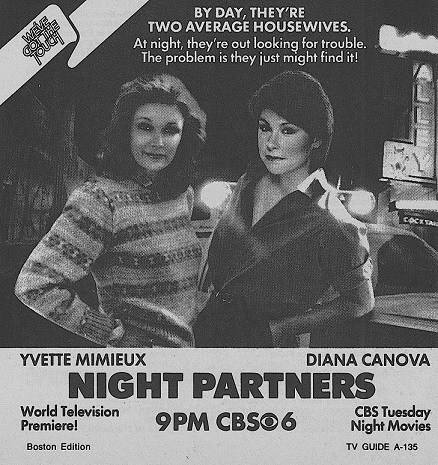
Welcome to Retro Television Reviews, a feature where we review some of our favorite and least favorite shows of the past! On Sundays, I will be reviewing the made-for-television movies that used to be a primetime mainstay. Today’s film is 1983’s Night Partners! It can be viewed on Tubi.
Lauren Hensley (Diana Canova) is a divorced mother who has a nice house in Bakersfield, California. Her best friends and neighbors are housewife Elizabeth McGuire (Yvette Mimieux) and Elizabeth’s husband, a cop named Glenn (Arlen Dean Snyder). One night, after spending the day with the McGuires, Lauren returns to her home and is attacked by three burglars.
For Lauren, the crime is not even the worst part of the night. The worst part is when the police don’t even seem to care that much about her suffering and instead take a “just-the-facts” approach to getting the details to what she’s been through. Glenn attempts to explain to both Lauren and Elizabeth that cops see terrible things every day and, if they seem desensitized to it all, that’s just their way to handling the stress of the job. Lauren, however, feels that the cops need a unit that provides the same support for victims that the criminals receive from their lawyers and social workers.
At a community meeting, Lauren proposes her idea to the police chief, John Wilson (Larry Linville). When Wilson replies that there is no money in the budget, Lauren suggests that maybe the program could be staffed by volunteers. She then proceeds to volunteer herself and Elizabeth. Wilson agrees, but on the requirement that Lauren and Elizabeth first attend the police academy and train with the officers. Under the watchful eye of the gruff but kindly Joe Kirby (M. Emmet Walsh), the two middle-aged housewives run obstacle courses and learn about conflict resolution. And while the conflict resolution lessons make sense, I’m not sure what the point of having them do the obstacle course was.
Eventually, Lauren and Elizabeth become quite good at their jobs, providing comfort to the victims and getting information that helps the police put away criminals, like the serial rapist (a young M.C. Gainey) who has been stalking the streets of Bakersfield. Of course, it takes them a while to get good at the job. When Elizabeth and Lauren are first sent out on the streets, they can’t even keep the police codes straight and they accidentally call in a robbery code when they’re instead just letting the dispatcher know that they’re on break. Bizarrely, when Lauren and Elizabeth are not at a crime scene talking to a victim, they’re just supposed to drive around in a beat-up patrol car. Neither one of them has the power to arrest anyone because they’re just volunteers. In fact, they’re supposed to stay out of the way until the police specifically call for them to come to a crime scene. So, why are they patrolling the city like real cops? It seems like that would basically be a lawsuit waiting to happen.
Night Partners was obviously designed to serve as a pilot for a series where Laruen and Elizabeth would comfort victims and help to solve crimes. The two lead actresses are likable and M. Emmet Walsh is particularly effective as their supervisor. That said, the film itself can’t decide if it wants to be a hard-hitting crime drama or a comedy about two housewives trying to make it as cops. Of course, there’s no reason why it couldn’t be both. Some of the best cops shows have had elements of dark, gallows humor. But this film’s tone is so inconsistent that the comedic scenes seem to be taking place in an entirely different universe from the dramatic scenes.
As someone who strongly believes that the right of the victims need to be given as much weight as the rights of the criminals, I appreciated the film’s message. I just wish it had been delivered a bit more effectively.
First released in 1975, Deadly Hero tells the story of Edward Lacy (Don Murray).
Lacy is an 18-year veteran of the New York Police Department and a proud family man. Lacy is clean-cut, handsome in a blandly pleasant way, and he has a wife and several children. He’s a member of the Knights of Columbus and there are times when he imagines himself pursuing a career in politics. One of the first things that we see Lacy do is introduce an anti-crime mayoral candidate named Reilly (George S. Irving) at a Knights of Columbus rally. Lacy goes out of his way to make sure that he and his family make a good impression but Reilly barely seems to notice him.
Lacy is also a racist who enjoys pulling and using his gun. He was once a detective but a long string of brutality complaints has led to him being demoted back down to being a patrolman. He and his partner (Treat Williams, making his film debut) spend their time patrolling the streets of New York City, getting dirty looks and verbal abuse from the people who they are supposed to be protecting. Much like Travis Bickle in the following year’s Taxi Driver, Lacy obsesses on the crime and the decay that he sees all around him.
Sally (Diahn Williams) lives a life that is a hundred times different from Lacy’s. She’s a cellist and a conductor. She spends her days teaching and her nights conducting at an avant-garde theater. Sally and Lacy have little in common but their lives become intertwined when Sally is attacked and briefly held hostage by a mentally disturbed mugger named Rabbit (James Earl Jones). Responding to a call put in by Sally’s neighbor (Lila Skala), Lacy discovers Rabbit holding a knife to Sally’s throat in the hallway of Sally’s apartment building. At first, Lacy handles the situation calmly and he manages to talk Rabbit into not only releasing Sally but also dropping his knife. However, instead of arresting the now unarmed and docile Rabbit, Lacy shoots and kills him.
Knowing that he’s about to be investigated and that he’s made enemies in the department due to his political activities, Lacy convinces the still-shocked Sally to lie and say that she witnessed Rabbit lunging for Lacy’s gun before Lacy fired. Lacy is proclaimed a hero and soon, Reilly is inviting him to appear at rallies with him. Lacy’s political dreams seem to be coming true but Sally starts to feel guilty about lying. Realizing that Sally is planning on revealing the truth about what happened, Lacy goes to extreme measures to try to keep her quiet.
Deadly Hero is an interesting film, one that is certainly flawed but which ultimately works as a portrait of the authoritarian mindset. Ivan Nagy directs without much visual flair and, especially at the start of the film, he struggles to maintain a consistent pace. For instance, the scene where Rabbit initially menaces Sally seems to go on forever, long beyond whatever was necessary to convince the audience that Rabbit was a dangerous guy. (With the amount of time that Nagy lingers over shots of Sally being menaced by Rabbit, I was not surprised to read that Nagy and Dianh Williams apparently did not get along during filming.) That said, the film’s low budget actually works to its advantage, with the grainy cinematography giving the film a gritty, documentary feel. The film was shot on location in New York City and it’s interesting to watch the actors interact with real New Yorkers. While Lacy is never a sympathetic character, seeing the actual streets of New York does go a long way to explaining why he’s so paranoid. This is one of the many 70s films in which the overriding message seemed to be that New York City was the worst place on the planet.
The film is dominated by Don Murray, who plays Lacy as being a blue-collar fascist who has learned how to hide his anger and his hatred behind a quick smile and an outwardly friendly manner. Feeling confident that everyone will back him up, he has no hesitation about executing an unarmed black man. Even when it becomes obvious that Sally is not going to continue to lie about what happened, Lacy is still arrogant enough to assume that he can charm her into changing her mind. When that doesn’t work, Lacy becomes increasingly unhinged and vindictive. The film’s final ambiguous image suggests that there really is no way to escape the Edward Lacys of the world.
With its portrayal of a violent cop who is convinced that he will be protected by the system, Deadly Hero feels extremely relevant today. Of course, Deadly Hero also suggests that the same system that Lacy is exploiting can be used to take him down, with Lacy eventually being investigated by both Internal Affairs and the District Attorney’s office. The film leaves it ambiguous as to whether or not the rest of the police are as dangerous as Lacy. Is Lacy a product of the system or is he just someone who has figured out how to exploit the system? To its detriment, that’s a question that the film doesn’t answer. Still, much like Harvey Hart’s similarly underappreciated Shoot, Deadly Hero is an always-interesting and occasionally insightful look at the authoritarian mindset.
Here’s a good example of why I need to clean out my DVR more regularly:
I recorded the 1983 legal thriller, The Star Chamber, off of Starz on March 14th. I know what you’re saying. “Big deal! That wasn’t that long ago.” Well, did I mention that it was March 14th, 2017?
That’s right! The Star Chamber sat on my DVR for over a year before I finally got around to watching it last night. You’d be justified in asking why it took me so long and I’m afraid that I really couldn’t give you a definite answer. I can, however, tell you the four main reasons why I recorded it in the first place:
I’m always intrigued whenever I come across a movie of which I haven’t previously heard.
The movie was described as being about a conflicted judge and I just happen to love legal films.
I really, really liked the title. The Star Chamber? Did that mean it took place in a room full of stars?
Before I recorded The Star Chamber, I only had 55 films on the DVR. Since I don’t like odd numbers, recording The Star Chamber took care of that problem.
As for the film itself, The Star Chamber is another one of those movies where a group of vigilantes end up getting pissed off because liberal California judges are letting too many murderers go free because of pesky, constitutional technicalities. The twist here is that the vigilantes are the same judges who keep tossing out evidence and ruling that confessions are inadmissible in court. After spending their day setting free the dregs of society, the judges all gather in a nearby house and review the evidence before voting on whether or not they believe the accused was actually guilty. If the verdict is guilty, the judges promptly hire a hit man who proceeds to clean up the streets.
The newest member of this tribunal is Judge Steven R. Hardin (Michael Douglas). Hardin is haunted by the technicalities that forced him to toss out a case against two accused of child murderers. (Making things even worse, the child’s father commits suicide afterward.) Despite his initial reservations, Judge Hardin signs off on hiring an assassin to take the two men out. But, when it becomes apparent that the two men actually were innocent, Judge Hardin is horrified to discover that there’s no way to call off the hit…
The Star Chamber is an oddly constructed movie. When the movie starts, it feels like a typical police procedural. From there, the movie turns into a rather talky examination of the U.S. legal system, with Judge Hardin trying to balance his idealism with the often frustrating reality of what it takes to uphold the law. The movie then briefly turns into a conspiracy film, featuring middle-aged men in suits holding secret meetings and debating whether or not they’re serving the greater good. And then, towards the end of the movie, it turns into an action film, with Judge Hardin being chased by two drug dealers, a contract killer, and a suspicious police detective (Yaphet Kotto). Judge Hardin may start the movie as a conflicted liberal but he ends at someone who can blow up the entire second floor of a drug lab. In many ways, The Star Chamber is a deeply silly film but, as directed and co-written by Peter Hyams, it’s also just pulpy enough to be entertaining. The dialogue may be over-the-top but so is Michael Douglas’s performance so it all evens out in the end.
It may have taken me a while to get around to watching The Star Chamber but I’m glad that I finally did. It’s a ludicrous film and all the more entertaining as a result.
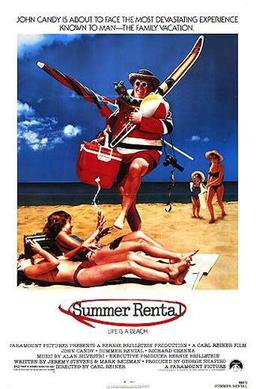 After a blow-up at work, air traffic controller John Chester (John Candy) is given five weeks of paid leave. He takes his family to Florida, where they rent a beach house and discover that their summer town is controlled by snobbish sailing champion Al Pellett (Richard Crenna). It’s the snobs vs slobs as Pellett tries to kick John and his family out of their summer rental and John tries to prove himself to his son and daughter (Joey Lawrence and Kerri Green) by winning the local sailing championship. Luckily, John has Sully (Rip Torn), a modern-day pirate captain, on his side.


 Through the Shattered Lens