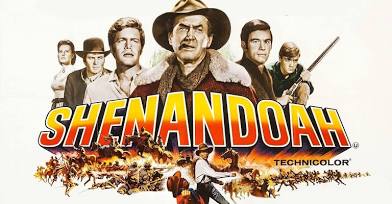
Jimmy Stewart plays Charlie Anderson, the patriarch of a large farming family in Virginia during the time of the Civil War. His family doesn’t own slaves, so he doesn’t figure it’s any of their business what all the fighting is about. He wants to keep working the land in hopes that the war will pass them by. Besides, he has six sons, a daughter, and a daughter in law that he wants to keep safe. He’s trying to keep the family together on his own as his beloved Martha had passed away sixteen years earlier giving birth to their youngest son, who we only know as Boy (Phillip Alford). Aside from the war that’s going on all around them, things seem pretty good for the Anderson’s. They all sit down for a big delicious meal every night. They attend Church every Sunday where they’re usually late and given the side-eye by Pastor Bjoerling (Denver Pyle). One of the sons, James Anderson (Patrick Wayne) and his wife Ann (Katharine Ross), have a precious newborn baby to take care of. The beautiful daughter Jennie (Rosemary Forsyth) is being courted by, and eventually marries, a lovestruck confederate officer named Sam (Doug McClure). Unfortunately the war won’t just go away, and when Boy is taken prisoner by Union soldiers, Charlie can’t stand idly by any longer. They head out to find him and bring him home.
In the guise of an entertaining semi-western, SHENANDOAH does a great job of illustrating how futile and randomly tragic war can be. The movie starts out lighthearted and fun as the family goes about its normal life, with Jimmy Stewart’s Charlie Anderson giving his homespun advice and rolling his cigars. This is a self-sufficient family that loves, respects and enjoys each other even if they don’t agree on everything. But the war keeps inching its way into their lives. First in the form of small group of confederate soldiers who come by to get some water and try to convince the boys to join up. None of the boys will join up, but they do help bury the soldiers when they’re ambushed and killed just down the road. Next a group of men come to the ranch to try to confiscate their horses for the Union army. Of course, Charlie Anderson isn’t going to let that happen and this turns into the type of brawl that seems to come right out of John Wayne western comedy like MCLINTOCK. Everybody joins in with the participants punching and being punched repeatedly, while Boy keeps getting knocked into the horse trough. This shouldn’t be a surprise because Director Andrew V. McLaglen directed MCLINTOCK and many other John Wayne films. Finally, Boy is taken prisoner because he is wearing a confederate cap that he found floating down the steam while he was out fishing one day. Once Charlie and most of his family head out to search for Boy, the movie begins a turn into tragedy. I won’t give the specifics away, but some members of the family will die, and not a single one of their deaths will be based on the actual fighting of a war. Rather, their deaths will be based on the chaos and depravity that surrounds the war. It’s tough to see, especially when they were all so happy just a little bit earlier. For me, the movie’s changes in tone make the tragedy more powerful and really drive home its message about the futility of war. But the Anderson family, like the United States of America after the Civil War, is made up of tough, resilient folks, and the movie ends on a hopeful note that definitely brought some extra moisture to my eyes.
Jimmy Stewart commands the screen in SHENANDOAH. You simply can’t take your eyes off of him, and his performance alone would make the movie worth watching. But with its powerful message, excellent cast, and solid direction, the movie is much more than just Stewart’s strong performance. I highly recommend it.
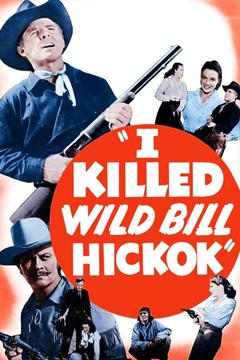
This low-budget western programmer tries to draw viewers in by using the name of an icon of the old west but it doesn’t take place in Deadwood, there’s no poker game, no dead man’s hand, and Wild Bill (Tom Brown) is presented as being a corrupt sheriff who works for evil businessman Jim Bailey (Denver Pyle). Denver Pyle, we all know him best as Uncle Jesse on theDukesofHazzard. He’s a bad guy here, the film’s Boss Hogg.
Our hero and the man who kills Wild Bill Hickok is a horse trader Johnny Rebel, who tells his story in flashback and who is often called “Mr. Rebel.” Johnny Rebel is played by Johnny Carpenter, no relation to the director. This Johnny Carpenter was a stunt man who took control of his career and wrote and played lead in a series of forgettable B-westerns, like this one. Carpenter probably could have been quite the hero in the Poverty Row days, when fast-paced westerns were being released on a weekly basis and directors and actors knew exactly what a matinee audience wanted. By the time IKilledWildBillHickok came out, westerns had started to grow up.
There’s the usual amount of stock footage. Director Richard Talmadge was himself a former stunt man so he does get a few good stunts into the last 15 minutes of the movie. Before the final gun battle, this movie about Wild Bill Hickok is nowhere near wild enough.
1976’s Buffalo Bill and the Indians, or Sitting Bull’s History Lesson takes place in the waning years of the Old West. Civilization is coming to America and the “wild” west’s days are numbered. And yet, even as the days of outlaws and gunslingers come to an end, America is already in the process of building up its own mythology.
Buffalo Bill (Paul Newman) owns a popular wild west show, one where his stars put on a show that claims to recreate the great moments of western history. The show is made up of a motely collection of performers, some of whom are more talented than others. This is a Robert Altman film and, as usual, the emphasis is more on watching how his large ensemble of actors interact as opposed to highlighting any one actor. Indeed, it can be hard to keep everyone in the film straight and one gets the feeling that this was intentional on Altman’s part. Buffalo Bill and the Indians may be a revisionist western and a satire of American history but it’s also a showbiz film. The emphasis is on people continually coming and going, sticking around long enough to either prove their worth as a performer or moving on to a hopefully more receptive audience.
Geraldine Chaplin plays Annie Oakley, the sharp shooter who takes joy in firing her gun and who barely seems to notice that her husband (John Considine) is terrified of getting shot. Joel Grey serves as the unflappable manager of the show while Harvey Keitel is miscast as Buffalo Bill’s somewhat nerdy assistant. (Keitel, with his natural intensity, seems like he’s desperately waiting for a chance to explode, a chance that never really comes.) Burt Lancaster plays Ned Buntline, the writer who made Buffalo Bill into a celebrity and who provides a somewhat sardonic commentary as Bill’s current activities. Shelley Duvall shows up as the wife of President Grover Cleveland (played by Pat McCormick), who comes to the show and is amused until an Indian points a gun towards the president.
Throughout it all, Buffalo Bill enjoys his fame and pushes his vision of the Old West on those who come to see his show. Newman plays Bill as being a blowhard, an eccentric who is obsessed with opera and whose entire persona is a fake. He can’t shoot straight. He can barely ride a horse. His trademark long hair is actually a wig. The only people who take Bill seriously as those who come to see his show. Those who know him view him as being a buffoon but they also understand that he’s a very successful and very famous buffoon and that ultimately matters more than any sort of historical truth.
What conflict there is in the film occurs when Sitting Bull (Frank Kaquitts) and his translator (Will Sampson) arrive on the scene. Sitting Bull has agreed to appear in the show but only under his own terms. Buffalo Bill grows frustrated with Sitting Bull and his refusal to pretend to be a savage but he also knows that this audience wants to see the last remaining great Indian chief.
It’s a big and sprawling film and it’s really not entirely successful. Altman was an intelligent director who was willing to take risks and no one deserves more credit for popularizing the idea of the ensemble film. That said, he could also be a bit heavy-handed and that’s certainly the case here. It takes a certain amount of courage to cast a star like Paul Newman as a thoroughly unlikable character and it also took a bit of courage on Newman’s part to give the performance that he did. At the same time, neither the shallow Buffalo Bill nor the dignified Sitting Bull are really compelling enough characters to carry a film that runs for more than two hours. The film’s message is an obvious one and it’s also one that Altman handled in a much more memorable way with Nashville.
That said, the film is a memorable misfire. It’s at its best when it abandons the politics and just concentrates on the community of performers that popular Buffalo Bill’s show. The film’s best moments are not the ones with Paul Newman growling but instead the ones with John Considine hoping that Geraldine Chaplin won’t accidentally shoot him. As with many of Altman’s film, Buffalo Bill and the Indians works best when it focuses on the misfit community at the center of its story.
During the final weeks of the Civil War, a group of Confederates, led by Joe Barlow (Dan Duryea,) hijacked a shipment of Union gold and buried it near Phantom Hill, Texas. Now that the war is over and Barlow is in custody, he makes an offer. He’ll lead the government to the gold in return for a pardon. Needing the money, the government agrees to Barlow’s conditions. A group of Cavalrymen, led by Matt Martin (Robert Fuller), are ordered to accompany Barlow to Phantom Hill and retrieve the gold. Because the gold itself is buried near Comanche territory, the men will be traveling undercover. If Martin and his men are captured or killed, the U.S. government will disavow any knowledge of the them. Cue the Mission Impossible theme.
It’s an eventful journey to Phantom Hill. When a local sheriff recognizes Barlow as a wanted criminal, Martin has to convince him not to kill Barlow. The sheriff agrees, on the condition that Martin and his men escort a prostitute named Memphis (Jocelyn Lane) out of town. When a group of outlaws discover that Martin and Barlow are heading for the gold, they take off after them. Meanwhile, Barlow has a few plans of his own.
Incident at Phantom Hill is a fast-moving B-western, the type that will be appreciated by fans of the genre. There are a few good shootouts. Jocelyn Lane is beautiful as Memphis, Robert Fuller is firm at Matt Martin, and Dan Duryea is dangerous as Joe Barlow. The outlaws are unusually cruel and the scene where the kill a comic relief character was probably shocking for 1966. The most interesting thing about the movie is its portrayal of Union officers working with former Confederates and the struggle to determine where everyone fits in now that the Civil War is over. Barlow is not to be trusted by the relationship between Memphis and Matt suggests that the country can come back together as long as everyone has a common enemy that needs to be defeated.
If you’re ever visiting my former hometown of Denton, Texas, you owe it to yourself to do two things.
Number one, go to Recycled Books and Records. It’s right across the street from the old courthouse and it’s perhaps the greatest used bookstore in the world. When I was going to college at UNT, I would spend hours in Recycled Books. Not only do they have three floors of books but they have some really nice apartments on the fourth floor. I attended my share of hazily remembered parties in those apartments.
The second thing that you must do is stop by the Campus Theater. The Camps Theater is located on the other side of the old courthouse and it is a true historical landmark. (It’s also the home of the Denton Community Theatre.) When you step inside of the theater, be sure to look for a plaque on the wall. The plaque will inform you that, in 1967, Arthur Penn’s Bonnie and Clyde premiered at the Campus Theater.
Bonnie and Clyde not only premiered in Denton but it was also filmed around North Texas. This was a pragmatic decision, made to minimize studio interference. Even with that in mind, that’s still the way it should have been because Bonnie Parker and Clyde Barrow are true Texas legends. In the 1930s, they were young, they robbed banks, and they killed people. Much like many of the outlaws of the era, they became folk heroes and they died in a hail of bullets.
In the picture above, Clyde is short, scrawny, and slightly handsome in a class clown sort of way. Bonnie, meanwhile, is even shorter than Clyde and has the hard look of someone who has never known an easy life. Both of them have a look that should be familiar to anyone who has spent any time in the small towns that dot the North Texas landscape. They look like real people. They don’t look like film stars.
Here’s the movie’s version of Bonnie and Clyde:
In other words, Bonnie and Clyde is not a documentary. But that doesn’t matter. 50 years after it was first released Bonnie and Clyde remains a powerful and, even more importantly, extremely entertaining film. When the film was released, it was controversial for it violence and, having recently rewatched it, I have to say that the violence still makes an impression. When guns are fired, the shots seem to literally explode in your ear. When people are torn apart by bullets, they die terrible deaths and the film’s most graphic demises are reserved for its most likable characters. Towards the end of the film, with the Texas Rangers relentlessly closing in on Bonnie and Clyde, the tension becomes almost unbearable.
What makes the violence all the more disturbing is that it often interrupts scenes that, until the bullets started flying, were often humorous. A bank robbery starts out as a lark, becomes an exciting chase scene as Bonnie and Clyde attempt to escape, and suddenly turns into an act of shocking of violence when Clyde fire a gun and shoots a man point-blank in the face. Later, stopping to help an old farmer change a tire leads to a sudden ambush. Perhaps the film’s outlook is best captured in a scene in which the Barrow gang cheerfully bonds with a hostage until they suddenly find out that he’s an undertaker, a reminder that the promise of death is always present.
“Get him out of here!” Bonnie snaps.
Like many of the great gangster films, Bonnie and Clyde presents its outlaws as being folk heroes. They may rob banks and occasionally kill people but they look good doing it and they seem like they would be fun to hang out with. The thing that set Bonnie and Clyde apart from previous gangster films is that it refused to even pretend to condemn its bank robbers. The cops and the Texas Rangers are all on the side of the banks and the banks are on the side of big business. Bonnie and Clyde aren’t outlaws. They’re rebels. When they rob banks, they’re not just taking money. They’re standing up to the same establishment that was feared in the 30s, resented in the 60s, and hated today.
Clyde is played by Warren Beatty (who also produced the film) and Bonnie is played by Faye Dunaway and both of them give performances that literally define screen charisma. You never forget that you’re watching two movie stars but, at the risk of repeating myself, Bonnie and Clyde is not meant to be a documentary. At times, it almost seems as if Beatty’s Clyde and Dunaway’s Bonnie know that they’re characters in a gangster movie. They know that they’re doomed because that’s how gangster movies work so, as a result, they’re determined to live as much life as possible before that final reel. The supporting cast — Gene Hackman, Estelle Parsons, Michael J. Pollard, Gene Wilder — are all great but the film is definitely a celebration of Beatty and Dunaway.
Bonnie and Clyde went from premiering at the Campus Theater to a best picture nomination. However, it lost to In The Heat of the Night.
The Story of Suicide Sal
A Poem by Bonnie Parker
We each of us have a good “alibi”
For being down here in the “joint”;
But few of them really are justified
If you get right down to the point.
You’ve heard of a woman’s “glory”
Being spent on a “downright cur,”
Still you can’t always judge the story
As true, being told by her.
As long as I’ve stayed on this “island,”
And heard “confidence tales” from each “gal,”
Only one seemed interesting and truthful —
The story of “Suicide Sal.”
Now “Sal” was a gal of rare beauty,
Though her features were coarse and tough;
She never once faltered from duty
To play on the “up and up.”
“Sal” told me this tale on the evening
Before she was turned out “free,”
And I’ll do my best to relate it
Just as she told it to me:
I was born on a ranch in Wyoming;
Not treated like Helen of Troy;
I was taught that “rods were rulers”
And “ranked” as a greasy cowboy.”
Then I left my old home for the city
To play in its mad dizzy whirl,
Not knowing how little of pity
It holds for a country girl.
There I fell for “the line” of a “henchman,”
A “professional killer” from “Chi”;
I couldn’t help loving him madly;
For him even now I would die.
One year we were desperately happy;
Our “ill gotten gains” we spent free;
I was taught the ways of the “underworld”;
Jack was just like a “god” to me.
I got on the “F.B.A.” payroll
To get the “inside lay” of the “job”;
The bank was “turning big money”!
It looked like a “cinch” for the “mob.”
Eighty grand without even a “rumble” —
Jack was last with the “loot” in the door,
When the “teller” dead-aimed a revolver
From where they forced him to lie on the floor.
I knew I had only a moment —
He would surely get Jack as he ran;
So I “staged” a “big fade out” beside him
And knocked the forty-five out of his hand.
They “rapped me down big” at the station,
And informed me that I’d get the blame
For the “dramatic stunt” pulled on the “teller”
Looked to them too much like a “game.”
The “police” called it a “frame-up,”
Said it was an “inside job,”
But I steadily denied any knowledge
Or dealings with “underworld mobs.”
The “gang” hired a couple of lawyers,
The best “fixers” in any man’s town,
But it takes more than lawyers and money
When Uncle Sam starts “shaking you down.”
I was charged as a “scion of gangland”
And tried for my wages of sin;
The “dirty dozen” found me guilty —
From five to fifty years in the pen.
I took the “rap” like good people,
And never one “squawk” did I make.
Jake “dropped himself” on the promise
That we make a “sensational break.”
Well, to shorten a sad lengthy story,
Five years have gone over my head
Without even so much as a letter–
At first I thought he was dead.
But not long ago I discovered
From a gal in the joint named Lyle,
That Jack and his “moll” had “got over”
And were living in true “gangster style.”
If he had returned to me sometime,
Though he hadn’t a cent to give,
I’d forget all this hell that he’s caused me,
And love him as long as I live.
But there’s no chance of his ever coming,
For he and his moll have no fears
But that I will die in this prison,
Or “flatten” this fifty years.
Tomorrow I’ll be on the “outside”
And I’ll “drop myself” on it today;
I’ll “bump ’em” if they give me the “hotsquat”
On this island out here in the bay…
The iron doors swung wide next morning
For a gruesome woman of waste,
Who at last had a chance to “fix it,”
Murder showed in her cynical face.
Not long ago I read in the paper
That a gal on the East Side got “hot,”
And when the smoke finally retreated
Two of gangdom were found “on the spot.”
It related the colorful story
of a “jilted gangster gal.”
Two days later, a “sub-gun” ended
The story of “Suicide Sal.”
The Story of Bonnie and Clyde
Another Poem by Bonnie Parker
You’ve read the story of Jesse James
Of how he lived and died;
If you’re still in need
Of something to read,
Here’s the story of Bonnie and Clyde.
Now Bonnie and Clyde are the Barrow gang,
I’m sure you all have read
How they rob and steal
And those who squeal
Are usually found dying or dead.
There’s lots of untruths to these write-ups;
They’re not so ruthless as that;
Their nature is raw;
They hate all the law
The stool pigeons, spotters, and rats.
They call them cold-blooded killers;
They say they are heartless and mean;
But I say this with pride,
That I once knew Clyde
When he was honest and upright and clean.
But the laws fooled around,
Kept taking him down
And locking him up in a cell,
Till he said to me,
“I’ll never be free,
So I’ll meet a few of them in hell.”
The road was so dimly lighted;
There were no highway signs to guide;
But they made up their minds
If all roads were blind,
They wouldn’t give up till they died.
The road gets dimmer and dimmer;
Sometimes you can hardly see;
But it’s fight, man to man,
And do all you can,
For they know they can never be free.
From heart-break some people have suffered;
From weariness some people have died;
But take it all in all,
Our troubles are small
Till we get like Bonnie and Clyde.
If a policeman is killed in Dallas,
And they have no clue or guide;
If they can’t find a fiend,
They just wipe their slate clean
And hand it on Bonnie and Clyde.
There’s two crimes committed in America
Not accredited to the Barrow mob;
They had no hand
In the kidnap demand,
Nor the Kansas City depot job.
A newsboy once said to his buddy;
“I wish old Clyde would get jumped;
In these awful hard times
We’d make a few dimes
If five or six cops would get bumped.”
The police haven’t got the report yet,
But Clyde called me up today;
He said, “Don’t start any fights
We aren’t working nights
We’re joining the NRA.”
From Irving to West Dallas viaduct
Is known as the Great Divide,
Where the women are kin,
And the men are men,
And they won’t “stool” on Bonnie and Clyde.
If they try to act like citizens
And rent them a nice little flat,
About the third night
They’re invited to fight
By a sub-gun’s rat-tat-tat.
They don’t think they’re too tough or desperate,
They know that the law always wins;
They’ve been shot at before,
But they do not ignore
That death is the wages of sin.
Some day they’ll go down together;
And they’ll bury them side by side;
To few it’ll be grief
To the law a relief
But it’s death for Bonnie and Clyde.
“When the legend become fact, print the legend.” — Maxwell Scott (Carleton Young) in The Man Who Shot Liberty Valance (1962)
Though I understand and respect their importance in the history of both American and Italian cinema, I have never really been a huge fan of westerns. Maybe its all the testosterone (“A man’s got to do what a man’s got to do…”) or maybe it’s all the dust but westerns have just never really been my thing.
However, I will always make an exception for The Man Who Shot Liberty Valance, which is not just a great western but a great film period.
But you already knew that. It’s a little bit intimidating to review a film that everyone already knows is great. I even opened this review with the exact same quote that everyone uses to open their reviews of The Man Who Shot Liberty Valance. To a certain extent, I feel like I should have found a quote that everyone hasn’t already heard a thousand times but then again, it’s a great quote from a great film and sometimes, there’s nothing wrong with agreeing with the critical consensus.
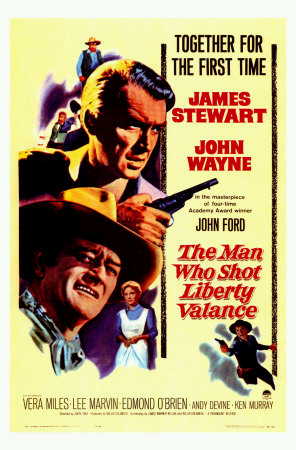
The Man Who Shot Liberty Valance opens with a train stopping in the small western town of Shinbone. The residents of the town — including newspaper editor Maxwell Scott (Carleton Young) — are shocked when Sen. Rance Stoddard (James Stewart) and his wife Hallie (Vera Miles) get off the train. Sen. Stoddard is considered to be a front-runner to become the next Vice President of the United States. Scott is even more shocked to discover why the Stoddards are in town. They’ve come to Shinbone to attend the funeral of an obscure rancher named Tom Doniphon (played, in flashback, by John Wayne).
Sitting in the funeral home with Doniphon’s coffin (and having reprimanded the local mortician for attempting to steal Tom’s boots), Rance tells Scott why he’s come to pay respect to Tom Doniphon. We see, in flashback, how Rance first came to Shinbone 25 years ago, an idealistic lawyer who — unlike most of the men in the west — refused to carry a gun. We see how Rance was robbed and assaulted by local outlaw Liberty Valance (a wonderfully intimidating and bullying Lee Marvin), we discover how Rance first met Hallie while working as a dishwasher and how he eventually taught her how to read, and we also see how he first met Tom Doniphon, the only man in town strong enough to intimidate Liberty Valance.
At first, Rance and Doniphon had an uneasy friendship, epitomized by the condescending way Doniphon would call Rance “pilgrim.” Doniphon was in love with Hallie and, when he attempted to teach Rance how to defend himself, he was largely did so for Hallie. Rance, meanwhile, was determined to bring law and society to the west.
And, eventually, Rance did just that. When Shinbone elected two delegates to the statehood convention in the territory’s capitol, Rance attempted to nominate Doniphon for the position but Doniphon refused it and nominated Rance instead, explaining that Rance understood “the law.” When Liberty Valance attempted to claim the other delegate spot, Rance and Doniphon worked together to make sure that it instead went to newspaper editor Dutton Peabody (Edmond O’Brien). And when Liberty Valance attempted to gun Rance down in the street, Rance shot him.
Or did he?
That’s the question that’s at the heart of The Man Who Shot Liberty Valance. However, as a film, The Man Who Shot Liberty Valance is far less interested in gunfights than it is in politics. Perhaps the most important scene in the film is not when Rance and Liberty meet out on that dark street. Instead, it’s the scene at the statehood convention where the reformers (represented by Rance) and the cattlemen (represented by John Carradine) battle over who will be the territory’s delegate to Washington. Between John Carradine orating, the horses riding in and out of the hall, Edmond O’Brien drinking, James Stewart looking humble, and John Wayne glowering in the background, this is one of the best political scenes ever put on film.
When Rance first arrives in the west, there is no political system in place. With the exception of the ineffectual town marshal (Andy Devine), there is no law. The peace is kept by men like Tom Doniphon and, oddly enough, by Liberty Valance as well. (Whether he realizes it or not, Shinbone’s fear of Liberty has caused the town to form into a community.) What little official law there is doesn’t matter because the majority of the Shinbone’s citizens can’t read.
When Rance arrives, he brings both education and the law. He makes Shinbone into a town that no longer needs Liberty Valance but, at the same time, it no longer need Tom Doniphon either. Hence, it’s Rance Stoddard who goes from dishwasher to U.S. Senator while Tom Doniphon dies forgotten. Rance represents progress and unfortunately, progress often means losing the good along with the bad things of the past.
(It’s no coincidence that when Rance and Hallie return to Shinbone, the first person that they see is the former town marshal, who no longer wears a star and who, we’re told, hasn’t for years. Time has passed by.)
It’s a bittersweet and beautiful film, one that features four great performances from Stewart, Wayne, Marvin, and Vera Miles. Personally, I like to think that maybe Sen. Stoddard had a daughter who married a man named Smith and maybe they had a son named Jefferson who later made his way to the Senate as well.


 Through the Shattered Lens