Both Arleigh and I have devoted a lot of time on the site to talking about our mutual admiration for the films of Italian horror director Lucio Fulci. While Fulci will always have as many detractors as defenders, the fact of the matter is that Fulci has been a major and often unacknowledged influence on the direction of horror cinema. To cite just one prominent example, the disturbing and graphic body horror of The Walking Dead has less to do with Romero and everything to do with Fulci.
Fulci remains a controversial figure and that’s not surprising. For every Fulci lover, there’s a detractor. For every good horror film that he made between 1979 and 1982, there’s a terrible one that he made in the years leading up to his mysterious death. But what everyone seems to agree on is that his 1979 epic Zombi 2 is one of the best (and most important) of the post-Romero Zombie films. Zombi 2 may have been produced to take advantage of the popularity of Romero’s Dawn of the Dead but Fulci created a film that transcended its origins.
(Personally, I prefer Fulci’s film to Romero’s but that’s a discussion for another day.)
Zombi 2 is a film that’s provided us with a few scenes that we love here at the Shattered Lens. Whether it’s the scene where a zombie wrestles with a shark or the very first Fulci’s signature eyeball impaling, Zombi 2 is a film that is full of memorable scenes. Tonight, I want to highlight another moment from Zombi 2 — the conquistador scene.
As this scene begins, the film’s star are already fleeing from an army of zombies when they discover that it’s not just the recently deceased that they have to fear. This is a scene that manages to be shameless, silly, and disturbingly effective at the same time. In other words, it’s pure Fulci.
Continuing our horror-theme for October the latest “Scenes I Love” entry comes from one of those hated remakes that was actually better than expected (and for some better than the original…yes, heresy). It’s from the excellent extended opening sequence for Zack Snyder’s remake of George A. Romero’s horror classic, Dawn of the Dead.
In most zombie films we never truly get to see the early hours of the zombie apocalypse from the ground. We always hear about it second-hand after it has already occurred. In Snyder’s remake we get to see it first-hand just as it’s flaring up to uncontrollable levels.
I’m a traditional Romero-type zombie enthusiast myself, but I must admit that Snyder’s choice to make the zombies in this remake runners does add a sense of the end-times as we see zombies after zombies running and gunning after neighbors who either don’t know what the hell just dropped in their neighborhood or just too slow to get away. Love how this sequence even has a shout-out to the original version with the traffic helicopter that flies in to give a bird’s-eye view of the whole apocalypse coming down on everyone.
Hi and welcome to the latest edition of Lisa Marie’s Favorite Grindhouse and Exploitation trailers! To be honest, I’m usually way too ADD to come up with (let alone maintain) any sort of theme with my trailer posts but this weekend — almost by pure chance — a theme has emerged! So, without further hold up, let us consider 6 Trailers of the Dead!
1) Night of the Living Dead (1968)
How have I done nearly a 100 of these posts without featuring the trailer for George Romero’s landmark Night of the Living Dead?
2) The Astro-Zombies (1968)
Apparently, 1968 was a big year for the dead returning to life.
3) The Majorettes (1986)
The Majorettes was directed by the late Bill Hinzman, the guy who played the Cemetary Zombie in Night of the Living Dead.
4) Dawn of the Dead (1978)
To be honest, I think I’ve already featured this trailer in an earlier post. However, there’s no way that you can start a post with Night of the Living Dead and then end it with Day of the Dead without finding some room for Dawn of the Dead in the middle.
5) Dead Heat (1988)
Wow, this looks really, really, really … not good. However, according to Wikipedia, it’s about zombies and it’s got the word “dead” in the title so it works theme-wise.
6) Day of the Dead (1985)
I’ve watched this trailer several times and those arms still make me jump every time!
We’ve now reached the final day of what has been a week-long horror-themed “Song of the Day” feature for the site. It’s quite appropriate that this final day also lands on Halloween and I’m sure many will approve of this final choice to cap off the week.
A week which has seen Italian film composers and prog-rock bands chosen for creating and contributing some of the best and most memorable themes to horror films which will stand the march of time. We’ve seen an epic song from a Montreal band whose music has the apocalyptic sound to it. There’s also two entries from films created by a master of the horror genre in John Carpenter.
The week began with Goblin’s main title theme for George A. Romero’s original Dawn of the Dead. With Halloween night the premiere of the long-awaited and heavily-hyped tv adaptation of Robert Kirkman’s The Walking Dead comic book series (by none other than Frank Darabont himself) I thought what better way to bookend Goblin’s theme for the Romero zombie epic than by picking Johnny Cash’s song “The Man Comes Around”. One of the last songs penned and sang by The Man In Black himself and properly used by filmmaker Zack Snyder to be the intro music for his remake of Dawn of the Dead.
This song with its gospel-like (though not as hopeful as most) sound and it’s apocalyptic and Biblical lyrics just speaks of the apocalypse like no other song from this past week has done. It comes off almost like a prophecy come down and spoken by one of God’s main dudes. This song when paired with the scenes of the zombie apocalypse crashing down on an unsuspecting world in Snyder’s film instantly made it a favorite with all zombie fans everywhere and introduced The Man In Black to a whole new set of fans.
I would like to think that when the zombie apocalypse does arrive it would be to this song as I and those who share my belief in how to survive such an event ready ourselves for whatever may come.
The Man Comes Around
And I heard as it were the noise of thunder One of the four beasts saying come and see and I saw And behold a white horse
There’s a man going around taking names And he decides who to free and who to blame Everybody won’t be treated all the same There’ll be a golden ladder reaching down When the Man comes around
The hairs on your arm will stand up At the terror in each sip and in each sup Will you partake of that last offered cup? Or disappear into the potter’s ground When the Man comes around
Hear the trumpets, hear the pipers One hundred million angels singing Multitudes are marching to the big kettledrum Voices calling, voices crying Some are born and some are dying It’s Alpha and Omega’s kingdom come
And the whirlwind is in the thorn tree The virgins are all trimming their wicks The whirlwind is in the thorn tree It’s hard for thee to kick against the pricks
Till Armageddon no shalam, no shalom Then the father hen will call his chickens home The wise man will bow down before the throne And at His feet they’ll cast their golden crowns When the Man comes around
Whoever is unjust let him be unjust still Whoever is righteous let him be righteous still Whoever is filthy let him be filthy still Listen to the words long written down When the Man comes around
Hear the trumpets, hear the pipers One hundred million angels singing Multitudes are marching to the big kettledrum Voices calling and voices crying Some are born and some are dying It’s Alpha and Omega’s kingdom come
And the whirlwind is in the thorn tree The virgins are all trimming their wicks The whirlwind is in the thorn tree It’s hard for thee to kick against the pricks
In measured hundredweight and penneypound When the Man comes around.
Close (Spoken part) And I heard a voice in the midst of the four beasts And I looked and behold, a pale horse And his name that sat on him was Death And Hell followed with him.
Halloween is less than a week away and for the next few days there’ll be more song of the day choices and this time around it will all be centered on horror. To start things off I chose the theme from George A. Romero’s Dawn of the Dead which was composed by the Italian prog-rock band Goblin.
The theme’s titled “L’alba Dei Morti Viventi” and it definitely creates a dissonant tone which just creeps along and makes one feel more than just a bit uncomfortable. Goblin used a lot of their electronic music background to make this such a signature and iconic horror theme. Anyone who has seen the original Dawn of the Dead will automatically recognize this theme and the feeling it brings up. A feeling of dread and of creeping horror which perfectly describes the zombies from Romero’s grand opus.
Horror fans everywhere have Italian horror maestro Dario Argento for having gotten Goblin to create the score for Romero’s film (Argento was one of the key producers for the film and even re-cut it for the European market). Goblin had already worked with Argento on previous films with their best early work with the filmmaker being the score for ProfondoRosso (known as Deep Red in the US and English market). But no matter how many other Italian horror scores the band has made since Dawn of the Dead (and the ones after have been great in their own right) it will be their score for that film which will indelibly link the band in film music history.
PS: as an added bonus below is the band’s theme for Argento’s Profondo Rosso.
Earlier this morning, while suffering from an annoyingly persistent case of insomnia, I decided to spend 2 hours watching a classic Italian exploitation film, Alberto De Martino’s oddly effective Omen rip-off, Holocaust 2000.
In Holocaust 2000, Kirk Douglas plays a businessman who wants to build a gigantic nuclear power plant in the Middle East. There are a few problems with this plan. First off, the site that Douglas selects just happens to be right next to a cave that is full of religious artifacts. Secondly, there’s a handful of angry environmentalists picketing his London office. And, perhaps the biggest problem, Douglas’ son happens to be the Antichrist. This fact is obvious to the viewer because not only is his son named Angel (yes, we’re in the land of irony) but he also looks and acts nothing like Douglas. Not only does Angel have a noticeably weak chin (no cleft to be seen at all) and speak with a rather posh accent but he’s also so extremely English that he’s even played by an actor named Simon Ward.
In other words, the viewer is pretty much in on the game from the beginning. What makes the movie work is that director De Martino understands that everyone’s going to know that Angel’s the antichrist from the minute he first appears so, as opposed to the Omen films, he doesn’t waste a lot of time playing any “is-he-or-isn’t-he” games. Instead, in the great tradition of Italian exploitation, De Martino jumps straight into the apocalypse without worrying about things like narrative cohesion and the end result is an enjoyably chaotic film that rarely makes sense but is never boring. Whereas the Omen films are almost tedious in their attempts to provide theological justification for all the blood that’s spilled on-screen, Holocaust 2000 has a cheerful, let’s-make-it-up-as-we-go-along feel to it that, at times, almost makes the whole thing feel like some long lost Lucio Fulci film.
Holocaust 2000 is probably best known for two sequences. The first features a helicopter blade very graphically chopping off the top of a man’s head. If seeing the original Dawn of the Dead made me nervous around helicopters, seeing Holocaust 2000 has ensured that I will never ever step anywhere near one of those things. Seriously, I’ve seen a lot of gore over the past few years but the decapitation scene in this movie …. well, perhaps it’s best to just shudder and move on. (For the record, Holocaust 2000 came out before Dawn of the Dead so the helicopter decapitation scene here was not stolen from that film. If anything, it was simply a more graphic version of David Warner losing his head in the Omen.)
The second sequence is a scene in which a very nude Kirk Douglas (who, it must be admitted, looked a lot better at 61 than most 20 year-olds do today) has a nightmare in which he watches the world literally come to an end. Set to Ennio Morricone’s intense and memorable score, this sequence manages to be surreal, disturbing, and entertaining all at the same time. It epitomizes everything that makes Holocaust 2000 such a surprisingly effective work of pure cinematic exploitation.
Like many of the great Italian exploitation films, Holocaust 2000 was released under several titles. It is currently available on DVD under the title Rain of Fireand a big bleh to Lionsgate for choosing to go with such a boring name. Admittedly, I can see their logic. Though the movie was first released in theaters in 1977, it took 31 years for it to show up on DVD. During that time, 2000 came and went and the world didn’t end (or maybe it did and the last 10 years have just been an extended hallucination, the choice is yours). But still, Rain of Fire sounds like a substandard country song about a nasty divorce that ends in murder. On the other hand, a title like Holocaust 2000 — nakedly exploitive and borderline offensive — represents everything that we’ve come to so love about Italian exploitation films.
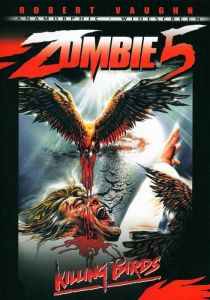
Thanks to the wonderful people at Anchor Bay, I recently watched Zombie 5: Killing Birds, one of the last of the old school Italian horror films.
Admittedly, when I first hit play on the DVD player, I was expecting the worst. Of all the various official and unofficial sequels to Lucio Fulci’s masterpiece Zombi 2 (which, of course, was itself an unofficial prequel to Dawn of the Dead), Zombie 5: Killing Birds has the worst reputation. While most Italian horror fans seem to agree that Zombie 4is enjoyable on its own stupid terms and even Zombi 3has a few brave defenders, its hard to find anyone willing to defend Killing Birds. The general consensus has always seemed to be that Killing Birds is a generic and rather forgettable splatter film that, title aside, had absolutely nothing in common with the Fulci classic.
Having now seen Killing Birds, I can say that the general consensus, in this case, is largely correct. Killing Birds is generic, predictable, and ultimately forgettable. However, taken on its own terms, it’s a perfectly enjoyable way for a lover of zombie cinema to waste 90 minutes. As long as you don’t compare it to Zombi 2, i’ts a perfectly tolerable piece of trash that actually has one or two memorable moments tossed randomly through its running time. At the very least, its a hundred times better than Umberto Lenzi’s similar Black Demons.
The film deals with a bunch of grad students who, while searching for a nearly extinct species of Woodpecker, end up spending the night at a deserted house in Louisiana. Many years ago, a brutal murder was committed at this house and, well, you can guess the rest. The grad students end up falling prey to a bunch of zombies, largely because the students are all remarkably stupid. Meanwhile, B-movie veteran Robert Vaughn shows up as Dr. Fred Brown, a blind man who spends his days studying birds. There’s a lot of birds in this movie and its never quite clear how they link up to the living dead but they certainly do look menacing flying past the camera.
With the exception of Vaughn (who overacts just enough to keep things interesting without going so far over the top as to become ludicrous), the film’s cast is likeable but not memorable. Everyone’s playing a stereotype (i.e., the leader, the computer geek, the slut, the girl with looks and brains) and no one makes much of an effort to be anything more than a stereotype. While this certainly keeps Killing Birds from displaying anything resembling nuance, it’s also strangely comforting. Its lets a neurotic viewer like me know, from the start, that there’s no need to think too much about anything she might see for the next hour and a half. Since this movie was made in the late 80s, most of the men sport a mullet and all of the women wear those terribly unflattering khaki pants that I guess were all the rage back then.
As I stated before, the film does have its occasional strengths. Some of the deaths are memorably nasty (even if the gore effects are decidedly cut-rate, pun not intended). As well, the film does an excellent job at capturing the hot, humid atmosphere of the Louisiana bayous. I’ve spent enough time in that part of the country that I can attest that the movie perfectly captures the stagnant heat and the way dehydration can cause your mind to play tricks on you. While the zombies themselves are hardly as impressive as Fulci’s, the filmmakers wisely keep them in the shadows for most of the film and, if nothing else, this allows the viewer to imagine something scarier than what they’re actually seeing. Finally, this movie does have one of the most effective nightmare sequences that I’ve ever seen. Lasting barely a minute and not really having much to do with the overall plot, this nightmare still features some rather disturbing imagery. One image, in particular, has so stuck with me that I found myself paying homage to it in a my own writing.
Though the movie’s director is credited as being Claudio Lattanzi, it is pretty much an open secret that the movie was actually directed by the infamous Joe D’Amato (who, regardless of what else he may have done during his storied life, also directed one of my favorite movies ever, Beyond The Darkness). I’ve read a few interviews where D’Amato said that he allowed Lattanzi to be credited as director because he wanted to help Lattanzi’s launch his own career. To judge by the movie itself, however, it seems more probable that Lattanzi wasn’t delivering the movie that D’Amato wanted and D’Amato stepped in as a result. Regardless, Killing Birds is hardly the best example of D’Amato’s work but, at the same time, it’s hardly the worst either.
In the end, Killing Birds is a movie that will probably be best appreciated by those who already have a good working knowledge of Italian exploitation films. It’s hardly a masterpiece (and, despite enjoying it, I would hesitate to even call it a “good” movie) but it’s not really deserving of all the criticism that it’s received over the years either. As a bonus, the Anchor Bay DVD come with a lengthy interview with Robert Vaughn in which he discussed his career in B-movies and, while Vaughn says nothing about Killing Birds during the interview, he’s still interesting and enjoyable to listen to. Unlike a lot of “reputable” actors who have made B-movies, Vaughn never condescends to the films that both started and ended his movie career.