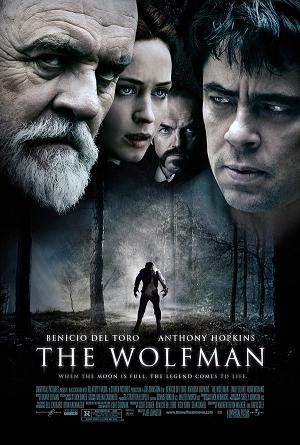
Horror Film Review: The Wolfman (dir by Joe Johnston)


I have to admit that I’m always a little bit surprised to discover how many people really don’t like the 2010 film, The Wolfman.

I mean, I’ll be the first to admit that it may not have been the greatest film ever made but the amount of negative feelings that this film has managed to generate over the years seems, to me, to be a bit out of proportion.  Essentially, it’s just a silly film about a werewolf.

Yes, it is a remake of The Wolf Man and we’re all honor-bound to dislike remakes but, if we’re going to be absolutely honest, the original Wolf Man was sometimes pretty silly too.  If anything, the original’s success is largely due to the heartfelt work of Claude Rains in the role of the Wolf Man’s father.  Yes, the original Wolf Man is a classic but remaking it is not exactly sacrilege.

In the remake, Benicio Del Toro takes over the role of Larry Talbot, who is reimagined as a Shakespearean actor who has a history of mental instability.  Del Toro is not exactly convincing as an Englishman, though the same could be said of Lon Chaney, Jr.  However, nobody broods with quite the panache of Benicio Del Toro and that’s what was needed for the remake’s version of Larry Talbot.  If Lon Chaney, Jr. played Larry as being a dumb lug, Del Toro plays Larry as being a tortured artist.

Anthony Hopkins takes over the old Claude Rains role.  Just as it’s difficult to imagine Del Toro as being English, it’s next to impossible to imagine him sharing any DNA with Anthony Hopkins.  And yet, I’m really glad that Hopkins was cast in the role.  Of course, in the remake, the character of John Talbot has been totally reimagined.  He’s now something of a bitter and sarcastic alcoholic, a negligent father who always seem to be amused at some mean-spirited joke that only he can understand.  I imagine that if I asked Hopkins, he’d say that he did this role for the money but there’s nothing wrong with that.  Some of Hopkins’s best performances have been the ones that he subsequently claimed to have done only for the money.  Freed from any obligation to give a nuanced or subtle performance, Hopkins goes totally over-the-top and it’s actually a lot of fun to watch.  In The Wolfman, Hopkins turns the delivery of bitter bon mots and erduite insults into an art form.

Watching the film’s first half, we all know what’s going to happen.  Gypsies are going to show up in the woods near Talbot Hall and paranoid villagers are going to blame them for everything that happens.  Larry is going to get bitten by a werewolf and transform every night when the moon is full.  Larry is going to fall in love with Gwen (Emily Blunt) but, for her own protection, will try to send her away.  An arrogant but clever inspector, Francis Abberline (Hugo Weaving, playing a version of the real-life detective who inspired the role played by Johnny Depp in From Hell), is going to arrive from London to investigate all the recent deaths…

About halfway through, The Wolfman takes a totally unexpected turn.  I won’t spoil it here, just in case you haven’t seen the movie.  I know a lot of people don’t care much for the big twist but I happened to love it.  Yes, it doesn’t necessarily make a lot of sense and it’s all a bit overdone but so what?  It’s exactly the type of weird twist that a movie like this needs.  It all leads to a final confrontation, one that is as exuberantly silly as the original’s conclusion was somber and tragic.

The key to enjoying The Wolfman is to accept it for what it is, an occasionally dumb and definitely not-to-be-taken-seriously movie that features some appropriately atmospheric cinematography, gorgeously gothic production design, and some very talented actors.  (I especially enjoyed Weaving’s performance as Abberline.)  A classic it may not be, but it’s still a fun little movie if you’re in the right mood for it.

Horror Film Review: From Hell (dir by The Hughes Brothers)


Who was Jack the Ripper?

That’s a question that people have been asking for 129 years.  Arguably the world’s first famous serial killer, Jack the Ripper killed at least five prostitutes in the Whitechapel section of London.  Some claim that he killed as many as twenty.  He may have also written several taunting letters to the police.  Again, some say that the letters are authentic and some say that they were hoaxes.  Hell, there’s even some people who say that Jack the Ripper himself is a myth and the five murders attributed to him were actually five unconnected crimes.  It was speculated that Jack the Ripper was a butcher, a surgeon, or maybe a midwife.  Just as suddenly as the murders began, they ended.  The London police claimed that he had committed suicide by jumping into the Thames.  Few people believed them then and even less now.

The reason that there is so much uncertainty is because Jack the Ripper was never caught.  He was never identified.  There were stories of confessions, though many of them came from the mentally infirm or they were heard by someone who was a friend of someone who claimed to be the Butcher of Whitechapel.  At one point, there was even a claim that Jack’s diary had been found.

As a horror fan, a true crime fanatic, and a lover of history, I’ve read quite a few theories about who Jack the Ripper was.  Nearly every prominent (or, at the very least, remembered) Victorian has been accused of having been Jack the Ripper.  Oscar Wilde has been accused of hiding a confession in The Picture of Dorian Gray.  Various members of the Royal Family have been fingered as the culprit.  Even Lewis Carroll could not escape accusation.  The true crime author Patricia Cornwell wrote an entire book where she (wrongly) accused the painter Walter Sickert.  Cornwell’s case could basically be summed up as follows: “Walter Sicket’s paintings were weird.  Walter Sickert must be Jack the Ripper.”  Apparently, she managed to destroy one of Sickert’s paintings while looking for clues.

The truth of the matter is that Jack the Ripper was probably some guy who no one has ever heard of, most probably one of the unknown men who lived and worked in the shadows of Whitechapel.  For all the talk of Jack being a doctor, it can be argued that the surgical precision of his murders has been overstated.  He didn’t get away with murder because he was particularly clever.  Instead, he got away with it because, in 1888, even fingerprinting was considered to be a radical science.

But, honestly, that’s not very intriguing.  For those of us who have researched the case, it’s far more interesting to speculate that Jack the Ripper was either a famous person or that the murders were all the result of a huge conspiracy.

That’s certainly the appeal of From Hell, the 2001 film from The Hughes Brothers.  Making the same basic case as Bob Clark’s Murder By Decree, From Hell argues that the Jack the Ripper murders were the result of a royal conspiracy.  In reality, that theory has been discredited but it certainly is the most cinematic of all the possibilities.

And, speaking of cinematic, it must be said that From Hell is very stylish movie.  Though the title comes from one of Jack the Ripper’s letters, From Hell also could just as easily be used to describe the film’s vision of Whitechapel.  Whitechapel is full of shadows and secrets and the blood flows freely.  If Mary Kelly (Heather Graham) isn’t killed by Jack the Ripper, it’s just as likely she’ll be killed by one of her clients.  Even as the murders are committed, life and business in Whitechapel goes on.  What other choice is there?  It’s either risk being killed or starve.

It falls to Frederick Abberline (Johnny Depp) to solve the murders.  The real-life Abberline was an almost legendary detective who lived for decades after the final Jack the Ripper murder.  The movie’s Abberline is an opium addict who always seems to be on the verge of a breakdown.  When he and Mary Kelly fall in love, you’re not really sure if it’s something to be happy about.  Abberline seems just as likely to go crazy as everyone else.

From Hell is an uneven and somewhat overlong movie but I like it.  Heather Graham and Johnny Depp give somewhat odd performances but the oddness fits right in with the Hughes Brothers’s vision of a world that’s been turned permanently upside down.  It’s a movie that’s full of atmosphere and the story is intriguing even if it’s never exactly convincing.  For obvious reasons, I can’t reveal who plays Jack the Ripper but I will say that he gives a very good performance.  When he says that, “One day, men will look back and say that I gave birth to the 20th century,” you believe him.

A Movie A Day #146: The Dogs of War (1981, directed by John Irvin)


Jamie Shannon (Christopher Walken) is a professional mercenary who is hired, by a British businessman, to overthrow the government of Zangaro.  Though Zangaro is currently ruled by a ruthless dictator, Shannon’s employers want to replace him with someone even worse, all so they can get their hands on the country’s platinum mines.  After Shannon is captured and tortured by the government, he wants nothing else to do with Zangaro.  Instead, he wants to return to New York and propose to his ex-wife (JoBeth Williams).  But, when she turns down his proposal, Shannon and his mercenary army return to Zangaro.

Before winning an Oscar for The Deer Hunter and becoming one of our most popular character actors, Christopher Walken was a finalist for the role of Han Solo in Star Wars.  If not for George Lucas’s decision to hire Harrison Ford to read lines for the actors at the auditions, Christopher Walken’s career could have developed far differently.  The Dogs of War, which was Walken’s first big film after the high of The Deer Hunter and the low of Heaven’s Gate, features Walken playing a character who has much in common with George Lucas’s original conception of Han Solo, an amoral mercenary who will work for anyone who pays him.  Walken is almost too good as Jamie, playing the part as being so aloof and ruthless that it is sometimes hard to feel any sympathy for him at all.  If he had taken that approach to playing Han Solo, audiences would have really been shocked when Han returned to attack the Death Star.  They would probably be worried that he had returned because the Empire offered him a thousand credits to kill Luke.

The Dogs of War has an intriguing premise but it’s a very slow movie that gets caught up in all the minutia that goes into staging a coup.  It’s exciting when Walken and his mercenaries finally attack the dictator’s compound but it takes forever to get there.  The book, by Frederick Forsyth, is a well-written page turner but the film adaptation largely falls flat.