Retro Television Review: The Love Boat 6.29 “Fountain of Youth/Bad Luck Cabin/Uncle Daddy”


Welcome to Retro Television Reviews, a feature where we review some of our favorite and least favorite shows of the past!  On Wednesdays, I will be reviewing the original Love Boat, which aired on ABC from 1977 to 1986!  The series can be streamed on Paramount Plus!
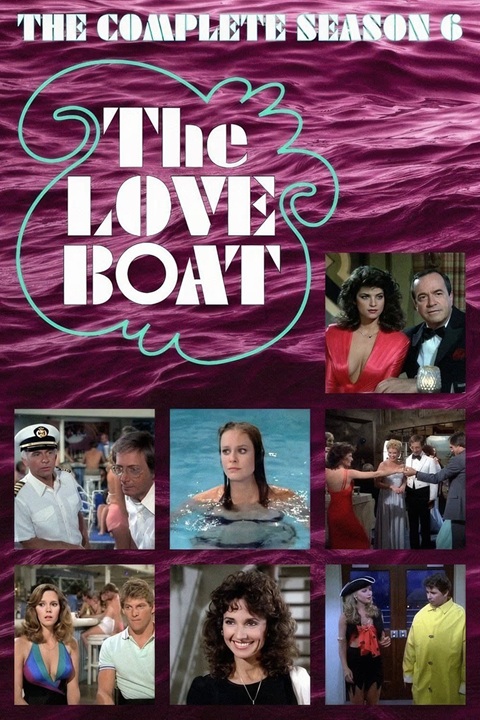
This week, the sixth season of The Love Boat comes to a close.

Episode 6.29 “Fountain of Youth/Bad Luck Cabin/Uncle Daddy”

(Dir by Robert Scheerer, originally aired on May 7th,1983)

The sixth season of The Love Boat ends on a rather silly note.

A newlywed couple (David Naughton and Lynda Goodfriend) board the ship and a coked-up Julia assigns them to a cabin that is known for being cursed.  Couples who stay in the cabin always break up.  Gopher and Julie try to make sure that the couple doesn’t fall victim to the curse.

Henry Harper (Ted McGinley), who appears to be in his 20s, boards the boat and tells elderly Dwight Schofield (David Wayne) that he’s the same Henry Harper that Dwight went to college with.  Henry claims that he’s discovered the Fountain of Youth!  Actually, this Henry Harper is the grandson of the original Henry Harper and this is all an elaborate scheme to get revenge on Dwight for cheating the first Henry Harper out of an oil well.  Dwight, however, falls for it and tries to buy the Fountain of Youth.  Grandson Henry, meanwhile, falls in love with Dwight’s granddaughter (Michele Tobin) who is all like, “I like you but I can’t be with someone from the Twilight Zone.”  Grandson Henry eventually admits the truth and all is …. forgiven?  Really?

Those two stories were pretty dumb.  Fortunately, the third story was an Isaac story and, as he always did whenever he got a chance in the spotlight, Ted Lange really delivered.  Isaac wants to marry Gayle Davis (Tracy Reed) so he can become the stepfather of Bobby Davis (Shavar Ross).  In the end, Isaac realizes that he doesn’t love Gayle and the marriage wouldn’t work.  It was a pretty simple story but Lange always did such a good job of portraying Isaac’s essential decency that it was hard not to get caught up in whether or not he was actually going to leave the Love Boat crew.  Fortunately, Isaac will still be pouring drinks during season 7.

This is not only the final Love Boat episode of Season 6 but it’s also my final Love Boat episode of 2025.  Retro Television Reviews is taking a break for the holidays so that I can focus on both the Awards Season and Christmas movies.  The Love Boat will return on January 7th, 2026.

Ice Cream Man (1995, directed by Norman Apstein)


When he was a young boy, Gregory Tudor was traumatized when he witnessed the gangland-style execution of the neighborhood ice cream man.  He was retraumatized when he was sent to an insane asylum.  Now, Gregory (Clint Howard) has grown up and he’s the ice cream man!  Everyone in the neighborhood loves his ice cream but the local kids suspect that he’s using human body parts to get the flavor just right.  It turns out that the kids know what they’re talking about.

Ice Cream Man almost feels like a zero-budget precursor to Stranger Things, with the kids knowing what’s happening in their town while the majority of the adults are too self-absorbed to notice.  One of the kids is a Macauley Culkin look-alike known as Small Paul (Mikey LeBeau).  He comes to admire Gregory and his murderous devotion to ice cream.  The movie’s really stupid but it’s clearly not meant to be taken seriously and Clint Howard really throws himself into his role.  One thing that makes Ice Cream Man enjoyable is that you know Ron Howard had to sit through it because his brother’s in it.

The most interesting thing about Ice Cream Man is the number of recognizable actors who appear in tiny roles.  David Warner is the town’s reverend.  David Naughton is a clueless father who is married to Sandahl Bergman.  Jan-Michael Vincent is a detective.  Olivia Hussey is Gregory’s former nurse.  Former baseball player and future senatorial candidate Steve Garvey plays another parent.  With the exception of Vincent, it’s hard not to believe that the members of the cast didn’t have anything better to do.  Never underestimate the appeal of a quick paycheck.

Clint Howard has said that a sequel is in pre-production.  The Ice Cream Man will return.

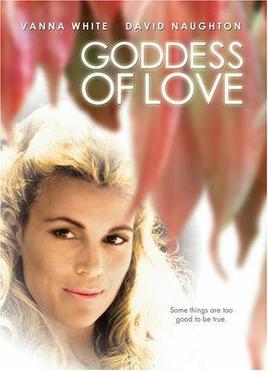
Goddess of Love (1988, directed by Jim Drake)


On Mount Olympus, “ages ago” according to a title card, Zeus (John Rhys Davies) is displeased with his daughter Aphrodite (Wheel of Fortune letter turner Vanna White).  Aphrodite, who insists on being called Venus, has refused to marry every man or God that Zeus has found for her and she even started the Trojan War.  Zeus says that Venus must learn what love means before she can rejoin the Gods.  He then turns her into a statue (!) and sends her down to Earth.

How is she going to learn what love means as a statue?  It’s obviously a pertinent question because, thousands of years later, she’s still set in marble and standing in a museum.  Two thieves wheel her out to a courtyard and leave her there so they can pick her up later.  Before the thieves return, Ted Beckman (David Naughton) and his womanizing friend, Jimmy (David Leisure), wander by.  For some reason, Ted slides an engagement ring on Venus’s finger.  Venus comes to life.  She and Ted must now fall in love for real in order for Venus to return to Mount Olympus.  The only problem is that Ted is a hairdresser and he’s already engaged to marry Cathy (Amanda Bearse).

A made-for-TV movie that unsuccessfully tried to revive the acting career that Vanna White abandoned for Wheel of Fortune, Goddess of Love is a spectacularly stupid movie that attempts to disguises its threadbare plot by being extremely busy.  Not only do Ted and Venus have to overcome a lack of romantic chemistry and fall in love but the two thieves are also still looking for Venus and even Little Richard shows up as one of Ted’s employees.  Venus not only accidentally burns down Ted’s business but also maxes out his credit cards.  Philip Baker Hall plays the detective investigating the theft of the statue and gives a performance reminiscent of his classic Bookman turn from Seinfeld.  It’s dumb but Vanna herself gives a far more engaging performance than the material requires or deserves.  Some of her line deliveries are a little wooden but she still radiates the natural likability that made her an unlikely celebrity in the 80s.  Goddess of Love should have cast Pat Sajak as Ted.  Then it would have been a classic.

Robotic Vengeance: Steel and Lace (1991, directed by Ernest Farino)


On trial for raping concert pianist Gally Morton (Clare Wren), evil businessman Daniel Emerson (Michael Cerveris) gets four of his sleazy buddies to provide a fake alibi for him.  After Emerson is acquitted, Gally goes to the roof of the courthouse and leaps to her death.
Five years later, Daniel and his four friends have made a fortune by illegally foreclosing on people’s houses.  They may think that they’ve gotten away with their crimes but what they don’t know is that Gally’s brother, Albert (Bruce Davison), has been building a robot version of his sister.  Soon, Robot Gally is killing off all of Emerson’s friends while a courtroom sketch artist named Alison (Stacy Haiduk) and a detective named Dunn (David Naughton) attempt to figure out what’s going on.

A mix of The Terminator and I Spit On Your Grave, Steel and Lace is a classic of its kind.  While the deaths are inventive and, considering who Robot Gally is killing, deserved, what really sets the film apart is the strong cast and the inventive direction.  Director Ernest Farino wastes no time getting down to business and he inventively opens the film by cutting back and forth between Emerson assaulting Gally and the jury acquitting him of the crime that we just saw him commit.  Davison is not in the film as much as you might expect but he still makes an impression as the fanatical Albert and Naughton and Haiduk are likable even if their scenes sometimes feel like padding.  Best of all is Clare Wren, an actress who deserved to be a bigger star and who is convincing both as the fragile Gally and as the vengeance-driven robot.  Robot Gally eventually comes to question whether justice is truly be served by all of the killings and Wren sells it.  Also be sure to keep an eye out for David L. Lander, playing the prerequisite eccentric coronor.  (Has there ever been a movie coroner who wasn’t an eccentric?)  Finally, Brian Backer — who will be forever known for playing nice guy Mark Ratner in Fast Times At Ridgemont High — is effectively cast against type as one of Emerson’s stooges.

Steel and Lace is one of the best low-budget films to come out of the early 90s, a deeply satisfying tale of robotics and vengeance.

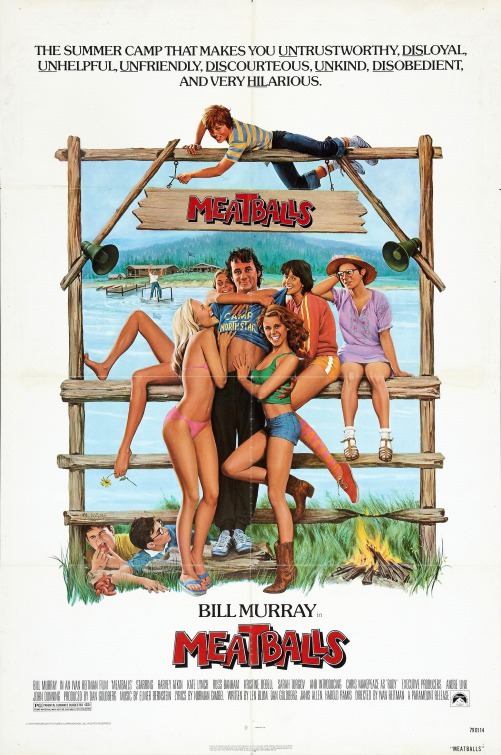
Summer Fun with Bill Murray in MEATBALLS (Paramount 1979)


gary loggins's avatarcracked rear viewer

Summer is finally here, so what better way to celebrate than with a summer movie starring Bill Murray!  Bill had joined the cast of SATURDAY NIGHT LIVE in 1979 (back when it was actually funny) and quickly became a fan favorite with his smarmy, snarky persona and silly characterizations. After the film success of John Belushi, it was only natural for Hollywood to come calling, right? Wrong, bucko… it was Canada that lured Bill for his first starring vehicle, the oh-so-70’s teen comedy MEATBALLS! Yeah, you heard right, ’twas the Great White North that plucked Bill away from being “Live from New York” to a location shoot at good ol’ Camp White Pines in the wilds of Ontario.

Bill’s fellow ‘Second City’ alumnus Harold Ramis (or as he was called in SCTV’s credits, ‘Ha-Harold Ramis’!) was a cowriter of the screenplay, beginning a long string of movie collaborations between the two (STRIPES, CADDYSHACK,  GHOSTBUSTERS I…

View original post 433 more words

A Movie A Day #52: Overexposed (1990, directed by Larry Brand)


overexposedSomeone is stalking soap opera star, Kristin (Catherine Oxenberg).  She is receiving frightening notes and her coworkers are dying.  Who is after her and what does it have to do with a tragic fire at a birthday party?  Is it one of her jealous co-stars?  Is it her duplicitous boyfriend (David Naughton)?  Is it the stranger (William Bumiller) that she’s having an affair with?  Or is it the obsessed fan (Karen Black)?  Detective Morrison (Larry Brand) is on the case!

The return of Detective Morrison (played, again, by the film’s director) makes Overexposed a sequel to The Drifter.  (Both films were directed by Brand and executive produced by Roger Corman).  Morrison has much more to do in Overexposed than he did in The Drifter so maybe the plan was to launch a low-budget franchise of Detective Morrison movies.  It didn’t happen, because Overexposed is much less interesting than The Drifter.  The spoiled and rich Kristin is never a likable character and the movie’s real star was Oxenberg’s busy body double, Shelley Michelle.

Overexposed does have a few good scenes, including death-by-acidic-facial-cream.  The best thing about movie is Karen Black, who brilliantly delivered a monologue about why she loves television.  It doesn’t have much to do with the rest of the movie but Karen Black knocked it out of the park.  The monologue ends with Karen Black paying homage to The Mod Squad by shouting out, “Solid!”

Overexposed was forgettable but Karen Black?

Karen Black was solid.

Horror Film Review: An American Werewolf in London (dir. by John Landis)


I resisted seeing An American Werewolf in London for quite some time because 1) I kept mixing the film up with its “sequel,” An American Werewolf in Paris (which is seriously one of the worst films ever made) and 2) werewolves scare me in a way that vampires and zombies don’t.  Seriously, what is a werewolf other than a really big pit bull and to say that I’m not a dog person is an understatement.  However, this Halloween season, several people on twitter suggested that I give the film a chance so, reluctantly, I watched it and I’m glad that I did.  Good call, twitter.

Originally released way back in 1981, An American Werewolf in London starts with two nice guys from New York (played by David Naughton and Griffin Dunne) backpacking across England.  They stop in one of those proverbial, fog-drenched English villages where they are told, by the secretive town folk, to stay off the moors.  Naughton and Dunne promptly wander into the moors.  “Whoops,” they literally say as the full moon shines behind them.  Suddenly, they are attacked by some sort of wild animal.  Dunne is killed and a severely wounded Naughton wakes up days later in a London hospital.

While recovering in the hospital, Naughton meets and starts up a tentative romance with his nurse (Jenny Agutter) even as he finds himself haunted by disturbing graphic nightmares in which he sees his family being massacred by humanoid wolves dressed up like storm troopers.  (Seriously, these genuinely disturbing nightmares were so seamlessly worked into film that they took me totally by surprise.)  Even worse, Dunne’s progressively decaying corpse keeps popping up in his hospital room and telling him that 1) they were attacked by a werewolf, 2) Dunne’s spirit is trapped on Earth until the werewolf’s bloodline is extinguished, and 3) that bloodline is currently being carried on by Naughton.  Fearing for his sanity, Naughton moves into Agutter’s flat after he’s released from the hospital and, for a brief moment, it actually seems like he might actually be okay.

And then, inevitably, a full moon rises and soon, there’s an American werewolf in London…

An American Werewolf in London is an oddly succesful hybrid of genres that don’t always mix well: it’s scarier than Paranormal Activity, funnier than Scream, and ultimately more romantic than any of the Twilight films.  David Naughton and Jenny Agutter are both so appealing in this film that you actually get invested in their relationship and, as a result, the inevitably of the film’s conclusion becomes all the more tragic.  As this film was pre-CGI, Naughton actually had to act out the process of transforming into a werewolf and, as a result, An American Werewolf in London feels real in a way that most werewolf films do not.

Director John Landis manages to maintain a perfect balance between the horror and the comedy and, as a result, I found myself both laughing out loud and hiding my eyes throughout this entire film.  For me, the scariest scene in the film comes when an unfortunate commuter finds himself being tracked through a nearly deserted tube station by our werewolf.  Landis  wisely draws the sequence out, with the camera taking on the point-of-view of the prowling werewolf.  Seriously, this growls heard during this whole sequence reminded me of why I’m so scared of big dogs.  The other stand-out sequence comes towards the end of the film, in which Naughton takes refuge in a filthy porno theater and talks to Dunne (who, by this point, is just a skeleton).  Dunne, it turns out, has brought with him the spirits of all the people who Naughton killed during the last full moon.  So, while Dunne and his new friends encourage Naughton to commit suicide and Naughton starts to painfully transform into a werewolf, the worst porno film ever made is playing in front of them.  The scene — with its perfect mix of tragedy, comedy, and horror — epitomizes everything that makes An American Werewolf in London work as a film.

One final note: one of the problems that I have with a whole lot of horror films is that they rarely make good use of their setting.  Whether it’s that old deserted building or that piece of wilderness that’s not on anyone’s map, horror locations often feel as a generic as horror plots.  However, Landis makes good use of both London and the English countryside here and this is a film that really should serve as a lesson for aspiring horror filmmakers todays.  Of course, it helps that the location in question happens to be London with all of its gothic traditions and old school horror heritage.  Let’s face it — An American Werewolf in St. Louis* just doesn’t carry the same punch. 

—-

* Or, God Forbid, Vermont.