Film Review: Francis In The Navy (dir by Arthur Lubin)


In 1955’s Francis In The Navy, Donald O’Connor plays Lt. Peter Sterling, an officer in the U.S. Army who gets word that his best friend, a talking mule named Francis (voice of Chill Wills), is about to be auctioned off by the U.S. Navy.  Sterling rushes to the Naval base but, along the way, his wallet gets stolen, he gets mistaken for an AWOL soldier, and Francis gets sold to a laboratory.

Hold on, I’m re-reading that last paragraph to make sure that I didn’t hallucinating typing all that…

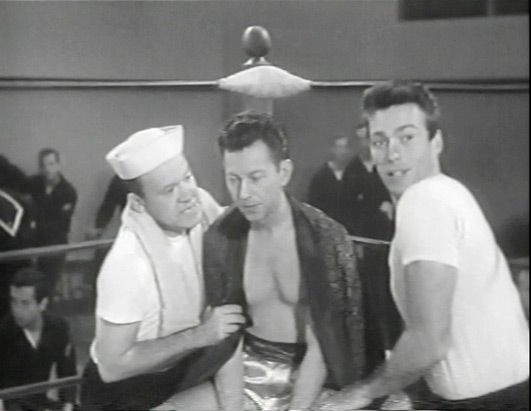
Peter argues that he’s not the AWOL soldier, he’s just someone who looks just like him.  Peter gets tossed into the psychiatric ward.  Francis advices Peter …. yes, the mule that can talk gives Peter advice on how to get out of the mental ward …. to pretend to be the AWOL sailor.  Unfortunately, the sailor is a champion boxer so that means Peter will have to enter the ring.  Peter, needless to say, is not a boxer.  Peter also falls for a nurse (Martha Hyer) but — uh oh! — she’s the sister of the AWOL soldier.  Well, that’s kind of awkward.  I don’t have a brother but if I did, I doubt I would ever want to make out with anyone who looked like him.  Like seriously….

Hold on, I’m re-reading that last paragraph to see if there’s anything that I need to add.

Like, seriously, what the Hell?  This movie has a talking mule, an oddly incestuous subtext, and Donald O’Connor playing two roles.  Doing some research, I discovered that this was the sixth film to deal with the adventures of Peter Sterling and Francis.  This was the last one of them to star Donald O’Connor, who apparently resented getting upstaged by a mule.  There was one more Francis movie after this one and it starred Mickey Rooney.  It was called Francis In The Haunted House so who knows?  Maybe I’ll review it for our October horrorthon.  (Don’t count on it.)

As weird as this film is, it’s kind of likable.  Donald O’Connor is a favorite of mine and this one featured O’Connor in two roles, as both the hapless Peter and also the sailor who goes AWOL and repeatedly refuses to help Peter out.  And, while I’m not really sure why he’s talking, Francis was actually cute.  I enjoyed the boxing scene where he attempted to help Peter out.  Unfortunately, there’s only so much a mule can do.

As for why I’m reviewing this movie, it’s because Clint Eastwood is in the cast.  He plays Jonesy, a friend of the AWOL sailor who becomes a friend of Peter’s.  Now, to be clear, Clint doesn’t do a lot in the movie.  He works Peter’s corner during the boxing match.  Otherwise, he spends most of the time in the background and he has a few scenes where he hangs out with the rest of the AWOL sailor’s friends.  That said, Clint does make an impression.  Even in this very early role, he had an impressive screen presence.  He’s the tallest guy there and he’s got the best hair.  Once you spot him in a scene, it’s hard to look away.

Francis In The Navy is historically significant because it’s the first film for which Clint Eastwood received on-screen credit.  (Eastwood previously appeared in films like Revenge of the Creature and Tarantula but his name wasn’t included in the credits.)  It’s an odd film, one that’s likable if you’re in an undemanding mood and you enjoy goof — extremely goofy — humor.  It would be forgotten if not for Eastwood’s appearance.  Seen today, this film, like Eastwood’s other early appearances, reminds us that everyone started somewhere.
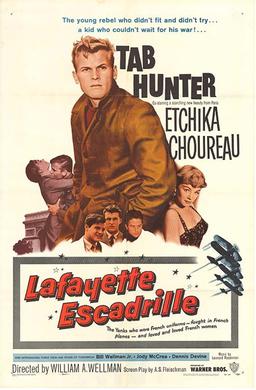
Lafayette Escadrille (1958, directed by William Wellman)


In the days leading up to World War I, spoiled rich kid Thad Walker (Tab Hunter) flees Boston after getting hit with a car theft charge and ends up in Paris.  He befriends a group of American expatriates (including David Janssen, Will Hutchins, Jody McCrea, and William Wellman, Jr.) and eventually joins the French Air Force as a members of the Lafayette Escadrille.  Thad also falls in love with a French prostitute named Renee (Etchika Choureau) and, after Thad strikes a French officer, he goes on the run with her.

I always wonder how many people have watched this film over the years because of the presence of a young Clint Eastwood in the cast, just to discover that he doesn’t get many lines and his character is largely interchangeable with the other young actors playing the members of the Lafayette Escadrille.  This is a Tab Hunter movie, meaning that the action is dominated by Hunter’s sincere but bland screen persona.  Director William Wellman wanted to cast Paul Newman in the lead role and that would have been something to see.  Instead, the studio insisted on Hunter.  They also insisted that Wellman change the film’s ending so that Hunter could survive instead of getting shot down on his very first mission.  William Wellman was so disgusted with the studio that he retired from directing.

What had to make it all especially galling for the director was that Lafayette Escadrille was based on his own life.  His son, William Wellman Jr., plays “Bill Wellman” in the film and Thad was based on actual friend of Wellman’s.  The film was meant to be a tribute to his friends, many of whom did not survive World War I.  Instead, the studio insisted that it be just another Tab Hunter service comedy.  The best scenes are the ones where it’s just Thad and his friends trying to make it through basic training.  Unfortunately, those scenes are overshadowed by Thad on the run.

The film is still there for those of us who enjoy catching future stars.  Clint Eastwood, David Janssen, Tom Laughlin, Will Hutchins, Brett Halsey, and Jody McCrea are all present and accounted for.  Rumor has it that James Garner can spotted in the background but I couldn’t find him and Garner had already co-starred with Brando in Sayonara when this move was made so I doubt he was doing background work.  Tab Hunter’s blandness sinks the production but the rest of the cast would go on to better things.

Film Review: Inchon (dir by Terence Young)


Inchon is an infamous film.

First released in 1982, this epic recreation of one key battles of the Korean War was an expensive film with a cast of well-known actors.  Jacqueline Bisset plays a wealthy army wife who tries to protect five South Korean children who have found themselves in the middle of the battle.  Ben Gazzara plays her husband, a major who is having an affair with the daughter of Toshiro Mifune.  David Janssen and real-life film critic Rex Reed wander through the film as journalist.  (Janssen growls like a man dealing with a serious hangover while Reed struggles to not look straight at the camera.)  Richard Roundtree plays a tough sergeant.  The great Italian actor Gabriele Ferzetti plays a Turkish officer.  And, finally, the role of legendary American general Douglas MacArthur — of “I will return” fame — is played by the very British Sir Laurence Olivier.  Olivier was apparently told that, in real life, MacArthur often sounded like the comedic actor W.C. Fields and Olivier often seems to be imitating Fields’s pinched style of speaking.  Olivier also wears almost as much makeup here as he did in his production of Othello.  MacArthur is portrayed as being almost a mystic warrior, a man who relies as much on his faith as his strategic genius to repel the communists.  (In victory, he recites The Lord’s Prayer.)  The film was directed by Terence Young, who previously brought James Bond to cinematic life.

Inchon is notorious for being a flop with both critics and audiences.  The film had a budget of $46,000,000 and reportedly made $5,000,000 at the box office before it was withdrawn.  The entirety of the budget was put up by the Unification Church, which is an organization that many people consider to be a cult.  (I like neither communists nor cultists so this film left me with no one to root for.)  The film proved to be such a flop at the box office that it has never been released on home video.  It did, however, air on television a few times and, in recent years, the television cut has been posted to YouTube.  That’s how I saw Inchon.

I watched Inchon because I’ve frequently seen it referred to as being one of the worst films ever made.  Watching the film, I have to say that I think the “worst film” label is a bit extreme.  For the most part, it’s just an extremely uneven and often rather boring film, one that mixed scenes of surprisingly brutal combat with dialogue-heavy scenes that just seem to drag on forever.  It’s a film that belongs as much in the disaster genre as the war genre as the film is full of rather shallowly-written characters who all have their own individual dramas to deal with.  Will Jacqueline Bisset save the children?  Who will sacrifice their lives to defeat the communists? Will Ben Gazzara, who often seems to be the sole member of the cast who is at least tying to give a credible performance, choose his wife or his mistress?  The film ultimately feels like a compressed miniseries.  Everyone has a story but hardly anyone makes an impression.

That said, Laurence Olivier’s performance as Douglas MacArthur …. agck!  Seriously, it’s hard to know where to even begin when it comes to talking about just how miscast Olivier is as the quintessential all-American general.  It’s been said that it takes a truly great actor to give a truly bad performance and Olivier certainly proves that to be true in this film.  Obviously frail and trying to sound like W.C. Fields, Olivier’s MacArthur is a general who would inspire zero confidence.  The film doesn’t help by portraying MacArthur as being an almost holy figure, one who is often framed to look like almost an angel descending from Heaven to lead the battle against America’s enemies.  The film is full of scenes of people discussing MacArthur’s genius just to be followed by a scene of Olivier looking old, tired, and rather grumpy.  There were a few times when I thought I could see Olivier’s hair dye running down the side of his face.  It may have been my imagination or just the graininess of the upload on YouTube but, given the quality of the film, I can’t really dismiss the possibility that it happened and no one felt like doing a second take.

As I said, Inchon can be found on YouTube.  It’s not the worst film ever made but that doesn’t mean it’s a good one.

Film Review: The Shoes of The Fisherman (dir by Michael Anderson)


The 1968 film, The Shoes of The Fisherman, opens in a snowy Siberian labor camp.  For the past twenty years, this camp has been the home of Kiril Pavlovich Lakota (Anthony Quinn), the Ukrainian archbishop of Liviv.  Kiril is unexpectedly released by Russia’s new leader, Piotr Ilyich Kamenev (a very British Laurence Olivier).  After explaining to Kiril that Russia and China are on the verge of nuclear war due to a famine that has been instigated by U.S. sanctions, Kamenev tells Kiril that he is being released on the condition that he tell no one about the conditions at the Russian labor camp.  Kiril starts to protest just for Father Telemond (Oskar Werner), the Vatican’s representative, to say that the conditions have already been agreed to.

In Rome, Kiril meets the Pope (John Gielgud), who makes the humble Kiril a cardinal, over Kiril’s objections that he just a “simple man.”  Later, when the aged Pope suddenly dies, Kiril is unexpectedly elected, as a compromise candidate, to succeed him.  Still humble and considering himself to be a simple man with a simple mission, Kiril suddenly finds himself as one of the most revered and powerful men on the planet.  With Father Telemond as his secretary, Kiril tries to make the Vatican responsive to the needs of the people and sets out to bring peace between the Russians and the Chinese. That turns out to be easier said than done, especially when Telemond himself is eventually accused of heresy for his progressive views.

(And yes, Telemond is a Jesuit….)

The Shoes of the Fisherman is a type of film that should be familiar to anyone who has any knowledge of the Hollywood studios in the 60s.  It’s the type of big and self-serious film that was meant to tell audiences, “You won’t find anything this opulent and important on television!”  The cast is designed to appeal to everyone.  Anthony Quinn and Laurence Olivier are there for the older viewers (especially the older viewers who made up the majority of the Oscar voters in 1968) while, for the younger voters, there’s handsome Oskar Werner as a Jesuit who interpretation of the Gospels is so radical that even Pope Francis would probably tell him to step back a little.  For the older, anti-communist viewers, there are scenes that portray the harsh conditions at a Siberian labor camp.  The commies put Kiril in prison so he must be one of the good guys.  And for the younger, more liberal viewers, there was the suggestion that the threat of World War III was largely due to the actions of the American government.  And, just in case there was still anyone who thought that television was preferable to a prestige picture, TV star David Janssen shows up as a cynical reporter whose wife (played by Barbara Jefford) is a doctor who Kiril helps to get some medicine for one of her dying patients.  Director Michael Anderson includes enough sudden zoom shots to let younger viewers know that he’s with them while still directing in a stately enough manner to appeal to the older viewers.

The end result is a film that is big and grand but also rather slow.  The film gets bogged down in subplots that don’t really add much to the overall story.  We spend way too much time with the reporter and his wife.  Anthony Quinn does a good enough job as Kiril, giving a rather subdued performance by Quinn standards.  (A scene where Kiril recites a Jewish prayer for a dying man is wonderfully acted by Quinn, who seems to truly be emotionally invested in the film’s message of togetherness.)  Laurence Olivier is not at all convincing as a Russian but still, he has the stately bearing of a man used to being in power.  Like many of the studio productions of the late 60s, The Shoes of The Fisherman tries a bit too hard to strike a balance between old school Hollywood and the counterculture and the film ultimately feels rather wishy-washy as a result.  It’s a noble film with good intentions but it’s not particularly memorable.

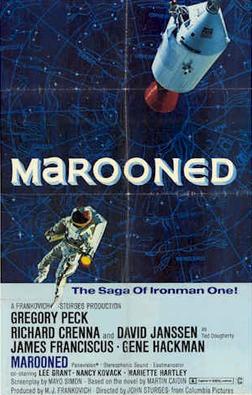
Marooned (1969, directed by John Sturges)


Imagine The Martian or Apollo 13 without any humor or narrative momentum and you’ve got an idea what Marooned is like.

Three American astronauts (played by Richard Crenna, Gene Hackman, and James Franciscus) are returning to Earth after serving on an experimental space station when the engine to their spacecraft fails.  Now stuck in orbit around the Earth, they only have two days before they run out of oxygen.  While flight commander Crenna tries to keep everyone calm and make sure that all the proper procedures are followed, Gene Hackman yells at NASA and demands to be rescued.

Down on Earth, the head of NASA (Gregory Peck) says that there’s nothing that can be done.  There’s no way to get a rescue mission set up quickly enough to save the lives of the astronauts.  Both the President and David Janssen disagree with him.  Janssen demands to be sent into space immediately, regardless of the dangers, so that he can bring America’s astronauts home.

Marooned is a painfully slow movie that went into production at the height of the space race and which was released just a few weeks before the first successful moon mission.  Because it was made at a time when there were still many who claimed that NASA was a waste of money, the movie goes out of its way to explain that, even though the astronauts are probably going to die in space, NASA is in no way to blame.  Richard Crenna absolves NASA of blame after being told that a rescue mission isn’t feasible.  Gregory Peck holds a press conference, where he gives a lengthy speech about why space exploration is still important.  The movie is very detailed in showing that NASA is staffed by personality-free professionals, which might have boosted confidence in NASA but which also leads to a dull story.  You’ll notice that I haven’t referred to anyone in this film by the names of their characters.  That’s because their names don’t matter because, other than Gene Hackman and David Janssen, none of them is really distinguished by any sort of identifiable personality.  Hackman chews the scenery while Janssen plays another surly character who seems like he has a permanent hangover.  I wouldn’t trust Janssen to pilot a spaceship.

Marooned won an Oscar for its Special Effects, which were probably impressive back in 1969 but which are dull by modern standards.  Winning that Oscar meant that Marooned would eventually earn the distinction of being the only Oscar winner to be featured on Mystery Science Theater 3000.  On MST 3K, it aired under the title Space Travelers, which is a perfectly generic name for a perfectly generic film.


An Offer You Can’t Refuse #6: King of the Roaring 20s: The Story of Arnold Rothstein (dir by Joseph M. Newman)


The 1961 gangster biopic, King of the Roaring ’20s: The Story of Arnold Rothstein, tells the story of two men.

David Janssen is Arnold Rothstein, the gambler-turned-millionaire crime lord who, in the early years of the 20th Century, was one of the dominant figures in American organized crime.  Though he may be best-remembered for his alleged role in fixing the 1918 World Series, Rothstein also served as a mentor to men like Lucky Luciano, Meyer Lansky, and Bugsy Siegel.  Rothstein was perhaps the first gangster to to treat crime like a business.

Mickey Rooney is Johnny Burke, Arnold’s best friend from childhood who grows up to be a low-level hood and notoriously unsuccessful gambler.  Whereas Arnold is intelligent, cunning, and always calm, Johnny always seems to be a desperate.  Whereas Arnold’s success is due to his ability to keep a secret, Johnny simply can’t stop talking.

Together …. THEY SOLVE CRIMES!

No, actually, they don’t.  They both commit crimes, sometimes together and sometimes apart.  Perhaps not surprisingly, Arnold turns out to be a better criminal than Johnny.  In fact, Johnny is always in over his head.  He often has to go to his friend Arnold and beg him for his help.  Johnny does this even though Arnold continually tells him, “I only care about myself and money.”

The friendship between Arnold and Johnny is at the heart of King of the Roaring 20s, though it’s not much of a heart since every conversation they have begins with Johnny begging Arnold for help and ends with Arnold declaring that he only cares about money.  At a certain point, it’s hard not to feel that Johnny is bringing a lot of this trouble on himself by consistently seeking help from someone who brags about not helping anyone.  From the minute that the film begins, Arnold Rothstein’s mantra is that he only cares about money, gambling, and winning a poker game with a royal flush.  Everything else — from his friendship to Johnny to his marriage to former showgirl Carolyn Green (Dianne Foster) to even his violent rivalry with crooked cop Phil Butler (Dan O’Herlihy) — comes second to his own greed.  The film’s portrayal of Rothstein as being a single-minded and heartless sociopath may be a convincing portrait of the type of mindset necessary to be a successful crime lord but it hardly makes for a compelling protagonist.

Oddly enough, the film leaves out a lot of the things that the real-life Arnold Rothstein was best known for.  There’s no real mention of Rothstein fixing the World Series. His mentorship to Luciano, Lansky, and Seigel is not depicted.  The fact that Rothstein was reportedly the first gangster to realize how much money could be made off of bootlegging goes unacknowledged.  By most reports, Arnold Rothstein was a flamboyant figure.  (Meyer Wolfsheim, the uncouth gangster from The Great Gatsby, was reportedly based on him.)   There’s nothing flamboyant about David Janssen’s performance in this film.  He plays Rothstein as being a tightly-wound and rather unemotional businessman.  It’s not a bad performance as much as it just doesn’t feel right for a character who, according to the film’s title, was the King of the Roaring 20s.

That said, there are still enough pleasures to be found in this film to make it worth watching.  As if to make up for Janssen’s subdued performance, everyone else in the cast attacks the scenery with gusto.  Mickey Rooney does a good job acting desperate and Dan O’Herlihy is effectively villainous as the crooked cop.  Jack Carson has a few good scenes as a corrupt political fixer and Dianne Foster does the best that she can with the somewhat thankless role of Rothstein’s wife.  The film moves quickly and, even if it’s not as violent as the typical gangster film, it does make a relevant point about how organized crime became a big business.

It’s not a great gangster film by any stretch of the imagination and the lead role is miscast but there’s still enough about this film that works to make it worth a watch for gangster movie fans.

Previous Offers You Can’t (or Can) Refuse:

  1. The Public Enemy
  2. Scarface
  3. The Purple Gang
  4. The Gang That Could’t Shoot Straight
  5. The Happening

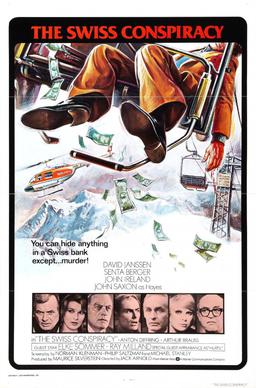
The Swiss Conspiracy (1976, directed by Jack Arnold)


In The Swiss Conspiracy, David Janssen growls his way through another international crime thriller.

Janssen plays David Christopher, a former Treasury agent who is now living in Geneva.  When a Swiss bank is contacted by blackmailers who threaten to reveal the secret account numbers of some of its most prominent and unsavory clients, the bank’s president, Johann Hurtill (Ray Milland), hires Christopher to find out who is behind the plot.  Unfortunately, one of the account holders is a U.S. gangster named Robert Hayes (John Saxon, naturally) and he’s not happy about having to work with a former fed.

With The Swiss Conspiracy, you know what you’re getting into the minute that the film opens with a narrator giving a lengthy explanation about how Swiss bank accounts work.  This is one of those 70s thriller where the budget is low, the plot is often nonsense, and the entire cast seems to be more interested in hitting the slopes than actually making a convincing movie.  The cast is full of familiar actors who, at the time of filming, had seen better days.  Along with Ray Milland, John Ireland, Anton Diffring, and Elke Sommer all have small roles while “German screen sensation” Senta Berger is cast as the woman who might be in love with David Christopher.  Martin Landau is not in this movie but it certainly feels like he should have been.

David Janssen made a lot of movies like this in the 70s.  Janssen was a good actor and he was especially skilled at playing grizzled tough guys but in The Swiss Conspiracy, he seems to be more interested in checking out the sights than in anything else.  You can’t really blame him because the film was shot on location in Zurich and the local scenery is always more interesting than anything else that’s happening on screen.

The Swiss Conspiracy was directed by Jack Arnold, a veteran B-movie director who was also did The Creature From The Black Lagoon and The Incredible Shrinking Man.  His direction in The Swiss Conspiracy is workmanlike and undistinguished but he does make great use of the locations.  The Swiss Conspiracy may not be a great movie but I’ll damned if I don’t want to hop on the next plane and head to Switzerland for the week.

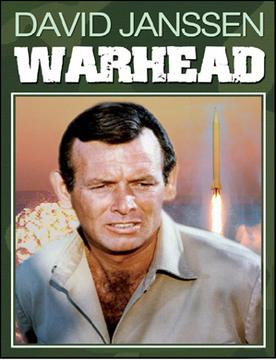
Warhead (1977, directed by John O’Connor)


Somehow, a nuclear bomb falls out of an American airplane that happens to flying over the border between Israel and Jordan.  Luckily, the bomb doesn’t explode but now it’s just sitting out in the desert where anyone can stumble upon it.  CIA operative Tony Stevens (David Janssen) just happens to be on vacation in the Middle East so he’s recruited and sent off to find the bomb before anyone else finds out about it.

At the same time, a group of Israeli soldiers, led by Captain Ben-David (Christopher Stone) and Lt. Liora (Karin Dor), are searching for a group of Palestinian terrorists, led by Malouf (Tuvia Tavi).  As soon as Tony finds the bomb, he is captured by Malouf.  He is then rescued by Ben-David but now Tony has to deal with two interested parties who want the bomb for themselves.

Warhead is a confusing movie that seems like it is trying to say something about the Middle East and America’s role as an international policeman.  Captain Ben-David feels that the Americans are being selfish with their refusal to allow other countries to develop their own nuclear missiles while Tony argues that the world would be plunged into war if everyone had the bomb.  (Remember, this film is from the 70s and was made at a time when the U.S. and the Russians were pretty much the only nuclear super powers.)  The film ends on a nihilistic note, with almost everyone either dead or disillusioned but why?  The acting is so bad and the production is so shoddy that it’s hard to figure out what this movie is trying to say.  Is Ben-David right about American arrogance or is Tony right to argue that deterrence is the only way to keep the world safe?  The movie doesn’t seem to know.  David Janssen was usually the ideal actor to play grizzled tough guys but, in this movie, he was clearly just collecting a paycheck and hopefully enjoying the chance to do some sight-seeing in the Holy Land.  The most intriguing character in the movie is a beautiful Israeli sniper played by Joan Freeman but she is killed off early and forgotten.

Warhead premiered on TV but was obviously originally intended for a theatrical release.  There’s a very gratuitous rape scene that is so awkwardly edited that it’s easy to see that it was cut down once it became apparent the movie was never going to play in theaters.  (The scene could have just as easily been removed from the film without effecting the narrative but I guess the networks wanted to give all of the dads and teenage boys a reason to not change the channel.)  According to the information I’ve found online, Warhead was filmed in 1973 but sat on the shelf for four years.  Watching the movie, it’s easy to see why.

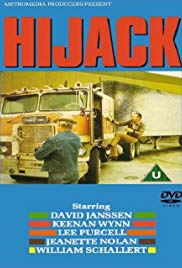
Hijack! (1973, directed by Leonard Horn)


Jake (David Janssen) is a down-on-his-luck trucker who is offered job by a mysterious man named Kleiner (WIlliam Schallert).  If Jake agrees to transport a cargo across the country, he will get not only $6,000 but Kleiner will also pull some strings get Jake back in the good graces of the trucking company.  If Jake takes the job, he will be given a slip of paper with a phone number on it and, according to Kleiner, that piece of paper will get him out of any trouble that he runs into along the way.  The only condition is that Jake is not allowed to know what he’ll be transporting.  Jake agrees and soon, he and his partner Donny (Keenan Wynn) are driving the truck through the desert.  They are also being followed by a group of men who will stop at nothing to steal the cargo.

This made-for-TV movie is called Hijack! but no one ever gets hijacked.  Instead, with the exception of a brief romantic interlude between Jake and a truck stop waitress (Lee Purcell), this is a nonstop chase movie but the chase itself is never exciting enough to justify that exclamation mark in the title.  It was probably made to capitalize on the success of Steven Spielberg’s made-for-TV classic, Duel, but it never come close to capturing the nerve or intensity of that film.  There’s one good scene where the bad guys come after the truck in a helicopter but otherwise, this is a pretty anemic stuff.  Even the eventual reveal of what Jake and Donny are hauling across the desert is a let down.

David Janssen specialized in playing grizzled loners and Keenan Wynn specialized in playing eccentric old coots so both of them are adequate in the main roles.  The bad guys are largely forgettable and, as she did in so many other TV movies in the 70s, Lee Purcell brings what life that she can to an underwritten role.

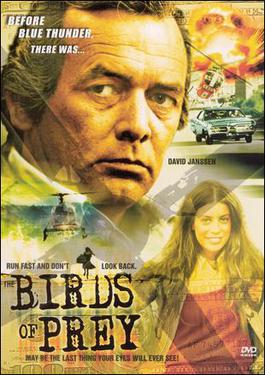
Birds of Prey (1973, directed by William A. Graham)


When three disgruntled Vietnam vets rob Zion’s Bank in downtown Salt Lake City and take a bank teller (Elayne Heilveil) hostage, they’re spotted by traffic reporter Harry Walker (David Janssen).  A World War II vet who is going through a mid-life crisis and who feels unappreciated by the country that he risked his life to defend, Harry chases after the robbers in his helicopter.  With Harry’s help, the police corner the robbers on the roof of a parking garage.

That’s when they discover that the robbers have a helicopter of their own!  After abandoning their car, the robbers and their hostage take off in their helicopter, heading into the Oquirrh Mountains.  Though he’s running low on fuel and has been ordered to back off by Police Captain Jim McAndrew (Ralph Meeker), Harry continues to pursue the other helicopter into the wilderness.

A made-for-TV movie from 1973, Birds of Prey is a chase movie, with the usual cars replaced by helicopters.  What makes this movie so exciting is that it was directed in the days before CGI so, when you watch the two helicopters dangerously pursuing each other over Salt Lake City and taking daredevil risk over the mountains of Utah, you’re watching the real thing.  David Janssen was a trained pilot who actually was flying the helicopter and doing his own stunts for the majority of the film.  When the two helicopters nearly collide, you’re aware that you’re seeing a real near-miss, one that could have gone tragically wrong if not for the talents of the men piloting those helicopters.

Despite all of the action in the air, the film does occasionally touch ground.  Harry and McAndrew talk about why some vets can move on and others can’t.  Harry briefly lands on the freeway and gets some help from a passing motorist.  Finally, Harry gets to know the kidnapped teller, who has never been outside of Salt Lake City and who shares Harry’s love of old movies.  David Janssen was the go-to guy for gruff and grizzled heroes in 1970s made-for-TV movies and he’s pretty good as Harry.  But the real stars of the film are the helicopters and the still-impressive aerial footage of them chasing each other above Utah.

Unfortunately, I have never seen a good print of Birds of Prey.  Even the version on Amazon Prime is grainy, scratchy, and sometimes washed-out.  (It also features a promo for a television station in Phoenix, suggesting that it was transferred straight from a VHS tape.)  I hope that, at some point in the near future, someone will restore this minor chase classic.