October True Crime: The Onion Field (dir by Harold Becker)


This 1979 true crime drama opens in Los Angeles in 1963.

Rookie Detective Karl Hettinger (John Savage) has just joined the Felony Squad and met his new partner, Ian Campbell (Ted Danson, making his film debut).  Ian is a tall, somewhat eccentric detective, the type who practices playing the bagpipes in the basement and who takes Hettinger under his wing.

Meanwhile, Jimmy Smith (Franklyn Seales) has just been released from prison.  The nervous and easily-led Jimmy almost immediately runs into Gregory Powell (James Woods), a small-time hood with delusions of grandeur.  Powell is the type who talks a big game but who really isn’t even that good of a thief.  Smith and Powell form an uneasy criminal partnership.  They are easily annoyed with each other but they also share an instant bond.  Though the film doesn’t actually come out and say what most viewers will be thinking, there’s a lot of subtext to a brief scene where Powell appears to caress Smith’s shoulder.

One night, Hettinger and Campbell are kidnapped by Smith and Powell.  Smith and Powell drive them out to an onion field.  Because he’s misinterpreted the Federal Kidnapping Act and incorrectly believes that he and Smith are already eligible for the death penalty because they kidnapped two police officers, Powell shoots and kills Campbell.  (The close-up image of Campbell falling dead is a disturbing one, not the least because he’s played by the instantly likable Ted Danson.)  Hettinger runs and manages to escape.  He saves his life but he’s now haunted by the feeling that he abandoned his partner.

The rest of the film deals with the years that follow that one terrible moment in the onion field.  Treated as a pariah by his fellow cops, Hettinger sinks into alcoholism and eventually becomes a compulsive shoplifter.  Smith and Powell, meanwhile, use a variety of tricks to continually escape the death penalty and to keep their case moving through the California justice system.  Powell, for instance, defends himself and then later complains that he had incompetent counsel.  Smith, meanwhile, is defended by the infamous Irving Karanek, a legendary California attorney who specialized in filing nuisances motions.  (Later Karanek found a measure of fame as Charles Manson’s attorney.  Eventually, he had a nervous breakdown in 1989, lived in his car, and was briefly suspended by practicing law.)  While Smith and especially Powell quickly adjust to being imprisoned, Hettinger spends the next decade trapped in a mental prison of guilty and bitterness.

Based on a non-fiction book by Joseph Wambaugh, The Onion Field is a compelling look at a true crime case that continue to resonate today.  The film can be a bit heavy-handed in its comparisons between the two partnerships that define the story.  Both Hettinger and Smith are young and neurotic men who find themselves working with a more confident mentor.  The difference is that Hettinger’s mentor is the cool, composed, and compassionate Ian Campbell while Smith’s sad fate is to be forever linked to the erratic Gregory Powell.  While the film may have the flat look of something that was made for television, it’s elevated by the performances of its lead actors.  James Woods give an especially strong performance as the cocky Powell, a loser in the streets who becomes a winner behind bars.  Over the course of the film, he goes from being a joke to being the prisoner that others come to for legal advice.  John Savage, meanwhile, poignantly captures Hettinger’s descent as the trauma from that night leaves him as shell of the man that he once was.

The film’s supporting cast is full of familiar faces.  Christopher Lloyd and William Sanderson show up as prisoners.  Ronny Cox plays the detective in charge of the onion field investigation.  David Huffman plays a district attorney who is pushed to his breaking point by the obstructive tactics of Smith’s attorney.  Priscilla Pointer play Ian Campbell’s haunted mother.  All of them do their part to bring this sad story to life.

The Onion Field is a chillingly effective true crime drama and a look at a murder that was inspired by one man’s inability to understand federal law.

Witchcraft V: Dance with the Devil (1993, directed by Talun Hsu)


Warlock-turned-attorney William Spanner is back and he’s getting dumber all the time.

In this, the fifth film of the improbably long-running Witchcraft sage, William Spanner is no longer played by Charles Solomon.  A considerably more bland actor, Marklen Kennedy, has taken over the role.  William is still an attorney and he’s still dating Kelli (Carolyn Taye-Loren).  He’s also still in denial about how impossible it is for a former warlock to live a normal life.

Usually, franchise heroes get smarter with each film but William gets progressively dumber.  This time, he allows his girlfriend to take him out to yet another club that’s secretly a front for Satanism.  Though he should know better than to put himself in the situation, William allows a hypnotist to call him on stage.  The hypnotist is Cain (David Huffman), who uses his power to take control of William’s mind and use him to kill his enemies.  In order to keep William from breaking free, Cain’s servant, Mala (Nicole Sassaman), frequently sneaks into William’s house in the middle of the night so that they can take part in the type of softcore sex scenes that would, for most people, eventually come to define the future entries in the Witchcraft franchise..

Realizing that something is wrong, Kelli goes to her minister, Rev. Meredith (Lenny Rose).  Rev. Meredith sends over a white witch who is played by Aysha Hauer, the daughter of Rutger Hauer.  The white witch doesn’t do much but the Hauer connection is cool.  Another cool thing is that Greg Grunberg has a small, uncredited role as a bartender, proving that everyone had to start somewhere.

Although the first four Witchcraft films were passably entertaining, Witchcraft V is too dumb to be believed.  For someone who doesn’t want to be a warlock, William has a really bad habit of getting involved in stuff that only a warlock could get involved with.  Given his long history of dealing with Satanists and sleazy club owners, there’s no way that William should have been dumb enough to allow someone named Cain to have a chance to hypnotize him in the first place.

Probably the best thing that the previous Witchcraft films had with them was the idea of William being both an attorney and warlock.  He had the potential to be an interesting character.  Unfortunately, in Witchcraft V, William is not just stupid but also reduced to being a supporting character.  He doesn’t get to do much, which seems unfair to the three or four people who might actually be invested in his story.  Instead, most of the movie focuses on Cain and, strangely, Reverend Meredith.  Neither one of them is really interesting enough to carry a movie.

William Spanner would return, albeit played by a different actor, in Witchcraft VI.


Horror Film Review: Blood Beach (dir by Jeffrey Bloom)


http://www.youtube.com/watch?v=FFSIK4lEYGk

“Nom nom nom nom,” says that monster under the sand.

“Agck!  Agck!  Agck!  Agck!” says the people above the sand.

And that’s all you really need to know about the 1981 film, Blood Beach.

Blood Beach takes place on a beach that also happens to be a hunting ground for this mutated worm thing that lives underground.  Basically, whenever anyone takes a stroll on the beach, they get sucked down into the sand and, for the most part, they’re never seen again.  Sometimes that’s not a bad thing, as in the case of a wannabe rapist who ends up getting castrated while being pulled down into the sand.  But, far too often, the victims are innocent people who were just walking their dog, chasing after their hat, or searching for buried treasure.

The beach becomes so well-known for being a death trap that the locals start to call it Blood Beach but, for some reason, that doesn’t seem to stop people from wandering out on the sand at inopportune times.  I mean, it would just seem logical to me that if there’s a monster killing people on the beach then maybe it would be a good idea to avoid the beach for a while.  I mean, you could go see a movie or you could lay out and work on your tan in your back yard.  Believe it or not, you do have the option of not going to a monster-infested location.

Strangely, there’s one person who is always on the beach but never gets killed.  That’s Mrs. Selden (Eleanor Zee), a somewhat odd woman who always seems to be nearby whenever someone is getting dragged into the sand but who never gets attacked herself.  Interestingly, Mrs. Selden never seems to be particularly concerned by all the carnage around her.  (One victim is even killed while specifically checking to make sure Mrs. Selden is okay.)  I kept expecting some sort of major twist where it was revealed that Mrs. Selden was a witch or something but it never happened.

Now, you would think that the presence of an underground monster would be the perfect excuse to call in the national guard but instead, the local police (led by John Saxon’s Captain Pearson) handle it.  Sgt. Royko (Burt Young) heads up the monster investigation, which in this film means that he kinda of stumbles from scene-to-scene, never looking particularly impressed by or interesting in anything that’s happening around him.  If anything, Royko seems to be annoyed that he’s having to give up time that he could be using to drink beer and watch TV and that attitude makes Royke the hero of this film.  Forget the scientist who wants to understand where the monster came from.  Forget the habor cop who wants to rekindle things with an old flame.  Royko doesn’t care about science or love.  He just wants to blow stuff up, which makes him the perfect audience surrogate

Anyway, Blood Beach sounds like it should be a fun movie but it’s not.  The movie delivers a lot of beach but very little blood.  There’s a lot of “nom nom” but very little “agck!”  Blood Beach is almost as much of a misfire as spending spring break in West Texas.

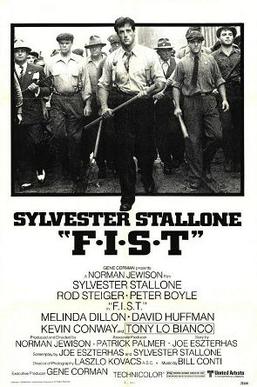
A Movie A Day #355: F.I.S.T. (1978, directed by Norman Jewison)


Sylvester Stallone is Jimmy Hoffa!

Actually, Stallone plays Johnny Kovak, a laborer who becomes a union organizer in 1939.  Working with him is his best friend, Abe Belkin (David Huffman).  In the fight for the working man, Abe refuses to compromise to either the bosses or the gangsters who want a piece of union.  Johnny is more pragmatic and willing to make deals with ruthless mobsters like Vince Doyle (Kevin Conway) and Babe Milano (Tony Lo Bianco).  Over thirty years, both Johnny and Abe marry and start families.  Both become powerful in the union.  When Johnny discovers that union official Max Graham (Peter Boyle) is embezzling funds, Johnny challenges him for the presidency.  When a powerful U.S. senator (Rod Steiger) launches an investigation into F.I.S.T. corruption, both Johnny and Abe end up marked for death.

Obviously based on the life and mysterious disappearance of Jimmy Hoffa, F.I.S.T. was one of two films that Stallone made immediately after the surprise success of Rocky.  (The other was Paradise Alley.)  F.I.S.T. features Stallone in one of his most serious roles and the results are mixed.  In the film’s quieter scenes, especially during the first half, Stallone is surprisingly convincing as the idealistic and morally conflicted Kovak.  Stallone is less convincing when Kovak has to give speeches.  If F.I.S.T. were made today, Stallone could probably pull off the scenes of the aged, compromised Johnny but in 1978, he was not yet strong enough as an actor.  Far better is the rest of the cast, especially Conway, Lo Bianco, and Boyle.  If you do see F.I.S.T., keep an eye on the actor playing Johnny’s son.  Though he was credited as Cole Dammett, he grew up to be Anthony Keidis of the Red Hot Chili Peppers.

The box office failures of both F.I.S.T. and Paradise Alley led Stallone back to his most famous role with Rocky II.  And the rest is history.